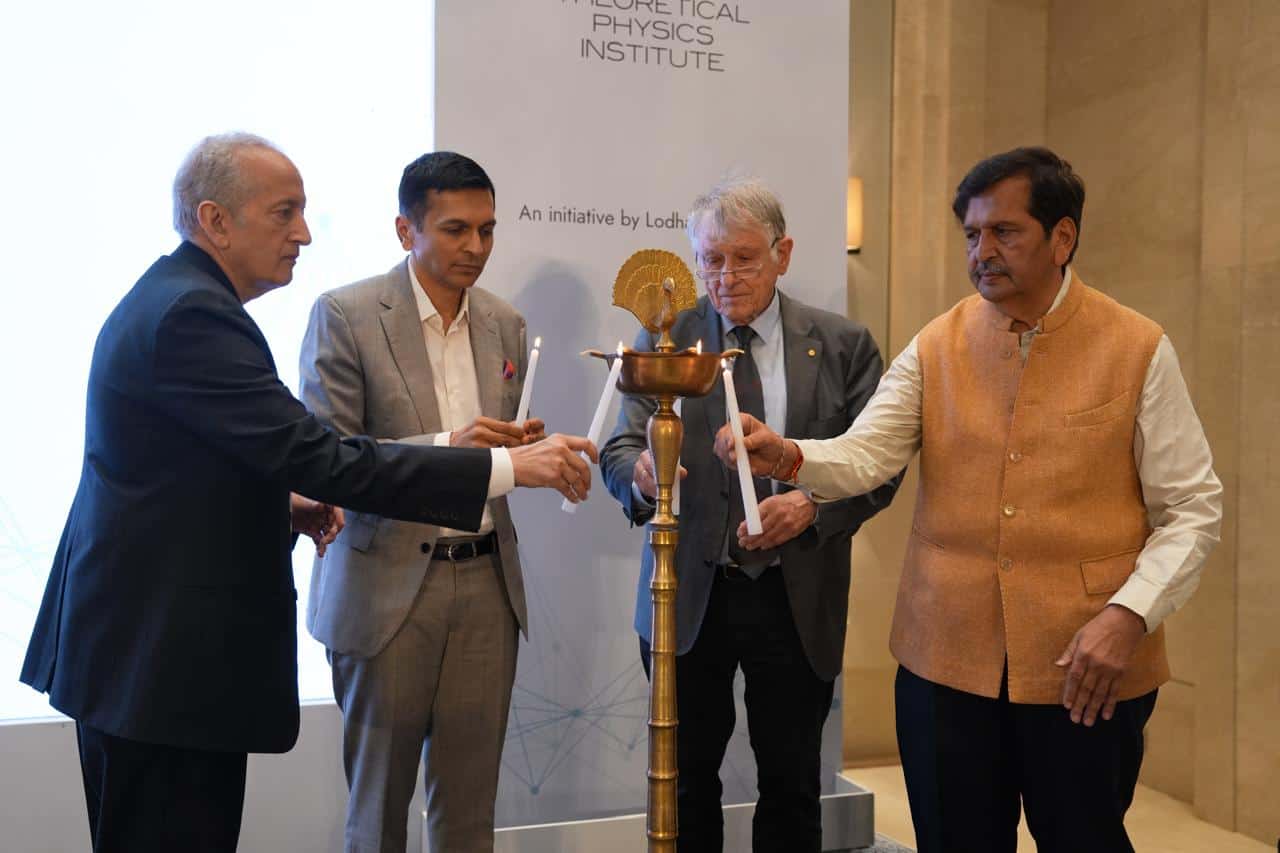
India’s first privately funded theoretical-physics research institute is set to open in the coming months in Mumbai. The Lodha Theoretical Physics Institute (LTPI), which was announced on 26 May, will be led by quantum physicist Jainendra Jain who is based at Pennsylvania State University in the US.
Jain, who will keep his position at Penn State, says that the new physics institute is expected to have at least 10 full-time faculty members, around 30 postdocs as well as long- and short-term visitors from around the world.
The first LTPI postdoc has already recruited and Jain expects several visiting faculty members at LTPI by early 2027, who will be spending significant time in Mumbai. LTPI plans to hire 3-5 full time faculty members within the next three years.
LTPI is intentionally designed to be smaller and more focused than a typical research institute and will initially focus on three or four areas, one of which is strongly interacting quantum matter.
“We believe that this scale will allow the institute to respond nimbly to emerging scientific opportunities,” Jain told Physics World, adding that quantum matter “promises to continue to be a fertile ground for new transformative discoveries”.
The LTPI is being set up by Mumbai-based Lodha Foundation – the philanthropic arm of India’s Lodha Group, which is one of the country’s largest real estate and construction companies.
In August, the Lodha Foundation established the Lodha Mathematical Sciences Institute in Mumbai – India’s first private-funded mathematical sciences institute.
‘A destination of choice’
Private-funded research institutes are still a novelty in India with most research, especially in basic science, often carried out in publically funded research institutes.
Compared to government-funded institutes, Jain says that the LTPI’s goal “is to create an environment where researchers can devote the maximum possible fraction of their time and energy to science”.
To that end, Jains adds that administrative burdens and bureaucracy that often accompany public-funded organizations will be kept to a minimum with the institute having the flexibility to move into new areas.
LTPI will not grant academic degrees, and its members will not have mandatory teaching obligations.
Researchers at LTPI will also not be required to secure external funding to sustain their research programs, which will help them pursue long-term scientific questions. The rise of women in quantum science in India and the legacy of Satyendra Nath Bose
“Our goal is to build an institute in India that stands alongside the finest theoretical physics centres and becomes a destination of choice for outstanding physicists from around the world,” adds Jain.
Sunil Mukhi, coordinator and head of physics at the public-funded Indian Institute of Science Education and Research in Pune, says that the lack of government support for theoretical sciences as well as visitor programmes means that the LTPI will be a “huge benefit to the community”.
“Public-funded institutes are subject to lots of rules and regulations that make it more complicated to function,” he says. “Government funding for [visitors] is very difficult to get because the value and necessity of visitor programmes is not understood by most of our agencies,” he says.
Mukhi adds it is “great to see industrialists stepping up” and that they are “now in a position to play a role”. “The talent is already there and only a well-funded, flexible, creative environment is needed,” adds Mukhi.