Physicists have discovered that the quantum arrangement of protons and neutrons inside atomic nuclei plays a much bigger role in nuclear pairing than previously thought. That is the conclusion of an international team of physicists that has scattered high-energy electrons from calcium and iron nuclei. Their study improves our understanding of the strong nuclear force, which binds atomic nuclei together.
The team focused on the brief partnerships that form when a proton and a neutron come unusually close together inside a nucleus. Known as short-range correlated (SRC) pairs, these fleeting configurations involve only about 20% of all nucleons but account for almost all of the fastest-moving particles in nuclei. Because the two particles approach each other so closely, such pairs offer a rare opportunity to probe nuclear matter under extreme conditions.
The new measurements suggest that these pairs form according to quantum-mechanical rules linked to the shell structure of the nucleus rather than simply depending on how many protons and neutrons the nucleus contains.
Distance matters
Atomic nuclei contain protons and neutrons, collectively known as nucleons. In the standard shell model of the nucleus, these particles occupy different quantum states, or shells, much as electrons do in atoms.
However, the shell model does not tell the whole story. Nucleons occasionally come very close together, forming temporary pairs with exceptionally large velocities. Almost all of these pairs consist of one proton and one neutron.
According to team member Lawrence Weinstein of Old Dominion University in the US, such pairs can reveal what happens when nucleons approach each other so closely that their internal structures may begin to overlap.
“Nucleons are like people,” he says. “When they are far apart they do not interact, at moderate distances they can attract each other, but if they get too close they can repel each other violently.”
Quarks and gluons
The pairs therefore provide a way to investigate how the strong nuclear force behaves at very short distances and whether these close encounters affect the quarks and gluons inside nucleons, where quarks are the fundamental constituents of protons and neutrons and gluons are the particles responsible for binding them together.
Previous experiments had suggested that neutron-rich nuclei contain more short-range pairs than nuclei with similar numbers of protons and neutrons. However, those studies compared nuclei that also differed substantially in mass, making it difficult to determine the true cause of the effect.
To separate these possibilities, the researchers examined three carefully chosen nuclei: two calcium isotopes and an iron isotope.
“We studied calcium-40, calcium-48, and iron-54,” says Or Hen of the Massachusetts Institute of Technology, one of the authors of the study. “These let us see how the number of SRC pairs increased as we added eight neutrons from calcium-40 to calcium-48 and then added six protons from calcium-48 to iron-54.”
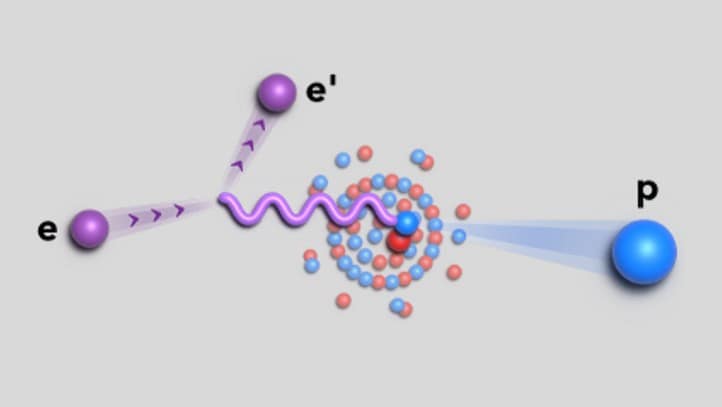
The measurements were carried out at the Thomas Jefferson National Accelerator Facility in Virginia. The researchers fired a beam of electrons at the nuclei and measured both the scattered electrons and protons knocked out of the target.
Reconstructed motion
By reconstructing the motion of the proton before the collision, they could determine whether it had belonged to a short-range correlated pair.
The team expected that adding large numbers of neutrons would significantly increase the number of proton-neutron pairs. Instead, the effect was surprisingly small.
“We found that adding 40% more neutrons only increased the probability of finding a proton in an SRC pair by 10%,” says Hen.
The additional neutrons occupied an outer quantum shell, while most of the protons remained in inner shells. The result suggests that the newly added neutrons rarely formed close-range pairs with protons in different shells.
The researchers then examined iron-54, which contains six additional protons occupying the same outer shell as the extra neutrons in calcium-48.
Dramatic effect
“Conversely, the added six protons in the outer orbital of iron-54 formed 50% more SRC pairs (relative to calcium-48), presumably with the outer-orbital neutrons in calcium-48,” Hen says.
The result points to an unexpected conclusion. Nucleons appear to prefer forming close-range pairs with partners occupying the same quantum shell rather than with particles located in different shells.
The finding also posed a challenge for existing theoretical models. Although some calculations reproduced part of the observed behavior, none predicted the strong increase seen in iron-54.
Physicists spot signs of an atom-like system bound by the strong force alone

The work could have consequences beyond the structure of individual nuclei. Researchers have proposed that short-range pairs influence the properties of extremely dense matter, including the matter found inside neutron stars. The pairs may affect both the cooling of neutron stars and the relationship between pressure and density within these exotic objects.
Hen says that the team will now study wider range of nuclei. “We are extending this work to other stable nuclei from beryllium-9 to gold-197 to further study the effects of shell structure and mass on pair formation.”
Future experiments will also investigate unstable neutron-rich nuclei that cannot be studied using conventional targets. Those measurements should help determine whether the newly observed shell effects represent a general rule governing how short-range proton–neutron pairs form throughout nuclear matter.
The research is described in Nature.