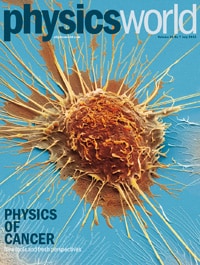
Physics of cancer: free PDF download of the July 2013 issue

By Matin Durrani

Medical physicists have made – and continue to make – many valuable contributions to the treatment, diagnosis and imaging of cancer using X-rays, magnetic fields, protons and other subatomic particles. But some physicists are trying to tackle cancer through a very different approach. Rather than seeing cancer purely in terms of genetic mutations, these researchers are instead examining the physical parameters that control how cancer cells grow, evolve and spread around the body.

Find out more by downloading your free PDF copy of the July 2013 special issue of Physics World on the “physics of cancer”.

(more…)

Between the lines

David Meyer as an elderly Sir Isaac

Let Newton be!

Isaac Newton was not a fan of the theatrical arts. On the one occasion when he is known to have attended an opera, he ran away during the third act. So it seems fair to surmise that the father of gravitational theory would have absolutely hated Craig Baxter’s play about his life, Let Newton Be! That, however, is no reason for the rest of us to avoid this excellent work. First performed in 2009 at Newton’s own Trinity College, Cambridge, the play toured a handful of institutions in the UK and US in 2011; however, as a physicsworld.com reviewer argued at the time (“Newton’s three body problem”, 30 March 2011), it deserved a much wider audience. Fortunately, someone in the publishing world agreed, and the play is now available in book form as The Isaac Newton Guidebook. In addition to the text of Let Newton Be!, the guidebook also contains a series of scholarly essays on various aspects of Newton’s life, introductions by both Baxter and Stephen Hawking and – best of all – a DVD of a performance by the splendid Menagerie Theatre Company. Probably the most useful of the essays is the one on Newton’s feud with Leibniz. The nature of this dispute was so complex, wide-ranging and important that Newton novices should probably read the essay about it before watching the play. Other than that, though, this is not a work that requires much introduction. Just sit back and enjoy the spectacle as the three different actors who play Newton take you through his life, his works, and his famously difficult personality.

  • 2012 Faraday Publishing £25.00/$40.00hb 176pp

Getting spammed

“Mail is easily deleted and so ‘junk’ mail is not really a serious problem.” As an example of faulty prognostication, this statement – made in 1978 on a mailing list of ARPANET, the progenitor of today’s Internet – surely ranks right up there with Lord Kelvin’s supposed declaration that, by 1900, nothing new remained to be discovered in physics. The story of how junk e-mail, or “spam”, evolved from a minor nuisance into a serious problem is thoughtfully and engrossingly told in Spam: a Shadow History of the Internet. Written by Finn Brunton, a historian of technology at the University of Michigan, US, the book is initially rather hardgoing, with clunky phrases such as “foundational ambiguities”, “root paradigm” and “co-constitutive feedback loop” marring the introduction. However, once this little display of academic impenetrability is finished, Brunton the storyteller takes over. The rest of the book is pacey and packed full of interesting titbits, from the tale of the first commercial spam message (an advert for DEC computers that appeared on ARPANET on 1 May 1978), to an inside look at the professional spammers who plagued the loosely organized Usenet in the mid-1990s, and finally a sobering assessment of new forms of spam that seek to game search-engine algorithms. Like all good historians, Brunton is an interpreter as well as a narrator, skilled at placing facts in context. That ARPANET post about junk mail, for example, made sense at the time because its audience was a community of computer scientists, engineers, physicists and other defence experts who were used to collaborating and often knew each other personally. As Brunton puts it, the proto-Internet “was not the electronic frontier but a fairly small town, populated almost exclusively with very smart townspeople”. Once that population expanded, old strategies for keeping noxious behaviour under control – including ad hoc flame wars and revoking offenders’ access privileges – ceased to function. New ones had to be developed to replace them, and as Brunton explains, this is still very much a work in progress.

  • 2013 MIT Press £19.95/$27.95hb 304pp

Alea iacta est

What does it mean for an event to be truly random? For science writer Brian Clegg, the answer depends on whether you are talking about classical randomness or chaotic randomness. As he explains near the beginning of his book Dice World: Science and Life in a Random Universe, classical randomness applies to things like roulette wheels and gambling dice: the outcome of a dice throw is uncertain, but it can be predicted using the standard tools of probability theory. Chaotic randomness, on the other hand, is the stuff of earthquake clusters, flapping butterfly wings and – in Clegg’s view, at least – the mysterious alchemy that transforms a handful of books into bestsellers. These things, he explains, are not actually random at all in the classical sense, because they cannot be controlled and are not easily predicted. Once this distinction is established, the rest of the book takes the reader on a tour of various forms of randomness and the methods scientists and mathematicians have developed to describe them. In addition to relatively well-known pioneers such as Blaise Pascal and various members of the talented Bernoulli family, Clegg also highlights the work of some lesser-known contributors to the field, including the Italian scholar and gambler Girolamo Cardano (see May 2009 pp36–40) and John Graunt, a button-seller with a sideline in statistics who became a member of the Royal Society. A light, quick read overall, the book does get into some weighty material later on, when quantum randomness and Bayesian statistics enter the picture.

  • 2013 Icon Books £12.99pb 288pp

Tsunamis could be spotted from magnetic anomalies


Magnetic anomalies created by tsunamis could be detected by satellites. That’s the claim of researchers in China, who have created a model that simulates the effect of huge ocean waves on the Earth’s magnetic field. The team believes that its work could lead to an early-warning system that can detect the deadly waves in real time.

Tsunamis are huge ocean waves often associated with earthquakes. While they can be tens of metres high when they reach land – often with devastating effects – they tend to have amplitudes of a metre or so in the open ocean. As a result it can be difficult to spot a tsunami against a background of normal waves.

While a tsunami in the open ocean might not be tall it is extremely long and fast moving and therefore involves the rapid displacement of large amounts of water. When a body of salt water moves through the Earth’s magnetic field its conductive nature induces a small anomaly in the field, which can be with a magnetic sensor mounted on a low-Earth-orbit satellite or high-altitude balloon.

Real and model tsunamis

Now, Benlong Wang and colleagues at Shanghai Jiao Tong University have developed a way to predict the local changes in the Earth’s magnetic field caused by a variety of model tsunamis. The basic models can then be combined to simulate the magnetic behaviour of a real-life tsunami. To test these models, the team compared its predictions with data recorded during the 2004 Sumatra and 2010 Chile tsunamis. The team was able to spot magnetic anomalies associated with the events and then estimate the wavelength and height of the tsunami waves.

In principle, a calculation of the tsunami wave profile from a magnetic signal can be done almost instantaneously, Wang told physicsworld.com. If applied in practice this could result in a marked improvement in tsunami early-warning systems. Today’s seismic detection methods, for example, can often take about six minutes to process. A further limitation of seismic prediction and alternative methods based on tidal gauges is that they cannot do continuous tracking of the wave as it moves in the open ocean – whereas magnetic monitoring could be capable of achieving this.

While the technology to detect these magnetic anomalies exists, a suitable infrastructure will need to be developed to provide a comprehensive early-warning network. There are two possible approaches to this, the team explains: using unmanned near-space airships or low-Earth-orbit satellites – both of which are close enough to the ocean to detect the magnetic signal of the wave.

Detection could be problematic

In practice, however, detecting the tsunamis may be more problematic than the researchers claim. “The tsunami magnetic signals are typically about 1–2 nT – compare this with about 40,000 nT of ambient geomagnetic fields,” says Manoj Nair, a geomagnetism expert at the University of Colorado, who was not involved in this study. Nair suggests that, while the researchers may have succeeded in detecting the tsunami signals retrospectively on the magnetic records, real-time detection comes with new challenges: “This is because the time variations in the geomagnetic field from other sources can overwhelm the weak tsunami magnetic signals. I am more sceptical on the use of satellites since [they see] a mix of time and space signals, further complicating the separation of tsunami signals from other sources.”

Nevertheless, Wang and colleagues will continue to test their model against other historical tsunami data. “The next step of our work will focus on the realistic tsunami wave history at Easter Island,” Wang explains. Located in the South Pacific, the island was struck by the 2010 Chile tsunami. The team will use magnetic data gathered from this region in conjunction with global tsunami propagation models to further its understanding of the connection between magnetic anomalies and the sea-surface variations.

The group also plans to look at the magnetic effects of internal waves and tides – movements of water that occur beneath the surface of the ocean and are important in heat and material exchanges between different ocean layers. “Using magnetic signals,” Wang adds, “we expect that these internal flows can be observed conveniently.”

The work is described in Proceedings of the Royal Society A.

Has Voyager 1 left the solar system yet?

By James Dacey

Artist's impression of Voyager spacecraft

“It is the consensus of the Voyager science team that Voyager 1 has not yet left the solar system or reached interstellar space.”

That is what Voyager scientist Edward Stone had to say on the matter back in March following reports that NASA’s most intrepid explorer had finally passed beyond the edge of our solar system. Today, three new papers published in Science back up this statement, asserting that the Voyager 1 had instead entered a distinct section at the edge of the solar system.

(more…)

Can Andy Murray give graphene a boost?

By Matin Durrani

It has become a cliché to call graphene the “wonder material” because of its incredible physical and electronic properties – this 2D honeycomb of carbon atoms is not only the strongest ever discovered, but also the stiffest, being able to sustain a current density a million times that of copper.

Having such great attributes is all well and good if you’re a researcher who’s fascinated by the subtleties of graphene’s electronic properties such as its lack of a band gap – but what if you’re a hard-nose business executive? Graphene will only be any good if it can help you to sell a product that’s somehow better than what’s already on the market and if it can at also make the company money at the same time.

That matter-of-fact thinking was very much to the fore at a meeting in London this week called the Graphene Commercialisation and Applications summit. It brought together nearly 150 senior research executives, academics and industry leaders to discuss how graphene can be turned into real money-making products.

Among those who spoke was Michael Balthasar, director of new technologies and innovation at Volvo Advanced Technology and Research. It might at first sight seem odd that a truck-building company should be interested in graphene, but just imagine if this ultrathin material could be included in flexible displays that could literally be moulded into the vehicle’s dashboard or windscreen. Or if graphene could be introduced into a vehicle’s brake pads to quickly extract the heat generated from friction when a lorry slows down.

Another speaker was Gareth Williams, vice-president of research and technology at Airbus. This European plane-making consortium is actively looking at the benefits of graphene and Williams highlighted any plane manufacturer’s obvious priority to ensure that its craft are not only safe but also  as light as possible. Fuel, after all, is expensive and if graphene can help to shave off even a few percent of a plane’s mass, the benefits could be huge. But as Marcello Grassi, head of technology at Spirit AeroSystems Europe, pointed  out, one promising application of graphene could actually be to help dissipate the current from lightning strikes, which is currently done using relatively heavy copper mesh.

There were also talks from industry chiefs at the likes of Philips Research (using graphene to make ultrasensitive photon detectors) and Nokia (as an ultra-transparent and bendable conductor on touch-screen smartphones), but probably what got delegates most excited during the coffee breaks was a presentation by Ralf Schwenger, a research director at Head Sport – an Austrian company that makes and sells some 200,000 tennis racquets a year.

Head Sport already uses graphene as a material in the frame of its YouTek Graphene racquets – the material acts as filler that can be added in such a way that less of the racquet mass  lies in the middle part of the racquet, with more in the grip of the shaft and also in the racquet’s head. According to the company’s website, this “unique construction provides players with an unmatched manoeuvrability and an increased swing weight”. Essentially, a Graphene racquet “is easier to swing and enables even more powerful shots”.

I’m slightly concerned that the company appears to have trademarked the name Graphene to describe its racquets – I’m not sure what graphene leaders Andre Geim and Konstantin Novoselov, who won the 2010 Nobel Prize for Physics, will make of that. But what’s interesting is that you can already buy Graphene racquets from Head – in fact, Andy Murray, Novak Djokovic and other tennis stars are already using them at this year’s Wimbledon Championships.

But what everyone at the meeting pointed out is that graphene will only ever enter the mainstream if there is a proper “graphene ecosystem” – in others words, we need companies that can make graphene of the right quality and amount, killer applications that create a demand, and the right graphene know-how so that the knowledge about this material can be transferred out of the laboratory and into real products. After all, there have been plenty of other exciting products and innovations over the years that have not yet at least really taken off commercially. (Fuel cells anyone?)

I’m optimistic though that graphene will eventually make the grade and if Andy Murray or Novak Djokovic wins Wimbledon, surely that’s got to give this wonder material a massive boost.

For more on graphene, check out this month’s Physics World Focus Issue on Nanotechnology, which includes a feature by Kostya Novoselov on the new National Graphene Institute at the University of Manchester.


Laser creates high-energy positron beam

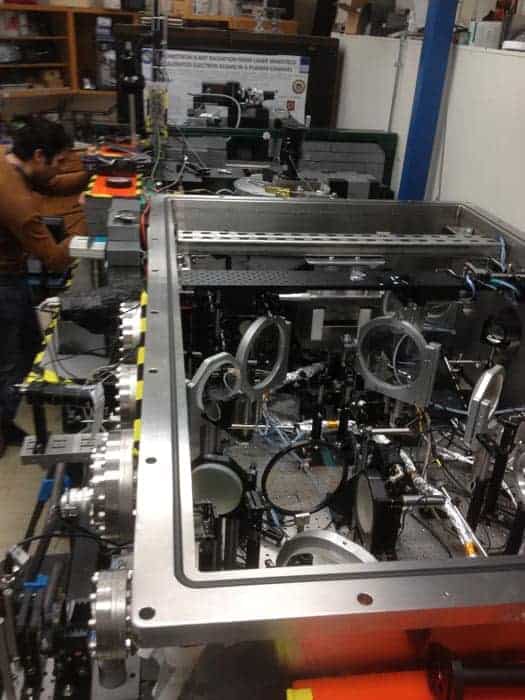
Photograph of the set-up used to create positron beams at the University of Michigan

Beams of positrons with energies well above 100 MeV have been created for the first time using a laser in a tabletop experiment. The work was carried out by physicists in the UK, US and Germany who say that their set-up could be used to do small-scale studies of astrophysical jets in the lab. The positrons are more than five times as energetic as those in previous laser-driven beams.

Over the last decade or so, researchers have taken great strides in making beams of energetic charged particles by firing intense laser pulses at gases. Electron beams with energies up to 1 GeV have been created and researchers expect that the next generation of lasers could deliver electron beams at 100 GeV. But beams of positrons created with lasers have so far been limited to energies below about 20 MeV.

Now, however, Matthew Zepf, Gianluca Sarri and colleagues at Queen’s University of Belfast have teamed up with physicists at the University of Michigan, the Max Planck Institute for Particle Physics in Heidelberg and the Helmholtz Institute in Jena to use a laser to generate for the first time highly collimated beams of positrons with energies well above 100 MeV.

A HERCULES effort

Created using the HERCULES laser system at the University of Michigan, the positrons were made by first firing an intense infrared laser pulse at a gas of helium and nitrogen. The pulse, which is just 30 fs in duration, ionizes some of the gas to create a plasma. The duration of the pulse is carefully chosen so that it excites a wave that propagates through the plasma, which in turn accelerates electrons to energies of up to 1 GeV. This occurs via a well known process called plasma wakefield acceleration.

These electrons form a tight beam that travels in the same direction as the laser pulse until they slam into a thin solid target, which slows them rapidly down, emitting photons in the process. As these photons then travel through the target, they scatter from nuclei, which encourages a photon to be converted into an electron and positron through “pair production”.

The positrons (and electrons) form a tight beam that is then sent through a magnetic spectrometer that deflects electrons in one direction and positrons in another. By detecting the positrons on a position-sensitive screen, the team was able to measure their energies in the 80–250 MeV range.

Jetting in

One possible early application of the accelerator could be the study of astrophysical jets. These appear to involve highly collimated jets of electrons and positrons that interact with the interstellar plasma. According to Zepf and Sarri, tiny analogues of these jets could be created by firing their electron/positron beam through a low-density gas.

The new research could also help with construction of a high-energy electron–positron collider for particle-physics experiments. While such collisions could be achieved using conventional accelerators such as the planned International Linear Collider (ILC), such facilities would be huge – up to 50 km long in the case of the ILC. In principle, future generations of lasers would be capable of producing electrons and positrons with high enough energies to do particle-physics experiments on a tabletop.

The accelerator is described in Physical Review Letters.

An appetite for adventure

How did you get into physics?

I started flying at a very early age. I was putting flying time in my logbook when I was 13, and made a parachute jump when I was 16, but back then a woman couldn’t fly for the military or the airlines, so instead I decided to study aeronautical engineering. But then I spent my freshman year at the University of Michigan drawing pictures of the threads on screws and mixing up batches of concrete, which really wasn’t what I had in mind, so I switched to physics. That was a much better fit. The beauty of it just entranced me – I’ll never forget deriving Maxwell’s equations, and the elegance and inevitability of them.

How did you get interested in racing?

After I graduated in 1960 I went to work in the aerospace industry, and I almost bought a half-share of an aeroplane. But there was no place in the area (this was on Long Island, near New York City) where I could go and have fun with it, and I needed a car, so I bought a 1953 Jaguar XK120 M coupé instead. That was the watershed. I started doing solo competitions – called gymkhanas at the time – in the car I drove to work every day. Oh, the Jaguar! So beautiful, so prone to breakdowns! My heart still goes pit-a-pat whenever I see one of them, that first XK120 M. Then in 1963 I bought an XK140 that had been set up for racing and took it to the Sports Car Club of America’s Driver’s School.

You also applied to be an astronaut.

Yes. By that time I’d been working in the aerospace industry for four or five years, and I was sort of a junior-grade all-purpose physicist; if we got something that nobody knew anything about, I would go down to the library and become the instant expert in it. One day a co-worker showed me a magazine article about NASA’s scientist-astronaut programme and said, “Look at this – you fit all these requirements with the possible exception of where it says ‘PhD or equivalent experience?'”. I thought, “Oh wow – the most exciting adventure of the 20th century!” So I applied, and I got through the first round before I was eliminated in the second – presumably because I didn’t have a doctorate, but one doesn’t know.

How did you get to the Indianapolis 500?

I spent 13 years building my own engines, supporting my racing with my salary as an engineer and sleeping in the back of my tow car. I won my class a couple of times at the 12 Hours of Sebring manufacturers’ championship race, but by 1975 I had reached the end of my rope. I was out of money and my career in physics was basically down the tubes; at one point I had started a Master’s degree in physics, but then it got to be spring and I needed to build an engine, which conflicted with final exams, so I took an “incomplete” in 1964 and that was the end of that. Then, at that 1975 nadir, somebody I’d never heard of called me up and asked if I’d like to take a shot at the Indianapolis 500. Well – yes! Back then, any racing driver would have given their eyeteeth for that. I was eventually successful in qualifying, and that led to a ride in NASCAR’s top series as well, so in 1977 I became the first woman to earn a starting spot in the Indianapolis 500 and also the Daytona 500.

What was the biggest challenge you faced?

Finding the money to get it done with, no question – nothing else even comes close. In 1976, of course, there was this great uproar about how having a woman on the track was going to result in the deaths of the other drivers and all that kind of thing. But once the drivers realized that I knew what I was doing and could give them some good competition – and that I was a clean driver – then all that calmed down. It was just a matter of their gaining the experience in running against me. But finding the money to get good equipment was impossible or close to it.

What are you working on now?

Not much! I wrote a memoir that was published in 2005 and I was inducted into the International Motorsports Hall of Fame in 2006, which was quite a thrill. And I still hike in the mountains here in Colorado, where I live. I’ve quit skiing, though – I’m not willing to go out on the mountain and subject myself to getting hit by a snowboarder. Being 75 sort of gets your attention. One doesn’t bounce quite so well at this age.

Skiing, flying, racing – what gave you this love of adventure?

Oh, I was born that way. I think it’s just in some people’s nature to want to find out what it’s like out there at the edge of human capabilities, and fortunately I was born in the machine age when broad shoulders and big muscles didn’t make that much difference – didn’t make any difference, in fact.

Earth-observation sensor adapted to hunt explosives


Satellite technology intended for Earth observation has been adapted to create an instrument that can recognize explosives remotely. Developed by a team of scientists in the UK, the system uses an infrared laser to detect volatile compounds given off by explosives and other dangerous materials.

Home-made chemical and explosive weapons pose a significant risk to people in many places around the world. Most improvised devices have some kind of volatile material associated with them. These are often remnants of the ingredients used to make the devices or chemicals that are produced as explosive materials decompose over time. These compounds can be detected if a sensor is placed close enough to sample the surrounding air – but this is a risky business. Remote sensing is a safer option but is not perfect either.

Space-based remote-sensing techniques rely on the fact that every species of molecule has a characteristic radiation absorption spectrum. By measuring this unique pattern of frequencies, the presence – and often the concentration – of a molecular species in a gas can be determined. “Passive” remote sensors simply collect thermal radiation from the scene. However, these are far too insensitive to reveal trace gases at parts per million (ppm) concentrations over the very short absorption distances necessary for detecting explosives. LiDAR, in contrast, is an “active” system that sends out a laser beam and interprets the backscatter. It offers a big jump in sensitivity but each instrument works at only one wavelength. While this is fine for spotting specific gases, it is not suitable for multi-gas detection and the comprehensive investigation of explosives of unknown composition.

Terrestrial application

This new explosives detector was created by Damien Weidmann and his team at Rutherford Appleton Laboratory (RAL). The researchers were originally designing a new passive satellite spectrometer when they realized it could be adapted for use in an active system for detecting trace gases on Earth. Dubbed the Active Coherent Laser Spectrometer (ACLaS), the system uses quantum cascade lasers that are integrated on tiny semiconductor chips and work at room temperature. Crucially, the laser frequency can be tuned and scanned. To tackle the problem of low sensitivity, the illuminating laser beam is in the mid-infrared, which is the atmosphere’s “transparency window” where water-vapour interference is minimal. A further benefit is that the light will not harm human eyes.

The new device has been tested at distances up to 50 m and gives unambiguous chemical identification and quantification readings in as little as 3 s. But it rewards those with a little more patience: “The sensitivity scales with the time you wait to get your reading,” explains Weidmann. “If you wait for 100 s rather than one, you improve the sensitivity by a factor of 10.”

Putting a specific value on the instrument’s sensitivity is difficult because it is more responsive to some molecules than others. However, the researchers say it is in the parts-per-million region. This is sufficient for detecting high-volatility materials and Weidmann’s team is working hard on extending its reach.

“We have an obvious way of doing this,” he says. “We can multiply the power of the laser by 10 very easily, and we’d gain immediately one order of magnitude.” At the same time, the researchers are working on a system to improve the signal-to-noise ratio and predict that they will be able to win another order of magnitude there too.

Multipurpose hazard detector

The researchers believe that the flexibility and range of the ACLaS makes it ideal for all kinds of hazardous or undercover gaseous-phase sampling, including detecting toxic leaks, chemical-warfare agents, illegal drugs manufacture or highly localized industrial air pollution. “[It] has a very high spatial resolution because you’re looking from a distance at a very narrow area and you can direct where you’re looking,” explains Weidmann. “It should really be seen as a generic system that will be able to detect any kind of volatile gas, providing the molecule you’re targeting is specifically absorbing enough.”

The RAL team is working with the UK’s Ministry of Defence and has already begun discussing a licensing agreement with a company that is keen to begin manufacture. Meanwhile, Weidmann and his team are back in the lab pursuing a trio of improvements to the design. In addition to boosting the sensitivity, the researchers plan to improve the device’s “frequency agility”, which means incorporating a more complex laser system to improve the device’s range and therefore the number of species that it can pick out. Finally, they have a long-term aim of miniaturizing the instrument from its current square-metre plot on the lab bench to a handheld device, but already reckon they can shrink the next-generation version to about the size of a shoebox.

Star has three super-Earths in the habitable zone

Suns rising over Gliese 667C

By Hamish Johnston

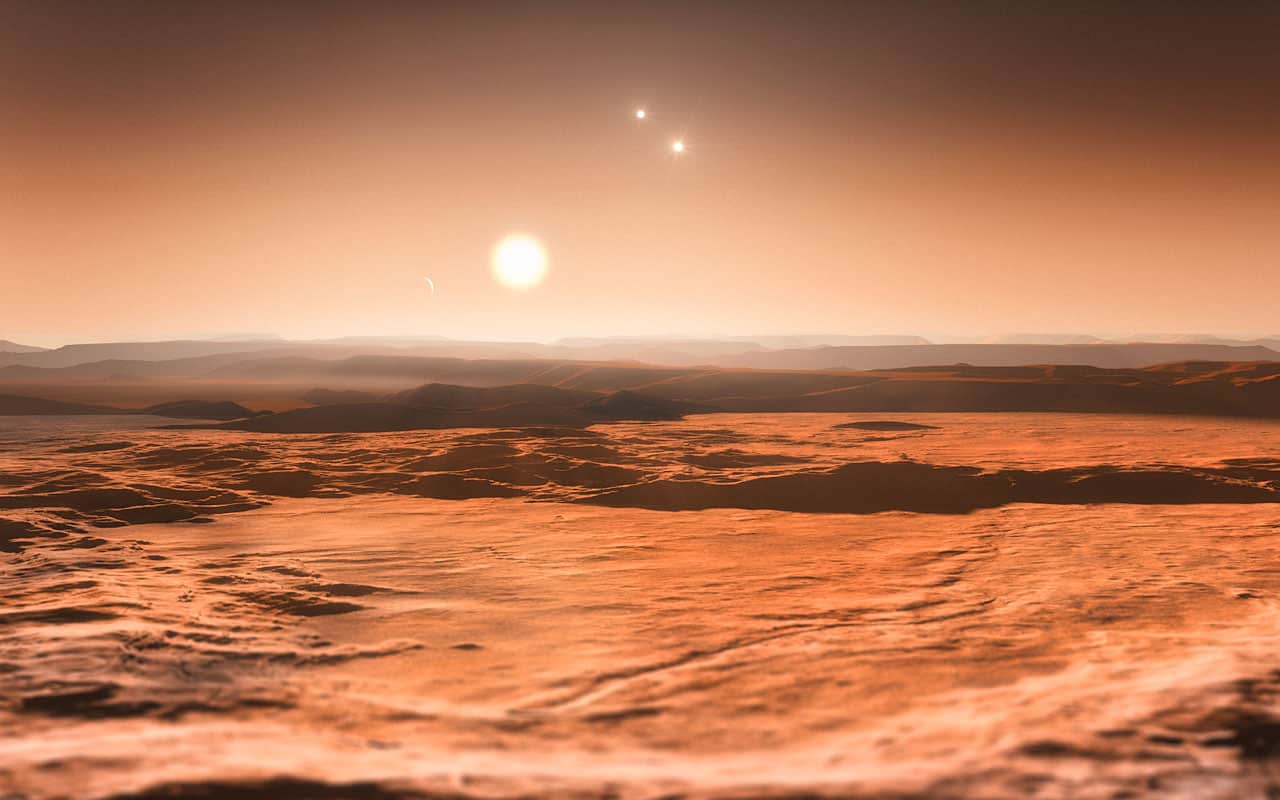
No, it’s not Tatooine. This is an artist’s impression of the view from the exoplanet Gliese 667Cd looking towards the planet’s parent star (Gliese 667C). In the background to the right, the more distant stars in this triple system (Gliese 667A and Gliese 667B) are visible and to the left in the sky is one of the other planets, the newly discovered Gliese 667Ce, can be seen as a crescent.

(more…)

Phototransistor combines graphene and chlorophyll

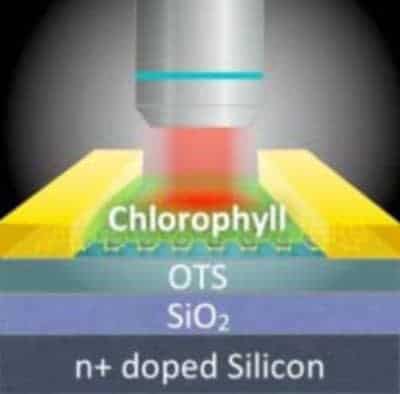
Schematic of the new graphene phototransistor

Researchers in Taiwan say they have created a new chlorophyll-coated graphene phototransistor that is much more sensitive to light than devices made of pure graphene. The researchers believe that the device could provide a blueprint for future graphene-based light sensors. However, some experts in the field are sceptical.

Graphene is a sheet of carbon just one atom thick and the material’s remarkable optical and electronic properties could make it useful for devices such as photodetectors and solar cells. Graphene absorbs photons over a wide range of frequencies and its ability to carry electrons at relativistic speeds means that graphene photodetectors can have very quick response times. However, there is one important challenge facing device makers: pure graphene has a low sensitivity to light. Indeed, only 2.7% of the photons hitting graphene create an electron–hole pair that can then be detected.

To get round this problem several groups have produced hybrid devices by coating graphene with another material that absorbs light more efficiently. In 2011 researchers at Manchester and Cambridge universities showed that a covering of plasmonic nanostructures – patterned metal films – could increase the proportion of light absorbed to nearly 50%. A year later at the Institute of Photonic Sciences in Barcelona, scientists achieved even higher sensitivities using quantum dots – with a slight loss in speed.

Cheap and non-toxic

Now, researchers at the Academia Sinica and the National Taiwan University, both in Taipei, have produced a simple yet effective device by covering graphene with chlorophyll. This is a cheap, non-toxic material extracted from plants, where it plays an important role in converting sunlight into chemical energy.

The team’s device is configured as a field-effect transistor (FET). Two gold electrodes attached at either end of a pure graphene flake function as the source and drain. A drop of chlorophyll dissolved in ether is placed on one surface of the graphene. The solvent evaporates to leave a thin film of pure chlorophyll on one side of the graphene. An insulating layer followed by a layer of doped silicon is added to the opposite side to create the gate of the FET (see figure).

By adjusting the voltage applied to the gate, electrons can be drawn from the chlorophyll into the graphene to create n-doped graphene. Changing the voltage to another value causes electrons to move in the opposite direction, making the graphene electron deficient or p-doped. N-doped graphene conducts electricity through the movement of electrons, whereas p-doped graphene conducts through the movement of positive holes.

High gain

When a photon of suitable wavelength hits the chlorophyll, it may create an electron–hole pair. The electron remains in the chlorophyll while the hole is swept into the graphene. If the voltage is set so that the graphene is n-doped, this hole recombines with one of the electrons, thereby reducing the number of charge carriers available and lowering the conductance of the transistor. If the graphene is p-doped, then the hole remains free, thus adding to the number of charge carriers and boosting the conductance.

Graphene has almost no resistance to the flow of charge carriers, therefore adding or removing a small number of carriers has a huge effect on the electric current that can flow between the source and drain. This, says the team, gives the phototransistor a gain of up to 106 when illuminated – making the device extremely sensitive to light.

Commercially viable?

The researchers believe that their results suggest a “feasible method to employ biomaterials for future graphene-based photoelectronics”. Team member Wei-Hua Wang of Academia Sinica accepts it would not be practical to use graphene flakes to make commercial devices because of the laboriousness of the “Scotch-tape method” used to make the flakes. Graphene can also be made using more commercially viable techniques but such materials tend to have lower electron mobility than pure flakes. Although chlorophyll devices made from this graphene would likely have lower gain, Wang says their performance could be comparable to flake-based phototransistors.

Frank Koppens of the Institute of Photonic Sciences questions the advantages of the device over current light-sensitive graphene technologies. “With quantum dots, the devices are quite easy to make at large scale,” he says. “You basically just have to deposit a solution on top of the graphene and then you have a photodetector that has extremely high performance.” He also believes that the limited wavelengths absorbed by chlorophyll could limit practical applications. Alexander Grigorenko, a member of the Cambridge/Manchester team, agrees that the researchers have yet to demonstrate the relative merits of their design.

A preprint of the research is available on arXiv.

Copyright © 2026 by IOP Publishing Ltd and individual contributors