How to hear the shape of a room


Can you obtain the dimensions of a darkened room by clapping your hands and listening to the echoes? Bats, dolphins and some other animals navigate using echoes and some blind humans have trained themselves to do this. Now engineers in Switzerland and the US have worked out a way to calculate the dimensions of a room using a single loudspeaker and four arbitrarily placed microphones. They believe this could find applications in building design, audio forensics and much more.

In his famous 1966 paper entitled “Can one hear the shape of a drum?” the Polish mathematician Mark Kac asked whether or not a listener could uniquely identify the shape of a vibrating membrane after hearing its resonant frequencies. In 1992 the American mathematician Carolyn Gordon and colleagues showed that the answer is no. In theory, however, it should be possible to hear the shape of a room by producing a sound and measuring the time taken for the echoes to arrive at particular points. But doing this in practice is not easy.

Several methods to calculate a room’s geometry from its echoes have all had significant limitations. Some have worked only in 2D. Others need an array of microphones that are placed sufficiently close together that the sound only has time to make one round trip to the walls and back, which may not always be possible if the sound source is close to one of the walls.

Works with flat walls

Now researchers at the École Polytechnique Fédérale de Lausanne (EPFL) in Switzerland and Harvard University in the US have developed an algorithm that uses sound to work out the dimensions of any room with flat, protrusion-free walls. The system uses a single loudspeaker to create sound and four microphones placed anywhere in the room to capture the echoes.

The algorithm that was created by the team only deals with first-order echoes, which means they exclude echoes of echoes. Lead researcher Ivan Dokmanić explains that this makes the system more practicable, as higher-order echoes can be too faint to isolate from background noise. However, isolating first-order echoes is also a challenge because it is not possible to say from a single recorded sound how many walls it has bounced off before reaching the microphone. The algorithm begins, therefore, by looking at the sounds recorded by the four microphones together and working out which sounds come from the same wall. The researchers propose two mathematical methods for doing this. “Once we know which echoes have to be grouped together,” says Dokmanić, “then from there we can compute which signals are first order and which are second order.” Using the arrival time at each microphone of all the first-order echoes, the researchers calculate the size and shape of the room.

They tested their algorithm by calculating the dimensions of a lecture theatre at EPFL and comparing the results of their echo calculations with the actual values. They found the two were remarkably close: the 7.08 m distance between two walls, for example, was calculated as 7.01 m – a discrepancy of less than 1%. They decided to find out how well their algorithm would perform when the requirement that the walls be flat and protrusion-free was not satisfied by placing their set-up in the portal of Lausanne Cathedral, which has a domed ceiling and numerous protrusions such as pillars and large statues. Even here, their system calculated the distances between flat surfaces accurately.

Concert halls and forensics

The researchers foresee a variety of possible applications for their technology. Most obviously, it could be used by architects and sound engineers designing a building in which echoes are important, such as a concert hall, to ensure that the room has the desired acoustics. Another potential application that the researchers are currently investigating, says Dokmanić, is to measure the echoes that a sound produces within a building where the geometry is known and to use the information to work out where in that building the sound was emitted. This could be used in forensics, for example.

Fabio Antonacci of the Image and Sound Processing group at Milan Polytechnic, an expert on this subject who was not involved in the present research, says, “One of the trickiest technical points in the estimation of room geometry is the assignment of echoes to the wall that generated them. Dokmanić [and colleagues] propose two elegant and innovative techniques for this purpose. This is the core of the article and, I believe, the most promising feature for follow-up.”

The research is published in Proceedings of the National Academy of Sciences.

Winds are picking up on Venus

Faster and faster: average wind speeds at low latitudes on Venus. The white line shows the data derived from manual cloud tracking, and the black line is from digital tracking methods.

By Hamish Johnston

Venus is a breezy planet. Planetary scientists have known for some time that its clouds zip along at hundreds of kilometres per hour – speeds on par with Earth’s high-velocity jet stream.

But now a team of researchers looking at data from the European Space Agency (ESA) Venus Express mission have noticed that the winds appear to have accelerated by about 33% over the past six years.

(more…)

How do we keep aeroplanes healthy?

In less than 100 seconds, Nicola Bowler explains how physicists can help to keep aircraft-structures healthy, safe and reliable.

Watch more from our 100 Second Science video series.

‘Charged charmonium’ confounds particle physicists


Physicists working independently at two different particle-physics labs have found tantalizing evidence for a new and mysterious hadron. Dubbed Zc(3900), the particle seems to be a “charged charmonium” and is made from quarks assembled in a way that has possibly never been seen before. Further studies of Zc(3900) could provide important new information about the strong force that glues together quarks in hadrons.

Charmonia, which are heavy mesons, contain a charm and anti-charm quark. Because they are a composite particle, they can exist in a number of different energy states – the most famous being the first excited state called the J/ψ particle. Discovered in 1974, the J/ψ particle made physicists realize for the first time that quarks are real. Although physicists have learned much about quarks over the past four decades, current theories are still not good enough to predict which of the many possible combinations of quarks will form stable mesons.

Mysterious XYZ particles

Zc(3900) was spotted independently by physicists on the BESIII experiment in Beijing and the Belle experiment in Tsukuba, Japan. Both teams focused on the mysterious Y(4260) particle, which was discovered in 2005 at the BaBar experiment in the US. Y(4260) is perhaps the most puzzling of the “XYZ” particles, which have been produced over the past decade at BaBar, Belle, BESIII and elsewhere.

Although they are believed to be combinations of quarks, the XYZ particles have so far defied explanation. At first glance Y(4260), which has a mass of about 4.260 GeV/c2, appears to be a charmonium meson. However, closer inspection suggests that its properties cannot be explained simply in terms of a charm and anti-charm quark bound together by the strong force.

One possible explanation is that Y(4260) is part of a new family of “hybrid charmonium” particles in which the gluons that mediate the strong force exist in excited states. Alternatively, Y(4260) could contain four quarks rather than just two (a tetraquark structure) – and could even resemble a “molecule” made of two mesons bound together.

More than they bargained for

To gain a better understanding of Y(4260), the BESIII and Belle teams therefore created large numbers of them by colliding electrons and positrons together. While the Y(4260) is so short-lived that it cannot be detected directly, its signature turns up in the energy spectrum of pions and J/ψ particles produced in the collision.

But both teams found more than they bargained for – evidence of an unexpected particle Zc(3900) with a mass around 3.9 GeV/c2. This new particle is even more mysterious than Y(4260) because it appears to decay to an electrically charged pion plus an electrically neutral J/ψ. This means that Zc(3900) must carry electric charge, therefore not simply comprising charm and anti-charm quarks.

One explanation for this behaviour is that the new charged particle is a molecule comprising two D mesons that are somehow bound together – something that is predicted by some models of how quarks interact. Another, more tantalizing possibility, is that Zc(3900) is a tetraquark comprising a charm/anti-charm pair plus an up quark and an anti-down quark. If the latter proves to be true, the number of possible hadrons allowed by nature could be much greater than physicists had thought – and by studying these new particles, important new insights into low-energy quark interactions could be gleaned.

“With [BESIII], we can accumulate a lot more data that will permit more comprehensive investigations of this unusual electrically charged charmonium state,” says Yifang Wang who is director of the Institute of High Energy Physics in Beijing and a member of the BESIII team. “When all of these results are used as inputs to theory, we may begin to open the door toward a fuller understanding of the XYZ particles discovered in recent years.”

The discoveries are described in two papers in Physical Review Letters (Phys. Rev. Lett. 110 252001 and Phys. Rev. Lett. 110 252002).

Physicist Kenneth Wilson dies at 77

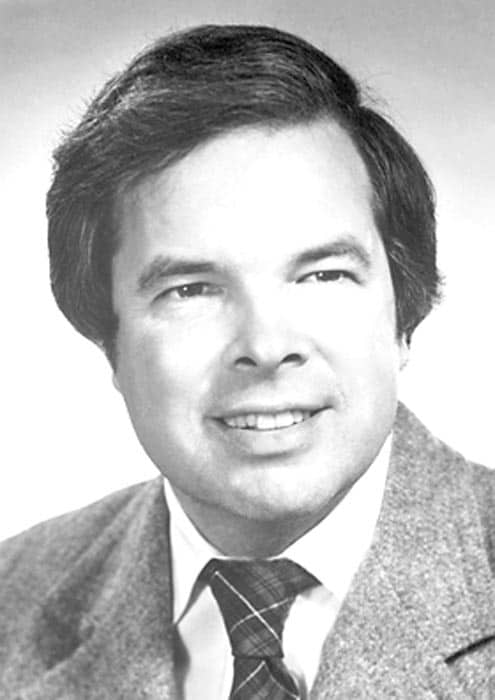
Kenneth Wilson

The US theoretical physicist Kenneth Wilson, who was awarded the 1982 Nobel Prize for Physics, died on Saturday 15 June at the age of 77. Wilson was the sole winner of the 1982 Nobel prize for “his theory for critical phenomena in connection with phase transitions”.

Born in 8 June 1936 in Waltham, Massachusetts, Wilson was the son of the prominent Harvard University chemist E Bright Wilson. After completing an undergraduate degree in mathematics at Harvard in 1956, Wilson was awarded his PhD in theoretical physics from the California Institute of Technology in 1961, which he did under the supervision of the future Nobel-prize-winning particle physicist Murray Gell-Mann.

After a year working at the CERN particle-physics laboratory near Geneva, Wilson joined Cornell University in 1963. He remained there for most of his career, later becoming director of Cornell’s Center for Theory and Simulation in Science and Engineering, which is now known as the Cornell Center for Advanced Computing. In 1988 Wilson joined Ohio State University and was co-principal investigator in an educational-reform project that was funded by the National Science Foundation. Called “Project Discovery”, the project aimed to develop more inquiry-based learning of physics in schools.

Critical phenomena

Wilson was awarded the Nobel prize based on his pioneering work developing a theoretical framework on the nature of phase transitions – such as when describing how a liquid turns into a gas by changing its temperature or when a material loses its magnetization when applying a magnetic field.

Phase transitions can be characterized by an abrupt change in the value of some physical property or by a smoother transition from one phase to another. However, many previous theories – most notably Lev Landau’s 1937 general theory of phase transitions – failed to predict the behaviour close to the transition, known as the critical point.

That problem was finally solved by Wilson in 1971. He realized that one has to deal with fluctuations over widely different length scales – taking into account short- and long-range fluctuations. Such transitions are then almost totally determined by the collective effects of every other object in the system. Modelling this behaviour near the critical point would require vast computing power but Wilson developed a method to divide the problem into a sequence of simpler ones based on renormalization group theory, which had been previously developed in the 1950s.

Wilson’s theory for critical phenomena gave a complete theoretical description of the behaviour close to the critical point proving that many seemingly unrelated systems – liquids or mixtures of liquids and ferromagnets – show identical behaviour.

Ahead of his time

Paul Ginsparg – founder of the arXiv preprint server – studied for a PhD at Cornell University under the supervision of Wilson. He says that Wilson’s ideas in physics will continue to dominate the way that physicists think about the link between statistical mechanical systems and quantum field theory.

Ginsparg also adds that Wilson was “decades ahead of his time” in computing and networks – writing code for parallel processor arrays to get round the problem of slow single-processor speeds, as well as calling for the implementation of the TCP/IP internet protocol that is in use today. “As a graduate student in the late 1970s, I had a unique three-decade window into the future,” Ginsparg tells physicsworld.com.

Wilson was elected to the National Academy of Sciences in 1975, the American Academy of Arts and Sciences in 1975 and the American Philosophical Society in 1984.

Wilson died on 15 June in Saco, Maine.

How can elite cyclists learn from aerodynamics?

In less than 100 seconds, Ivan Marusic describes the power struggle between a cyclist and the wind.

Watch more from our 100 Second Science video series.

New portrait of Peter Higgs unveiled

By Tushna Commissariat

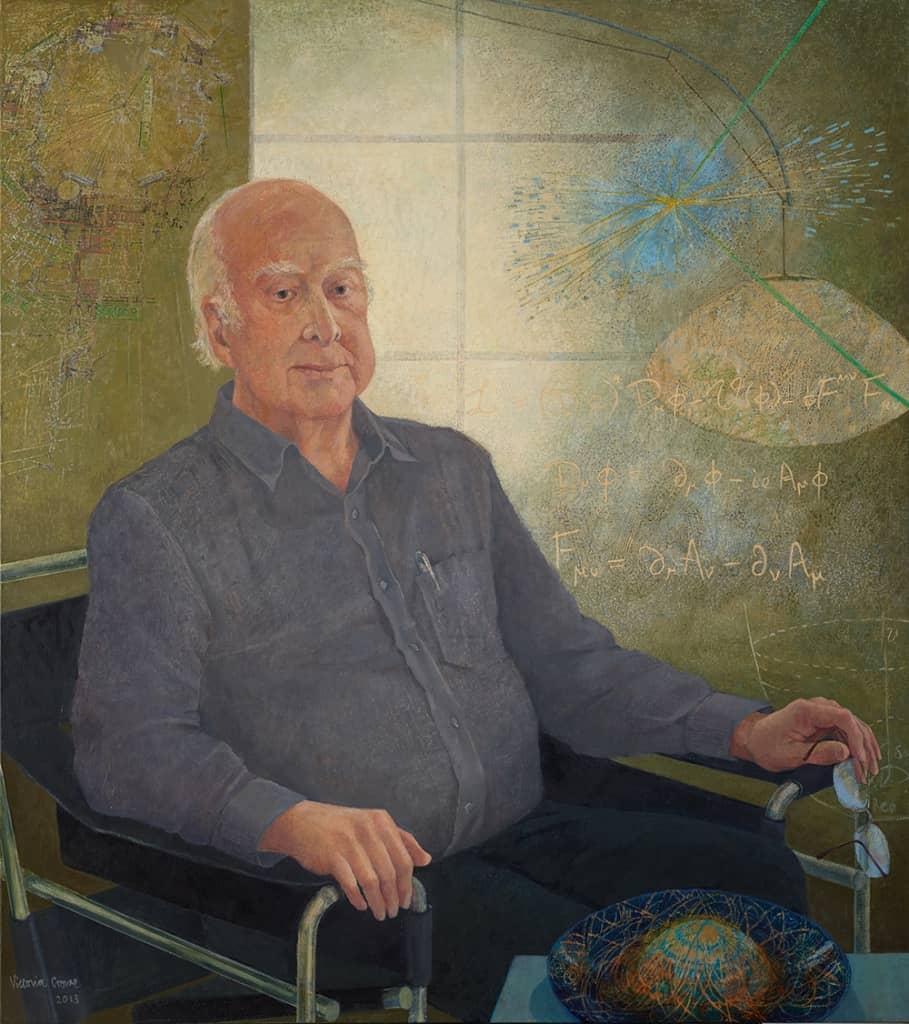
The Royal Society of Edinburgh (RSE) has just unveiled a portrait of famed physicist Peter Higgs, at the Society’s Fellows’ Summer Reception last week. The painting, which will hang on the walls of the Kelvin Room within the RSE’s premises in Edinburgh, was commissioned to one of Scotland’s leading artists, Victoria Crowe, “to honour the man whose outstanding research was instrumental in [the Higgs boson’s] discovery”. The professor seems distinctly unperturbed by the high-energy proton–proton collision taking place in the top right corner of the painting. I shall leave you to find and discern the other interesting imagery in the painting for yourselves – click on the thumbnail to view a larger picture of the portrait.

Livermore slashes 10 per cent of workforce


The Lawrence Livermore National Laboratory (LLNL) in the US has begun laying off around 10% of its 6500-strong workforce in preparation for “challenges” in the lab’s 2014 budget, which will start on 1 October. The lab’s redundancy offer gives workers one week of base salary for each year of continuous service, up to a maximum of 26 weeks. As of last Friday, 399 individuals had accepted the lay-off terms.

Significant limitations

The Obama administration’s budget request for 2014 includes about $1.48 bn for the LLNL – a sum that lab director Parney Albright told a Senate subcommittee last month “will significantly limit our ability to utilize the National Ignition Facility and undermine [our nuclear] stewardship programme”. However, even this figure is uncertain, given the political disputes between the Democratic administration and the Republicans, who have a majority in the House of Representatives and a blocking minority in the Senate.

Albright adds that there are still a number of “unknowns” in the 2014 budget request. “It is clear the budget proposal will face an uphill battle in Congress this summer,” he says. “It is our hope that implementing the [redundancy programme] now, rather than waiting for additional details on the 2014 budget, will put the laboratory in a better position to address whatever budget realities we’ll face.” According to lab spokesperson Lynda Seaver, “the voluntary redundancy is available to all employees, though some could be denied due to critical skills”.

Budgeting woes

The lay-offs at LLNL follow more than 550 permanent employees having accepted severance packages last year from the Los Alamos National Laboratory when it faced a reduced budget and little prospect of increases. The LLNL itself offered voluntary redundancies in 2008 but, according to Seaver, did not get “the numbers we had hoped for”. The lab then resorted to compulsory redundancies, which some employees challenged in the courts. Indeed, in late May five lab staff were awarded more than $2.7m when a local jury found that the LLNL had violated a contractual promise that it would lay the workers off only for a “reasonable cause”. The LLNL will reconsider its response to the impending financial situation – which could still include forced redundancies – as soon as it knows its final budget for 2014.

Meanwhile, further budget woes are threatening the Massachusetts Institute of Technology’s Alcator C-Mod fusion project, which faces closure within a year as the US government moves fusion funds from home-grown projects to international collaborations such as ITER. The administration’s proposed 2014 budget includes no funding for C-Mod and its shutdown would lead to 70 staff losing their jobs, leaving only two fusion experiments in the US. The Massachusetts Congressional delegation has called for restoration of funds for the programme, which produces more PhDs in fusion and plasma physics than at any other US institution.

Graphene circuit breaks the gigahertz barrier


Researchers in the US and Italy have made the first integrated graphene digital circuits that function at gigahertz frequencies. The circuits are ring oscillators and the work could be an important step towards realizing all-graphene microwave circuits, says the team.

Graphene is a 2D sheet of carbon just one atom thick and it – along with similar 2D materials such as carbon nanotubes and molybdenite – shows great promise for future electronics. This is because electronic devices smaller than 10 nm could be made using these 2D materials – at least in principle. Below the 10 nm length scale, devices based on conventional silicon are expected to be too small to function properly and therefore graphene and similar materials offer a route to making ever-smaller electronic devices.

One major challenge facing those developing such 2D devices is speed. Modern silicon processors operate at microwave (gigahertz) frequencies, as do communications chips in devices such as mobile phones. Therefore, any practical 2D device would have to run just as fast. Until now, however, the fastest 2D device – a carbon-nanotube ring oscillator – operates at a lethargic 50 MHz.

Now, a team led by Roman Sordan of the Politecnico di Milano and Eric Pop of the University of Illinois says it has made the first integrated graphene oscillators – with the added bonus that the devices operate at 1.28 GHz. The graphene ring oscillators also appear to be less sensitive to fluctuations in the supply voltage compared with both conventional silicon CMOS devices and earlier oscillators made from the 2D materials.

Final “missing” component

In addition to being used to generate clock pulses in microprocessors, oscillators are also one of the main building blocks of analogue electronics. Microwave electronics, for example, are based on voltage amplifiers, oscillators and mixers. “Graphene amplifiers and mixers have already been demonstrated, so the oscillators we made represent the final ‘missing’ component for making all-graphene microwave circuits,” Sordan says.

And that is not all. The team has also fabricated stand-alone graphene frequency mixers from its ring oscillators. Previous graphene mixers were not stand-alone because they required external oscillators to function.

“We believe that our study significantly advances research in low-dimensional nanomaterials towards practical, high-speed digital and analogue applications, and we hope that it will motivate significant future work in this direction,” says Sordan.

The research is reported in ACS Nano.

Why is chewing gum sticky?

In less than 100 seconds, Richard Dewhurst gives a brief history of chewing gum and explains how it gets its sticky properties.

Watch more from our 100 Second Science video series.

Copyright © 2026 by IOP Publishing Ltd and individual contributors