“Can’t we make science more efficient?” a physicist asked me recently. Here’s what often happens, he said, especially in speculative areas. Someone proposes a theory and – to ground it in reality and attract interest – makes a prediction. Experimentalists then set to work.
Guess what usually happens next? A banquet of interpretations! The experimental findings are judged inconclusive. The theorist reworks the theory or calls for more experiments. Other experimentalists jump in with new experiments that disprove the first, but with flaws of their own. Theorists refine the theory to incorporate the initial findings, rethink the theory or produce rival theories.
My physicist-friend cited half a dozen or so recent episodes. “End the interpretations!” he demanded. “Wouldn’t it be more efficient to get everyone in a giant room to thrash out specific predictions and exactly how to test them?”
Against interpretation
I sympathized. Yet I had to tell him that an affirmative answer would be possible only if science were akin to that erstwhile TV game show Concentration, in which contestants make clear-cut guesses regarding the answers to well-formulated questions – and no sooner is a guess formulated than offstage technicians activate a video screen to reveal the equally clear-cut answer. Science, in this idealized view, always consists of well-formulated theories and perfectly set up experiments.
Theories, however, do not necessarily make clear-cut predictions. As I’ve written before in this column, theories organize what we’ve learned, frame the present and orient us by indicating important areas for future research. They come in many forms and play many roles. Some make exact predictions, while others – evolution, for instance – are open-ended.
Experiments, meanwhile, do not necessarily have clear-cut outcomes. They are conceived, staged and performed without knowing beforehand exactly what will happen – that’s why we do them! Nature is always deeper and richer than the concepts through which we understand it, and the possibility is always open that experiments will disappoint, confuse or mystify us. When they do, it initiates an interpretive process in which we try to adapt theory and experiment to understand the findings.
Let me illustrate with what happened to a theory – proposed in the 1960s by my colleague Fred Goldhaber and a collaborator – of how protons scatter at small angles off heavy nuclei. An experiment gave a result that could not be explained without making absurd assumptions about the shape of the nucleus. Discussions between participants revealed that the experimentalists had analysed their data by taking account of additional pre- and post-scattering interactions at very small angles of a proton beam on other nuclei in the target, which involved using a recipe that incorporated only Coulomb interactions and ignored nuclear interactions. The nuclear interactions, however, proved to be important in just the extremely small angle data addressed by the experiment and related theory in this case. When the very small-angle Coulomb-plus-nuclear scatterings were taken into account, the theory turned out to work fine.
This story illustrates, writ small, a process that commonly occurs in science. The theorists were not slipping up. Nor were the experimentalists. They were trying to frame what was significant about their findings: the principal scattering component. “You put in all the things you know are important at the time,” Goldhaber says, “but these may not be all the things you need later on.” Both theory and experiment turned out to be right, after additional discussion, exposure of untested assumptions and the incorporation of new distinctions to make explicit what was implicit in the findings.
Why, then, does the game-show view of science persist?
One reason is that scientists may be reluctant to admit the pervasive presence of interpretation for fear it makes science seem a matter of judgment, as if it is one person’s view over another’s – just another way of talking about the world. Philosophers who seek a merely formalistic approach to truth rather than one rooted in interpretation can also buy into the game-show model of science. The wish to shun interpretation is understandable but unnecessary, for we cannot perform experiments any way we like, and the experimental process exposes us to the stubbornness of nature – to something that our concepts and theories do not create but to which they must be accommodated.
A second reason is that, every so often, something like the game-show model actually seems to occur. A classic example is Einstein’s theory of general relativity. This story is messier in detail, but superficially enough like game-show science to satisfy those who yearn to believe.
A third reason is that both theorists and experimentalists tend to write up their work to fit the game-show mould, which among other things makes it more attractive to funding agencies. The media, meanwhile, love the game-show format because it is understandable, explainable, full of clear winners and losers, and makes science as exciting as…a game show.
In short, we are all co-conspirators in promoting the game-show model of science.
The critical point
My physicist friend’s lament, however, was partly driven by the desire to protect science.
For what happens when, inevitably, science doesn’t behave game-show-like? Then it looks uncertain or broken, beset by inefficiency and incompetence – and maybe even malpractice or fraud. Politicians who control science budgets may retaliate, especially if findings imply the need for costly political action. This happened three years ago, for instance, when publication of stolen e-mails of climate scientists provoked some US legislators to seek to slash science budgets.
So I answered my friend that we do get everyone in a giant room to thrash out questions and answers. That room is called science. But there are more than scientists present, and the challenge is to explain to everyone what is happening – without resorting either to the fiction of science as an ideal process, or to science being just another way of talking about the world.
Without carbon, life as we know it on Earth would not exist. But carbon itself would not exist in sufficient quantities for life were it not for a strange feature of its nuclear structure, which has yet to be fully understood. This mystery surrounds one particular excited state of the carbon-12 nucleus – a special arrangement of its protons and neutrons – which our basic models say should not even be there, but is. An essential step in carbon creation within the depths of red giant stars, the nature of this excited state is one of the most intensely researched questions in nuclear physics.
Only three elements were produced in the Big Bang – lots and lots of hydrogen and helium, plus a tiny amount of lithium. Since the 1950s we have known that heavier elements, such as carbon, oxygen and silicon, are produced through nuclear fusion in stars. But as the scientific understanding of these fusion processes began to evolve, scientists also wanted to know why and how the elements form in the abundances in which we find them.
We now know that stellar nucleosynthesis begins with four hydrogen nuclei (four protons) fusing together to form a helium nucleus (two protons and two neutrons). Heavier elements are then created when these alpha particles fuse at high temperatures in massive stars, leading to nuclei such as beryllium-8, carbon-12 and oxygen-16, which have twice, three times and four times the number of protons and neutrons as alpha particles. However, there is a problem. The first step in any of these reactions involves two alpha particles fusing to create beryllium-8, but this nucleus is extremely short-lived, with a lifetime of only 8 × 10–17 s. It therefore does not usually hang around long enough for a third alpha particle to fuse together with it to form carbon-12. Indeed, the probability of carbon-12 forming should be tiny and could not account for the observed abundances.
To try to explain this mystery, in 1953 the British astronomer Fred Hoyle reasoned that because we exist and carbon manifestly exists, there must be something that makes the production of carbon in stars proceed at a much faster rate than would appear likely at first glance. To understand what that something is, recall that nuclei – like atoms – have a discrete set of energy levels consisting of a ground state plus many excited states. Hoyle predicted the existence of a very short-lived excited state in carbon-12 that serves as an intermediate step in the synthesis of carbon.
This fleeting “Hoyle state”, which would decay by emitting gamma rays to reach the stable ground state of carbon-12, would serve as a “resonance” that would accelerate production of carbon-12 by seven orders of magnitude. However, for this to work the Hoyle state would need to have certain properties, including a specific excitation energy.
To understand why, recall that some nuclei have larger binding energies than others. In particular, carbon-12 has 7.28 MeV more binding energy than an alpha particle and a beryllium-8 nucleus combined. So when an alpha particle and a beryllium-8 nucleus, both at rest, fuse they form a carbon-12 nucleus with an excitation energy of exactly 7.28 MeV – because energy has to be conserved. In stars, however, nuclei are not at rest but have some thermal energy, which they bring with them when they fuse, resulting in a slightly higher excitation energy. Hoyle calculated that the excitation energy of this short-lived state had to be 7.68 MeV, plus or minus a few per cent. The Hoyle state should also have a nuclear spin of zero and positive parity.
Hoyle badgered his experimental colleague, Ward Whaling from the Kellogg Radiation Laboratory at the California Institute of Technology, to search with his team for such a state, which they did by bombarding a nitrogen-14 target with deuterons (which contain one proton and one neutron). Using a magnetic spectrometer, they then measured the energy spectrum of the alpha particles produced alongside carbon-12, which – using energy conservation – revealed a state at the precise excitation energy suggested by Hoyle.
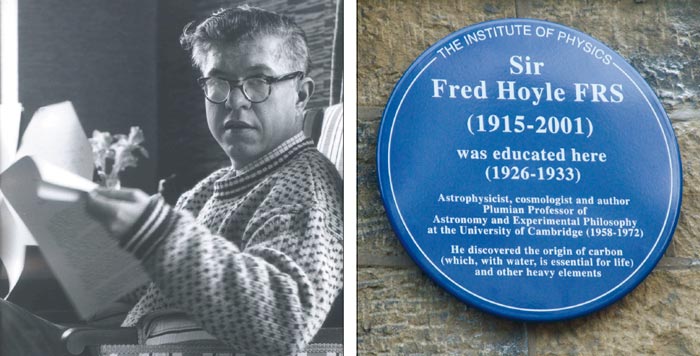
Sir Fred Hoyle The astronomer whose theories concerning the origin of elements are arguably his most lasting contributions to science and a plaque placed at his former school, Bingley Grammar School, near Bradford, by the Institute of Physics Yorkshire Branch, which mentions his achievement in discovering the origin of carbon. (Courtesy: By permission of the Master and Fellows of St John’s College, Cambridge; Richard de Grijs)
So had the carbon-production conundrum now been solved? In a way, yes – scientists could now rationalize that, via the Hoyle state, carbon can be formed fast enough to overcome the fact that beryllium-8 is so short-lived, resulting in the abundance of carbon we see around us. However, a new puzzle immediately emerged that, 60 years on, has still not been resolved. Quite simply, the Hoyle state cannot be described by any known models of atomic nuclei. Given how important carbon is for life to form, this situation is deeply unsatisfying, though it is not for want of effort. Indeed, trying to work out the precise nature of the Hoyle state remains one of the most intensive theoretical and experimental efforts in nuclear physics.
Not your normal nucleus
So what picture do we have of nuclei? Our understanding of the nucleus is underpinned by the “nuclear shell model”, which was developed in 1949 – four years before the discovery of the Hoyle state. The model, which was a triumph in our understanding of nuclear structure, says that protons and neutrons act like independent particles that fill up shells rather in the same way that electrons do in atoms, with simple nuclear states constructed from configurations of protons and neutrons in different shells. This model is remarkably successful in describing ground states and excited states, especially in light nuclei. It also does a reasonably good job of describing most of the lowest excited states in carbon-12. The nuclear shell model is, however, hopelessly inaccurate for the Hoyle state. Quite simply, none of the energy levels that the model calculates are remotely close to the energy of the Hoyle state. Indeed, there are similar states in other light nuclei where the shell model also fails badly.
But could it be that the Hoyle state is better described in terms of clusters of alpha particles rather than in terms of nucleons as independent particles? Indeed, in 1956 – only three years after the prediction and discovery of the Hoyle state – Haruhiko Morinaga, who was then at Purdue University, Indiana, conjectured that the Hoyle state could be thought of as a linear chain of three alpha particles. Similar states composed of four, five and six alpha particles, he argued, should also exist in oxygen-16, neon-20 and magnesium-24.
From the beginning, it was clear that the static, linear-chain structure proposed by Morinaga had to be a gross over-simplification. The alpha particles would have to be in continuous motion so as not to violate Heisenberg’s uncertainty principle: since they are confined within a small distance – a nucleus no larger than a few femtometres – their momentum and therefore speed must be above a certain value. The alpha particles might even exchange nucleons between one another. In other words, Morinaga’s alpha-cluster model merely represented the time-averaged picture of a dynamic system.
Our current “best understanding” is that the Hoyle state is a gas-like system of weakly interacting alpha particles that move almost freely over distances that are large on nuclear scales. Moreover, within the past decade, it has become clear that the Hoyle state is likely to exist as a superposition of states: in the same way that Schrödinger’s cat is 50% dead and 50% alive, the Hoyle state is about 70% a state of three alpha particles and 30% a shell-model-type state (in which individual nucleons fill up quantized energy levels).
The only other strong contender for a competing theory is an evolution of the alpha-cluster model in which the Hoyle state could be a Bose–Einstein condensate (BEC). This idea arises because alpha particles have zero spin, which means that they are bosons and obey Bose statistics. A system of alpha particles with a low internal temperature might therefore form a BEC, similar to the atomic condensates that are nowadays routinely made and manipulated in laboratories. This idea has attracted much attention but also faces many difficulties. Nuclear condensates, if they exist, would differ from their well-established atomic counterparts in many respects, and it is not clear how, or if, the theory of atomic condensates can be adapted to the nuclear domain.
Recent revelations
Current-day Hoyle-state physicists are trying to get to the bottom of this mystery once and for all. Theorists dream of being able to predict the properties of nuclei from first principles, which requires two ingredients: a theory of how the protons and neutrons in the nucleus interact and a method to solve the many-body Schrödinger equation numerically. The first ingredient was provided by Steven Weinberg in 1991 in the form of the “chiral effective field theory”. For many years the second ingredient seemed a distant prospect, but the enormous growth in computer power has recently allowed nuclear physicists to make some hugely exciting theoretical simulations.
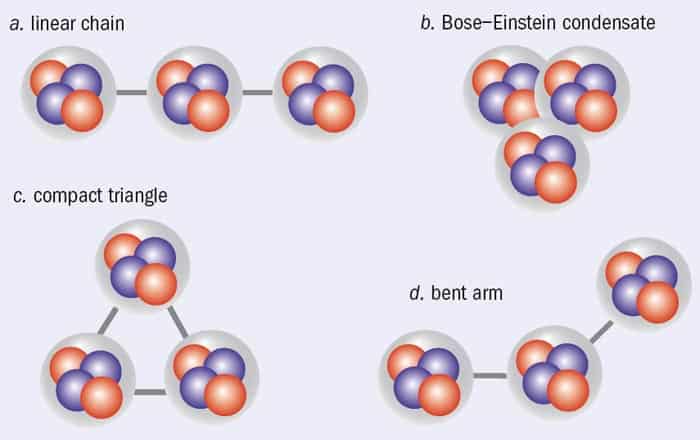
In 2011, for example, a team led by Evgeny Epelbaum, from the Institute of Theoretical Physics II at Ruhr-Universität Bochum in Germany, performed the first calculation of the Hoyle state from first principles, using a computational method known as Lattice Monte Carlo simulation and a nuclear interaction derived from quantum chromodynamics – the theory of quarks and gluons – using Weinberg’s approach. Remarkably, they found a state with zero nuclear spin and positive parity about 7 MeV above the ground state that appears to be the Hoyle state. And only a few months ago, Epelbaum and colleagues published new improved calculations for the Hoyle state (2012 Phys. Rev. Lett.109 25201) in which the alpha-cluster structure emerges naturally from their calculations rather than having to be “put in by hand” as is usually the case. According to Epelbaum’s work, the alpha particles in the ground state of carbon-12 appear to be arranged in a compact triangle, whereas in the Hoyle state, they are in a bent-arm configuration (figure 1).
1 Carbon configurations Physicists have been trying for 60 years to figure out the nuclear structure of the Hoyle state, an excited state of carbon-12. (a) The earliest model, proposed in 1956, comprises a linear chain of three alpha particles. (b) In 2001 it was suggested that the Hoyle state can be viewed as a Bose–Einstein condensate, i.e. rather than being treated as three separate entities the alpha particles are described by one single wave function. Most recently, in December 2012 the ground state and Hoyle state of carbon-12 were calculated from first principles. In the ground state the alpha particles were found to be arranged in a compact triangle (c) whereas in the Hoyle state they were in a bent-arm configuration (d). (Courtesy: IOP Publishing)
As well as advances in theory, there have been important strides in experiment. Unfortunately, as we cannot use a “nuclear microscope” that lets us see directly what is going on inside the Hoyle state, we have to rely on indirect experimental evidence of its structure. Physicists have, for example, determined the excitation energy of the Hoyle state to a precision of 0.05% and they have measured a very rare decay mechanism seen in only seven in one million decays of the Hoyle state, where it relaxes into the carbon-12 ground state by simultaneously emitting an electron and its antimatter counterpart, the positron.
Nevertheless, 60 years on from the verification of the existence of the Hoyle state, experiments are only just beginning to provide discriminating tests of its true nature. By studying its properties in detail, physicists hope to figure out if the alpha-cluster description is the best model for the Hoyle state, and if so whether the alpha particles behave like a gas or a BEC.
One promising line of experimental inquiry relates to rotational excitations of the Hoyle state. This story dates back to 1956, when Morinaga conjectured that the Hoyle state might consist of a linear chain of three alpha particles, and that – just like a chemical molecule – it should therefore be possible for this structure to rotate. If this were to happen, it would lead to a set of quantized energy levels with spin and parities of 2+, 4+, 6+, etc. The spacing of these levels is related to the moment of inertia associated with the Hoyle state, which would tell us something about how compactly the alpha particles are arranged.
This was a tangible prediction and experimentalists quickly began looking for these “rotational excitations” of the Hoyle state. Sadly, more than half a century later the search is still on – showing just how hard the task is and the importance of the result in pinning down the structure of the Hoyle state. But efforts have not been abandoned; most people think the states exist but are just incredibly difficult to identify experimentally. In fact, the search is being conducted more vigorously now than ever before, with as many as 10 experiments performed in the past decade. An important recent result has been a candidate 2+ state identified by Martin Freer of the University of Birmingham in the UK and his team in an experiment conducted at the iThemba Laboratory for Accelerator-Based Sciences in South Africa.
A second strand of experimental endeavour has been to study the break-up of the Hoyle state into its constituent alpha particles. Recently, one of us (OK) led an experiment to scrutinize the break-up mechanism. It was already known that the Hoyle state preferentially decays to the ground state of beryllium-8, which subsequently breaks up into two alpha particles. We wanted to see if, on rare occasions, the decay to three alpha particles would proceed differently, bypassing the ground state of beryllium-8. We found that, at least 99.5% of the time, the Hoyle state decays via the ground state of beryllium-8. If an experiment with higher sensitivity could be designed, it might be possible to discover other, very rare, decay mechanisms. This could shed light on the current controversy regarding the nature of the Hoyle state – BEC or “ordinary” alpha-particle gas?
Understanding the origin and structure of the Hoyle state continues to pose a strong challenge to theory and attracts considerable experimental efforts. At last year’s international Cluster12 nuclear-physics conference, for instance, discussion of the nature of the Hoyle state was a major focus of the meeting and dominated the first day. Curiosity still abounds 60 years on from Fred Hoyle’s prediction of his eponymous nuclear state, as we strive to finally understand how carbon, and thus life, came to be.
Anthropic musings
Were it not for a particular excited state of the carbon-12 nucleus known as the Hoyle state, the universe would look very different. In particular, there would be essentially no carbon and hence life as we know it would not have evolved, nor would other heavy elements exist. In hindsight, it is remarkable that the laws of nature have conspired to create an excited state in carbon-12 that allows carbon to be produced in significant quantities in stars.
Some people have discussed this situation in terms of the anthropic principle. This is the point of view that the physical parameters of the observed universe must be compatible with our existence as conscious observers; if the physical parameters had been different in a way that prevented life from forming, we simply would not be around in order to measure them.
The situation becomes more remarkable still when one considers that the rate at which three alpha particles fuse into carbon is incredibly sensitive to the energy of the Hoyle state. The Hoyle state is 7.65 MeV above the ground state of carbon-12, but if it were a mere 0.06 MeV more or less, the abundance of carbon in our universe would be very different.
In 2010 Sylvia Ekström, an astrophysicist at the Observatory of Geneva, and colleagues used this property of the Hoyle state to test whether the strengths of electromagnetic and nuclear interactions might vary in time and space, rather than be constant as assumed. Ekström and her team observed abundances of carbon and oxygen on the surfaces of very old stars in the galactic halo, which were formed from interstellar dust only 200–300 million years after the Big Bang. This allowed them to determine by how much the energy of the Hoyle state could have been different back then. Since the energy of the Hoyle state ultimately depends on the interplay between the electromagnetic and nuclear interactions, they were able to relate this to a change in the interaction strengths. Their conclusion: there is no evidence that the strengths of the electromagnetic and nuclear interactions were any different in the early universe, and the most they can have changed by is 0.001% and 0.1%, respectively.
Cellular communication networks can be used to accurately predict large-scale rainfall distribution patterns in real time, according to researchers in the Netherlands. The team created rainfall maps for the whole of the Netherlands by using data from a mobile network in the country. This was based on measurements of the attenuation of microwave signal levels across 2400 network links over a four-month period. The resulting maps had a strong correlation with the same measurements taken by the conventional techniques of weather radar and rain gauges.
Predicting precipitation
The research was carried out by Aart Overeem and colleagues, from both Wageningen University and the Royal Netherlands Meteorological Institute. “Microwave links are used in telecommunication networks to transmit signals from the antenna of one telephone tower to the antenna of another telephone tower,” says Overeem, who led the study. “When it rains the signal is attenuated, which is noticed as a decrease of the received power measured by these telephone towers. The average rainfall intensity…can be computed from the decrease in power during rainy periods with respect to the power during dry periods.”
The team looked at the minimum and maximum received signal power at each telephone tower over 15 minute periods. Passing through falling raindrops absorbs part of the incident microwave transmission and causes minor beam scattering, lowering the power that ultimately reaches the receiving tower. The more raindrops in the beam’s path – or the larger the drops are – the more signal power is lost.
By comparing received powers for each network link with reference values for known dry periods – and factoring in accounts for humidity and the water films that can develop on the communications antennae – rainfall densities along each path can be calculated. These values are then treated as point measurements at the centre of each network link and used to extrapolate the larger rain distribution maps. In the frequencies employed in these links, attenuation caused by raindrops is the main source of power reductions, beyond free space losses. Typically, the microwave network links operate at least 10 m off the ground and use frequencies between 13 and 40 GHz.
Reasons for rain reporting
Measurements of precipitation rates are essential for agriculture, weather forecasting and the management of water resources and, in the long run, for climate-based studies. Also, rapid rain reporting can be vital in minimizing the loss of life in flood-prone regions. The researchers point out that their new technique is based on measurements that telecommunication companies often already take to monitor the stability of the microwave links in their networks. The team suggests that this approach – using pre-existing resources – could thus help to ease the reliance on the rapidly falling number of rain gauges worldwide.
It is estimated that the total number of rain gauges in Europe, Africa and South America has fallen by around 50% in the last 17 years. In contrast, the spread of mobile networks continues to increase and, while they are more comprehensive in urban areas, it was estimated that in 2007 they covered around 20% of the land-based surface of the earth.
Scarcity of measurements
“More than 25 years ago it was estimated that if you put all the world’s rain gauges together in a single place they would barely fill a football pitch,” explains Dominic Kniveton, a professor of climate science at the University of Sussex. He goes on to say that globally, the area covered by surface-based rainfall radar measurements would only be approximately 4%. “I can confidently state that little has changed since in this scarcity of measurements: this remains one of the major challenges to providing high-quality climate services.”
Kniveton told physicsworld.com that “the technique shown by Overeem et al. presents an exciting addition to efforts to measure rainfall. By virtue of coming from the cellular-phone networks these measurements potentially can be harnessed using fast hydrological models. With such techniques, and the rise of mobile networks, this opens a range of possibilities to help build the resilience of many to increasing climatic hazards with climate change”.
In addition, weather radar readings are often fine-tuned using local readings from gauges. This is especially useful at greater distances from the radar. In countries where radar is frequently used, communications network data thus have the potential to be combined with radar measurements for increased accuracy.
The team is to continue its research, Overeem reports. Future work aims to improve on the algorithms used to calculate the rainfall distribution by looking at communications network data over longer periods, such as across one whole year.
Physicists in the UK have come up with a new way of storing a handful of photons in an ultracold atomic gas, in which strong interactions between neighbouring photons can be switched on and off using microwaves. The team believes that the technique could be used to create optical logic gates in which single photons could be processed one at a time. The method could also prove useful for connecting quantum-computing devices based on different technologies.
Optical photons make very good “flying” quantum bits (qubits) because they can travel hundreds of kilometres through fibres without losing their quantum information. However, it is very difficult to get such photons to interact either with each other or with “stationary” qubits such as those based on trapped ions or tiny pieces of superconductor. Exchanging quantum information between such devices can therefore be tricky.
What Charles Adams and colleagues at Durham University have now done is come up with a way of storing individual optical photons in highly excited states of an atomic gas. Once stored, the photons can be made to interact strongly, before being released again. An important feature of the technique is that it uses microwaves, which are also used to control some types of stationary qubit.
Rydberg polaritons
The Durham experiment involves holding up to 100 rubidium atoms in an optical trap created at the focus of a laser beam, before two pulses of light are fired at the trapped atoms. One pulse is “signal” light that is to be stored and the other is “control” light. The control light allows 10 or so neighbouring rubidium atoms to absorb a signal photon, creating a collective state called a “Rydberg polariton”. Such a state is similar to that of a Rydberg atom, which has an electron in a highly excited state – in this case, with a principal quantum number of 60.
When the control pulse is switched off, the photon remains “stored” in a Rydberg polariton for as long as 1 μs. But if the control light is switched on again, the Rydberg polariton is converted back into light, re-emitting the photon that it had held.
Adams told physicsworld.com that the team used Rydberg polaritons – rather than Rydberg atoms – because there is strong coupling between a photon and a Rydberg polariton. This is because the polariton contains many atoms rather than just one. It is therefore much more likely that the photon will be captured and stored in their set-up. Another benefit of a Rydberg polariton is that it will only absorb one photon – and no more.
Micro-spheres in a row
Each Rydberg polariton can be thought of as a 7 μm diameter sphere. The atomic cloud, meanwhile, is only about 30 μm long and has a diameter of about 6 μm – which means that it contains a line of about three Rydberg polaritons in a row. In practice, however, not all of these polaritons will contain a photon, and photons are able to hop between the polaritons. Adams explains that in this case, photons can be lost and are therefore not recovered when the control pulse is switched on again.
However, if a microwave signal is applied to the cloud it creates an interaction between neighbouring polaritons that prevents hopping from occurring – and therefore photons are not lost but rather are recovered when the control pulse is switched back on.
Next step, logic gates
The team believes that this ability to control interactions between adjacent polaritons could be used to create logic gates for single photons. Instead of making three polaritons in a row, this could involve making a Y-shaped junction in which the output of one polariton would be determined by the presence of absence of photons in the other two polaritons.
According to Adams, this would require a new experimental set-up with two focused laser beams and a larger atom cloud – something that the team is looking at creating.
Alex Kuzmich of the Georgia Institute of Technology in the US says that the Durham team’s ability to create strong interactions between single photons makes the work “an important advance”. He adds that the research “breaks new ground on the way towards realization of quantum logic for photons”.
The experiment will be described in an upcoming issue of Physical Review Letters and a preprint is available on arXiv.
Nobel laureate Steven Chu has announced he is to resign as US energy secretary. (Courtesy: DOE)
The Nobel laureate Steven Chu has announced he is to resign as US energy secretary. When Chu departs, most likely at the end of February, he will have served in the post for four years – longer than any of the 14 previous heads of the Department of Energy (DOE). Chu now plans to return to “an academic life of teaching and research” in California.
Politically independent, Chu received plaudits from Democrats and environmentalists during his time in office, which spanned the whole of US President Barack Obama’s first term in office beginning in 2008. “Steve helped my administration move America towards real energy independence,” Obama said in a statement. “Over the past four years we have doubled the use of renewable energy, reduced our dependence on foreign oil and put our country on a path to win the global race for clean-energy jobs.”
In a letter to DOE staff, Chu noted his successes in office, such as funding the Advanced Research Projects Agency-Energy (ARPA-E) – a programme to promote and fund research and development into advanced energy technologies. The agency’s work in areas such as improving batteries for electric vehicles and developing manufacturing technologies for solar cells has drawn plaudits across the board.
Chu also played a key role in overseeing efforts to cap the oil spill from BP’s Macondo well in the Gulf of Mexico, while the physicist’s “SunShot initiative” – an effort to increase US use of renewable-energy technologies – began progress towards a goal of reducing the cost of solar power to $1 per watt. “Secretary Chu has led the energy department at a time when our nation made the single largest investment ever in clean energy and doubled our use of renewables,” stated Gene Karpinski, president of the League of Conservation Voters.
In his stint as energy secretary, Chu also worked hard to break down the traditional walls between basic and applied science. “He had a substantial impact on changing research in the department, although mainly in terms of applied research,” Robert McKeown, deputy director for science at the Thomas Jefferson National Accelerator Facility, told physicsworld.com.
Facing the critics
Yet Chu also became a controversial figure, facing heavy criticism from Republicans, deniers of climate change and some members of the business community. Critics focused on occasional failures of Chu’s initiatives, such as Solyndra – a solar-cell manufacturer that went bankrupt after receiving $535m in DOE loan guarantees – as well as A-123 Systems, an innovative battery maker that went bust before being rescued by a Chinese conglomerate.
Daniel Kish, senior vice-president of the Institute for Energy Research, a Washington DC-based non-profit corporation, asserted that the emphasis on renewables has cost jobs. “The policies and priorities of Chu’s energy department have benefited our global competitors and intensified the economic pain felt by millions of unemployed Americans,” he says.
Chu responded to those criticisms in his letter to DOE’s employees. “The truth is that only 1% of the companies we funded went bankrupt,” he noted. “The test for America’s policy makers will be whether they are willing to accept a few failures in exchange for many successes.”
Early speculation on the Obama administration’s nomination of Chu’s successor focuses on former governors, including the Democrats Bill Ritter of Colorado, Jennifer Granholm of Michigan and Chris Gregoire of Washington state. Yet there is a possibility that Chu’s successor will be another scientist: theoretical physicist Ernest Moniz of the Massachusetts Institute of Technology, who served as undersecretary of energy for former US president Bill Clinton.
Magnetic-resonance-imaging technology has been shrunk to the nanoscale by two independent teams of researchers, so that molecular samples just a few cubic nanometres in volume can now be detected and imaged at room temperature. Both groups used nitrogen-vacancy defects in diamonds as magnetic-field sensors to probe such minute samples. The research could be the first step towards complete 3D molecular-scale magnetic resonance imaging (MRI) and nuclear magnetic resonance (NMR).
Classic images
Classical MRI and its related chemical-diagnostic technique NMR are useful tools as they can be used to study samples and even living organisms non-invasively. However, once a sample is smaller than, say, a few microns, the technique does not have the required sensitivity to work well. This is because a part of the apparatus – the antenna or the magnetic induction coil – that collects the magnetic signal from the sample being measured cannot be made any smaller than a few microns, and so it cannot pick up a signal from tiny volumes. Other methods, such as magnetic resonance force microscopy (MRFM), have been developed to image on very small scales but these only work at ultralow temperatures and so cannot be used outside the lab in an ambient environment.
The new method uses nitrogen vacancy (NV) defects, which occur when two neighbouring carbon atoms in diamonds are replaced by a nitrogen atom and an empty lattice site. NV sites are capable of detecting the very weak oscillatory magnetic fields that come from the spins of protons in a sample.
Defects and vacancies
Tobias Staudacher and Friedemann Reinhard of the University of Stuttgart, Germany, and colleagues used these NV defects to record the NMR spectra of various materials that they placed on the surface of a diamond. First the team embedded a single NV defect 7 nm under the surface of the diamond. “On a quantum level, our NV is in a two-spin state – a bright and dark fluorescence. So we set up a very basic quantum algorithm or protocol – the spin flips from bright to dark only if it detects the proton’s oscillations, and we can detect this with a photodiode or camera,” explains Reinhard. The team used this method to detect the proton spins of a number of liquid and solid samples placed on the diamond’s surface.
To build up an actual 3D image on the nanoscale, however, the sample would somehow need to be moved; but as the current method involves placing it on the diamond surface, this is not possible. Instead, Reinhard and his team are currently developing a diamond (with an NV defect) atomic force microscope (AFM) tip that could be used like a scanning device to image a sample in full 3D. “We are quite optimistic about this method and have been building this device for a while now,” says Reinhard.
He also points out that while being able to carry out the procedure at room temperature is a huge advantage, the team will also build some units of the diamond AFM device for low-temperature studies. He tells physicsworld.com that many samples, such as proteins, need low temperatures during imaging as they “move and shake too much at room temperature, so freezing them would give a more accurate image”.
Diverse applications
Reinhard claims that apart from the most basic application – being able to resolve a single atom at room temperature – in the future the method could have many other applications. He claims that the technique could help solid-state researchers and the nanotechnology community image their tiny devices, where “each atom in a device matters”. Currently, nanotechnology researchers can only image the surface of their devices. “Using this technique, they could selectively and chemically image below the surface,” says Reinhard.
Another potential application of the method includes using it as a polarizing agent for traditional NMR. This would involve polarizing the NV defect and transferring this polarization from the defect to the sample.
The method could also be applied to quantum information storage – single spins have been stored and then recovered from an NV, providing a way to store information in a quantum computer.
Manipulative measurements
The other group included Dan Rugar and John Mamin of the IBM Research Division in California, US, and colleagues. The researchers also used NVs in a diamond, just under its surface; however, their sample was not on the diamond surface itself but placed next to it. Their sample was an organic polymer. They manipulate the electron-spin echoes on the NV defects as well as the sample’s spin with an additional radio-frequency field to manipulate the electrons in the hydrogen atoms in the sample. The team believes that the sensitivity of the technique could, someday, even allow single protons to be resolved.
Bubbles are wonderful things – as well as giving children hours of fun, they provide physicists with a number of fascinating phenomena to study and genuine mysteries to solve.
One curious effect that physicists have known about for some time is that tiny air bubbles in water will last much longer when they are stuck on a surface – rather than floating freely. A free bubble with a diameter of 100 nm or less will only survive a few microseconds, while a bubble of similar size on a surface can endure for days.
Why is this interesting, you might wonder? For one thing, controlling nanobubbles can be very important when designing tiny machines that shift fluids about. A coating of nanobubbles could make it easier for a fluid to flow along a tiny channel. Conversely, bubbles in the wrong place could gum up the works. Nanobubbles could someday be designed to carry drugs to specific places in the body, popping on arrival.
It’s the first of the month so – as if by clockwork – the February issue of Physics World is now ready for your enjoyment, in print, online and through our apps.
Our lead news story this month is about how Barack Obama, who was sworn in for a second term as US president last month, deals with the US “fiscal cliff” and what impact any resolution has on funding for science.
Elsewhere, we examine the lasting impact of two famous astronomers – Fred Hoyle and Sir Bernard Lovell. The former’s impact is felt most acutely in the “Hoyle state” – a short-lived excited form of carbon-12 that holds the clue to life in the universe but is still baffling today’s best nuclear physicists. As for Lovell, his notorious visits to the Soviet Union in the 1960s at the height of the Cold War might have been frowned upon by authorities in the West, but they set the tone for international collaboration and helped to pave the way to today’s ITER fusion experiment.
There’s also a great feature on how researchers are gaining valuable information about the black hole Cygnus X-1. Plus don’t miss Peter Kenny’s lateral thoughts about the mysteries of mathematical subtraction and find out why friends hold the key to career success.
Physics for leisure: Just how many popcorn kernels would it take to fill a cinema? Lawrence Weinstein’s Guesstimation 2.0 has the answer to this and dozens more factoid challenges. (Courtesy: iStockphoto/Gustaf Brundin)
Go on – guess!
For many of us in the Physics World office, the chief attraction of stumbling across an intriguing numerical factoid – the total energy required to air-freight a tonne of oranges across the US, say – is that it immediately turns into a guessing game, as we invite colleagues and friends to estimate the correct answer. If you are also partial to this kind of quick calculation, then you will surely enjoy Guesstimation 2.0: Solving Today’s Problems on the Back of a Napkin. Written by Lawrence Weinstein, an experimental nuclear physicist from Old Dominion University in Virginia, it treads the same path as his earlier book Guesstimation (see July 2008 p43). In the current volume, Weinstein poses a series of 70 or so numerical questions and invites the reader to make an educated guess at the answer – with help, if needed, from some gentle hints. Questions range from the simple (What is the total length of toilet roll used in the US each year? How many popcorn kernels would it take to fill a cinema?) to the complex, such as comparing the energy efficiencies of different forms of lighting. Weinstein does an admirable job of giving full and clear answers, always concentrating on making sensible estimates rather than striving for absolute precision. The final chapters of the book contain some quite advanced questions that will test even seasoned physicists. How closely, for example, could we safely orbit a neutron star if we considered only gravitational effects? (About 1000 km.) And what must the minimum possible lifetime of the proton be, such that radiation from proton decay will not kill us? (Some 1017 years.) Weinstein’s strong US-centrism and fondness for footnotes aside, this book will be perfect for all physicists wanting to give their minds a good workout.
2012 Princeton University Press £13.95/$19.95pb 377pp
A celebration of physics
So you want a popular-science book that encompasses our entire state of knowledge of fundamental physics, is technically correct yet also short and easy to read? Then The Universe Within by Neil Turok, director of the Perimeter Institute for Theoretical Physics in Waterloo, Canada, is for you. Based on the Massey Lectures that Turok gave in November 2012 on CBC Radio, the book races through the “standard history” of physics – from ancient Greek scholars to Einstein – before romping through quantum theory, cosmology and recent attempts to unify physics. It is all familiar territory, but whereas lesser authors might have got bogged down in details, Turok stays lucidly on track, drawing on his own experiences at Princeton University, Imperial College London and the University of Cambridge, collaborating with the likes of Stephen Hawking. The technical level is nicely consistent – there are no wild lurches up or down – and Turok’s prose is measured and even. However, the final chapter, which seeks to remind us of the power of scientific thought in tackling society’s ills, is a rather curious affair. Its strange conclusion – if there is one – is that we face a bright future because humans will derive “great mutual benefit” from quantum computers as both are analogue devices. (Classical computers, in contrast, provide digital information – which, Turok claims, is “evolutionarily regressive” for some reason.) The last chapter also has a few silly errors – South Africa didn’t “win the competition” to host the Square Kilometre Array (it will host the radio telescope jointly with Australia), while Paul Dirac studied engineering at the University of Bristol, not Cambridge. Unfocused ending aside, the rest of the book is first rate and highly recommended.
2012 Anansi £9.96/$15.95pb 294pp
Rolling in the deep
Most of us have been to the beach and seen waves rolling up the shore line. We may even have idly wondered where such waves come from, how they form and how they travel. But how much do we really know of the science behind their evolution? In Waves, author Fredric Raichlen takes an in-depth look at all of these topics, flowing easily from the mechanics of how water waves are born, through the way currents travel across the Earth, to the effects of wind, astronomical tides and the formation of tsunamis and hurricanes. An expert on coastal engineering and wave mechanics at the California Institute of Technology, Raichlen was inspired to write the book after recalling the questions his sons asked him about waves as they sat on a beach many years ago. A compilation of the answers would, he decided, help others with similar queries. The book is interspersed with interesting titbits, such as the fact that tsunami waves – the lengths of which are typically about 100 times their depth – travel at average speeds of “about 700 km per hour – the speed of a jet plane”, which is a neat way of conveying their might and destructive power. Later in the book, Raichlen also explains how a ship 300 m in length can be displaced by the action of waves that may be less than 1 m high – even to the point where the lines mooring it to a dock can be snapped by the wave action. However, the book is quite technical in its content, with a fair number of formulae and graphs. The language is also rather formal, making Waves feel like a textbook despite its slick cover and handy “pocket book” size. But if you want a quick reference guide to the nitty-gritty of water waves rather than a casual beachside read, this could be a handy addition to your bookshelf.
People can simultaneously identify the pitch and timing of a sound signal much more precisely than allowed by conventional linear analysis. That is the conclusion of a study of human subjects done by physicists in the US. The findings are not just of theoretical interest but could potentially lead to better software for speech recognition and sonar.
Human hearing is remarkably good at isolating sounds, allowing us to pick out individual voices in a crowded room, for example. However, the neural algorithms that our brains use to analyse sound are still not properly understood. Most researchers had assumed that the brain decomposes the signals and treats them as the sum of their parts – a process that can be likened to Fourier analysis, which decomposes an arbitrary waveform into pure sine waves.
However, the information available from Fourier analysis is bound by an uncertainty relation called the Gabor limit. This says that you cannot know the timing of a sound and its frequency – or pitch – beyond a certain degree of accuracy. The more accurate the measurement of the timing of a sound, the less accurate the measurement of its pitch and vice versa.
Getting around Gabor
Unlike the Heisenberg uncertainty principle, the Gabor limit is not an intrinsic property of the signal but is a result of the method used to analyse it. If you can find a way to analyse a complex waveform without decomposing it into sine waves, you can in theory track the frequency at a particular time to much greater accuracy. However, whatever analytical technique you choose must be nonlinear because any technique that represents the waveform as a sum of simpler waveforms will be bound by the Gabor limit.
Researchers such as Brian Moore at the University of Cambridge first showed, in the 1970s, that the human auditory system could beat the Gabor limit, implying the brain could perform some kind of nonlinear analysis of the signals that it received from the ear. However, this work was not picked up by the broader scientific community, partly because cochlear processes were not then understood.
Pitch and timing
In this latest study, Jacob Oppenheim and Marcelo Magnasco of Rockefeller University gave volunteers a series of tasks in order to determine precisely how sensitive humans are to the pitch and timing of sounds. One test involved playing two notes widely spaced in time but at the same pitch. In-between the two, they were played a third note, and they were asked to identify whether it was slightly higher or slightly lower than the other two. In another, the subjects were played two notes widely spaced in pitch almost simultaneously: they were then asked whether the higher or the lower one had been played first.
The final test combined the first two tasks: a low note was played followed by a high note. At almost the same time as the high note was played, a third note was played at almost the same pitch as the low note, and the volunteers were asked whether it was pitched above or below the low note and whether it was before or after the high note.
Oppenheim and Magnasco discovered that the accuracy with which the volunteers determined pitch and timing simultaneously was usually much better, on average, than the Gabor limit. In one case, subjects beat the Gabor limit for the product of frequency and time uncertainty by a factor of 50, clearly implying their brains were using a nonlinear algorithm.
Highly nonlinear hearing
“In signal processing, there are a very large number of time–frequency distributions that have been proposed in order to analyse these signals,” says Magnasco. “The question is, since there are very many different ways in which you can do this and only the highly nonlinear ways can offer performance comparable to what humans do, which one of these is in the same family as what the brain does?”
Mike Lewicki, a computational neuroscientist at Case Western Reserve University in Ohio, says the research is “a nice demonstration that our perceptual system is doing complex things – which, of course, people have always known – but this is a nice quantitative demonstration by which, even at the most basic level, using the most straightforward stimuli, you can demonstrate that the auditory system is doing something quite remarkable”.