In their 2010 book The Grand Design, Stephen Hawking and Leonard Mlodinow expressed the opinion that philosophy was dead as a useful vocation – and that it was now scientists who must address the big questions such as “How was the universe created?”.
Of course this is not the first time that scientists – primed by the many triumphs of their craft, particularly in the last few centuries – have put down philosophy, and the debate about its usefulness will continue.
A recent instalment pits the biologist Lewis Wolpert of University College London against Steve Fuller, who is a philosopher at the University of Warwick. It was organized by the Institute of Art and Ideas (IAI) and you can watch it on the IAI’s video website. Also sticking his oar in on the side of philosophy is Jonathan Derbyshire, who is culture editor of the New Statesman. You can watch the debate here.
In this week’s Facebook poll we are asking which side of the fence you sit on – Hawking’s or the philosophers’.
Has today’s science rendered philosophy obsolete?
Yes No
Let us know by visiting our Facebook page, and as always please feel free to post a comment to explain your answer.
In last week’s poll we asked what many would consider a philosophical question: In your interpretation of quantum physics, do objects have their properties well defined prior to and independent of measurement?
64% of you answered no – and when the same question was put in 2011 to professional physicists who study quantum theory, the result was 48%. The most popular response then was “yes in some cases”, which garnered 52% of the vote. In our poll, by contrast, only 18% went for that option.
Aaron Swartz at a Creative Commons event. (CC BY Fred Benenson)
It’s surprising the little nuggets of information that come our way here in the Physics World office.
A couple of weeks back, for example, we received an e-mail from Paul Ginsparg, the Cornell University physicist who set up the now-ubiquitous arXiv preprint server more than 20 years ago.
Ginsparg had written a great article for us back in 2008, when Physics World celebrated its 20th anniversary, in which he reflected on the early days of the Web and examined how it has changed scientific communication.
At one point in that article, Ginsparg discussed the growing influence of blogs, describing how he watched someone at a scientific seminar blogging with seemingly expert ease.
“Glancing over my shoulder”, Ginsparg wrote, “I was struck by how a native laptop-user can navigate text and search windows faster than the eye can follow, and assemble references, photos and graphics from multiple sources, simultaneously replying to comments, and in the end spending far less time to assemble a set of useful pedagogic pages, accessible to the entire world, than I spend writing problem-set solutions for a small class.”
Ginsparg did not realize at the time who the person in question was, but he has now discovered that the mystery blogger was in fact the Internet activist and open-access advocate Aaron Swartz. Swartz had been arrested by US federal authorities in 2011 in connection with systematic downloading of journal papers form the JSTOR database and was tragically found hanged in his Brooklyn apartment on 11 January this year.
Ginsparg had been reading reports about Swartz’s death and realized, from photos of the SciFoo 2007 meeting, that Swartz was the person who had been “sitting next to me…blogging with unforgettable skill”.
“I didn’t know who he was,” Ginsparg wrote in an e-mail to me, “having missed introductions because I was going back and forth between sessions, and never did get to talk to him at all. [It was a] missed opportunity and only now I learn he was not the typical generic 20-something blogger as assumed. Oddly enough, 5.5 years later I see the precise text I’d presumably described him writing preserved here
You can read more about the meeting in this blog entry by the science writer George Dyson.
“It was the morning of my hundredth birthday. I shaved the final mirror-disc of old tired face under the merciless glare of the bathroom lighting. It was all very well telling oneself that Humphrey Bogart had that sort of face; but he also had a hairpiece, half a million dollars a year and a stand-in for the rough bits. I dabbed a soda-stick at the razor nicks. In the magnifying mirror it looked like a white rocket landing on the uncharted side of the moon.”
Len Deighton’s classic novel Billion Dollar Brain was written in 1966. It captures perfectly the cloying fug of Cold War paranoia that infected the childhood of anyone older than the age of 40 today. The knowledge that, at any given moment, serried ranks of silos from Sverdlovsk to South Dakota were poised to spew forth missiles that would reduce Europe to a radioactive wasteland was a dreary undercurrent to life in the 1960s.
And then there was television, which featured a steady diet of spy thrillers gleefully highlighting one horror after another: smallpox viruses carried in hen eggs; secret biomedical research complexes in the back-woods of Siberia ready to brainwash kidnapped American soldiers; computers primed to seize control of the nuclear trigger at a second’s notice and cut their human makers out of the decision loop. All of it provided the two subtexts that defined the Cold War: science and technology.
So how close were these fictional accounts to the truth? A fascinating insight into the reality of the situation comes from the diaries of the celebrated astronomer Sir Bernard Lovell, who died last August aged 98. He had transferred most of his papers to the University of Manchester several years before his death, but felt that some parts relating to his scientific links with the Soviet Union in the 1960s were still sensitive and instructed they remain closed during his lifetime. Those sections – now released by the university – reveal Lovell’s deep commitment to international research collaboration, even in the face of stupendous barriers erected by the combatants in the Cold War.
A Lovell playing field
Having worked tirelessly through the late 1940s and 1950s setting up a radio-telescope facility at Jodrell Bank in rural Cheshire, Lovell had spent three weeks in the summer of 1963 travelling in the Soviet Union. While international scientific collaboration is an everyday occurrence in the 21st century, Lovell’s trip beyond the Iron Curtain was an unusual affair at the time of the Cold War. Coming just eight months after the Cuban Missile Crisis – the closest the world has ever got to outright global thermonuclear war – the visit was perhaps an unlikely one for such a leading scientific figure. But Lovell was passionate in his pursuit of scientific understanding and was happy to accept his invitation from the Soviet Academy of Sciences.
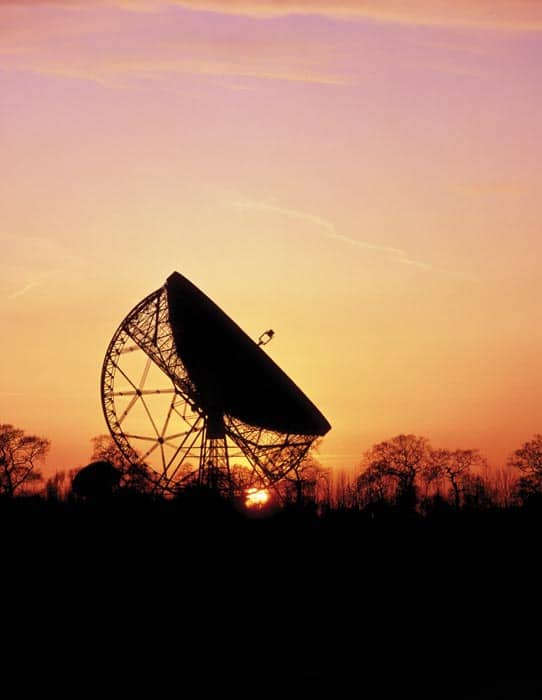
Visionary thinker Sir Bernard Lovell, shown here in the control room of the 75 m Mark 1 radio telescope at Jodrell Bank, was for a short while in the front line of the West’s nuclear defence against the Soviet Union, yet he fervently believed in the collaborative nature of science. (Courtesy: Jodrell Bank/Science Photo Library)
Yet Lovell’s visit affected more than just science, for he had played, perhaps rather unexpectedly, a key role in the Cuban crisis. In 1962 Lovell had been told that, according to British intelligence, the Soviets had mobile intercontinental ballistic missile launchers targeted on London and that there was a seven-minute window between launch and the arrival of the missiles. With the Royal Air Force’s primary missile-defence warning system at Fylingdales in Yorkshire over-budget and overdue as a result of strike action, Lovell was asked by military officials if Jodrell Bank was technically able to detect the launch of the missiles. He replied that it was, but after wondering aloud how helpful any such advance notice would be, Lovell was informed that a seven-minute warning would achieve a lot, giving Britain crucial time to launch fighter planes and mount a retaliatory strikeback. “At least a million people in London could be saved and the Bomber Force could be scrambled,” he was told.
And so – throughout much of 1962 and on into 1963 – Jodrell Bank became Britain’s early-warning system in the event of a sneak attack by the Soviet Union. The telescope was simply the only instrument in the West that could detect the launch of nuclear missiles from the USSR and there were good reasons to be optimistic about Jodrell’s far-seeing eye. In April 1957 it had been the only ground-based facility in the world that could locate the rocket that the Soviets had used to launch Sputnik 1. In 1958 it had been the telescope that tracked America’s first satellite, Explorer 1. Such was the importance of the telescope that a special telephone with a distinctively coloured green handset was even installed in Lovell’s home to allow Britain’s Chief of the Air Staff to tell Lovell if an attack was imminent and to hand the telescope over to the RAF officers whom he had personally trained to detect launches.
And yet, Lovell’s posting as point man on the front line of the West’s nuclear defence hid another side of his character – his fervent belief in the collaborative nature of science. Throughout the late 1950s and on into the 1960s, Lovell was a regular host to Soviet guests who would come to work at Jodrell Bank and stay in the nearby family home at Swettenham in Cheshire. Slumbering among the grassy knolls and sleepy copses of north-west England, Jodrell Bank proved to be the unlikely location where western and eastern bloc science met. And contrary to the Cold War techno-thrillers being written at the time, nobody batted an eyelid. If anything, the British government thought Lovell’s planned trip to the USSR might be a good way of extracting information from the Soviets.
The Eupatoria enigma
Lovell’s visit to the USSR in 1963 was not his first journey beyond the Iron Curtain. He had been there five years previously and was to travel there again in 1975 and 1976. It is quite clear from his diaries of these trips that Lovell was well treated when in the hands of his scientific hosts. As Lovell happily confided to his 1963 notebook, “The president [of the Soviet Academy of Sciences] said that a country’s scientific effort was a most significant contribution to the standing of a country in the eyes of other nations. He was good enough to illustrate this by pointing out that Jodrell had enormously contributed and added to the prestige of the UK in the USSR.”
All of Lovell’s trips were devoted to the development of collaborative interactions between the two countries. However, there is an enigma surrounding his 1963 visit to the city of Eupatoria on the Black Sea coast. In a last-minute addition to an already busy scientific tour, Lovell was taken to see the Soviet Union’s new radio-telescope and space-tracking facility in the Crimea. It included a powerful radar transmitter for contacting space probes that was never operated at an elevation of less than 15° because of “the intense beam of radiation being a danger to human beings”, as Lovell later termed it.
Watchful eye In 1962 and 1963 the Lovell Radio Telescope at Jodrell Bank in Cheshire, UK, was the only instrument in the West that could detect the launch of nuclear missiles from the Soviet Union. (Courtesy: Martin Bond/Science Photo Library)
Lovell was deeply impressed by the sophistication of the technology and, on his return to Moscow, was quizzed about his plans for the development of a larger telescope at Jodrell Bank. As Lovell wrote in a 2008 memorandum that was released last year alongside the diaries of his trip, the Soviets made it clear to him that if he elected to stay in the USSR and build the facility there, then they would give him the money. Such an offer was not, however, the flattering trans-national intellectual poaching it would be considered nowadays. After all, there was still a Cold War on. Lovell’s reply was immediate and unambiguous: “I am an Englishman and I wish to remain in England.”
On Monday 15 July 1963 Lovell flew back to Britain. But after arriving back in Swettenham, he became unwell and remained under the weather for some weeks. “It was as though all life had suddenly turned to dust and ashes,” Lovell wrote in his 2008 memorandum. “The family could do nothing for me nor the doctors”. Lovell recovered only after joining his daughter Susan and son-in-law John on a holiday in Ireland, which restored him to his normal robust health. “At dawn with the boat sailing up the river to Cork I suddenly began to feel normal,” he wrote.
So what are we to make of his sudden illness?
When Lovell was debriefed by the Ministry of Defence in the months after his recovery, he was told that the illness might have been caused by a Soviet attempt to remove his memory of the recruitment offer and what he had seen at the Eupatoria facility. The method used, the unnamed official speculated, had been radiation. When this story was originally told in 1984 by Lovell and his biographer Dudley Saward, “radiation” was widely interpreted to mean ionizing radiation. But the Jodrell Bank astronomer Tim O’Brien, who is also the observatory’s public-relations officer, says that what was really meant was simply “electromagnetic radiation”.
Although O’Brien admits that no-one knows whether the Soviets really did try to brainwash Lovell, his son Bryan favours a more mundane explanation. “My father was so tired that his mighty constitution took quite a while to recover; he needed a holiday,” he told Physics World. Referring to the “huge load” his father had borne in completing his telescope, Bryan Lovell thinks that the added responsibility of it playing a key military role, coupled with his Russian visit, had simply taken a toll. “For me the more likely explanation is that father was simply exhausted – and that gels with the account that he wrote in the contemporaneous diary of the 1963 trip, in which you will find nothing untoward, but plenty of fascinating science.”
On 9 August 1963 an important part of Lovell’s secret burden was lifted when he was flown by the RAF to Fylingdales as part of a handover of early-warning responsibilities that took place that autumn. From then on, if he looked east, he could give his undistracted attention to collaboration with his Soviet colleagues and friends – and deal purely with astronomy matters.
Fusing relations
One person who agrees that Lovell was unlikely to have been brainwashed is Mike Forrest, a physicist who collaborated with scientists from the Soviet Union on nuclear fusion during the Cold War. “It just flies in the face of my experience of working with the Russians,” recalls Forrest, who at the time was based at the UK Atomic Energy Authority’s laboratory in Culham, Oxfordshire. In the 1960s the lab led the country’s efforts in studying potential practical applications of fusion power, including its use as a possible source of cheap, plentiful and clean energy – the philosopher’s stone of energy production.
Lovell was impressed by the Soviets’ technology and they made it clear that if he elected to stay in the USSR, they would give him the money to build a larger telescope there
Forrest was a member of a major British post-war experiment called the Zero-Energy Toroidal (or Thermonuclear) Assembly, or ZETA, which was the world’s first large-scale fusion machine when it opened in 1957. It was a doughnut-shaped toroidal device about 3 m in diameter containing a hot plasma, in which a powerful magnet was used to induce an electric current inside the ionized gas. The current generates its own magnetic field that causes the plasma particles to be attracted to each other, effectively making it contract – an effect known as “Z-pinching” (the z referring to the current travelling axially in the z-direction). A series of secondary magnets ringed the torus, with the two external magnetic fields combining to create a helical field that compressed and stabilized the plasma.
The idea of the device was that it could heat the plasma to such a high temperature that light elements in it would fuse together and release huge amounts of energy. The holy grail of such technology is that the ratio of output energy to input energy should be greater than one. ZETA, based at Harwell in Oxfordshire, was an experimental device that served, in Forrest’s words, as a “proof-of-principle” experiment. Soon after ZETA was switched on, it produced a burst of neutrons – the most obvious output of nuclear fusion – that amazed and heartened its designers, though the results were hyped (some would say over-hyped) to suggest that Britain was on the cusp of a fusion-technology breakthrough. But when it was discovered that the neutron bursts were not the result of a nascent fusion reaction, spirits slumped at Harwell and the prospect of nuclear fusion seemed as far away as ever.
It was soon thereafter that the Culham researchers began their unusual liaison with Soviet scientists, who had been pursuing their own line of research at the Kurchatov Institute on the outskirts of Moscow. Under the leadership of Igor Tamm and Andrei Sakharov, the Soviets had designed the “tokamak” – a different kind of fusion device in which the high-temperature plasma is confined by magnetic fields in the shape of a torus. But whereas the magnetic field created by the toroidal current in ZETA was smaller than the external magnetic field from solenoidal coils wrapped around it, the reverse is the case in a tokamak. In other words, the applied field is stronger than the magnetic field caused by the current in thetorus.
This may seem a subtle point – but it made all the difference. From early on in their development, it became clear that tokamaks were superior to other fusion devices in their ability to confine the plasma. However, one thing that the Soviets had not been able to do as well as their British counterparts was to accurately measure the temperature of their plasma. Indeed, the Harwell scientists’ ability to do so, which involved the use of lasers and Thomson scattering, was one of many successes that emerged from ZETA in spite of its failure to achieve fusion.
Forrest, who was one of the British researchers involved in developing this laser technique, was therefore sent together with four other colleagues to the Kurchatov Institute in 1969 to help measure plasma temperatures in the Soviets’ new breed of tokamak reactors. The team made four separate trips, each lasting about six weeks, between April and December of that year.
International science ITER director-general Osamu Motojima (left) unveils the foundation stone of the facility with the help of Igor Borovkov, the head of the Russian delegation to the ITER Council. In the background are (from left to right) Robert-Jan Smits, head of the European delegation, William Brinkman from the US Department of Energy and Evgeny Velikhov, chair of the ITER Council. (Courtesy: LESENECHAL/PPV-AIX.COM)
There were many challenges to overcome, not least the differing voltages between the two countries and the notorious instability of the Moscow power supply. Perhaps more so than with Lovell, there were concerns from Forrest’s contacts in the intelligence community about his work in Russia. Forrest had access to sensitive knowledge, which meant that he and his colleagues – like Lovell – had to be careful what they said and to whom. And yet, Forrest insists, the British researchers were handled well. “All scientists, whether Soviet or Western were treated with total respect,” he says.
The path to international collaboration
The temperature measurements were highly successful and led to the world fusion community switching to tokamaks. But just as significant were the strong links forged between British and Soviet fusion researchers in the depths of the Cold War. The collaboration proved that it was possible for science – and scientific research in particular – to diffuse tensions between geopolitical rivals. Getting researchers to work together for a common purpose was a relatively uncontroversial matter that leaders from both sides could easily agree on.
Indeed, the fusion collaboration forged in the 1960s ultimately led to the creation of the International Thermonuclear Experimental Reactor (ITER) project. ITER emerged from the Geneva Summit in November 1985 when the US and Soviet presidents Ronald Reagan and Mikhail Gorbachev agreed that their nations would join forces on fusion science. These were the same unlikely bed-fellows who did so much to initiate the scaling down of the world’s nuclear arsenals. Gorbachev was in a strong position since his country was so far ahead of any other in the tokamak field and it says much for his statesmanship that he was willing to share his country’s technology. In fact, the current ITER instrument, which is being built near Cadarache in the Maritime Alps of southern France, is a tokamak design.
ITER is a practical attempt to prove that ideas from plasma physics can be translated into full-scale electricity-producing fusion power plants, and the project has since expanded to include China, the EU, Japan and South Korea as well as Russia and the US. No tokamak has previously managed to produce more energy than has been put in, but ITER is designed to generate 500 MW of output power from 50 MW of input power. The first plasma is expected to be produced in 2020 with the first real working fusion power plants coming – if all goes well – some 20–30 years after that.
When – and if – that happens, historians will be able to trace that success back to those early collaborations between Britain and the Soviet Union, and, in part, to the legacy of Sir Bernard Lovell’s radio telescope that was used as the earliest of early-warning systems. Its importance in maintaining world peace cannot be underestimated, for a single slip at that time and, as Len Deighton’s laconic hero put it, “every alarm in the whole world will blow, and four minutes later, nobody is going to be around”.
A new compact high-flux source of energetic neutrons has been built by physicists in Germany and the US. The new laser-based device has the potential to be cheaper and more convenient than the large neutron facilities currently used by physicists and other scientists. The inventors say the source could be housed in university laboratories and might also be used to identify illicit nuclear material.
Neutrons are a valuable tool for scientists in many fields, allowing them to probe the structure and dynamics of a range of materials. Today, the main drawback of neutron science is that intense beams of neutrons must be produced in either nuclear reactors or dedicated accelerator facilities – making a laser-based table-top source very attractive.
Low fluxes
Laser-based sources involve creating very brief pulses of high-energy electromagnetic radiation, which ionize a small solid target and then propel the liberated electrons to the back of the target, so creating a very strong electric field that in turn accelerates the ions. The ions – typically deuterons, which comprise one proton and one neutron – then stimulate nuclear reactions in a second target, producing neutrons. Despite a decade of research, however, the resulting neutron fluxes have remained low. This is largely because charged molecules such as water vapour contaminate the target surface and are accelerated at the expense of the ions.
In 2006 Lin Yin and Brian Albright at Los Alamos National Laboratory in the US showed how this problem might be overcome. They used computer simulations to show that an intense laser beam can penetrate a thin solid target. Usually a solid object is opaque because the frequency with which its constituent electrons vibrate exceeds that of the incoming light. But Yin and Albright calculated that a very intense laser beam should be able to boost the speed of electrons in a plasma to such an extent that their relativistic mass significantly reduces the electrons’ frequency to below that of an infrared laser.
Breakout afterburner
Yin and Albright named this effect the “laser breakout afterburner” because in “breaking out” to the far side of the target the laser beam would re-energize electrons that have lost energy in accelerating ions, so allowing those ions to reach higher energies. The beam would also interact with the entire target, rather than just the atoms on the surface, meaning that many more deuterons would be accelerated, so increasing the neutron flux.
This scheme has now been put into practice by Markus Roth of the Technische Universität Darmstadt and colleagues at Los Alamos and Sandia National Laboratories. Roth’s team directed extremely powerful and well defined pulses from the Los Alamos TRIDENT laser onto a 400-nm-thick plastic target doped with deuterium atoms. This was positioned just 5 mm in front of a secondary target made from beryllium.
Even though the pulses delivered less than a quarter of the energy employed in previous experiments, they produced neutrons that were nearly 10 times as energetic – up to 150 MeV – and also nearly 10 times as numerous. In addition, many of these neutrons were emitted in the forward direction, which the researchers attribute to one specific kind of nuclear reaction, the break-up of deuterons.
First radiographs
Roth’s group also took the first radiographs using a laser-driven neutron beam, by placing a series of tungsten, steel and plastic objects between the neutron source and a scintillating fibre array that was linked to a CCD camera.
Hopefully this will make neutron science available to many university students
Markus Roth, Technische Universität Darmstadt
Roth says that although his group’s device produces fewer neutrons than reactors or accelerators do, it packs the neutrons into extremely short pulses – each lasting just a few 10-billionths of a second. This, he explains, makes it suitable for applications that need high temporal resolution, such as pump-probe investigations of neutron damage inside nuclear reactors or monitoring simulations of conditions inside planetary cores. And he claims that, once commercialized, the entire device will fit on a lab bench and that only the target will need shielding. “The really cool thing for me as a university professor is that we replaced an accelerator hundreds of metres long with a laser,” he says. “Hopefully this will make neutron science available to many university students.”
The group will now work on tailoring the device’s energy spectrum – low-energy neutrons being useful for studying matter under extreme conditions, for example, whereas high energies are needed for the inspection of sensitive material inside containers. It is for this counter-terrorism application that the device could find its first customers. “We have started a network with US laboratories and universities to develop a system that can be sold commercially within the next five to six years,” he explains.
Boosting repetition rate
Laser-driven neutron expert Scott Wilks of Lawrence Livermore National Laboratory in the US points out that non-laser based neutron sources small enough to fit in a suitcase can generate comparable numbers of neutrons, but, he says, over a time interval measured in seconds and at much lower energies. This makes them less good at imaging very short-lived phenomena. The next step, Wilks adds, will be to increase the laser’s repetition rate, which, he predicts, “will be no small feat, but, given laser technology’s rapid evolution, inevitable”.
The device is likely to have its limits, cautions Bob Cywinski of the University of Huddersfield in the UK. He agrees it could be useful for applications requiring single shots of neutrons, such as nuclear-materials monitoring or radiation-damage studies, and might, if its time-averaged flux can be made high enough, be suited to nuclear-waste transmutation. However, Cywinski thinks the average flux will be too low to replace reactors and accelerators for conventional neutron-scattering applications.
A new method to produce indistinguishable and coherent electrons has been developed by scientists in France. The researchers have created a small, electron-emitting chip and used it to produce two single electrons emitted from different sources that are in the same quantum state. This technique is a key step for developing electron-based quantum-information-processing techniques.
Fermionic rules
Electrons are fermions and so must obey Pauli’s exclusion principle that prevents identical fermions from occupying the same state, which leads to anticorrelations or “antibunching”. Although this was recognized decades ago, it has proved difficult to perform such an antibunching experiment because electron beams are not coherent – there are many electrons in any system and they all interfere with each other, as well as the environment.
This is what encouraged Erwann Bocquillon and Gwendal Fève at the Ecole Normale Supérieure in Paris, along with colleagues from the Laboratory for Photonics and Nanostructures near Paris and from the Ecole Normale Supérieure de Lyon, to see if indistinguishable electrons could be generated by independent sources, as is done in optics. “We now understand how electrons move in a system – a very fundamental issue – a lot better. Of course, it is also important to produce such electrons to encode quantum information in the future, but we were most interested in the fundamental proof of concept, in this case,” explains Fève.
Restricted movement
The researchers’ electron-emitting “chip” was built using a “very clean” micron-sized bulk-semiconductor sample in which the electrons propagate in very straight lines for several microns in 2D before getting scattered, limiting their interactions. This can be seen as the green plane in the artist’s illustration above. The team then uses a strong magnetic field to further restrict the movement of the electrons to only 1D along the edge of the plane (denoted by the arrows in the illustration), such that single electrons may be guided to each of the emitters – the two small islands of the electron gas located on each side of the picture. The gold sections next to the emitters represent metallic electrodes deposited on top of the electron gas.
By applying a voltage pulse to the metallic electrode deposited on top of the emitter, the researchers trigger the emission of a single electron to an electronic beamsplitter that is made up of two input and two output arms. Fève told physicsworld.com that their sample is capable of emitting billions of single electrons per second – one electron per nanosecond.
Perfectly synchronized
“The two sources are perfectly synchronized such that both particles arrive simultaneously on the splitter and perfect antibunching occurs, meaning the two electrons always exit in different outputs,” explains Fève. That means that if a single electron is sent in one of the input arms with the other input being empty, for example, the electron would escape randomly in one of the outputs. But in the experiment, the two electrons, generated by the two identical, synchronized but otherwise independent emitters would arrive simultaneously at the two input arms of the splitter and would always emerge in two distinct outputs, obeying Pauli’s principle.
“This electron antibunching effect can only be explained by quantum mechanics. So it is a quantum interference between two particles and that relates to their indistinguishability. This would only happen for two electrons in the same pure quantum state that has not been affected by interactions with the environment, making the electrons indistinguishable and coherent,” says Fève.
But he is also quick to point out that while the team did achieve a high degree of indistinguishability, the electrons were not completely so, meaning that some minimal environmental interaction did occur. “To be able to entangle the electrons, wherein they would violate Bell’s inequality, they need to be completely indistinguishable – so this is something we are currently investigating and working on,” says Fève. The researchers are looking at making their sample even smaller so that the electrons travel even shorter distances, while keeping in mind the effects of temperature at such sizes.
Fève says their method shows that it is indeed possible to produce well-controlled single electrons. “Our technique also provides a lot of tenability in terms of the energy and rate at which one would want to produce electron wavepackets, on demand, in the lab,” he explains, saying that the degree of control their source offers is its main advantage.
Silicon nanoparticles could be used to produce hydrogen almost instantly, as they react with water, according to researchers at the University at Buffalo (SUNY) in New York. The reaction does not require any heat, light or electricity and the hydrogen generated could be used to power small fuel cells. The technology could come in handy as a “just add water” approach to produce hydrogen on demand, says the team. In essence, the technique recovers some of the energy that goes into refining the silicon and producing the nanoparticles in the first place.
Splitting water to produce hydrogen is a clean and renewable way to produce energy, and traditional techniques to split water include electrolysis, thermolysis and photocatalysis. Water can also react with bulk silicon to produce hydrogen, but this route has been little studied because it is slow. In theory, silicon can release two moles of hydrogen gas per mole of silicon (or 14% of its own mass in hydrogen). Silicon is also abundant on our planet, has a high energy density and does not release any carbon dioxide when it reacts with water.
Faster reaction rates
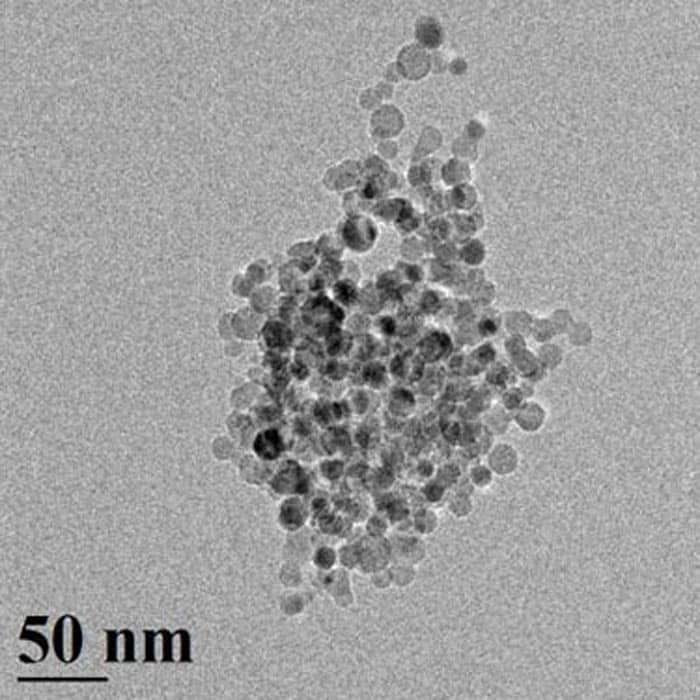
Thanks to their high surface to volume ratio, silicon nanoparticles should naturally generate hydrogen much more quickly than bulk silicon. Now, a team led by Paras Prasad and Mark Swihart at Buffalo has shown that the increase in reaction rate is much greater than would be expected based on increased surface area alone. In fact, nanoparticles 10 nm in diameter appear to produce hydrogen in under a minute, compared with around 45 minutes for nanoparticles that are 100 nm. The 10 nm particles are also 1000 times faster at producing hydrogen than is bulk silicon.
A large group of silicon nanoparticles This transmission-electron-microscopy image shows spherical silicon nanoparticles about 10 nm in diameter. These particles react with water to quickly produce hydrogen. (Courtesy: Swihart Research Group, University at Buffalo)
According to the SUNY team, the difference in hydrogen production rates between the 10 and 100 nm-sized silicon particles is much greater than can be accounted for by the difference in the surface areas of the particles. To understand this difference, the researchers conducted experiments in which they stopped the reaction before all of the silicon had been fully consumed. As the reaction proceeds, the 10 nm silicon particles reduce in size but do not change shape and remain roughly spherical.
The 100 nm particles, on the other hand, do not uniformly reduce in size but form hollow shells or capsules with walls consisting of a few monolayers of silicon. These walls then slow down the water–silicon reaction because they provide an extra layer through which the reactants must diffuse. Particles that are initially larger also have less surface area per unit volume.
Ideal for powering portable devices
“With further development, this technology could be ideal for powering small portable devices and might even replace bulky gasoline or diesel generators in the future,” says Prasad.
“A typical silicon generator could comprise a small hydrogen fuel cell and some plastic cartridges of silicon nanopowder, to which water would be added when needed, to produce energy,” adds team member Folarin Erogbogbo.
Although the technique could probably not be used to generate large amounts of hydrogen, the overall efficiency of the process could be quite competitive with primary batteries and other sources of portable power, which makes it interesting for these applications, Swihart told physicsworld.com.
The researchers have already successfully tested their technique in a small fuel cell that they used to power a fan. They are now planning to study the hollow nanostructures formed by the reaction of the larger silicon particles in more detail and look at how hydrogen can be produced when silicon nanoparticles are mixed with other materials, such as alkali hydrides. “These hollow ‘nanoballoons’ may have interesting applications in other areas such as anodes for lithium-ion batteries,” explains Swihart. “Alkali-metal hydrides react with water to release hydrogen and produce alkali-metal hydroxides (such as sodium hydroxide, for example) needed to catalyse the silicon reaction with water. On their own, the metal hydrides are air reactive and unstable, but coating them with silicon nanoparticles might let us increase the hydrogen generation capacity of the system while maintaining an air-stable, easy-to-handle material.”
Physicists in Singapore are the first to create a refrigerator that cools a piece of semiconductor using light, using their technique to cool a room-temperature sample of cadmium sulphide by some 40 K. Although a similar technique has previously been used to chill glasses doped with rare-earth elements, this latest work could lead to practical optical refrigeration devices for use in satellites, or even “self-cooling” lasers.
First developed in the 1980s, laser cooling has opened up the new and incredibly fruitful study of ultracold atomic gases. The technique involves firing counter-propagating laser beams at an atomic gas, with the atoms absorbing and emitting photons in such a way that the net effect is to reduce the average motion of the atoms, and thus lower the temperature of the gas.
Removing phonons
The laser cooling of solids is somewhat different because heat is stored in a solid in the form of quantized lattice vibrations called phonons, which do not interact directly with light. In the case of rare-earth-doped glasses, energy is removed from the phonons when a single atom in the glass undergoes an “anti-Stokes” transition. This involves a photon being absorbed by an atom before emitting a higher-energy photon – with the extra energy coming from phonons.
From a technological point of view, it would be much more useful to be able to laser-cool a more conventional material, such as a semiconductor, than a doped glass. Last year, Eugene Polzik and colleagues at the University of Copenhagen managed to use a laser to cool an extremely thin sheet of semiconductor that was stretched like a drumhead. Rather than being a general refrigeration method, however, the optomechanical technique focused on damping out a specific subset of drum-like phonon modes in the sheet.
Chilly nanobelts
What Qihua Xiong and colleagues at Nanyang Technological University in Singapore have now demonstrated is a more general technique that uses lasers to cool an extremely thin ribbon (or “nanobelt”) of the semiconductor cadmium sulphide (CdS). The method also relies on an anti-Stokes process, but in this case the transition involves an absorbed photon being converted into an electron–hole pair. This “exciton” annihilates and the semiconductor emits a higher-energy photon – with the extra energy coming from the annihilation of phonons. As a result, the sample loses phonons and cools.
Xiong told physicsworld.com that his team stumbled upon the effect by accident when doing laser-based Raman-spectroscopy experiments on the CdS nanobelts – materials that have a particularly strong anti-Stokes photoluminescence. The nanobelts were about 3 μm wide and about 100 nm thick, and were draped across a silicon-oxide substrate that was peppered with holes that were about 4 μm across. Measurements were made on the portions of the nanobelts that were suspended over the holes.
Strong coupling
The experiment involved firing “pump” laser pulses at the nanobelt to create excitons, with the laser energy adjusted so that the exciton energy plus the energy of several phonons equals the energy of a photon emitted in an anti-Stokes transition. Each photon emitted in this way therefore takes a significant amount of heat energy. Indeed, Xiong says that more than 100 meV of energy is removed per pump photon – the very high efficiency being because excitons and phonons in CdS nanobelts couple very strongly.
The team began the cooling process with the nanobelt at room temperature (290 K) and then reduced the temperature to about 250 K in about 40 min. This corresponds to a cooling power of 180 μW. The temperature of the sample was measured using a technique called pump-probe luminescence thermometry, which involves firing a second “probe” laser pulse at the sample.
Sensors in space
According to Xiong, the cooling technique could be used to cool tiny devices. As well as being relatively straightforward to miniaturize, laser cooling does not involve mechanical refrigeration – which can introduce unwanted vibration – or cryogenic liquids. One application that Xiong says is “particularly appealing” is the cooling of sensors used on satellites and other space missions. He also says that the technique could be used to cool a laser by using some of its own light.
While Xiong says that there are several challenges that must be overcome to make the technique work on larger samples of semiconductor, it is, in principle, possible. Polzik described this latest cooling technique as “a very interesting result” adding that, in principle, the technique could be used to remove heat from semiconductor devices.
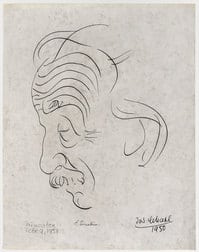
Ink-on-paper sketch of Einstein. (Courtesy: Sigrid Freundorfer Fine Art LLC
This ink-on-paper sketch of Einstein will go on public display for the first time tomorrow as part of an art show in New York City. It is the handiwork of Josef Scharl, a German artist who produced the work in 1950 while visiting his close friend Albert Einstein at Princeton University in the US.
Born in Munich in 1896, Scharl gained recognition in his time after being part of the “New Munich Secession” artists in the 1920s. He won various awards including the Albrecht Dürer Award from the city of Nuremberg, and the Prix-de-Rome. But Scharl was a vocal critic of the Nazi Party and by 1935 he was considered a “degenerate artist” and banned from painting.
Einstein, who by this time was already working at the Institute for Advanced Study at Princeton, had met Scharl in 1927 in Berlin at the house of photographer Lotte Jacobi. Upon learning of the fate of his friend, Einstein offered to sponsor Scharl’s immigration to the US, which the artist accepted. Once in the States, Scharl used to visit Einstein regularly and when the artist passed away in 1954 Einstein wrote the eulogy that was read at the funeral.
“Scharl was an outspoken man, not shy with his opinions, often rather witty. Einstein appreciated Scharl’s candor and views on this or that, and their conversations were lively and informative for both,” says Sigrid Freundorfer, the fine-art dealer based in New York who owns the drawing. “It must have been refreshing for Einstein to have had somebody like Scharl to talk to once in a while, in German at that.”
Freundorfer bought the painting last year from someone in the field of manuscripts and rare books “Being an art dealer, I bought it first as a magnificent drawing by Josef Scharl, depicting this great man Einstein, signed by both men,” she said. The image will go on sale at the Master Drawings New York exhibition, which runs 26 January – 2 February and has a preview show on 25 January.
Last week my colleague Hamish Johnston wrote about a fascinating survey carried out recently in the quantum research community. Physicists, philosophers and mathematicians were asked to give their responses to a series of questions about the foundations of quantum mechanics. Topics covered aspects of the subject from Einstein’s views on the topic to the prospects of a practical quantum computer. The survey is described and analysed in this accompanying paper posted on the arXiv preprint server.
Perhaps the most fascinating outcome of the survey was the extent of variation in responses to the questions about interpretations of quantum mechanics. This is perhaps surprising given the fact that the modern theory of quantum mechanics has been knocking around now for the best part of a century.
Perhaps it just goes to show how many of the key concepts at the heart of this strange theory are still strong sources of debate for physicists. In this week’s Facebook poll we thought it would be interesting to ask you one of the questions from this recent poll:
In your interpretation of quantum physics, do objects have their properties well defined prior to and independent of measurement?
Yes, in all cases Yes, in some cases No I’m undecided
Let us know by visiting our Facebook page, and as always please feel free to post a comment to explain your answer.
In last week’s poll we asked you a question about the mechanism by which fundamental physics research is transformed into commercial products. We asked you whether you think patents are hampering the commercialization of graphene. The question was motivated by the publication of a new report from the intellectual-property consultancy CambridgeIP, which suggests that the UK might be losing out in the quest to commercialize this material. 78% of respondents said “yes” it is being hampered, while the remaining 22% said no.
Thank you to everyone for taking part and we hope to hear from you again this week.
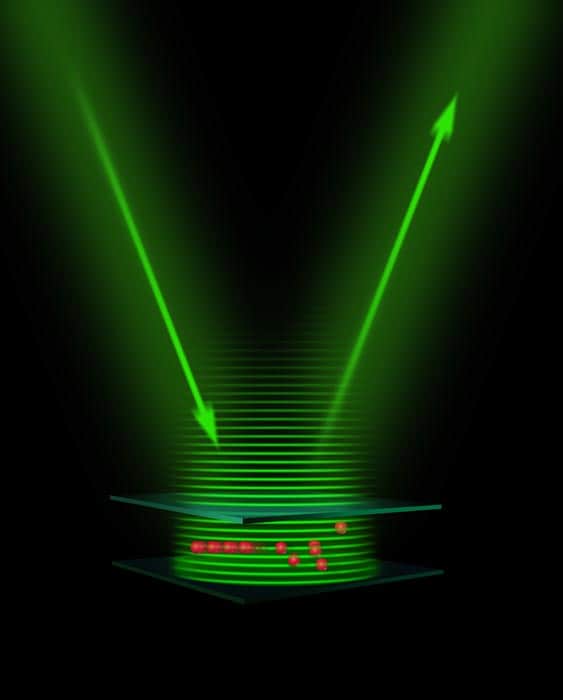
Pushing and pulling using polarized light: schematic illustration of the tractor beam set-up. The particles (red balls) are held between a mirror (lower sheet) and a transparent slide (upper sheet). Laser light (green) is focused at the region between the mirror and slide, causing the particles to arrange themselves neatly at the left. (Courtesy: O Brzobohatý et al.)
The idea that light can grab hold of objects may sound like science fiction, but optical tweezers that hold particles at a laser focus are widely used today. An even more fictional-sounding concept is the tractor beam – a beam of light or sound that can pull an object towards it. Over the past three years or so, physicists have shown that tractor beams are theoretically possible – and there has been a flurry of activity in the lab to try to build one. Now, researchers in the Czech Republic and the UK have produced a simple example using two laser beams. And as an unexpected bonus, they have also discovered a potentially powerful technique for sorting microscopic particles.
Optical tweezers can hold a particle still at the focus of a laser; but if you want to move the particle, you have to move the focus by, for example, adjusting a lens. In theory, a tractor beam is a beam of light that can reel in particles towards the source of the radiation without having to fiddle with foci. However, photons carry momentum, which can be transferred to a particle and therefore nudge it away from the source – something that seems to rule out a tractor beam.
However, in 2006 Philip Marston of Washington State University showed that there is a little flexibility. If the particle is irradiated with a specially shaped beam called a Bessel beam, consisting of wavefronts that form concentric circles centred on the object, then the recoil momentum that the particle acquires from scattering photons forward can exceed the momentum that it receives from the incoming photons. According to his calculations, the net force that the particle experiences can be directed back towards the light source.
No easy task
Actually creating a Bessel beam that can exert a pulling force over any significant distance is no easy task, however, because it would require an incredible amount of energy. As a result, tractor beams have remained a theoretical construct – although scientists such as physicist David Grier at New York University have constructed imaginative approximations.
In this latest research, physicists at the Institute of Scientific Instruments of the Academy of Sciences of the Czech Republic and the School of Medicine at the University of St Andrews have produced a simpler version of a tractor beam. It comprises two laser beams brought to a focus with a lens – a relatively simple geometry that can easily be made using a standard commercial microscope system. They found that by focusing the light inwards they could generate the same effect as if they had used a Bessel beam.
“Our geometry represents an alternative to the previously proposed optical fields based on Bessel beams” explains group leader Pavel Zemánek, “the concept allows larger extent of the tractor beam existence as well as controlling the polarization that plays a very important role”. The researchers managed to pull particles 30 μm, and could have gone further if they had used more powerful lasers.
Unexpected and useful effects
As an added bonus, the researchers found that the light had some unexpected and potentially very useful effects on the particles. For example, whether particles were pushed or pulled by the laser light depended on both the size of the particles and the polarization of the light. Light that was s-polarized, so that the electric field lay in the plane of the incident and reflected rays, was often found to pull particles of a particular size. On the other hand, light of the same wavelength that was p-polarized – where the electric field was perpendicular to the plane – would push it.
This allowed the researchers to devise a way of separating mixtures containing particles of two different sizes simply by switching the polarization of the light. The researchers also observed “optical binding”, whereby illuminated particles could be induced to stick together and self-arrange into various structures.
Polarization has potential
Optical physicist Miles Padgett of the University of Glasgow believes that the discovery of the polarization dependence is where the real interest of the work lies. “You would always expect some difference with polarization,” he says, “but the fact that the difference is big enough to do something with is the surprising thing.”
David Grier agrees. “This really is a clean demonstration of Marston’s principle in action,” he says. “It had to work, but it was really disappointing that it had not been made to work, given how many people had been working on it for so many years. But probably, going forward, the big long-term applications are using polarization to control self-organization and creating an extended light field that achieves sorting in the way that this does. And there it is not so much as a tractor beam but as the driving force for a lab-on-a-chip system.”