Fuelling the thorium dream

As an alternative to uranium as a fuel for reactors, thorium has been debated and evaluated since the dawn of the nuclear era. The primary reason for considering thorium is concern over scarcity of uranium resources, and this remains the reason why countries with limited supplies of uranium, such as India, are developing thorium-based technologies (see Physics World June 2012 pp12–13).

Richard Martin’s book Superfuel seeks to build support for expanding such developments. Written as a follow-up to his December 2009 article in Wired magazine on the same subject, Martin’s book covers three topics related to thorium: the technical and engineering aspects of its use; the historical context for its development as a nuclear fuel; and a commentary on the current nuclear energy industry and its acceptance of new technologies. The book is not intended for a technical audience, but rather for those who support the “cause” of using thorium as a future fuel for reactors. This includes organizations such as the Thorium Energy Alliance, the International Thorium Energy Organization and several other thorium advocates quoted and mentioned in the book.

My own perspective on this “cause” is that thorium is a potential fuel cycle option that deserves to be considered. Unfortunately, the book contains a number of embellishments, incorrect characterizations and erroneous bits of information regarding the use of thorium, most of which seem to place thorium in a more positive light. This certainly diminishes the book’s value to more technical readers, and could potentially mislead those who are not knowledgeable in this area.

In any discussion of nuclear energy, the relevant technical areas are safety, sustainability and nuclear waste, and indeed Martin discusses these throughout the book. But while he attributes aspects of safety, plentiful supply and beneficial waste characteristics to thorium, most of these features are in fact more closely related to a specific reactor technology – the molten salt reactor (MSR), also called a liquid fluoride thorium reactor (LFTR) in this book – rather than to thorium itself.

MSR-type reactors use fuel dissolved in a high-temperature liquid salt, which offers a high degree of safety because – in the event of an accident – the liquid fuel can passively drain from the reactor core into tanks cooled by natural circulation. The molten salt design also allows for an optimized use of thorium in thermal-spectrum breeder reactors, and between the 1940s and the 1970s, researchers at Oak Ridge National Laboratory (ORNL) developed the concept of a molten salt breeder reactor (MSBR) that used fertile thorium to produce fissile uranium-233 as a fuel. The MSBR programme successfully demonstrated the operation of an MSR with an experiment that ran from 1965 to 1969. The programme ended when the US Atomic Energy Commission (AEC) decided put all of its resources into developing a sodium-cooled fast reactor (then called the liquid-metal fast-breeder reactor) that allows effective breeding using a uranium-plutonium fuel cycle.

Another potential source of confusion is the book’s claim that one tonne of thorium produces as much energy as 200 tonnes of uranium. This is true if we are comparing an advanced thorium-fuelled reactor (which would incorporate a full system of fuel recycling) with the current generation of uranium-fuelled light water reactors (which use fuel in a “once through” fashion, and which in the US were mostly designed and built in the 1970s and 1980s). However, the claim is not accurate if we instead compare the thorium proposals with advanced reactors and associated technologies that use uranium, such as the sodium-cooled fast reactor mentioned earlier. In the latter case, the energy generated by thorium and uranium will be comparable.

The middle part of Superfuel covers the historical context for the development of thorium-based nuclear technology. In these chapters, Martin discusses the contributions of pre-eminent historical figures such as Alvin Weinberg, Eugene Wigner and Admiral Hyman Rickover to technologies such as MSRs and light water breeder reactors. Weinberg, for example, served as ORNL’s director when the MSR was being developed, but left in 1972 when he was “fired” (according to Weinberg himself) after falling out with AEC managers over reactor safety. Martin’s discussions of this period parallel those found in books such as Weinberg’s own The First Nuclear Era (AIP Press, 1994), and provide a good background on thorium research in the US through the 1970s.

The author also presents a high-level account of the history and context of India’s thorium nuclear energy development programme. This account includes Martin’s own commentary on what he perceives to be the implications of historical events that support his arguments for the benefits of thorium, as well as events that led to the demise of thorium projects. These historical sections of the book are well written and will be captivating for those interested in the history of the development of nuclear energy. In addition, he discusses future nuclear technologies such as Generation IV nuclear energy systems (which comprise six reactor types, including the thorium-fuelled MSR) and their implications regarding nuclear waste. Comparisons between nuclear and other forms of energy are also debated.

The final chapters of the book contain a great deal of commentary on the possible deployment of thorium-based technologies. Martin is very critical of current light water reactor technologies, focusing on events such as those at Japan’s Fukushima Daiichi plant after the 2011 earthquake and tsunami. His comments are very likely to turn off those, such as myself, who believe that today’s nuclear reactors are reliable and safe in the context of our current regulatory framework and compared with other, non-nuclear energy technologies. In particular, Martin’s use of terms such as “wooden-headedness” and “nuclearati” to characterize the nuclear industry as anti-thorium and closed to new developments is inflammatory, and may alienate the thorium movement from the very people who would ultimately implement it.

Overall, while Superfuel does provide useful historical information on the thorium movement, I would not recommend it as a source of technical information about thorium as a nuclear fuel. Most knowledgeable readers will cringe at a few of the technical characterizations, and will be concerned about many of the claims attributed to thorium. Instead, Superfuel should be read as an advocacy book, one that is largely written for an audience interested in the expanding thorium energy movement. In that context, it provides good insight into how the movement characterizes the use of thorium in comparison to uranium-based technologies.

  • 2012 Palgrave Macmillan £18.99/$27.00hb 272pp

Pulsed lasers could make proton therapy more accessible

A table-top proton accelerator for medical therapy could be one step closer thanks to work done by physicists in Germany. The team’s system is based on a compact Ti:sapphire laser, which fires ultrashort light pulses at a diamond-like foil to produce bunches of protons with energies of around 5 MeV.

The team has shown that its device delivers radiation doses to biological cells that are similar to doses created by much larger conventional proton-therapy systems. The researchers say that the technique could also be used to study ultrafast processes in biology and chemistry.

Accurate delivery

Protons – and other heavier ions such as carbon – show great promise for radiation therapy because when fired into living tissue, they deposit most of their energy at a very specific depth that depends on their initial energy. This is unlike X-rays and electrons, which tend to deposit energy over much larger regions of tissue. As a result, protons can be used to destroy tumours while leaving surrounding healthy tissue unharmed.

The downside of proton therapy is that it requires the use of a large and expensive accelerator and can only be done at about 30 facilities worldwide.

With the aim of offering proton therapy to more people, medical physicists are looking at how compact lasers could be used to create smaller and less costly proton sources. The basic idea is to fire short, intense laser pulses at a thin target, which liberates protons or other ions and accelerates them over distances as small as a few microns. Researchers have already shown that table-top femtosecond lasers with pulse energies of several joules can create proton beams with energies of up to 40 MeV.

Biological effectiveness

But before laser-driven ion beams can be used on patients, it is necessary to study how the proton pulses interact with living cells. In, particular scientists must compare the effectiveness of ultrashort-pulsed ion beams with that of continuous beams from conventional accelerators.

With this aim, Jan Wilkens from the Technical University of Munich and colleagues have used a high-power table-top laser to generate nanosecond proton bunches that deliver single-shot doses of up to seven gray to living cells. This is equivalent to a peak dose rate of 79 Gy/s over a 1 ns interval, and such doses are sufficient for radiation therapy.

System set-up

The researchers used the ATLAS laser – a table-top Ti:sapphire laser that delivers 30 fs pulses – at the Max Planck Institute of Quantum Optics near Munich. Laser pulses with 0.4 J energy were focused to a 3 μm spot, yielding a peak intensity of 8 × 1019 W/cm2. This beam was used to irradiate diamond-like carbon (DLC) foils with thicknesses of 20 and 40 nm.

“The nanometre foils enabled a hundred-fold higher [proton] luminosity as compared to [standard] micron-thick targets,” explains Jörg Schreiber, from Ludwig Maximilian University of Munich, who was one of the team. “We have pioneered the application of nanometre DLC foils and it has paid off.”

The beamline included a miniature quadrupole doublet magnetic lens inserted behind the DLC foil to focus the protons at a distance of 1.2 m. A circular aperture is placed 810 mm from the target, in front of a dipole magnet that deflects the protons downwards. This avoids irradiation of the cells by X-rays created when the laser pulse slams into the target. The beamline is evacuated and to irradiate living cells, the proton bunch leaves the vacuum through a Kapton window and enters a customized cell holder.

Irradiating cancer cells

The researchers exposed single layers of human cervical cancer cells to protons generated in a single shot. The resulting dose distribution was measured using radiochromic film behind the cells. A microstructured grid on the cell holder enabled registration of the dose distribution with a spatial uncertainty of 21 μm. The team confirmed that cells were damaged by the protons using a chemical assay that detects the presence of broken strands of DNA.

Using these data, the team calculated the relative biological effectiveness (RBE) of the dose and found it to be similar to that of conventional proton beams at comparable energies.

The researchers say that this work demonstrates the potential of small, high-repetition-rate lasers for creating intense pulse protons that are almost monoenergetic and contain relatively small amounts of background radiation.

Ultrafast studies

Beyond proton therapy, the researchers say that the proton source could be used for basic science: “The laser-driven beam could have impact as a tool in fast biological or chemical processes. Of special interest is the availability of other temporally synchronized laser-driven sources to perform pump probe experiments,” they note.

The team is now aiming to create beams with higher ion energies. “This requires more powerful lasers, which are currently under construction in our lab and elsewhere,” Wilkens and Schreiber explain.

The research is reported in Applied Physics Letters.

Fires ravage Siding Spring Observatory

A large bushfire has swept across Australia’s largest optical and infrared observatory, closing it at least until the end of January. Preliminary assessments of the Siding Spring Observatory, located around 500 km north-west of Sydney, indicate that precautionary measures saved the telescopes from major damage but that three buildings belonging to the observatory have been destroyed with a further three badly damaged.

Siding Spring is operated by the Australian National University (ANU) and is home to 11 telescopes including the 4 m Anglo-Australian Telescope, which is run by the Australian Astronomical Observatory (AAO). The 420 km2 bushfire started on 13 January in the surrounding Warrumbungle National Park after several days of high temperatures and a series of lightning strikes.

Staff were quickly evacuated hours before the blaze swept across the site – almost 10 years to the day that bushfires destroyed much of ANU’s Mount Stromlo Observatory in Canberra. The Siding Spring telescopes were saved largely thanks to several precautionary measures that were implemented at the observatory after the experience at Mount Stromlo. These include the burning of vegetation surrounding the site at Siding Spring, the installation of mesh screens on the building’s windows, doors and vents as well as the use of heat retardant paint.

‘Still in shock’

Early inspections, carried out over the last three days by staff from the AAO and ANU, suggest the measures were successful in protecting the instrumentation. An initial inspection of the Anglo-Australian Telescope and the 1.2 m UK Schmidt Telescope found ash and debris inside the domes, but no visible damage to any of the instruments. Inspections of other telescopes were also promising, revealing only smoke damage and small amounts of ash inside the telescope’s housing.

However, three buildings, including the staff-accommodation lodge, have been completely destroyed and a further three have been badly damaged, including the visitors’ centre. The fire has also knocked out electricity and water supplies to the site and has closed the road accessing the observatory, with urgent work being undertaken to restore power and water to the site. Nearby, several homes of observatory staff have also been destroyed.

Detailed inspections and testing will start on Monday, to assess the full extent of any damage to instrumentation as well as a clean-up of the site to make it safe for staff to return. Those tests will last several weeks and a date for the reopening of the observatory is currently unknown.

Speaking to physicsworld.com, AAO astronomer Amanda Bauer, who is based in Sydney, says staff are still in shock, but on the whole relieved by initial reports from the site. “We hope to get the telescopes operational as soon as possible,” she says. “Those of us who have observations scheduled during the coming months are still making arrangements as we normally would, until we hear otherwise.”

How many dominoes will topple a cathedral tower?

“How many dominoes does one need to topple a domino as tall as the Domtoren?” was a question in the Dutch Science Quiz 2012 and the inspiration for a quirky bit of mathematical physics from J M J van Leeuwen of Leiden University in the Netherlands.

The Domtoren is a 112 m-tall cathedral tower in Utrecht and the idea is to begin with a standard-sized domino, which topples a larger domino. This then topples an even larger domino and so on until a Domtoren-sized domino can be felled. The process is called “domino multiplication” because a tiny tap on the first domino can, in principle, topple a huge monolith. Now, Van Leeuwen has calculated the upper limit on how much larger each successive domino can be. In principle, his calculations suggest that the maximum ratio of successive domino heights can be about 30% larger than the widely accepted value of 1.5.

The underlying principles governing the domino effect are simple: each brick is given potential energy when it is raised against gravity and stood on end. Given the slightest push a brick will fall, releasing this energy. It is capable of toppling a larger neighbour because the energy required to tip the bigger brick over is much less than the potential energy the smaller brick releases on falling.

Real-world effects

But in the real world not all that energy is channelled into bringing down the next domino in line. First off, the dominoes bounce a little as they strike one another. Next, they have a tendency to slip along the surface they are stood on as they are nudged, lessening the chance of a fall or causing them to fall back towards the striking domino. And finally, once in contact, they drag against one another as they fall.

In his model, Van Leeuwen simplifies the situation by assuming that the collisions are completely inelastic, that the friction between the dominoes and the surface they stand on is infinite, and that the dominoes, once touching, experience zero friction and simply slide over one another.

Chain reaction

Van Leeuwen’s idealized model shows that – assuming optimal spacing between successive dominos, a fixed density and thickness-to-height and width-to-height ratios for all dominoes – the maximum theoretical “growth factor” is two. In other words, each domino can be no more than twice the height of the one that strikes it, if the chain is to continue. Until now, that limit was widely thought to be 1.5.

“In real life, [these assumptions] are not realized,” Van Leeuwen concedes. “But in principle you could reach two,” by standing the bricks on a very high friction surface and lubricating their upright surfaces.

Energy amplification

Even with a more modest ratio, the effect in numbers is impressive, as demonstrated in the above video by Stephen Morris at the University of Toronto. Morris topples a series of 13 dominoes with a growth factor of 1.5. He claims that the energy needed to tip the first fingernail-sized domino is amplified two-billion times by the end of the chain reaction – when a 45 kg block crashes to the floor. “If I had 29 dominoes,” says Morris, “the last domino would be as tall as the Empire State Building.”

So, starting with a standard domino 4.8 cm tall, how many are needed to topple the Domtoren? Assuming a growth factor of 1.5, it is 20 dominoes, but pushing the growth factor to two, it should easily be done with just 12.

The work is described in a preprint on the arXiv server.

Quantum information is a breath of fresh air

By Hamish Johnston

Modern quantum mechanics has been around for a century or so and has proven to be an incredibly useful tool for both understanding nature and creating practical technologies. Therefore, it might come as a surprise that different “attitudes” to quantum mechanics still exist among experts in the field.

These are highlighted in a paper recently uploaded to the arXiv preprint server. It describes a poll of 33 leading physicists, philosophers and mathematicians that asks their opinions on quantum theory. The survey was done at a conference in 2011 in Austria that was called “Quantum Physics and the Nature of Reality”.

Delegates were asked which is their preferred interpretation of quantum mechanics. Not surprisingly, “Copenhagen” was the winner with 42% of the vote, followed by an “information-based” approach” with 24%.

On the subject of quantum information – that is, the ongoing development of quantum computing, cryptography etc. – 76% of the respondents agreed that “it’s a breath of fresh air for quantum foundations”, whereas only 12% thought it was not relevant to the study of the foundations of quantum mechanics.

And what about that question that physicists are hearing a lot of these days: “When will we have a working and useful quantum computer?” While only 9% said within 10 years, 42% chose within 10–25 years.

The paper is by Maximilian Schlosshauer of the University of Portland, Johannes Kofler of the Austrian Academy of Sciences and Anton Zeilinger of the University of Vienna. As well as presenting the results, the trio look at correlations between different responses to try to build a picture of participant’s overall view of quantum theory. They also compare the responses to a similar poll done in 1997. You can read the paper here .

Nanoantenna array steers light

Images of the integrated optical phased array

The first large-scale array of optical antennas on a silicon chip has been made by researchers in the US. The structures, which can generate accurate pre-defined patterns of light, could be used in a host of new application areas, including 3D holography displays and advanced medical imaging.

Antennas have long been used to transmit radio and television waves, but researchers have only recently begun to extend this concept to visible light. All antennas work by oscillating charges along their structure, which means that the size of the antenna must fit to a resonant mode for the wavelength of the electromagnetic radiation it supports. To make an antenna work at optical frequencies, it must thus be scaled down to nanometre dimensions.

The idea of connecting up multiple radio antennas, fed from a common source, has been around for a long time too. Here, the antennas are aligned in phase to enhance the emission of radio waves in a given direction. The technique is also routinely employed in astronomy, where information from multiple telescopes is collected in phase to improve the resolution of the entire set-up.

Thousands of antennas

Now a team led by Michael Watts at the Massachusetts Institute of Technology (MIT) has extended the concept to infrared light and has succeeded in fabricating an integrated optical phased array containing more than 4000 antennas on a single chip that has an area of little more than 0.5 × 0.5 mm. This is equivalent to an array of 64 × 64 antenna units, or pixels, with each pixel covering 9 × 9µm.

The antennas are made from a strong, high-index contrast dielectric grating and all work at the same power level. They are all aligned in phase to produce a sophisticated light pattern – in this case, the MIT logo, in the far field. “To our knowledge, this demonstration represents the largest coherent combination of silicon nanophotonic elements ever produced,” says Watts.

The researchers say that they are able to accurately control the direction in which light is emitted from the array and steer an emitted light beam in two dimensions.

Watts and colleagues made their phased array in a conventional 300 mm complementary metal-oxide–semiconductor (CMOS) fabrication facility using state-of-the-art tools, such as optical immersion lithography.

Imaging and 3D holography

According to the team, the arrays could be used for beam steering in sensing applications, such as light detection and ranging (LIDAR) and interferometry. The devices could also find use in medical images because they could be used to take images through light-scattering materials such as biological tissue. Such imaging makes use of “adaptive optics” techniques that automatically adjust the phase of an optical wave to compensate for the distortion caused by the surrounding medium – something that calls for accurate phase control of the light beam being employed and a huge number of pixels, two characteristics that the new optical phased arrays possess. One immediate application would be in intravascular surgery, to steer laser beams and image vascular walls, says Watts.

I believe that 3D holographic displays are not only possible now, but [are] within our grasp
Michael Watts, MIT

“However, I think the most interesting application for these arrays is in 3D holographic displays,” he says. “I believe that 3D holographic displays are not only possible now, but [are] within our grasp. This is because our array allows for separate control over the phase and amplitude of the light wave emitted as well as single-point excitation of the nanophotonic emitters, enabling truly arbitrary holograms to be generated entirely on-chip for the first time.”

He adds that such an application would be even better if the arrays operated at visible optical wavelengths, which are shorter than the near-infrared frequencies demonstrated in the current work. “To achieve this, we will now be working on reducing the arrays’ pixel size even further and using a material other than silicon for the waveguide in the structure, since silicon absorbs light in the visible part of the spectrum.”

The research is described in Nature.

Proteins boost quantum coherence in bacteria

A new theory of how plant photosynthesis involves quantum coherence has been suggested by physicists in the UK, Germany and Spain. This latest research is based on the study of organisms that live deep under the sea yet are able to convert sunlight into energy. The study suggests that molecular vibrations do not destroy the coherence – as previously thought – but rather perpetuate and even regenerate coherence. The discovery provides a better understanding of how as much as 99% of the energy of light absorbed by photosynthesis cells is successfully transferred to locations in the cells where electric energy is converted to chemical energy. The work opens up the possibility of using nature-inspired designs in quantum devices.

Until recently, living systems were thought to be “too wet and warm” to rely on delicate quantum properties such as entanglement and coherence. The problem is that these properties decay rapidly via random interactions with things in the outside world, such as vibrating molecules. However, over the past decade physicists have begun to suspect that quantum properties play important roles in biochemical processes – including photosynthesis.

This latest work was done by Alex Chin (now at Cambridge University) and colleagues at the Institute of Theoretical Physics in Ulm and the Technical University of Cartagena. The team looked at organisms called green sulphur bacteria that live 2000 m below the ocean surface. There is so little sunlight down there that the bacteria cannot afford to lose a single photon – indeed, almost 100% of the light they absorb is turned into food.

Excited states

When sunlight hits the surface of the plant, energy is transferred via chains of pigments to a reaction centre, where it is converted into chemical energy. Those pigments are held in place by proteins, which together create pigment–protein complexes, or PPCs. The PPCs effectively act as corridors and the energy itself travels in the form of molecular excited states, or molecular excitons. These excitons are able to move along the PPC by hopping from one molecule to the next.

In 2007 Graham Fleming and colleagues in the US showed that these excitons exhibit quantum coherence, which means that the excitons may exist simultaneously in a superposition of several quantum states with varying probabilities. Coherence also allows the exciton to explore multiple pathways to the reaction centre simultaneously, ultimately choosing the fastest, most efficient option. As is demonstrated in man-made solar cells (which also rely on excitons), the longer this trip takes, the more likely it is that the energy will dissipate before it reaches its destination.

Optimizing function

The presence of quantum effects in photosynthesis surprised both physicists and biologists, and left them wondering how a fragile quantum state could survive in a living organism. More specifically, research groups found that the coherenent states exist for 100-times longer than the coherence time of the energy states of an exciton. Something was helping these wave states survive long enough to ensure the safe passage of nearly 100% of the photon energy that the organisms absorbed.

This latest research suggests that the answer lies in the proteins in the PPCs, which provide structural support for the pigment molecules. The new calculations reveal that these proteins are more active participants in the transport system than was previously thought. The natural vibration frequencies of the proteins resonate with the exciton waves, and like a parent pushing a child on a swing, the protein structures keep the excitons oscillating without dampening. In fact, the exciton may pass its vibration into the protein structures, which then return it to the exciton, thus restoring its coherence.

“People have not viewed this protein structure as something that actively helps quantum phenomenon to take place in biological systems,” says team member Martin Plenio. “This is really a new way of thinking about things.”

Definitely not noise

The team’s conclusions come from precise analysis of the protein vibrations, using data from Markus Wendling and colleagues in the Netherlands, who in 2000 examined the PPC structures from green sulphur bacteria. Previous efforts to study the protein vibrations used rougher approximations and usually concluded that the vibrations were noise.

“The main difference in terms of the paradigm for doing this simulation was to not separate the system into the exciton and the environment, but to treat them all together as one large many-body system,” says Chin. “We took a completely holistic approach. This makes it very complicated in terms of variables and things that one has to keep track of, which means that computationally it is very tough.”

Understanding these protein structures could assist in building similar structures in quantum devices. If similar structures are used in the conversion of electrical energy to chemical energy, it could shed light on how to mimic photosynthesis’s high efficiency rates in man-made solar cells.

A good hypothesis

Greg Scholes of the University of Toronto in Canada praises the detailed analysis conducted by the team, and says the conclusions “fit with some of the pieces of the puzzle that have been emerging in more recent experiments”.

While Scholes believes the analysis is “sufficient proof of the idea in principle”, he says direct experiments will need to be done to confirm the conclusions. “From that perspective this work really contributes something important. Because it gives us a hypothesis, [and now] we can go and test it,” he says.

The study is described in Nature Physics.

Somersaulting film generates electricity

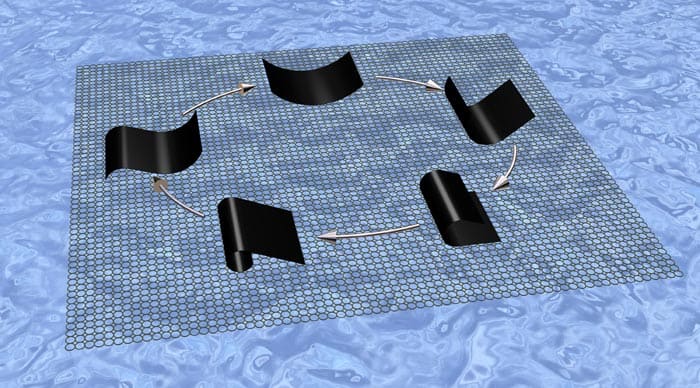
A specialized polymer film that can generate electricity thanks to its response to moisture has been created by a team of researchers in the US. The composite polymer absorbs minute amounts of evaporated water from its environment, causing it to curl up and down repeatedly. This continuous motion is converted into electrical energy that can be stored in small generators, and eventually could be harnessed to power micro- and nanoelectronic devices, such as remote sensors or actuators, as well as having biological applications.

Ways and means

With the ever-increasing demand for power, scientists are keen to develop alternative ways to harvest energy, especially from the ambient environment. But Mingming Ma, a postdoc at the David H Koch Institute for Integrative Cancer Research at Massachusetts Institute of Technology (MIT), and colleagues were studying something quite different – they were developing a polymeric electrode for medical purposes as a way to simulate muscles for nerve regeneration. “It [the discovery] was not intentional at all,” says Ma. “During our experiments, we found the film expanded when it came into contact with water vapour and realized that this caused its movement.”

Ma told physicsworld.com that the team’s newly designed 20-µm-thick film is made by interlocking two different polymers to form a network – like a mesh. One of the polymers, known as polypyrrole, forms a hard but flexible matrix that provides structural support. The other – polyol-borate – is a soft gel, and it is this polymer that swells when it absorbs water and contracts when the water is expelled.

Curling mechanics

When the material is in an environment that contains even a small amount of moisture, it absorbs some of the water, causing the film to curl upwards. This exposes the underside of the film to air, making it quickly release the moisture and somersault forward. This continuous motion converts the chemical energy of the water gradient into mechanical energy.

An illustration of the film's movement

Ma is quick to point out that the device does need a water gradient – place the film on a water surface, for example, and it will absorb too much moisture to be able to flip over. “It does not need a lot of water,” Ma says. “A very small amount of moisture is enough.”

Ma says that the team was inspired by the network structure present in the skin of many animals. “They [animals] have two layers – a tough fibre layer and a softer flexible and elastic layer, which together make a sturdy and flexible material,” he says. So the researchers approached designing their film in a similar way, hoping to produce a better water-responsive actuator.

Two better than one

In the past, other water-responsive films have been made only from polypyrrole, which has a much weaker response on its own. “By incorporating the two different kinds of polymers, you can generate a much bigger displacement, as well as a stronger force,” says Liang Guo, another team member.

The team says the film can generate “contractile stress” up to 27 MPa. It claims that a 25 mg film could lift a load 380 times its own weight and transport a load 10 times its own weight.

To turn it into a generator, Ma and colleagues coupled the polymer film to a piezoelectric material – which converts mechanical stress to an electric charge – to generate an average power of 5.6 nW. This energy can be stored in capacitors to power ultra-low-power microelectronic devices such as temperature and humidity sensors. It could also power microelectricalmechanical systems (MEMS) or even smaller devices such as nanoelectronics.

Big ideas, small films

Other applications could include attaching the film to clothing worn while exercising, where sweat evaporating from the body could power small devices. Ma even suggests placing it above or near a large body of water, such as a lake, to generate electricity. But this would involve greatly increasing the mechanical-to-electrical energy conversion to make it much more efficient. “We want smaller films to power larger devices. For this we need a better piezoelectric material developed for the purpose,” explains Ma. The researchers plan to investigate this, as well as other applications for their film, in the coming months.

The research is published in Science.

Physicist homes in on universe’s earliest magnetic fields

Scientists have long wondered where the observed magnetization of the interstellar medium came from, given that the fully ionized gas of the early universe contained no magnetic particles. According to new research by an astrophysicist in Germany, the answer lies in magnetic fluctuations within this plasma. Although these fluctuations initially summed to zero, he calculates, they would have left a positive excess of field once compressed by energetic phenomena such as supernovae explosions.

Permanent magnetism is a property of only a few materials, such as iron, in which the spins of individual electrons naturally line up in the same direction and create a residual magnetic field. In the early universe, before iron and other magnetic materials had been created inside stars, permanent magnetism did not exist. Nevertheless, the proto-interstellar medium, a plasma consisting of a few light nuclei along with free protons and electrons and which formed when the universe was less than a billion years old, did have a non-zero magnetic field.

Magnetic seeds

Astrophysicists believe that the explosive collapse of massive stars known as supernovae or the streams of charged particles referred to as galactic winds could have provided the energy needed to compress small and disordered, or “seed”, magnetic fields so that they became unidirectional and as strong as the fields observed in the interstellar medium – that is, having an energy density roughly equal to that caused by the medium’s thermal pressure. The question is: where did these seed fields come from?

To answer this question, Reinhard Schlickeiser of Ruhr University in Bochum considered the proto-interstellar plasma shortly after it came into being – an era known as “reionization” when something, probably the light from the first stars, provided the energy needed to break up the previously neutral gas that existed in the universe. The protons and electrons inside the plasma would have moved around continuously, simply by virtue of existing at a finite temperature. And, like any charged particles in random motion, they would have created random magnetic fields – which would have cancelled each other out. Nevertheless, it was the finite variance of the resulting magnetic “fluctuations”, says Schlickeiser, that subsequently led to the creation of a permanent magnetism across the universe.

To work out the field-strength variance of the fluctuations, Schlickeiser used a theory he developed in 2012 with Peter Yoon of the University of Maryland. The fluctuations are “aperiodic”, which means that, unlike the variations in magnetic and electric fields that give rise to electromagnetic radiation, they do not propagate as a wave. Indeed, their wavelength – the spatial distance over which the fluctuations occur – and their frequency – dictating how long these fluctuations last – are uncorrelated, in contrast to light, for which the values of wavelength and frequency are tied to one another via the wave’s velocity.

Much weaker than a fridge magnet

Schlickeiser summed over all possible wavelengths and frequencies for the magnetic fluctuations in a gas at 10,000 K, which would have been roughly the temperature of the proto-interstellar medium at the time of reionization. The calculation revealed field strengths of about 10–12 G inside very early-stage galaxies and around 10–21 G in the void surrounding the galaxies. These values compare with the roughly 0.5 G of the Earth’s magnetic field and the 100 G typical of a strong refrigerator magnet.

Schlickeiser points out that he is not the first person to put forward a seed mechanism for the interstellar magnetic field. Indeed, as far back as 1950 the German astronomer Ludwig Biermann proposed that the centrifugal force generated in a rotating plasma cloud will separate out heavier protons from lighter electrons, thereby creating a separation of charge that leads to tiny electric and magnetic fields. According to Schlickeiser, however, this scheme suffers from a lack of suitable rotating objects, meaning that it could only ever generate the magnetic fields in a small portion of the interstellar medium.

Observational evidence needed

Schlickeiser’s next step is to find observational evidence to back up his idea. One option, he says, would be to look at the cosmic microwave background, the very faint long-wavelength radiation that fills the universe and which was emitted about 400,000 years after the Big Bang, when electrons and protons had cooled to the extent that they could combine via mutual attraction and leave photons to propagate freely through space. The idea would be to measure variations in the polarization of this radiation, which could be done using data from the European Space Agency’s Planck satellite, given that magnetic fields rotate the plane of polarization of electromagnetic waves. “It is not clear at the moment whether these fluctuations would have measureable effects on the background radiation,” he says. “But I think it would be worth finding out.”

Massimo Stiavelli of the Space Telescope Science Institute in Maryland is positive about the latest work, arguing that “the mechanism described could indeed provide the seeds to primordial magnetic fields”. And he suggests an alternative line of evidence, from before reionization – that any magnetic fluctuations would have tended to fragment the universe’s second generation of stars as they formed. “Finding somewhere in the local universe a small-mass star with a magnetic field and primordial chemical composition would provide evidence that a mechanism like the one described was at play,” he says.

The research is published in Physical Review Letters.

Do university professors have one of the least stressful jobs?

If you are looking for a nice, relaxing job that is reasonably well paid with excellent job security, then university professor is the career for you. At least that is according to a new ranking exercise on the website careercast.com, which names “university professor” as the least stressful job of 2013 – followed by seamstress/tailor, then medical-records technician. The survey is based on criteria such as “physical demand” and “deadlines”, and is part of a more extensive categorization of the best and worst jobs that will be released in April.

Since the list was published last week there has been a mighty backlash from some members of the academic community, who feel their working life has been falsely characterized. A large dose of this anger was directed at this article in the magazine Forbes, which gleefully endorsed the results. Forbes journalist Susan Adams described the life of an academic with several gems, including “Working conditions tend to be cozy and civilized and there are minimal travel demands, except perhaps a non-mandatory conference or two.” However, after the article appeared, it received so many comments from disgruntled academics that Adams felt moved to write an addendum to reflect these sentiments and to clarify her position.

Let us know what you think about the debate by taking part in this week’s Facebook poll.

Do university professors have one of the least stressful jobs?

Yes
No

Please feel free to explain your answer by posting a comment on the poll.

In last week’s poll we asked you a question that involved a scientist whose fame now extends far beyond his academic research. We asked whether Stephen Hawking’s appearance in a recent advert for a price-comparison website was good for the communication of science. In the advert, Hawking is seen to create a black hole on a UK high street to destroy the comedy character known as Gio Compario. The poll was tightly contested, with 46% of respondents saying yes the advert is good for science communication, and the remaining 54% saying no it is not.

Of course, it was a very open question, so the poll attracted many comments. “It helps raise the profile of scientists in a jokey way. More and more people are now familiar with Hawking, Jim Al-Khalili and Brian Cox as TV personalities, and are enjoying and benefiting from their appearances on TV,” wrote Paul Londale. Another commenter, Raul Raúl, also has no qualms with Hawking taking part in the advert. “Isaac Asimov, a PhD in biochemistry and icon science-fiction writer and science popularizer, used to advertise IBM PC machines in late 1980s. So, let them do it,” he wrote.

Thank you for all your participation and we hope to hear from you again this week.

Copyright © 2026 by IOP Publishing Ltd and individual contributors