On to the Moon…

By Hamish Johnston

orion.jpg
Will Orion visit the Moon or even Mars?

…or maybe Mars?

My earliest childhood memory is of being called inside by my mother on a warm summer day to watch Buzz Aldrin and Neil Armstrong walk on the Moon. I’m not sure if it was a live or recorded programme I saw 40 years ago — I suppose it doesn’t really matter, but I would like to think that I watched history unfold.

Then, three years later, Eugene Cernan stepped back into his Apollo 17 lander and no-one has set foot on the Moon since.

This morning on BBC Radio 4’s Today news magazine, there was a discussion about NASA’s Orion Spacecraft — a full-sized replica of which has just gone on display in the Mall in Washington DC.

Orion is expected to carry humans to the International Space Station in 2015 and to the Moon in 2020. Further in the future, Orion could carry astronauts to Mars.

You can listen to the discussion here . Unfortunately the BBC has not posted this piece as an excerpt so you will have to listen to about the first 50 minutes of the show — unless you can work out a way to fast-forward to about 06:53.

I’m guessing that many at NASA are looking forward to Orion with a mix of anticipation and dread. What will happen to the US space programme if the nation fails to revisit the Moon, let alone Mars? Failure could come from a lack of money — or more ominously, a lack of collective will to overcome what remains a significant technological challenge.

Will Eugene Cernan be the last person to walk on the Moon in my lifetime? Or will I live to see someone take their first steps on Mars? — which is the hope of Louis Friedman, president of the Planetary Society .

Friedman told Today that using Orion to travel to the Moon but not Mars is a 20th century goal wasted on a 21st century spacecraft.

A little later on Today, the historian, Richard Dunn is interviewed about his book The Telescope – A Short History. The interview takes place at the The Royal Observatory Greenwich and the Today reporter takes a peek through a reproduction of one of Galileo’s telescopes — and manages to spy a traffic light. You can listen to the excerpt here — just scroll down to 0740.

Flu fighters use the Web to track virus

Physicists in Italy have begun analyzing data from a new Web-based project that seeks to model how flu spreads through a population.

The project, known as Influweb, involved some 2000 ordinary Italians replying over the last six months to a weekly e-mailed questionnaire about their state of health and current geographical location. The project will be able to pin down the spread of flu in real time and with a spatial resolution on the level of a person’s postcode.

The spread of flu is traditionally monitored using information provided by doctors after they have seen ill patients. One problem with this approach is that it can take over a week for the data to be processed. Moreover, such methods do not sample enough people.

Most don’t see a doctor

“We found that 90% of people with symptoms never see a doctor,” explains physicist Daniela Paolotti from the Institute for Scientific Interchange (ISI) in Turin, who is a joint co-ordinator of Influweb along with Vittoria Colizza.

What the ISI researchers hope to obtain is much more accurate data that will allow them to test and refine their theoretical models of the spread of flu and other epidemics. This should, in principle, allow them to make better predictions of how widespread a particular outbreak will be and when it will peak.

Traditional monitoring techniques have so few data that they only become statistically relevant if summed over a large geographical area. The Influweb team now has six months worth of data, including information on groups such as pensioners and children.

Alerting hospitals

Influweb is inspired by similar Web-based projects that have been running in Belgium and the Netherlands since 2003 and in Portugal since 2005. The former scheme, which has information on 60,000 people, has been able to predict a week earlier than other techniques when a particular epidemic will peak. The Influweb project will, however, try to exploit that breathing space by alerting hospitals of an imminent epidemic so that they can, for example, put extra ambulances on stand-by.

Although Paolotti has not obtained enough data this winter to make full predictions, she is optimistic for next year. “We are confident that next winter will yield even more participation and that we will gain predictive capacity,” she says.

The ISI researchers are also co-ordinating a €5m four-year European-wide extension of Influweb, known as Epiwork. Funded by the European Union and co-ordinated by Alessandro Vespignani from the ISI, Epiwork began in February and involves 12 organizations from seven European countries and Israel.

“I believe this project is a cutting-edge approach to data collection,” says Zoltán Toroczkai, a physicist at the University of Notre Dame in Indiana, who is also involved in modelling epidemics. “It will be extremely useful in tackling a problem that has not really been exploited in the current modelling, namely the dynamical coupling between people’s mobility in geographical space and the spread of an epidemic.”

New technique boosts NMR sensitivity 1000-fold

Researchers in the UK have invented a new way of boosting the sensitivity of nuclear magnetic resonance (NMR) measurements by a factor of 1000. The technique involves mixing molecules of interest with a “spin isomer” of hydrogen and a metal hydride, which forces the nuclear spins of the sample into a specific energy state. This makes the molecules much more visible to NMR measurements as well as magnetic resonance imaging (MRI), which uses NMR to map different tissue types within the body.

According to the researchers, led by Simon Duckett and Gary Green from the University of York, molecules that have been treated in this way could someday be injected into the body, reducing the time to take an MRI image from hours to a fraction of a second. This, they say, could allow medical researchers to watch how a patient responds in real time to drug therapy. It could also allow larger and more detailed scans to be made — allowing doctors to see tumours earlier than possible today (Science 323 1708).

NMR measurements are made by exposing a sample to a very high magnetic field, which aligns the magnetic moments of its nuclei in a specific direction. The magnetic energy levels are quantized, and the spacing between the levels — as well as the time it takes for transitions between those levels — can be measured by applying a radio-frequency signal to cause a transition and then measuring the radio signals that are given off as the magnetic moments return to equilibrium. This provides a wealth of information about the chemical and structural composition of the sample.

Few molecules take part

The problem with NMR is that the energy levels of interest in a sample at room temperature are almost equally populated. Only a very small fraction of molecules in a sample — fewer than one in 30,000 — therefore contribute to the NMR signal. Some researchers have tried to get round this problem using various “hyperpolarization” techniques that involve transferring spin to molecules of interest to ensure that most of the molecules are in one specific nuclear spin state.

Unfortunately, some of these techniques involve long sample preparation times while others involve altering the target molecules in chemical reactions – neither of which are appropriate for medical scans. What Duckett’s team has done is to work out a way of transferring spin from “parahydrogen” — a spin isomer of the hydrogen molecule with no overall magnetic moment — to the organic molecule pyridine C5H5N.

The technique involves mixing the pyridine with parahydrogen and iridium dihydride. Parahydrogen and iridium dihydride molecules first pair-up to create a metal complex that is in a specific spin magnetic state. This complex then attaches itself to a pyridine molecule, and again the entire structure is in a specific spin magnetic state. The structure then breaks up into the three original constituents — leaving the pyridine in the desired spin magnetic state.

Good news for chemists

Duckett told physicsworld.com that by doing this the team were able to boost the proton, carbon and nitrogen NMR signals from pyridine by a factor of 1350 over untreated samples. Similar results were also achieved with the compound nicotinamide and Duckett says that the technique could be applied to other molecules. This improvement could be great news for chemists as it would boost the performance of high-resolution NMR.

Another advantage is that the technique can be used without modifying MRI equipment, which means that the technique could be easily implemented on scanners currently used in hospitals. Moreover, molecules prepared in this way would stand out in a scan relative to identical molecules that had not been treated, allowing the treated molecules to be tracked as they move through the body.

The team have applied for a patent on the method and Green says that they are “exploring commercial options”.

Physics and astronomy bedtime story

By Hamish Johnston

This week BBC Radio 4’s Book at Bedtime is presenting five short stories by James Lasdun — an Englishman who lives in upstate New York.

Last night’s story Cranley Meadows was about two physicists (or maybe astronomers) who are married and about to become parents for the first time. You can listen to it here

Although the characters are rife with stereotypes — she was his student; he is a fifty-something Russian emigre and refusenik; and the college where he had taught has been forced to trim its academic offering — I suspect the stereotypes would only be obvious to physicists and academics.

The story is set in an observatory on a cold autumn evening and looks at his struggle to find a new academic job, her apprehensions about becoming a mother, and the chasm that has opened between their respective expectations.

And like the other stories I heard this week, the ending is a corker. Indeed, from what I have heard so far, Lasdun’s writing evokes Alice Munro and John Cheever — not bad company.

The stories come from his latest collection It’s Beginning To Hurt , which is published next week.

Saved by the gong

saving miners.jpg
Make yourself heard

By James Dacey

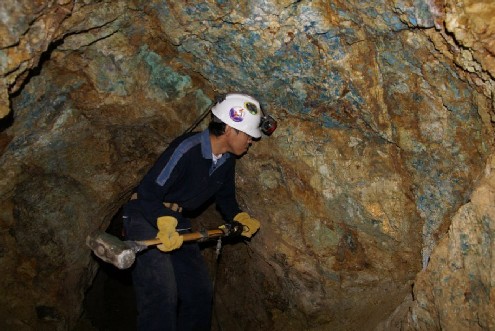
If I were trapped down a mineshaft on the point of imminent collapse, I’m not sure my first instinct would be to thwack the wall with a giant sledgehammer. However, the act of doing this might just save my life…

Scientists at the University of Utah have devised a clever new system in which trapped miners can inform rescuers of their whereabouts through pounding an iron plate on the wall of the mine. Seismic echoes generated by this impact will travel through the mine before being detected by geophones at the surface.

“This is not rocket science; its rock science,” said Gerard Schuster, one of the author’s of a study describing this technique, published in this month’s issue of The Leading Edge, a journal of the society of Exploration Geophysics.

The researchers, from the University of Utah, trialled their system at two different locations. One test was in a utility tunnel beneath the University campus, and the other was in the deeper tunnels of an abandoned copper mine in Arizona.

Both volunteers were safely retrieved, as the researchers report “100 percent accuracy”.

The next step is to test the method in deeper mines, such as coal mines, which can be a few thousand feet deep.

Schuster and his collaborators have a vision that all mines of the future should have their walls lined with sledgehammers and iron plates at regular intervals. Then, should a miner find them self in trouble, they can summon help via the iron gong.

China experiments with solar-thermal power

Construction is due to start next month on an experimental solar–thermal power plant in the shadow of China’s Great Wall that will bring clean energy to 30,000 households by 2010. Built on the outskirts of Beijing at a cost of £10m, the 1.5 MW Dahan plant will cover an area the size of 10 football pitches, and will serve as a platform for experiments on different solar-power technologies.

Unlike photovoltaic solar panels, which produce electricity directly from sunlight, solar–thermal power is based on an array of mirrors that focus the Sun’s rays onto a receiver. Several solar-thermal plants are already operating elsewhere in the world — notably in California’s Mojave Desert and in Granada in Spain — but the Dahan facility will be the first of its kind in Asia.

“The actual amount of power generated is small, but it is a big step for China to go into solar-thermal power generation using its own designs,” says Christoph Richter, site manager of the German Aerospace Centre at the Plataforma Solar de Alméria, a solar-power research centre in Tabernas, Spain.

100 ‘heliostat’ mirrors

The Chinese design relies on 100 curved “heliostat” mirrors that track the Sun’s movement across the sky and redirect light onto a receiver atop a 100m–high central tower. Water flowing through the receiver is transformed into superheated steam, which can then drive electricitygenerating turbines as in a conventional power plant. Surplus energy is stored as heat, with a tank of synthetic oil serving as a reservoir for the high temperature (350oC) heat needed to produce superheated steam, and a second system “downstream” to store heat at lower temperatures.

Such two stage thermal storage boosts the plant’s efficiency, notes Zhihao Yao, a researcher at the Laboratory of Solar Thermal Energy in Beijing and member of the Dahan design team. The oil used in the Dahan storage system is also cheaper than the molten salts used to store heat at the Spanish facility, in part because the salts’ high melting point means that such systems must be drained when the plant is not in use.

Favourable sign

Keeping costs down is important. “In China, the cost for using their own coal is unbeatable, unless you factor in the environmental damage,” says Richter. Another snag is the large amount of land needed. David Faiman, director of Israel’s Ben-Gurion National Solar Energy Center, notes that China’s energy demand increased by about 430 terawatt–hours in 2007, and simply keeping up with this expansion would require devoting about 3000 km2 of the Gobi desert each year to solar-thermal power. Still, the fact that China is investing in solar power on any scale is a “favourable sign”, he adds.

The next step for the Chinese will be to enlarge the Dahan plant to 5–10 MW. This will happen by 2015, deputy project leader Li Xin told physicsworld.com. A separate 1000 MW plant is being planned for the Chinese province of Inner Mongolia, with support from Solar Millennium, the German firm that built the plant in Granada, but this commercial–scale facility is still a few years away.

Dangled DNA reads genetic code

Quantum physics could come to the aid of medical science thanks to a new technique for identifying DNA that utilizes the quantum effect of tunnelling. The method, developed by physicists in the US, will enable users to read genetic codes directly by studying DNA with a scanning tunnelling microscope (STM). This new approach could be developed into a low cost commercial technique for sequencing DNA, say the researchers.

Unlocking the secret of the human genome in 2003 involved more than a decade’s hard graft at a cost of more than $1 bn. The technology that made it possible is known informally as the “shotgun approach” because it involves replicating a strand of DNA millions of times before blasting the replicates into tiny fragments. Computers are then used to piece together a full genome — the genetic profile of a given organism — by matching up overlapping base patterns amongst the DNA shards.

In more recent times the sequencing community has been on the lookout for cheaper, faster and more reliable technologies. This latest effort sees Stuart Lindsay and his colleagues at Arizona State University employ an unusual tool from the world of quantum physics. The physicists exploit the fact that each individual base in DNA has a unique effect on the tunnelling current of a scanning tunnelling microscope (STM).

“This application is very appealing, since tunnelling-based detection has the high spatial resolution to detect individual bases one at a time,” said Tim Albrecht a molecular electronics researcher at Imperial College.

Dangling DNA as bait

An STM involves placing a tiny metal tip very near to a surface of interest and applying a voltage between the surface and tip. Quantum mechanics enables a portion of electrons to tunnel across the gap that, under classical mechanics, they would have insufficient energy to cross. The tip is scanned with great precision across the surface and an image is generated by measuring the current of electrons that tunnel between tip and surface.

DNA’s double helical structure is interspersed with “ladder rungs” which combine the four nucleotide bases — adenine (A), thymine (T), cytosine (C) and guanine (G). These bases exist in DNA in pairs with A pairing only with T, and C pairing only with G. The specific sequence of base pairs in DNA — in the millions for complex organisms — acts as an instruction manual for organisms to build their own bodies.

Key to this new DNA reading technique is the fact that the strength of these bonds differ; A-T pairs are held by two hydrogen bonds, whereas C-G pairs by three hydrogen bonds. Lindsay and his colleagues attach a particular base to the end of an STM and “dangle” it over a sample of DNA. The tip will only bond to the DNA if it is directly above its complementary base. As a result, the tunnelling current fluctuates as the STM tip passes along the sample.

Presenting their findings in Nature Nanotechnology, Lindsay and his collaborators determined that a pattern in the STM image represents a composite of 10 molecules at a time, with the tunnelling currents providing a sort of average stickiness of the hydrogen-bonded pairs.

Getting up to speed

“The basic measurement of DNA base paring electronically has been possible for more than a year, but it has taken to now to understand the mechanism quantitatively,” Lindsay told physicsworld.com.

In moving towards a commercial sequencing technique the next stage is to refine the technique to distinguish between individual bases in a sequence.

“It is an interesting work that elucidates the role of hydrogen bonding to a conducting probe. By itself though it is not a sequencing technique yet,” said Henk Postma , a nano-scale applications researcher at California State University.

Another challenge is that sequencing techniques need to be performed very quickly and the read length — the length of DNA material that can be scanned in one time — needs to be maximized. Some researchers think that this new approach will always be limited by its speed.

“STM-based processes are essentially slow and not cost-effective,” said Changgu Lee a mechanical engineer at Colombia University. “Perhaps the biggest obstacle or challenge for beating conventional techniques will be developing a multiprobe technique — but that seems to be a long way off.”

Do cosmic rays destroy the ozone layer?

New data gathered from satellites and ground-based stations support the idea that much of the destruction of Antarctic ozone involves the action of cosmic rays, says a physicist in Canada. This goes against the widely-accepted notion that the ozone layer — which shields Earth from harmful ultraviolet radiation — is depleted via the action of direct sunlight.

Qing-Bin Lu of the University of Waterloo also predicts, given the timing of the 11–year cosmic-ray cycle, that the ozone hole will be particularly large in 2008–09 and 2019–2020 (Phys Rev Lett 102 118501 ).

Broken up by light or electrons?

Over the Antarctic, ozone concentration has dropped to as low as one third of its pre–1975 levels, with this ozone “hole” occurring during the southern polar spring. The conventional understanding of the depletion process is that chlorofluorocarbon (CFC) pollutants are broken down by the Sun’s ultraviolet light. This occurs at high altitudes (around 40 km), and the CFC fragments are then transported to lower altitudes (below 20 km) via air circulation. In the Antarctic winter these fragments settle on ice particles, where a number of chemical reactions convert them into molecular chlorine. The arrival of sunlight in the Antarctic spring then releases atomic chlorine, which destroys ozone.

There is no need for this extra mechanism because the chlorine can be produced by direct sunlight Neil Harris, European Ozone Research Coordinating Unit

Lu, however, believes that cosmic rays break up the CFCs. He says that when cosmic rays ionize atmospheric molecules the liberated electrons can be stored on the surface of the ice particles and that these electrons, rather than the sunlight, break up the CFCs and convert the fragments into molecular chlorine.

In 1999 and 2001, Lu and colleagues provided evidence to back up this theory by carrying out experiments at low temperatures that showed the breakup of CFCs by electrons is greatly enhanced when the CFCs are placed on a surface along with polar molecular ice. In 2001 Lu also used satellite data to show a correlation between cosmic ray intensity and ozone loss at latitudes between 0 and 65 degrees S. This variation occurred within the cosmic ray cycle taking place between 1981 and 1992.

New data from ground and space

Lu has now improved the case for his model by drawing on more extensive climate data. Using measurements of ozone concentrations taken from NASA’s TOMS and OMI satellites and cosmic-ray data from several ground stations, he has shown that cosmic ray intensity and annual mean total ozone were correlated, at latitudes between 0 and 60 degrees S, between 1980 and 2007 — a period covering two cosmic ray cycles.

He also found a correlation between cosmic ray intensity and the fluctuation in ozone in the Antarctic (between latitudes of 60 and 90 degrees S) from one October to the next between 1990 and 2007.

Any non-cosmic-ray related mechanism, if it exists, must be a very minor or negligible effect Qing-Bin Lu, University of Waterloo

“These correlations mean that nearly 100% of the ozone loss over Antarctica must be driven by cosmic rays,” he says, pointing out that the degree of variation of cosmic ray intensity and Antarctic ozone are very similar (both about 10%). “In other words, any non-cosmic-ray related mechanism, if it exists, must be a very minor or negligible effect.”

2008 prediction

As well as analysing past data, Lu also made a prediction at the time of writing his paper in August last year. He said that the amount of ozone over Antarctica in October 2008 would be about 14.5% lower than it was in October 1992 (his reference point), and that there would also be another significant minimum in 2019–2020. He says the latest satellite data agree with his 2008 prediction to within 5%, and also points out that the Antarctic ozone concentrations in November and December last year were almost record lows.

However, Neil Harris of the European Ozone Research Coordinating Unit in Cambridge, UK, is not convinced. He told physicsworld.com that showing a statistical correlation is not enough to prove the validity of the cosmic-ray mechanism since there could be other causal factors varying throughout the solar cycle. In any case, he says, Lu is wrong to compare cosmic ray intensity against total ozone because measurements of the latter depend on the movement of ozone around the atmosphere as well as the actual disappearance of ozone.

“He has put forward an additional mechanism to explain the creation of atomic chlorine,” adds Harris. “But there is no need for this extra mechanism because the chlorine can be produced by direct sunlight.”


Graphene works as a frequency multiplier

Electrical engineers at Massachusetts Institute for Technology (MIT) have created a carbon-based component which could significantly increase the speed of computers and communication devices, they say. Tomas Palacios and his team have used the “wonder material” graphene — sheets of carbon just one atom thick — to create a frequency multiplier that can double the amplitude of an electrical signal.

“With hindsight, it is hard to believe that no one previously thought of this application,” Andre Geim, University of Manchester

“In electronics, we’re always trying to increase the frequency.” says Palacios, “It’s very difficult to generate high frequencies above 4 or 5 gigahertz,” he says.

This new graphene technology could lead to practical systems in the 500 to 1,000 gigahertz range such as digital and analogue communication devices, radio-astronomy and THz sensing.

Graphene comes of age

Amongst its portfolio of useful properties graphene is a special semiconductor whose electrical state can be adjusted by simply applying a voltage across a region of a graphene sheet — rather than by introducing chemical impurities as in silicon. As a result, some researchers have tried to create transistors that are smaller and faster than traditional silicon-based devices. Indeed, in some cases, transistors have been made for intended use in wireless communication.

Despite these advances, Palacios believes there is a critical limitation in developing graphene transistors — graphene’s very small bandgap will always restrict performance. So, bypassing this obstacle, the researchers focussed on developing graphene frequency multipliers (FM) — a more advanced electronic component which produces an output signal whose frequency is an exact integral multiple of the input signal.

“With hindsight, it is hard to believe that no one previously thought of this application,” said Andre Geim, one of the researchers credited with the discovery of graphene back in 2004.

Flakey wonder

Using mechanical exfoliation — basically, “sticky tape” — the researchers removed flakes from a larger sample of graphene and deposited them onto 300 nm of silicon dioxide with an underlying silicon wafer which acted as the gate for the incoming and outgoing electric currents.

To double the outgoing frequency, Palacios and his team used graphene’s “ambipolarity”. That is, electrons and holes will conduct in alternative half cycles to produce an output signal, whose fundamental frequency is twice that of the input. They applied a certain voltage across the gate in order to make the amplitudes of the electron and hole currents roughly symmetrical. Using this setup they converted a 10 kHz input signal to a 20 kHz output.

“In the last few months, the understanding of the transport properties of graphene has improved considerably — this definitely helped us to create our new device,” Palacios told physicsworld.com.

Striding forward

“From what they have demonstrated, the work is more concrete than other fancier proposals,” said Yu-Ming Lin, a nanotechnology researcher at the IBM T.J. Watson Research Center in New York.

Lin was a bit less optimistic about scaling this effect up to boost the input and output signals by include multiple layers of graphene.

“One of the challenges will be to control of number of graphene layers in the final device… the domain size and the uniformity need to be further addressed and explored in my opinion.”

Palacios told physicsworld.com that his group intend to now recreate their device using graphene grown by chemical deposition on large wafers — a key step towards commercialization.

The findings will be published in the May Edition of Electron Device Letters

Desert-island picks

athene.jpg
Athene Donald, as not seen on a desert island (Credit: University of Cambridge)

By Matin Durrani

Sadly I missed the appearance of my former PhD supervisor Athene Donald on the legendary BBC radio programme Desert Island Discs last Sunday.

The show, which has been running for over 65 years, features a celebrity or noted figure who picks their eight top records that they’d like to take with them as a castaway on a desert island. They also get to pick a luxury and a book.

The show’s website lists Athene’s choices, which unfortunately do not include any physics-related material that I could have made an amusingly weak comment about.

So there is nothing by astrophysicist-turned-rock-legend Brian May from Queen or by the former D:REAM keyboardist Brian Cox, who is now a particle physicst at Manchester University.

Donald, a polymer physicist at Cambridge University in the UK, also didn’t pick anything by Canadian band The Nylons or new Glasgow indie outfit We Are the Physics. Nor was there anything from Olivia Newton-John, whose grandfather was Max Born.

What she did pick though are pieces by mainstream composers like Beethoven, Mozart, Haydn, Schubert and Vaughan-Williams, with three left-field choices from Irving Berlin, Enrique Grandos and Paul Hindemith (no I’d never heard of him either).

The closest I can get to a physics pun is that the Irving Berlin piece she picked was “Blue Skies”, which perhaps reflects the kind of basic research she does.

You can catch up with a repeat of the show on Friday 27 March at 9.00-9.45 a.m. GMT.

(more…)

Copyright © 2026 by IOP Publishing Ltd and individual contributors