Nanotubes flex their muscles

A new type of artificial muscle made from carbon nanotubes has been developed by researchers in the US. The muscles flex when electrically charged and can expand to 220% of their original length in a matter of milliseconds. The devices could find use in medical and aerospace applications, and perhaps even in robots of the future.

Carbon nanotubes (CNTs) are tiny tubes with radii of just a few nanometres and walls as thin as a single carbon atom. Ray Baughman and colleagues the University of Texas at Dallas created their artificial muscle by starting with a “forest” of CNTs, which all are aligned in the same direction. CNTs at the edge of the forest are pulled away in a direction perpendicular to the CNT alignment (see figure). This creates an aerogel-like material with a density of just 1.5 mg/cm3, which is not much heavier than air (Science 323 1575).

The aligned nanotubes can be transformed into carbon nanotube aerogel sheets at rates of up to 2 m/s. The sheets can be as much as 1 m in length.

‘Unprecedented degree of anisotropy’

The finished material expands like a stretched sheet of rubber when electrically charged, while remaining extremely stiff and resistant to bending. “This apparently unprecedented degree of anisotropy is akin to having diamond-like behaviour in one direction and rubber-like behaviour in the others,” says John Madden of the University of British Columbia, who was not involved in the work.

The devices operate over a range of temperatures — 80–1900 K — that previous artificial muscles could only dream of, and can expand and contract at rates that are around 1000 times higher than those for natural muscle. They also generate a force that is 30 times bigger than that exerted by natural muscle.

Together these properties mean that the muscles might be used as actuators in medical and other devices, as well as in electrodes for solar cells, light-emitting diodes and displays. They might also find their way into future robot arms and legs.

Their ability to function over extreme temperature ranges may also make them attractive for aerospace and space applications, say the researchers.

US energy boss reveals $1.2bn spending plans

New US energy secretary Steven Chu has outlined how the Department of Energy will spend $1.2bn of the $1.6bn in research funding provided by the American Recovery and Reinvestment Act, which became law in February. Chu says most of the money for science from President Barak Obama’s stimulus package for 2009 will be spent on accelerating the progress of existing “shovel-ready” research projects and lab construction programmes.

The package includes $277m for Energy Frontier Research Centers. These are small-scale research projects at universities and national labs that focus on creating new technologies for generating and distributing clean energy. The programme, which will award grants worth $2-5m per year over a five-year period, was originally put forth by the Bush administration with a budget of $100m per year.

US national labs will receive $830.2m thanks to the act, although a large fraction — some $688.2m — had already been promised to the facilities. Winners include the Brookhaven National Laboratory in New York, which receives $184.3m. Most of this will be spent on accelerating the construction of Brookhaven’s National Synchrotron Light Source-II, which is expected to begin this year.

Upgrades and infrastructure

Another big winner is the Pacific Northwest National Lab in Washington State, which will get $124m to allow it to buy equipment for its Environmental Molecular Sciences Lab and ARM Climate Research Facility. Meanwhile, the Lawrence Berkeley National Laboratory in California, which Chu headed before joining President Obama’s cabinet, will gain $115.8m to advance the construction of a user-support building for its existing Advanced Light Source synchrotron facility.

The Thomas Jefferson Lab in Virginia will get $75m, which will mostly be spent on a planned upgrade of the lab’s Continuous Electron Beam Facility to run at 12 GeV instead of the current 6 GeV. The project, which is scheduled to begin next month, should be completed in 2015.

Fermilab in Illinois will receive $34.9m to hasten the construction of the NOvA underground neutrino detector in northern Minnesota. The Oak Ridge, SLAC, Ames and Argonne national labs will also benefit from the stimulus package. Finally, some $90m has been allocated to support graduate students and scientists across the US. Chu has also committed $69m to create a 100 Gbit/s data network linking US research centres.

Speaking at Brookhaven yesterday Chu said the money “will create thousands of jobs and breathe new life into many local economies, while helping to accelerate new technology development, renew our scientific and engineering workforce, and modernize our nation’s scientific infrastructure”.

Initiation rites

Chu, who shared the 1997 Nobel Prize for Physics for his work on atom cooling and trapping, is one of several scientists to join Obama’s Administration. His appointment was widely welcomed by physicists, although Chu was quoted yesterday in the New York Times as saying that his initiation to the cut-throat world of Washington politics has been like being “dumped in the deep end of the pool”.

Chu, a keen supporter of biofuels, is keen to end US dependence on carbon-based fuels and speed up its action on climate change. “If we don’t spend this money wisely and invest in new technology that addresses these challenges,” he told the New York Times, “we will have failed the country. We will have failed the world.”

Last week the plasma physicist John Holdren was finally sworn in as Obama’s science advisor. Also last week, Obama nominated another physicist to his administration – theoretical physicist Steven Koonin has been tipped as Under Secretary of the DOE. Koonin has been Chief Scientist at the oil company BP since 2004 and before that was at Caltech for 29 years.

Technique to mass produce metamaterials

Researchers in Taiwan and the US have developed a technique that could lead to the large-scale production of optical “metamaterials”. The team used the technique, which is based on a well-established deposition method, to fabricate thin films of silver nanorods on a silicon substrate. The resulting composite material can manipulate light in unusual ways and could enable a range of applications in the photonics industry, say the researchers.

“Our technique should couple naturally with much of microelectronics” Akhlesh Lakhtakia, Pennsylvania State University

Metamaterials are materials that have been artificially engineered to have unusual electromagnetic properties. They have generated a lot of interest in the last few years, largely because they could produce exotic applications like invisibility cloaks and “superlenses” – that have higher resolution than traditional correction lenses. Unfortunately, the metamaterials made so far have only worked over a limited range of frequencies and are difficult to produce in large quantities.

Taking a different approach, Yi-Jun Jen of Taipei University of Technology, Taiwan, and his colleagues, have turned their attention to a more established production technique known as “oblique angle deposition” (OAD) which is widely used in the photonics industry to deposit thin films. It involves depositing vapour at an angle onto a substrate held in a vacuum.

Emerging from the shadows

Jen and his colleagues first vaporized a block of silver by firing electrons into it and then directed the vapor at two-inch substrates of silica material. Deposits tend to accumulate in patches on the substrate but — at certain angles to the substrate norm — nanorods can grow preferentially towards the incoming vapor because of the “self-shadowing effect”.

The film thickness was 240 nm and the angle between the normal to the substrate and the tilt of the nanorods was maintained at 66 degrees. Silver nanorods were grown to about 650 nm long and 80 nm wide.

The researchers then determined the optical properties of the film by illuminating it a number of times with light at wavelengths between 300 and 850 nm. They found that light between the wavelengths 532nm and 690 nm was refracted negatively but say that – in theory – almost all visible light (380 to 750 nm) could be negatively refracted (arXiv 0903.1177v1 ).

Simple is best

“Of course, such films had been grown by others but no one thought to characterize them as biaxial dielectric-magnetic materials,” said Akhlesh Lakhtakia , one of the researchers, at Pennsylvania State University.

“Their results are interesting because of the simplicity on the fabrication of the layers of nanorods,” said Jaime Gomez Rivas of the Nanowire Photonics group at the AMOLF Institute in Eindhoven.

Lakhtakia told physicsworld.com that the next step is to explore the effect of morphology and start developing layered structures to avoid energy attenuation.

“Since OAD technology is a planar technology, this production method should couple naturally with much of microelectronics,” he added.

Webcasting physics

dark matter.jpg
Teachers discuss dark matter at the Institute

We all know the stereotype of a physics lecture – a bearded befuddlement of equations and geeks.

Today the Institute of Physics has been doing its bit to blow this image out of the water by webcasting lectures given by two eminent physicists at the Institute’s headquarters in London.

First up was Damian Pope – of the Perimeter Institute for Theoretical Physics in Canada – discussing the latest findings and debates in the world of dark matter. Then Richard B Jackman of University College London talked about nanoscience and its potential applications across fields from healthcare to aerospace to jewellery-making. He also addressed some of the fears of nanotech purported by the mainstream media.

If you missed the webcasts then don’t fret – they can still be accessed from this link.

I spoke with Joe Winters, senior press officer at the Institute, which publishes Physics World. He told me that both speakers had been carefully selected; Damian Pope has a long history of public engagement projects and Jackman is a highly regarded interdisciplinary researcher.

The lectures themselves were attended by teachers of A Level physics classes, which, typically comprise 16-18 year olds. “Many of the teachers present are the only physics teachers in their school and days like this give them an opportunity to meet physics counterparts from other schools,” said Winters.

“Through webcasting the talk, we hope that we can help physics teachers from all over the UK and not just those in London,” he added.

Happy birthday, JPCM!

jpcmjpg.jpg
Metal letters defy gravity as Jocelyn Bell Burnell addresses the crowd

The world-famous IOP Publishing journals reception was held last night here in Pittsburgh — and this year revellers were toasting 20 years of the Journal of Physics: Condensed Matter.

The history of the journal can actually be traced back a further two decades to 1968, when the Journal of Physics C: Solid State Physics was born. This publication merged with Journal of Physics F: Metal Physics (launched in 1971) to create JPCM in 1989.

The Institute of Physics chief executive Robert Kirby-Harris was on hand to introduce the Institute’s president Dame Jocelyn Bell Burnell (above) — who addressed the throng of journal board members and other friends of IOP Publishing.

One person who wasn’t there was Richard Palmer , who recently retired from IOP Publishing. Richard worked on the journal and its predecessors for 37 years — and was awarded an MBE in 2006 for his services to scientific publishing.

And yes, there was a cake but sadly it was cut before I had a chance to snap a picture. I hope someone saved a piece for Richard!

Seeing chemicals at the nanoscale

Physicists in Japan have developed a new technique for determining the identity of groups of individual atoms. The technique is an improvement on existing characterization methods in microscopy, which can only detect the positions of atoms and not their specific chemical type. It has been used by the researchers to detect the composition of a substance to a resolution of 10 nm.

Dubbed Synchrotron Radiation Scanning Tunnelling Microscopy (SRSTM), the new technique has been developed by Taichi Okuda and colleagues at the Institute and the University of Hyogo, in Japan. It involves placing a sample of interest in the intense x ray beam of a synchrotron source.

Photons from the beam excite core electrons in the sample’s atoms, which then spit out “secondary” electrons as they decay back down to their ground states. These secondary electrons are then detected by the tip of the scanning tunnelling microscope (STM) as they tunnel across the gap. The size of the current depends on the specific type of atom that has produced the secondary electrons, which means that each element has a unique “fingerprint” (Phys. Rev. Lett. 102.105503).

The Japan team tested its technique on a checker board-patterned sample of nickel and iron on a gold film. Each square of nickel and iron was one micron wide and 10 nanometres thick. Using the BL-13C beam line at the KEK Photon Factory in Japan, they found they could distinguish the individual elements with a spatial resolution of just 10 nm.

“We are now trying to further improve the spatial resolution and signal-to-noise ratio in our technique,” Okuda told physicsworld.com. “We will also apply the method to magnetic materials and observe magnetic domain structures,” he added.

How to focus a tsunami

wave.jpg
The 2004 tsunami strikes Thailand: was the wave focussed by underwater features? (Courtesy: David Rydevik)

By Hamish Johnston

One terrifying thing about the Asian Tsunami of 2004 is that some coastlines were devastated, while others had much less damage inflicted on them.

That got Bristol’s own Michael Berry thinking about whether such massive waves could be focussed by underwater features towards unfortunate places.

In an invited talk at the APS March Meeting here in Pittsburgh, Berry took us through the mathematics of how an underwater island could focus a tsumani at a region where it would unleash ten times more energy than had it not been focussed. The effect occurs because the change in depth associated with the island affects the wave much like a change in refractive index at the surface of a lens.

The intitial conditions — island size; distance to the source of the tsunami; and the size of the source — affect the degree of focussing. Berry found that in some cases the island scatters the tsumani and reduces the energy in the region directly in front of it.

Berry described this effect as “very significant and something that should be taken into account” by those investigating the possible effects of such waves.

He left us with the scary thought that a wave created by a well-placed manmade explosion at sea could in principle be focussed at unlucky coastal dwellers. Let’s hope that never happens.

Beautifully hewn experiments

georgeh.jpg
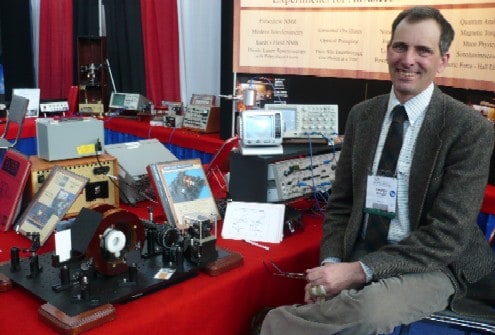
George Herold and Teach Spin’s spectroscopy experiment — note the wooden coil holders and the detail in the optical table’s wooden feet.

torsionj.jpg

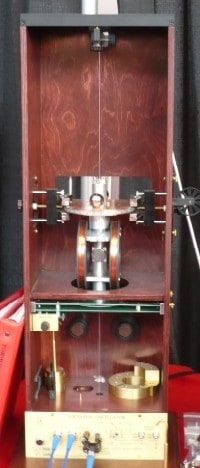
I was strolling though the exhibition here at the March Meeting when my eyes were drawn to a collection of beautifully-crafted lab equipment.

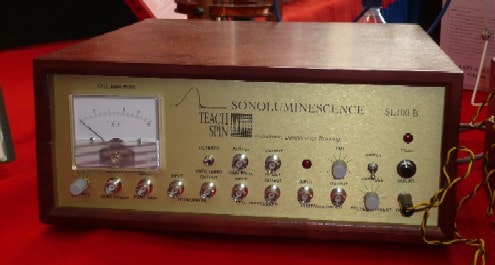
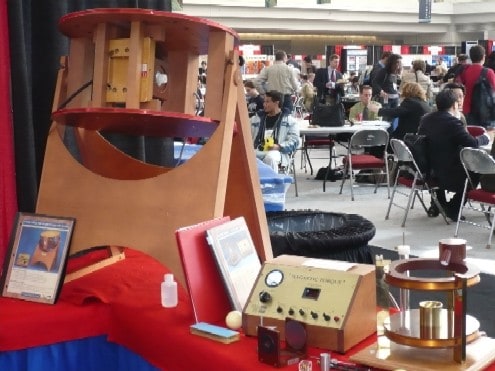
Housed in polished wooden cabinets and sporting retro dials and script — the equipment is made by Teach Spin of Buffalo New York.

Now when I was an undergraduate I thought that all that wooden kit was ancient (even back then) but it turns out that at least one company is lovingly building the stuff.

The company’s research physicist George Herold gave me a demonstration of a spectroscopy experiment (above) and a torsion pendulum (right). You can read all about the latter in the compay’s latest newsletter

According to Herold, the company has its own carpenter — how many scientific equipment companies can say that?

Below are a few more photos from Teach Spin’s stand.

sonoj.jpg

bigcoilsj.jpg

Stars in his eyes


Can you tell me a bit about what the Public Astronomer does on a typical day?

That’s a tricky question because it really does vary so much. I guess my two key roles are, firstly, to ensure that our exhibits and programmes here at the Royal Observatory are accurate and up to date, and, secondly, that everything we present is clearly explained to the outside world. In practice this means that I could spend a morning with primary-school kids helping to run an astronomy workshop, then spend the afternoon with the media trying to explain the latest findings of the Cassini space programme or in a meeting to plan a new exhibition of astronomy images.

What made you pursue a career in explaining science to the public?

It was something I started to get into while I was a postdoctoral researcher at the UK’s other Royal Observatory in Edinburgh. As well as my research on galaxies, I was giving public lectures, talking to school groups and writing a couple of astronomy articles aimed at the general public. It was then that I began to realize that I had a passion for communicating astronomy to an audience beyond the research community. So, I suppose the main reason is because I really enjoy doing it.

What can visitors expect from the Royal Observatory exhibitions?

Well, the observatory gets over a million visitors per year, so we really are trying to cater for everybody here. For many years we’ve had the Time galleries alongside the Meridian line; these tell the story of the quest for longitude and showcase the history of Greenwich Mean Time. These are the kind of stories that can be told really well in a traditional museum setting, but then two years ago the observatory underwent a £16m expansion that included a new interactive centre focusing on contemporary astronomy research — the Weller Astronomy Galleries — and the brand new laser-powered Peter Harrison Planetarium, which is currently the only public planetarium in London. With these new facilities we now have the opportunity to showcase astronomy as a living, changing science and one that is practised by real people who make their careers by understanding and explaining the universe. Our galleries and planetarium shows help explain many of the latest discoveries and techniques in astronomy, and kids particularly love the interactive elements. And given the observatory’s long history, we’re able to place the modern science in its historical context.

Do you think astronomy would benefit from more engagement with the media?

I think it’s gradually becoming a more important aspect of research, and obviously the International Year of Astronomy gives everyone a fantastic opportunity to get their research out there to the general public. in addition, I think that if researchers do get involved with public-engagement projects, then it can help them when it comes to applying for research funding. If you can make your research sound exciting, relevant and comprehensible to a tabloid journalist or a bunch of surly 14 year olds, then suddenly a panel of academics doesn’t seem quite so scary.

But do you think some researchers don’t want to or aren’t cut out for this?

Obviously it’s a matter of individual choice, and some researchers will be happier just getting on with their work without having to deal with the media. But from my own experience, I think a lot of scientists would like to see their research publicized — they just don’t always have the time to do so, or perhaps they’re simply unsure how to go about it. In fact, these are issues that we’re looking to address here at the Royal Observatory by providing a stage on which researchers can present their discoveries to a wider audience, as well as offering backing and support for busy academics who maybe don’t have the time or the experience to organize public events by themselves.

Can you see yourself returning to research one day?

I certainly wouldn’t rule it out. I’m actually very lucky with this job because it does include the provision for me to carry out my own research, should I choose to do so. Having said that, I can’t imagine I’ll find time this year…possibly next year? To be honest though, I don’t miss academia that much right now and that’s mostly because I’m learning so much through this job. I trained as a radio astronomer studying distant galaxies, but I get asked to comment on literally all aspects of astronomy and cosmology — I’ve really had to read up on all my science and not just physics. The Royal Observatory was founded at a time when it was still just about possible for an individual to know everything there was to know about astronomy, but that’s obviously no longer the case. In effect I’m constantly researching and learning — which is about as exciting as it is daunting.

What do you see as the most exciting areas of astronomy?

There are so many exciting areas that it’s very difficult to pick just a few. However, I do think that there are three “big questions” that have intrigued people for centuries and where significant progress is finally being made during our lifetimes.

The first is about how the universe began and how it evolved into the clumpy distribution of galaxies that we see today. The second addresses how common planetary systems around other stars are, and how many of these resemble our own solar system. And the third concerns the origins of life here on Earth and the prospects of finding it elsewhere in the universe. We currently know so much more about each of these fundamental questions than we did, say, 15 years ago and the pace of discovery is almost dizzying — even though we can’t tell how close we are to final answers.

As the search for life on other planets becomes more focused, do you think physics education will need to adapt to become more interdisciplinary?

For me, one of the most exciting aspects of contemporary research is the way that it sometimes crosses traditional subject boundaries — astrobiology is a great example of this. And certainly when I go into a school to talk to a physics class about astronomy, it’s always fun to throw in a bit of biology or chemistry — you can see a dawning realization that “Oh, these subjects are connected…they’re all part of a bigger picture”.


Nanotubes and desalination

Is there anything that carbon nanotubes can’t do?

I know I’ve asked that question before — but I can’t stop being amazed at the fantastic properties of the tiny tubes.

This morning I heard Olgica Bakajin of Lawrence Livermore National Lab describe how she made a water filter using carbon nanotubes.

She did this by growing a forest of nanotubes on a silicon substrate and then filling in the gaps between the tubes with a nitride material.

After removing the silicon substrate, her team were left with a thin film that is permeated by nanotubes with an average diameter of about 1.6 nm — each of which turns out to be an excellent conductor of water.

Indeed, experiments showed that water flows through the nanotubes about four times faster than what would be expected from simple pipes.

The reason, according to Bakajin, is two fold. Firstly the walls of the nanotubes are hydrophobic — water molecules avoid the walls — which reduces drag. Also, the nanotubes are exceptionally smooth, again reducing drag.

And if that wasn’t good enough, the team found that the nanotube filters are very good at removing ions from water as it passes through. Bakajin thinks that the broken bonds at either end of the tubes attract the ions.

As a result, the filters could play an important role in the desalination of seawater — Bakajin’s filters were able to remove 40% of the chloride ions at a relatively high flow rate. This means that they already outperform commercial nanofilters.

The filters could be improved significantly by increasing the density of nanotubes in the filter; and optimizing the ends of the nanotubes for removing salt.

All of could mean highly-permeable filters that would reduce the amount of energy required in a desalination facility — perhaps making it economically viable.

Copyright © 2026 by IOP Publishing Ltd and individual contributors