Cooling polar molecules

polarscheme.jpg
How to cool polar molecules

By Hamish Johnston

Talks at the APS are very hit and miss — especially for someone like me who wants a gentle introduction to a field rather than a full-on blitz of data and equations.

However, some talks are pure gold…it was definitely worth getting up early to hear Silke Ospelkaus’s 8 am lecture on how to create a gas of ultracold polar molecules.

Physicists have already perfected cooling atomic gases to very low temperatures using lasers — leading to a renaissance in the study of quantum systems.

Polar molecules are attractive because unlike ultracold atoms, they interact via long-range forces and thefore could be used to investigate a broader range of quantum phenomenon.

But molecules pose an additional challenge because they have rotational and vibrational energy, which must also be removed.

Although one could try to cool the atoms directly — or cool individual atoms and then combine them to make molecules — but both of these approaches have their problems.

According to Ospelkaus — who is at JILA in Boulder, Colorado — there is a better way. Her team began with “Feshbach molecules” which are made by taking ultracold potassium rubidium atoms and binding pairs together very weakly by applying an external magnetic field.

Although the molecules are ultracold, the separation between atoms is great, which means that they have a tiny dipole moment.

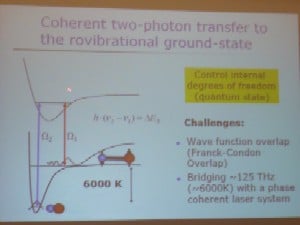
The next step is to gently coax the Feshbach molecules into the ground state of potassium-rubidium, which has a much higher dipole moment. This is tricky because there is very little overlap between the states. To get around this problem, Ospelkaus and crew shunted the Feshbach molecules into a third state that overlaps the two.

Easy right? Except that transition requires a 125 THz laser — and such things don’t exist!

Undaunted, Ospelkaus used the “beating” of two lasers to obtain light at the right frequency.

So after all that, did they manage to create a “quantum degenerate” gas?

Not quite, the team managed to get the molecules as cold as 400nK, whereas the onset of degeneracy is at about 100nK.

But now that they have a nearly degenerate gas of polar molecules Ospelkaus believes that it could be cooled further by applying electric fields.

…who said this sort of work was complicated?
Pollution writ in stone

P1000316.JPG
Once a treasure trove of pollutants

By Hamish Johnston

Earlier today I caught a few talks in a session called “The Greening of Pittsburgh”.

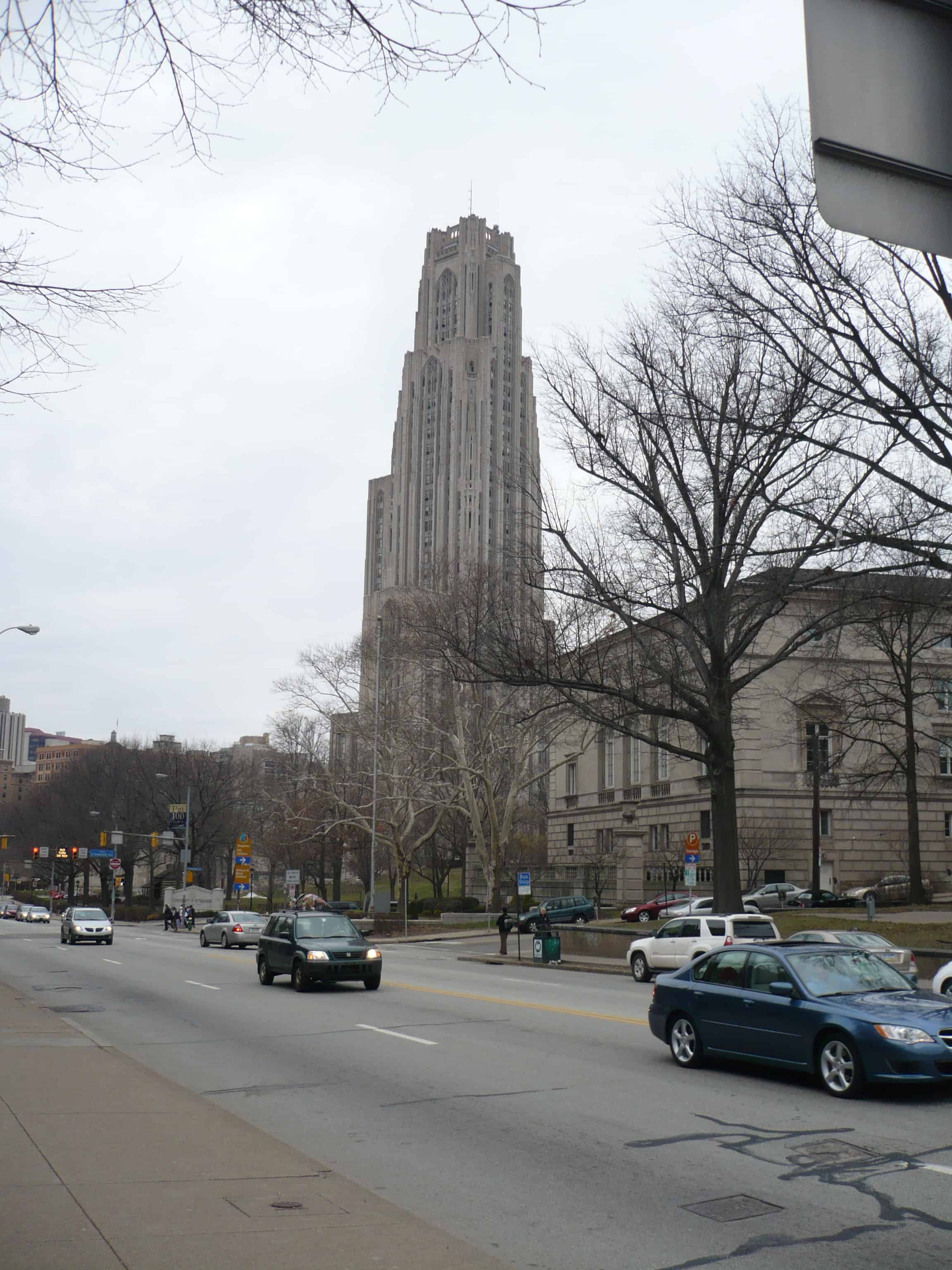
One talk could have been called “The Cleaning of the Cathedral of Learning” because it focused on how that building’s limestone facade was first blackened by smoke and then blasted clean by the rain.

The study of the Pittsburgh landmark was done by Cliff Davidson and colleagues at Carnergie Mellon University, who looked at historical photos of the building; took samples of the material staining the building; studied how the building is affected by driving rain; and did computer simulations of the wind patterns around the building.

They found that just a few years after the cream-coloured building was completed in 1930 it was completely blackened by smoke. But around 1945 the city began to enforce anti-smoke rules and by 1950 erosion caused by driving rain was beginning to clean the 42-storey building.

The team using wind and rain measurements and simulations the team were able to understand why some sides of the building were getting cleaner, while others remained relatively sooty — because they were exposed to pollutants from a nearby steel works. This was confirmed by studying the chemical composition of the staining, some of which was iron-based.

Sadly, the study came to an abrupt end a few years when the University of Pittsburgh had the entire building sand-blasted clean.

In a different study, Davidson and colleagues discovered that about 75% of particulate-matter pollution in Pittsburgh today comes from outside the city — mostly from coal-fired generators in the Midwest as far away as Iowa.

So if you have a bad air day it Pittsburgh — or anywhere else in Eastern North America — it’s probably because millions of people to the west of you are turning up their air conditioners.

What physicists can learn from industry

adam.jpg
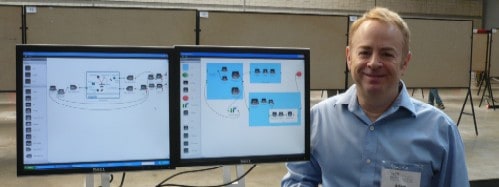
Adam Kollin shows off R9

By Hamish Johnston

If you are struggling to get your experiment to work, you might want to pop into a local manufacturing plant or hospital for a few tips.

That’s the impression I was left with after a fascinating conversation with Adam Kollin — the founder and president of RHK Technology.

The company makes atomic force microscopes. But it is probably most famous for its control units — ultraprecise electronics that allow AFMs to resolve single atoms on a surface.

An AFM works by positioning a tiny tip with great precision near the surface of a sample. The tip is designed to vibrate at a certain frequency, and properties of this vibration change depending on the structure of the nearby surface.

An image is taken by moving the tip from one place to another — but this also affects the vibrations — so its important to let the tip settle down for a while before making a measurement. The key to making a rapid scan is to wait long enough to achieve the desired resolution, but not too long or the scan will take forever.

Physicsts that use AFM had worked out a way to deal with this problem, but according to Kollin they had it all wrong. He knows this because he happened to be talking to an engineer with a background in automated manufacturing.

It turns out that robots used in manufacturing suffer from the same problem — their arms move quickly from one place to another and then settle down to perform a very precise function. And the engineers who design manufacturing lines have devoted alot of time to understanding the best way to do this.

According to Kollin, RHK Technology has embraced this knowledge to improve its products — as well a borrowing ideas from medical imaging and particle physics.

Gravity probe blasts off

A mission to make a very high-resolution map of the Earth’s gravitational field has blasted off today at 15:21 local time from the Northern Russian Plesetsk Cosmodrome. The €350m Gravity Field and Steady-State Ocean Circulation Explorer (GOCE) will produce a much improved model of the “geoid” — the gravitationally-defined surface that Carl Friedrich Gauss described as the “mathematical figure of the Earth”. GOCE, launched by the European Space Agency, will fly at an altitude of just 250 km and operate for 20 months.

The gravitational force at the Earth’s surface, g, does not have a constant value but varies across the planet. The most significant variation is due to the Earth’s spin, which causes it to bulge very slightly at the equator, meaning that the surface at this point is further from the planet’s centre – by about 20 km – than it is at the poles. Due to this – and also to an unequal distribution of mass inside the Earth – g is 9.83 m s–2 at the poles but only 9.78 m s–2 at the equator. Other, more minor, influences cause smaller variations in g – for example, mountains and ocean trenches lead to fluctuations at the third decimal place.

Associated with these fluctuations in g is a representation of the Earth’s surface known as the geoid. This is defined as the surface of equal gravitational potential and follows the surface of the ocean without any tides and is the basic ellipsoid shape of the Earth but with very smooth, shallow bumps and depressions superimposed on top of it, according to the local variations in gravity. For example, the extra mass in a mountain 2 km in height under the sea attracts water over it to produce a bulge in the sea surface some 2 m high and 40 km across.

Plotting the variations in g itself could allow scientists to improve their understanding of geophysical processes, such as earthquakes. Mapping the geoid, on the other hand, provides a base reference – or 0 m sea level – throughout the world and lead to a better understanding of ocean circulation, and hence climate. This is because local values of the geoid can be subtracted from radar measurements of the sea level to reveal the heights of waves around the world, and this surface behaviour can then be combined with data on the topography of the sea bed to calculate currents and heat flows through the oceans.

To measure gravitational fluctuations over large distance scales, but at low resolution, GOCE will continuously record how its orbit changes – and therefore how its pull towards the Earth changes – with respect to GPS satellites. To fill in the details of fluctuations over smaller scales, GOCE will sense the minute differences in acceleration experienced by three pairs of proof masses held at the ends of arms 50 cm long inside the spacecraft. In this way, the mission should measure g to an accuracy of 10–5 ms–2 and of the geoid to an accuracy of 1–2 cm, with both sets of measurements plotted with a resolution better than 100 km.

GOCE’s resolution will be far better than earlier gravity-measuring satellites, such as the US–German GRACE mission, launched in 2002, that was limited to a resolution of 600 km. GOCE mission manager Rune Floberghagen says that although GRACE can record changes in the Earth’s gravitational field over time, allowing it to observe the melting of polar ice caps for example, its lower resolution means that it cannot study ocean circulation in great detail, as GOCE can. “The GRACE mission delivers low-resolution movies of gravity-field variations,” says Floberghagen, “while GOCE will deliver an ultrahigh-resolution snapshot.”

Diapers, DNA and very few knots

diapersj.jpg
diapersj.jpg

By Hamish Johnston

Many important biological processes involve the packing and unpacking of long stringy molecules such as DNA into very dense structures.

One of the most amazing aspects of this little-understood process is that the stringy molecules don’t get all tied up into a mess of knots.

According to Alexander Grosberg of New York University — who was speaking about this knotty issue this morning — collapsing proteins are thought to form 19 distinct types of knots. Compare this to simple chains of the same length, which can get knotted up in about 3000 different ways.

“Evolution avoids or supresses knots in proteins”, he declared.

Grosberg argues that physicists need a new model for describing how biomolecules collapse. The key features, he says are the process being driven by pressure from the outside — and a mathematical way of avoiding knots.

One approach he has taken is to model proteins as rings instead of single strands. Why this seems to work was beyond me, but Grosberg seems to have made some progress in describing the collapse mathematically.

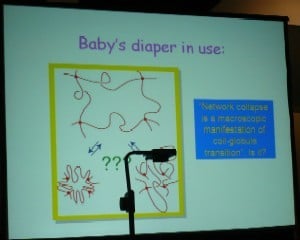
And what does this have do do with diapers? Well it seems that the water-hungry material in nappies undergoes a similar collapse — but as the photo above suggests, the actual process of compaction is unknown.

Quantum friction: does it exist after all?

For several decades physicists have been intrigued by the idea of quantum friction — that two objects moving past each other experience a friction–like lateral force that arises from quantum fluctuations in the vacuum.

Several independent groups of physicists have previously calculated that quantum friction could arise from the Casimir force between two plates — when those plates move relative to one another. There is also some indirect experimental evidence that such a lateral force exists.

Now, however, researchers in the UK having performed detailed calculations, which they claim show that there is no lateral force and that quantum friction therefore doesn’t exist.

In 1948 Dutch physicist Hendrik Casimir worked out that two uncharged, perfectly conducting metal plates placed in a vacuum should be attracted to one another. This force arises from the fact that, according to quantum mechanics, the energy of an electromagnetic field in a vacuum is not zero but continuously fluctuates around a certain mean value, known as the “zero–point energy”. Casimir showed that the radiation pressure of the field outside the plates will tend to be slightly greater than that between the plates and therefore the plates will experience an attractive force.

Reflection leads to friction?

Evgeny Lifshitz generalized Casimir’s prediction for real materials in 1956, and for the last thirty years researchers have also tried to calculate what happens to the Casimir force when the plates move relative to one another with uniform velocity. The electromagnetic waves, or modes, that exist between the plates bounce back and forth off the plates and this reflection will be affected by the motion of the plates.

Physicists agree that this changing reflection alters the now familiar perpendicular component of the Casimir force, but a number of researchers have also calculated that there should be a lateral force between the plates, a quantum-mechanical friction that could potentially be of great interest to engineers trying to improve the performance of ultra-small mechanical devices.

For example, John Pendry of Imperial College in London has calculated that differences between the Doppler shift of two modes reflecting off moving plates in different directions can lead to a frictional force if the reflectivities of the surfaces depend on frequency.

However, Thomas Philbin of the University of St Andrews says that trying to calculate this modified Casimir force is extremely difficult and that previous efforts to do so have not been satisfactory because they have used approximations. Working with his colleague at St Andrews, Ulf Leonhardt, he has used Lifshitz’s theory to carry out what he claims is an exact calculation and shows that there is no lateral force (arXiv:0810.3750v2, to appear in New Journal of Physics).

Thought experiment

To illustrate the feasibility of this result in very general terms, Philbin describes a thought experiment using what is known as a “bi-anisotropic medium”. This is a material in which electric fields or magnetic fields applied separately will induce both magnetic dipoles and electric dipoles in the material, and that such a medium at rest is the equivalent of a certain kind of non bi-anisotropic material in motion.

Philbin then considers building caterpillar tracks from this bi-anisotropic medium and imagines what would happen when the tracks are placed on some other arbitrary medium — as far as electromagnetism is concerned, he says, the tracks are then moving. He goes on to argue that if quantum friction existed these tracks would experience a lateral force and therefore start to actually move, and that they would continue to move indefinitely, thereby performing the impossible — extracting unlimited energy from the quantum vacuum.

“If quantum friction existed one could think about trying to manipulate and engineer it, as experimentalists are now doing with the Casimir force between non-moving objects,” says Philbin. “But since it doesn’t exist this possibility disappears.”

Pendry, however, defends his work, maintaining that he derived his result using two completely different lines of argument, and that these were also backed up by independent research. In addition, he says that quantum-frictional effects have been observed experimentally, albeit indirectly, in resistance measurements of a device consisting of two field-effect transistors placed one above the other and separated by a very small insulating gap.

Climate roulette

roulette fin.jpg
Is the climate gun already loaded?

By James Dacey

Mankind is playing a Russian roulette with the climate, according to a study published today in the Proceedings of the National Academy of Sciences.

Elmar Kriegler of the Potsdam Institute for Climate Impact Research and his colleagues sought to find out what leading scientists really think will happen to the climate.

So Kriegler surveyed 43 scientists to gauge the impact of rising temperatures on five major components of the global climate system.

They calculate a one in six chance that a “tipping event” will occur if the temperature increases by two to four degrees in the next two hundred years.

The five systems concerned are:

Major changes in the North Atlantic Ocean circulation
The Greenland and West Antarctic ice sheets
The Amazon rainforests and El Nino.

They define a tipping point as “the event of initiating the transition, or making its future initiation inevitable”. Essentially they are saying that beyond these points the climate will reach a kind of elastic limit – beyond which, we will feel the wrath of the climate and there’ll be nothing we can do about it.

Realising that previous surveys have been met with a fair degree of apathy they used “imprecise probabilities” – a part of Bayesian statistics.

This new mathematics has been controversial but advocates say it can weigh up a given hypothesis in a more rounded way than classical statistics.

Developed in the 1980s and 1990s Bayesian statistics seem to have gained most traction in the field of operations research and economic decision making.

“The currently discussed long-term targets of 50% reduction globally by 2050 (and 80% reduction for the industrial countries), with a continuing reduction after 2050 is an important step in this direction, but does not guarantee the reaching of the 2 degree target,” Kriegler told physicsworld.com.

This may sound like a very gloomy forecast but Kriegler was a bit more pragmatic about taking co-ordinated international action:

“Nevertheless, these [targeted reductions] are a useful benchmark to focus the minds of politicians and society. Reaching this goal requires at least the following – in the order of importance:

1) A massive decarbonisation of the energy system, starting in the electricity sector;
2) A strong increase in energy efficiency;
3) A stop to tropical deforestation, and an increase of the forest area in the tropics in the long run;
4) A massive reduction of CH4 and N2O emissions from the agricultural sector.”

Fancy a bacterium wrap?

wrap.jpg
wrap.jpg

By Hamish Johnston

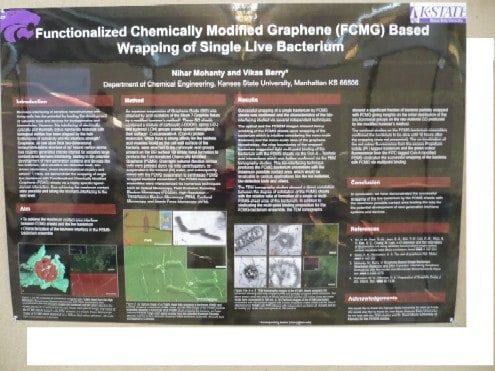
I came across this fantasic poster this afternoon. It tells how Vihar Mohanty and Vikas Berry went about wrapping a live bacterium in a sheet of graphene.

The point of the work, which was done at Kansas State University, is to explore ways of combining manmade nanodevices with naturally occuring ones such as bacteria. This could lead to “bio batteries” in which biochemical processes within bacteria could be tapped as a source of energy for tiny devices — allowing such devices to operate within the body for example.

A big challenge in this kind of bionics is getting the nanostructure to stick to the bacteria. What Mohanty and Berry did was use graphene oxide — a sheet of carbon and oxygen just one atom thick — which has has an affinity for certain molecules found on the surface of bacteria. By mixing the bacteria and graphene oxide in a solution they found that some of the bacteria were completely wrapped up.

If you look at the poster above (sorry for the poor photo) you can see a fully wrapped bacterium at the bottom of the third column.

Warhol, Heinz and a few physicists

heinz.JPG
Around the convention centre

By Hamish Johnston

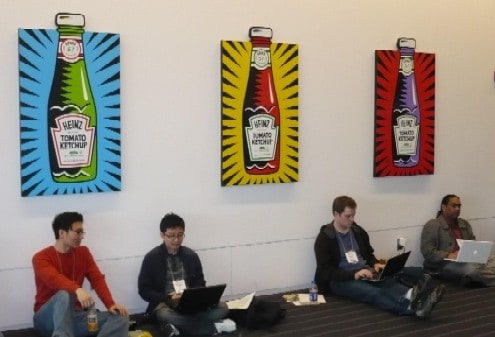
Pittsburgh is the birthplace of Andy Warhol and Heinz Ketchup — and the two come together nicely in these pieces hanging on the convention centre wall.

The paintings are by the Pittsburgh-born artist Burton Morris and evoke Warhol and other 20th century American artists.

I don’t think Warhol did ketchup bottles — although I think he gave us his take on the cardboard boxes that held the bottles.

By the way, the folks under the pictures are real physicists, not life-sized artworks!

And the hot topic this year is…

Monday-001.jpg
As close as I could get

By Hamish Johnston

Despite legging it across the convention centre, I left it a bit late to get anywhere near Hideo Hosono’s talk on “Materials and Physics in Pnictide Superconductors”. It looks like the pnictides — which burst on the scene during the last March Meeting — are a contender for this year’s hot topic.

You might recall that these materials comprise a completely new family of high-temperature superconductors. They could help physicists understand just exactly why some materials are superconducting at relatively high temperatures — something that has been a genuine mystery for over 20 years.

Of course, they might just add to the confusion by giving physicists more materials that they don’t understand.

But if the crowd at Hosono’s talk is any indication, there won’t be a lack of trying.

Copyright © 2026 by IOP Publishing Ltd and individual contributors