Superposition and entanglement flee the quantum nest

When a forest loses its trees, it also loses its identity as a forest (as well as creating an ecological disaster). Similarly, quantum theory would be a different beast altogether without the defining effects of superposition and entanglement. However, the converse is not necessarily true. The two physical effects can be observed independently of the theoretical framework used to explain them, and an international team of researchers has now shown that the connection between them does not hinge on quantum theory’s mathematical formalism either. In practical terms, the result opens the door to realizing quantum cryptography even if quantum theory proves incorrect.

Quantum theory is one of the most successful theories in physics to date. Despite its non-intuitive nature, its predictions have consistently agreed with empirical observations. Over time, emerging applications such as quantum computing and quantum cryptography have received considerable interest from industry. However, it remains a challenge to reconcile it with gravity, which suggests that quantum theory may be superseded or overthrown by another more complete theory in the future. This is a natural process in scientific evolution, where falsified theories are discarded and the paradigm shifts as a result.
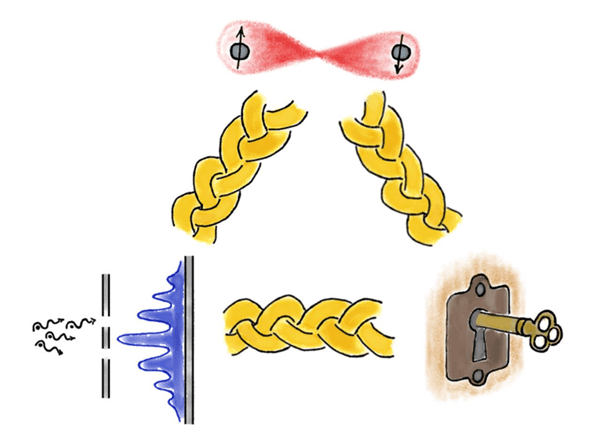
Diagram showing a pair of electron spins (representing entanglement), a double slit pattern (representing superposition) and a lock with a key (representing quantum cryptography), each connected to the other via thick ropes

Although entanglement and superposition are widely observed in the lab, it was the mathematical formalism provided by quantum theory that previously explained how the two concepts were related. This left their exact relationship prone to future corrections.

General probabilistic theories

In the latest work, which is described in Physical Review Letters, the researchers proved that in any physical theory, entanglement can exist between different systems if and only if superposition can exist in each of them. The result yields an equivalency between the two concepts that extends beyond the quantum realm.

To show that the connection between superposition and entanglement holds in any physical theory, the researchers used a framework called general probabilistic theories. This framework provides a general mathematical description for the key requirements of a physical theory: physical states, their transformations and measurements. The framework encompasses both classical and quantum theory. More importantly, it also includes more exotic theories that exhibit typically quantum features such as superposition and entanglement. For example, in one such non-classical theory, known as “Boxworld”, the non-local correlations that characterize entanglement can be so strong that they surpass what is allowed by quantum theory.

Quantum cryptography

The link between this result and quantum cryptography is that the latter uses features of quantum theory to provide secure information transfer between two parties. A notable example is the textbook protocol BB84, which uses entanglement to ensure that any hacker can be detected and excluded from the communication. If this protocol were to become widely adopted, only for its unhackability to be overturned by a new theory, catastrophic consequences could ensue. For instance, vast swathes of sensitive data, such as credit card details, could be compromised by evil actors.

The novel theory-independent connection implies that this apocalyptic depiction is unlikely to become reality, as the researchers show that the protocol can be realized according to any non-classical theory. In a press release coinciding with the publication of the research, Ludovico Lami, a co-author of the paper and a physicist at the University of Ulm, Germany, stated: “It is somehow reassuring to know that cryptography is really a feature of all non-classical theories, and not just a quantum oddity, since many of us believe that the ultimate theory of nature will likely be non-classical.”

Rare X-rays from white-dwarf explosion spotted by chance

Astronomers have made the first observations of X-rays being emitted from a white-dwarf star that has burst into life while stripping material from a companion star. The process caused a thermonuclear runaway that resulted in a massive explosion or nova.

Ole König a PhD student at the Dr Karl Remeis-Observatory and Erlangen Centre for Astroparticle Physics at Friedrich-Alexander-University, Germany  and colleagues used the eROSITA telescope to observe the tell-tale X-rays that signal the onset of the violent process. The X-rays were emitted by the white dwarf YZ Reticuli 11 h, which is located over 8800 light-years from Earth. Remarkably, the observation was made by chance – but previous research allowed the scientists to understand what they had seen.

“We were quite lucky that eROSITA was pointed to the right patch of the sky at the right moment,” König, lead author of a Nature paper describing the discovery, tells Physics World. “For over 30 years it has been postulated that novae should show X-ray flashes. These flashes are a direct consequence of the fusion process, a so-called thermonuclear runaway, that occurs on the surface of the white dwarf.”

Brief emission

König explains that X-rays from such an event should be emitted briefly, just before the white dwarf brightens with visible light. The spectral distribution of these X-rays is expected to resemble that of a black body. The team found that there was no X-ray source detected by eROSITA  both four hours before and four hours after the event meaning the bright flash must have lasted less than six hours. This is in good agreement with theoretical models, and this told the team they had indeed spotted an X-ray flash from the nova explosion for the first time.

König explains why this kind of X-ray emission is only just being glimpsed for the first time. “It is very difficult to find such a source because there are only around 40 to 50 novae per year in our galaxy and most of them are from sources that are not known before they are seen in the optical wavelengths,” he says. “At this time the X-ray flash is, however, already over and this is the reason why it took so long to discover them.”

Despite fitting well with theoretical predictions, the astronomers’ fortuitous discovery still yielded some surprises. “The most surprising thing was that the source was so bright. Too bright actually,” König says. “It overexposed the central part of the detector because so many X-ray photons arrived in such a short time.”

This meant the researchers had to come up with a clever way to analyse the overexposed data , which was done using a simulator called SIXTE, designed specifically to study bright sources with eROSITA.

Kick-started fusion

White dwarfs are the remnants of stars like the Sun. These objects have burned all the hydrogen in their cores, but they do not have mass needed to kick-start the fusion of heavier elements like carbon and nitrogen. As a result, isolated white dwarfs spend the rest of their existence as a gradually cooling inert exposed core of mostly carbon.

However, white dwarfs can spring back into life, albeit briefly, when in a close-proximity binary system with a star that donates matter to the white dwarf. This material, mostly hydrogen, is stripped from the donor and accreted onto the white dwarf’s surface. As this happens immense pressure builds beneath this donated envelope of material. Because the gas is forced into a state in which quantum properties set the pressure, the accreted hydrogen cannot expand despite the temperature increasing.

As the temperature rises in this region, it triggers thermonuclear reactions. Fusion rates increase rapidly as the temperature builds and the reactions run out of control. The white dwarf then blows off much of the accreted layer —which is estimated to have a temperature of several million degrees — reliving the pressure and expanding its radius.

‘Fireball’ created

“The X-rays are emitted as a consequence of the thermonuclear runaway. The fusion process creates a lot of energy that diffuses through the envelope of mostly hydrogen,” König says. “When it reaches the top of the envelope the nova is a very hot glowing black body or a ‘fireball’.”

“This black body emits radiation and it peaks in the soft X-rays. The explosion is a very, very dynamic situation. The envelope quickly expands and the temperature drops. Thus, the source becomes visible in the optical a few hours after the X-ray flash.”

The explosion that results is often called a “recurrent nova” because the white dwarf is left intact, unlike in “classic” supernova explosions, and can continue to accrete material from its donor star companion allowing the process to occur over again.

“There are certainly still questions left to answer about these novae. For example, how the X-ray flash decays or how fast the envelope expands,” König explains. “It would be great to go through the eROSITA dataset or propose another satellite with higher spatial resolution and sensitivity to find more of these flashes.”

Microcavity could make a platform for quantum sensing

The motional fluctuations of nanoparticles trapped between mirrors in optical cavities could form the basis for a new type of high-precision quantum sensor, according to calculations by researchers at the Austrian Academy of Sciences, the University of Innsbruck in Austria and ETH Zurich in Switzerland. The team’s theoretical work shows that the dynamical instabilities of a quantum system can be exploited as a resource rather than being considered as a problem to be avoided, as is usually the case.

Optical cavities, or resonators, are structures in which light is reflected back and forth between two or more mirrors. This light interacts with nanoparticles trapped in the cavity, creating dynamical instabilities that are usually considered undesirable for sensing applications.

In the new work, researchers led by Romain Quidant of ETH Zurich and Oriol Romero-Isart of the Institute of Quantum Optics and Quantum Information (IQOQI) and the University of Innsbruck’s department of theoretical physics showed that by properly controlling these instabilities, the unstable dynamics within the optical resonator can be used to quickly and strongly “squeeze” the motion of nanoparticles levitating in the cavity. This squeezing significantly reduces the motional fluctuations of the nanoparticles trapped in the optical resonator to below their so-called “zero-point” motion.

While optical cavities are routinely used to cool the motion of levitated particles via successive momentum “kicks” from reflected photons, these structures need to be relatively large to keep a photon inside the cavity for longer than the oscillation period of a nanoparticle. However, Romero-Isart explains that if the goal is not to cool the nanoparticles’ motion, but to squeeze it, the requirement is different. Here, much like a balloon, the nanoparticles are squeezed in one direction in position-momentum space, which creates a bulge in the other direction. This generates stronger light-nanoparticle coupling, which can be achieved using smaller cavities.

The researchers applied their theoretical approach to a model system consisting of levitated silica nanoparticles coupled to a microcavity. Squeezing the motion of particles is helpful, Romero-Isart says, because it makes them more sensitive to external signals – something that can be exploited for inertial and force sensing. Optical resonators therefore offer a new platform for the design of quantum sensors that could be used, for example, in satellite missions, self-driving cars and in seismology, to name but three examples.

According to the researchers, the study is timely because other research groups have recently demonstrated ground-state cooling and quantum control of optically-levitated nanoparticles in free space in laboratory experiments. The team is now looking into how to prepare macroscopic quantum superpositions of a nanoparticle. “This means preparing it in a state in which its position is delocalized over length scales comparable to the size of the nanoparticle,” Romero-Isart tells Physics World.

The present research is detailed in Physical Review Letters.

Artificial intelligence beats humans at crossword solving and assesses the health of ‘singing’ coral reefs

Many people around the world enjoy doing crosswords, taking a few moments out of their day to test their knowledge and wordplay by answering clues to find words that complete the crossword grid. Crosswords are a puzzle that humans particularly excel at, so much so that we can outperform machines — or so we thought.

One of the most prestigious crossword competitions is the annual American Crossword Puzzle Tournament and the best that a machine could do in 2017 was 11th place thanks to a programme called Dr Fill. But machines are now making a comeback and in 2021 the Berkeley Crossword Solver – built by a team at the University of California, Berkeley – managed, for the first time, to outscore every human player.

The programme, which is outlined in a paper on arXiv, is based on “neural question answering, structured decoding, and local search,” which involves finding solutions to questions and then using databases and natural language artificial intelligence (AI) to refine the answers. And despite such progress, there is still room for improvement. The Berkeley Crossword Solver has an “exact puzzle accuracy” of 82% for crossword puzzles set by The New York Times – compared to 57% in previous incarnations. Crossworders beware.

Singing coral reefs

Another novel application for AI that we came across this week is using the technology to assess the health of coral reefs. An international team led by researchers at the UK’s University of Exeter and Lancaster University have used AI to analyse the sounds emitted by reefs. These “songs” are made by the rich variety of fish and other creatures that live on the reef – and the presence or absence of these organisms is related to the health of the ecosystem.

The team trained their AI system using audio recordings made at the Mars Coral Reef Restoration Project in Indonesia. The recordings were from both healthy and damaged coral reefs and once trained, the system was able to identify the health of a reef 92% of the time.

“Coral reefs are facing multiple threats including climate change, so monitoring their health and the success of conservation projects is vital,” says Exeter’s Ben Williams. He adds that assessing the health of a reef using conventional visual and audio techniques can be labour intensive.

“Our findings show that a computer can pick up patterns that are undetectable to the human ear. It can tell us faster, and more accurately, how the reef is doing,” adds Williams.

Lancaster’s Tim Lamont adds, “In many cases it’s easier and cheaper to deploy an underwater hydrophone on a reef and leave it there than to have expert divers visiting the reef repeatedly to survey it – especially in remote locations”.

The research is described in Ecological Indicators.

Desktop air curtain could block viral spread in hospitals

Medical procedures such as collection of blood samples or intubation, for example, require doctors and other healthcare staff to work in close proximity to the patient. To protect them from exposure to infections in such scenarios, a team at Nagoya University in Japan has developed a desktop air curtain system (DACS) that blocks emitted aerosol particles and prevents potential spread of viruses such as SARS-CoV-2.

The DACS contains a generator at the top that produces a steady airflow, which is then guided to a suction port at the bottom of the device, effectively creating a smooth curtain of air. As this integrated system contains both a discharge and a suction port, it can be installed at any location, and is portable enough to be placed on a desk. A high-efficiency particulate air (HEPA) filter inside the suction port can provide air purification.

“We envisage this system will be effective as an indirect barrier for use in blood-testing labs, hospital wards, and other situations where sufficient physical distance cannot be maintained, such as at a reception counter,” says first author Kotaro Takamure in a press statement.

To assess the potential of using the DACS in a medical environment, Takamure and colleagues performed a series of experiments using a set-up replicating a blood-collection booth. First, they used particle image velocimetry (PIV) and a hot-wire anemometer to evaluate the velocity field of the air curtain. The measurements confirmed that the flow rate of the air curtain generated by the DACS is maintained from the discharge port up to the suction port.

Next, the team used an air compressor connected to a mannequin to simulate human exhalation. A tube at the mouth of the mannequin blew out air containing aerosol particles (2–3 µm-diameter particles of the solvent dioctyl sebacate) towards the air curtain at a flow rate of 52 l/min. The distance from the air outlet to the centre of the DACS was 250 mm.

With the DACS switched off, PIV measurements showed that the emitted aerosol particles diffused as they moved forward and travelled straight through the gate of the DACS to the other side. The particles had maximum velocity immediately after ejection from the mannequin’s mouth and then gradually slowed.

When the DACS is operational, the researchers observed similar initial behaviour. However, when the aerosol particles approached the gate, they were bent abruptly downward along with the air curtain flow and were eventually sucked into the suction port, with none passing through the gate.

Average velocities of aerosol particles

The researchers then investigated a scenario mimicking the use of the DACS during blood collection, with the arm of the mannequin resting on the gate. They saw that arm disrupted the curtain’s airflow, creating turbulent flow nearby. The aerosol blocking performance, however, was unaffected. Statistical evaluations revealed that even with the arm on the gate, no aerosol particles reached the other side of the air curtain, demonstrating effective particle blocking even in the presence of turbulence.

The team is now also integrating a virus inactivation system into the DACS, using UV LEDs connected to the suction port. The UV irradiation destroys the outer coat of virus particles; the sanitized air can then be recirculated to maintain airflow of the air curtain. Laboratory tests revealed that the combination of the air curtain with UV irradiation inactivated 99.9% of SARS-CoV-2 particles.

“Although acrylic sheets are currently widely used as partitions, our air curtain not only blocks, but also deactivates, viruses,” says co-author Tomomi Uchiyama. “Therefore, we expect this device to render acrylic partitions obsolete and become widely used.”

Takamure says that the group’s future goal is to develop a compact and lightweight virus inactivation device. “If we can achieve miniaturization without compromising virus inactivation performance, we expect the device to be more versatile,” he tells Physics World.

The DACS is described in AIP Advances.

Ultrathin nanowires could be a boon for error-resistant quantum computing

Researchers have fabricated ultrathin semiconductor-superconductor hybrid nanowires measuring less than 20 nm across. Such wires are thinner than those grown previously and are predicted to host phenomena known as Majorana zero modes – the core ingredient of so-called topological quantum bits (qubits), which could form the basis of a stable and error-resistant quantum computer.

Originally, Majorana zero modes (MZMs) were simply a mathematical construction that allowed an electron to be described theoretically as being composed of two halves. From a quantum computing perspective, they are attractive because if an electron can be “split” in two, the quantum information it encodes will be protected from local perturbations as long as the “half-electrons” can be stored far away from each other. According to theory, these entities should appear in a set-up consisting of a semiconducting nanowire wrapped in a shell made from a superconducting material and placed in a magnetic field.

In theory, the simplest type of nanowire in which MZMs should appear is a one-dimensional electron system – that is, one in which electrons occupy a single electronic sub-band in the semiconductor. In experiments, however, multiple sub-bands are occupied.

ultrathin semiconductor-superconductor hybrid nanowires

Diameter of less than 20 nm

In a new study, researchers led by Jianhua Zhao and Dong Pan of the State Key Laboratory of Superlattices and Microstructures, Institute of Semiconductors, Chinese Academy of Sciences, grew ultrathin nanowires of the semiconductor indium arsenide (InAs) covered with an in situ epitaxial superconducting aluminium (Al) film using a technique called molecular-beam epitaxy (MBE). They used a silver (Ag) catalyst to grow the wires – a technique routinely employed in this type of experiment. The new nanowires have a diameter of less than 20 nm, which is five times smaller than semiconductor nanowires previously grown using this approach.

The diameter of the of the wires depends on the diameter of the Ag catalyst, and Zhao explains that very small Ag catalysts (ranging from 5 to 40 nm) can be prepared using the team’s MBE system. The crystal quality of the wires also depends on their diameter and the wires grown in the new study are of high quality.

New avenue for future MZMs searches

“When combined with Al superconducting films, these ultrathin wires offer a possible way of reaching the fewer sub-band regime (and ultimately the single sub-band regime),” Hao Zhang of Tsinghua University, who led the electron transport measurements in the work, tells Physics World. “These wires therefore open a new avenue for exploring fewer sub-band regimes for future MZMs searches.”

Thanks to basic transport characteristic measurements, the researchers have already discovered two phenomena in their system: a “hard” superconducting gap in tunnelling spectroscopy measurements; and a “parity preserving Coulomb blockade” in so-called hybrid island devices. Both phenomena are crucial ingredients for future Majorana searches, Zhang explains.

The team says it is now looking for stronger evidence for MZMs by measuring the quantum transport properties of its ultrathin InAs-Al nanowire structures.

The work is detailed in Chinese Physics Letters.

Experiments with quantum cause and effect reveal hidden nonclassicality

Cause-and-effect explanations like “catnip causes cats to be happy”, “jokes cause laughter” and “exciting research causes Physics World articles” are a useful way to organize knowledge about the world. The mathematics of cause-and-effect underpin everything from epidemiology to quantum physics. In the quantum world, however, the link between cause and effect is not so straightforward. An international team of physicists has now used quantum violations of classical causality to better understand the nature of cause-and-effect. In the process, the team uncovered quantum behaviour in a situation where standard methods indicate that the system ought to be classical – a result that could have applications in quantum cryptography.

In quantum physics, a result known as Bell’s theorem states that no theory that incorporates local “hidden” variables can ever reproduce the correlations between measurement outcomes that quantum mechanics predicts. A similar result occurs in the theory of causal inference, where quantum systems likewise defy the rules of classical causal reasoning. The idea behind the causal inference approach is that while a statistical correlation between two variables can arise due to a direct causal relationship between them, the correlation may also contain the contribution of a hidden common cause. In some cases, this hidden contribution can be quantified, and this can be used to show that quantum correlations do exist even when Bell’s theorem cannot be violated.

Inferring causal structure achieves direct control over cause and effect

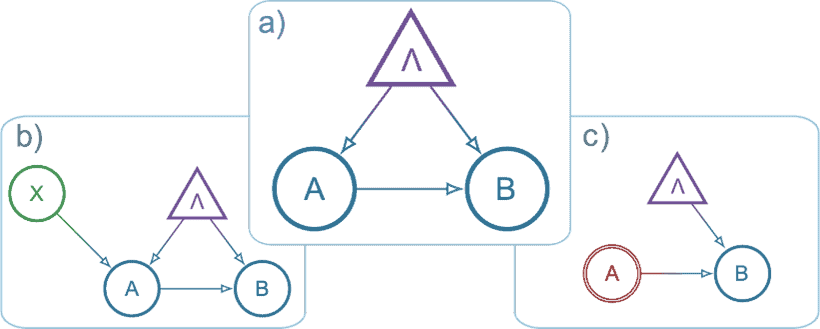
In the latest work, a team led by experimental physicist Davide Poderini and colleagues in Brazil, Germany, Italy and Poland combine theory and experiment to show quantum phenomena in a system that would otherwise appear classical. The researchers explore the notion of cause and effect by considering whether correlations between two variables, A and B, imply that one is the cause of the other, or whether some other (potentially unobserved) variable may be the source of the correlations.

In their investigation, the researchers use a causal model (see image) in which the statistics of variable A influence those of variable B, either directly or by the action of a common source (called Λ) that connects the outcome of both variables even without the presence of a causal link between them. To distinguish between these two scenarios, the researchers perform an intervention on variable A that erases any external influences. This leaves the variable A under the experimenter’s complete control, making it possible to estimate the direct causal link between A and B.

A directed acyclic graph of various cause-and-effect scenarios

Alternatively, by introducing an additional variable X that is independent of B and Λ, any observed correlations between variables A and B can be decomposed into conditional probabilities. These conditional probabilities place a lower bound on the degree of causal effect between the variables, making it possible to estimate the level of influence between A and B.

The researchers call this lower bound an instrumental inequality, and it is a classical constraint that (similar to the inequality that arises from Bell’s theorem) stems from imposing this causal structure on an experiment. As a result, the degree of quantum causal influence between variables A and B will be less than the minimum required for a classical system, allowing nonclassicality to be observed through an intervention even when no Bell inequality is violated.

Experimental intervention reveals quantum effects

To observe the instrumental causal process, the researchers generated pairs of photons with entangled polarizations and measured them in different representations of state space, or bases. Thanks to photons’ entangled nature, the choice of basis for one is determined by the measurement on the other, producing a “feed-forward” mechanism that implements a direct causal link between the two variables. As a result of this feed-forward process, the researchers experimentally observe violations of the classical lower bounds for causal influence between two variables by producing several quantum states characterized by different degrees of entanglement.

Like Bell’s inequality, violation of this classical lower bound represents a signature of quantum correlations. Furthermore, it yields statistical data that can act as the foundation of any basic quantum cryptographic protocol. While current cryptographic protocols rely on Bell’s theorem, inferring causal structure from instrumental intervention represents a more general compatibility between classical causality and quantum theory. Poderini and his colleagues seek to experiment with different causal scenarios to explore complex networks with richer correlations, which can be exploited to develop novel quantum technologies. The researchers believe their experimental techniques could lead to quantum advantages in cryptographic protocols, making it possible to realize more resilient and less technologically demanding cryptographic tools.

Asking the big questions in the philosophy of physics and quantum biology

In this episode of the Physics World Weekly podcast we look at some of the big questions in physics from biological and philosophical points of view.

Katie Robertson is a philosopher of science at the UK’s University of Birmingham and she explains why philosophers are interested in physics and how they approach some of the big questions in the field. Robertson also talks about her research on the microscopic origins of the second law of thermodynamics.

Keeping to our philosophical theme, the molecular geneticist Johnjoe McFadden talks about his latest book Life Is Simple: How Occam’s Razor Set Science Free and Unlocked the Universe. Based at the UK’s University of Surrey, McFadden also chats about the burgeoning field of quantum biology and how scientists are discovering that quantum mechanics can play important roles in living organisms.

  • Katie Robertson and Johnjoe McFadden are speaking at the HowTheLightGetsIn festival. The event is being held in Hay-on-Wye, UK, on 2–5 June. If you cannot be in Hay, the festival will be streamed online.

The quantum hype cycle, revisited

Quantum computers have incredible potential, but world-changing applications are still n years away. For some value of n, everyone in the quantum community agrees with this statement. Today’s quantum computers are noisy, with gate fidelities generally below 99%. They are also intermediate in scale, incorporating a little over 100 qubits at most. Getting from these noisy, intermediate-scale quantum (NISQ) devices to the multi-million qubit, super-high-fidelity system required to model, say, a cytochrome P450 enzyme could take 10–15 years. A quantum computer capable of cracking RSA encryption (and thus breaking Internet commerce as we know it) is likely even further in the future.

Beneath the surface of this consensus, though, a definite split emerged among the luminaries at last week’s Commercialising Quantum conference, which took place in London under the auspices of The Economist newspaper. Perhaps surprisingly, the biggest point of disagreement within the event’s blue-chip list of speakers wasn’t the estimated value of n. Instead, it was the relative emphasis they placed on “incredible potential” versus “still n years away”.

Optimists and realists

In the realists’ corner were speakers like IBM Quantum vice president Jay Gambetta, who used his talk to lay out a roadmap full of challenging yet limited milestones: 2023 for solving a problem faster than it can be simulated classically; 2025 for building a chip with 4158 qubits, and so on. Meanwhile, on the optimists’ side, Catriona Campbell, the chief technology and innovation officer for EY in the UK and Ireland, touted a recent survey in which a whopping 48% of UK companies reported that quantum computing would play a role in their business by 2025.

Which of these views is closest to reality? The words “play a role in the business” are broad enough to cover many possibilities, and Campbell acknowledged in her talk that EY’s survey (carried out in partnership with the Financial Times) focused on a small number of innovative firms. Still, 2025 is only two and a half years away. Even if NISQ devices are – per Gambetta’s roadmap – somewhat less NISQ-y by then, Campbell’s timeline for incorporating them en masse into UK plc seems extraordinarily tight.

During a panel discussion at the same conference, Quantinuum president and chief operating officer Tony Uttley offered a way of squaring the circle. While Uttley estimated that only 12 companies will use quantum computing in their day-to-day operations this year, he also suggested that fully 69% are thinking of heading in that direction. If having someone in the C-suite thinking hard about a topic constitutes “playing a role in the business”, then Campbell may not be far off the mark.

Peak quantum hype?

The conference’s award for starry-eyed quantum optimism went to Haim Israel, the managing director of research at Bank of America. Midway through the in-person day on 17 May, Israel got up in front of a packed hotel ballroom and declared with a straight face that quantum computing will be “bigger than fire” – a statement that surely marks the pinnacle of quantum hype, if only because it would be difficult to top it.

For my money, the more interesting views about quantum’s commercial future came from representatives of the 69% of businesses that are thinking seriously about it, but not using it day-to-day. One of Uttley’s fellow panellists was Bijoy Sagar, chief information technology and digital transformation officer at the pharmaceutical firm Bayer AG. While Sagar worried aloud about the quantum “hype cycle” and warned that he was “not seeing commercial value yet on the scale of the investment”, he quickly added that this is not a criticism. “It takes time,” he observed. “That does not mean we don’t continue to invest.”

In Sagar’s opinion, the first use cases for quantum computing in pharma will include in silico clinical trials of new drugs. Identifying candidate molecules is, he said, “an imperfect science” with today’s methods, and bringing in a quantum computer to assist with this task would offer “tremendous value to humankind” even if the benefits were initially marginal. Another biotech expert, Amgen vice president for biologics Alan Russell, drove the point home. “Patients die while we wait, inventing new science,” Russell told a session focused on quantum applications and the enterprise journey. “There is no Schrödinger equation for biology.”

I last wrote about quantum hype in November 2019, as part of a Physics World supplement on classical as well as quantum computing. Since then, enthusiasm for quantum technologies has gone up several gears: although Israel’s “bigger than fire” comment was extreme, he is hardly alone in talking up this promising field. But the involvement of people like Sagar, Russell, and Peter Clark of Janssen, who spoke about using D-Wave Systems’ quantum annealer to solve a 14-amino-acid peptide problem, gives me reason to believe that there is indeed a “plateau of productivity” beyond the peak of quantum hype. I just hope I get the chance to see it – ideally by the glow of a few dozen bigger-than-fire quantum computers, standing in for candles on my birthday cake n years in the future.

Avoiding artefacts: do you know when you’re seeing a real signal?

Are you seeing a blotch on your microscope slide, or a cell? Have you discovered a new astronomical object or is it just light bouncing off a support structure in your telescope? Is your clock telling you that neutrinos are travelling faster than the speed of light, or do you have a loose connection between your GPS receiver and the clock?

There’s no more common, or fundamental, question in experimental science than whether what you are looking at is an artefact or a signal. “The cornerstone of experimental knowledge,” writes the Virginia Tech philosopher of science Deborah Mayo in Error and the Growth of Experimental Knowledge, “is the ability to discriminate backgrounds: signal from noise, real effect from artefact.”

Trickster

Like many others, I met my first artefact in a high-school physics lab. I had followed the lesson plan carefully, but my results indicated that what I had measured didn’t agree with Coulomb’s law. I took several readings, and was careful to measure and re-measure the distance between the two charged conductive spheres that were repelling each other, and the amount of twist in the torsion wire suspending one of them. My strange result had staying power.

Like many others, I met my first artefact in a high-school physics lab.

So did I think I had discovered a fifth force of nature? No. I figured that I must have screwed up. Why was I sure? Because I knew better from the teacher, the textbook and the results of other students in the class. But I couldn’t figure it out. The teacher came over and after a few puzzled moments realized that the standard-issue power supply was faulty.

That was my first artefact. My experimental set-up had tricked me. It looked like it was telling me something about nature, but instead it was telling me about itself. The teacher used my mishap as the occasion for an admonition about how to avoid getting artefacts. Measure everything twice. Double-check your equipment. Substitute parts if you can. Don’t necessarily trust the factory-built elements.

Researchers, though, have to judge whether what they have is an artefact or signal without the benefit of teachers like that; they are trying to come up with what will appear in the next generation of textbooks, and know that experiments to follow will show whether their work is right or not. These researchers are susceptible to what I think of as “experimentalist’s anxiety”.

I came away from my high-school lab with the notion that an experiment is like a little performance. You collect a set of props or “performers”, make sure you understand them and what you do, set them to working together, and if you set them up just right their performance shows the audience something they didn’t know before. But if you don’t set the performers up just right, the performance isn’t very good and they tell you nothing new.

Offbeat and tantalizing

Defining an artefact is easy – it’s something that your instrument is showing you with no counterpart in reality; it’s produced by your equipment or your techniques rather than by nature. I think there are at least two kinds of artefacts. The kind that haunted me I’d call a “klutzy” artefact – caused by your misunderstanding or overlooking some behaviour in the equipment. But there’s another kind that I’d call a “tantalizing” artefact – produced by something truly novel in the experiment’s performance that you can’t quite make out.

An example of such an artefact – one that involved the “real” ghost of a fifth force – occurred at Brookhaven National Laboratory in 1961, just a few years before my experience in the high-school physics lab. At Brookhaven, a group led by Yale University physicist Robert Adair accelerated bunches of protons, smashed them into a steel target, used electromagnetic fields and other means to sweep away everything but long-lived neutral kaon particles. Known as “K-longs”, these particles were directed into a bubble chamber where their decays could be imaged.

The experimentalists rebuilt and improved every part of the equipment to try to eliminate the impossible two-pion decays, but could not.

The results showed an impossible number of two-pion decays, at least according to a fundamental part of the prevailing theory known as CP symmetry. The experimentalists rebuilt and improved every part of the equipment to try to eliminate the impossible two-pion decays, but could not. The only thing the group members could not rule out was a fifth force of nature, which they hinted at in their published paper.

Another group from Princeton University, whose leaders – James Cronin and Val Fitch – had the office next to Adair’s, noted the baffling result, mounted an experiment structured so that the performance would show whether CP symmetry was violated or not, and led the audience to conclude that it was. That conclusion earned Cronin and Fitch the Nobel Prize for Physics in 1980.

No doubts were ever expressed about the quality of the Yale experiment. Yet its result was ambiguous, and it was only the Princeton experiment that cleared things up. By staging an experiment to look just at the role of CP symmetry in K-long decays, the Princeton experiment changed the structure of elementary particle theory, and was able to “parse” the Yale result, showing what part was due to CP violation.

But because the Yale result had only a hint of CP violation, mixed in with other things, some science historians have insisted it was an artefact. “It was an artefact,” declared the US physicist and philosopher Alan Franklin. “A spurious result stimulated the work of the Princeton group.” But since the ambiguity of the Yale result was at least partly due to CP violation, it was at least a tantalizing artefact.

The critical point

But experimentalists must have encountered more types of artefacts than klutzy and tantalizing. Let me know what artefacts you’ve run in to and I’ll write up your amusing – or disastrous – experiences in a future column. Let’s hope the collective experiences of Physics World readers will help you avoid mistakes of your own.

Copyright © 2026 by IOP Publishing Ltd and individual contributors