A recently discovered metal organic framework can act as a “quantum sieve”, with pores that selectively open for deuterium molecules at the right temperatures and pressures. The material was created in Germany by a team led by Stefan Kaskel and Thomas Heine at the Dresden University of Technology, and Michael Hirscher at the Max Planck Institute for Intelligent Systems in Stuttgart. Its development could reduce the considerable cost of isolating deuterium, which is an isotope of hydrogen that has several practical uses.
There are two stable isotopes of hydrogen and by far the most abundant is hydrogen-1 (H), which comprises a single proton. Hydrogen-2 (deuterium or D) comprises a proton and a neutron and accounts for just 0.015% of hydrogen nuclei in sea water. An isotope with two neutrons – tritium or T — is also found on Earth but is much rarer and unstable.
Pricier than gold
Deuterium has a range of uses from nuclear fusion to medical imaging and drug discovery. Today, chemical and physical processes are used to extract heavy water molecules – which contain two deuterium nuclei – from water. Then deuterium gas is created by electrolysis. The process is very expensive, with one gram of deuterium costing more than a gram of gold.
Some researchers believe that quantum sieves could do the job at much lower cost. A quantum sieve is a material that is porous on the molecular scale. The sieve is designed so that some types of molecules interact with the pores and pass through, while others do not.
In 2012, researchers at Dresden created a new type of metal-organic framework (MOF). This is a material with metal ions that are linked together by organic ligands to form an orderly lattice.
Selective response
Called DUT-8, this material stood out for its flexibility, which enabled it to selectively respond to different external stimuli by adjusting its ligands – altering the size of its pores in turn. In the 2012 studies, researchers showed that DUT-8 prevented molecules of gaseous hydrogen from passing through – either at high pressures, or very low temperatures.
In their latest experiments, the researchers examined the material’s response to D2 – hydrogen molecules made from two deuterium nuclei. This involved probing the state of the pores using a combination of advanced imaging techniques including neutron diffraction, and low-temperature thermal desorption spectroscopy. The latter observes the extent to which molecules are removed from a surface as temperature increases.
First-principles calculations
At temperatures of about 23 K, and pressures of about 24 kPa, they observed that the DUT-8 pores opened in the presence of D2 – which allowed almost 12 times as many D2 molecules to pass through than H2. In parallel with their experiments, Hirscher’s team used first-principles calculations of the MOF’s properties, coupled with statistical thermodynamics, to simulate its isotope-selective properties.
This allowed the researchers to describe the process by which the pores opened to D2 – while closing to H2 and HD. In addition, they predicted how the sieve would respond to tritium. Their simulations suggest that DUT-8 will open to molecules of T2 and DT, but remain closed for HT.
The team says that its combined results clearly demonstrate the promising potential for DUT-8 as an efficient way of separating the isotopes contained within gaseous hydrogen. Using this flexible quantum sieve, it could someday be possible to isolate large quantities of D2 gas at low cost.
Around the world interest is growing in using high-power laser beams to disable airborne invaders such as drones and other uncrewed objects. These so-called directed-energy systems have the potential to damage or destroy small aerial devices at a fraction of the cost of launching conventional defence missiles or munitions. They have the added advantage that they can be reused many times to counter multiple attacks as well as the growing threat of drone swarms.
At QinetiQ, a UK-based technology company specializing in defence and security solutions, around 10 years of research effort into the physics underpinning these directed-energy systems has demonstrated enough potential to start building and testing practical prototypes. “We have taken a high-risk, high-reward approach to developing these systems,” says Richard Hoad, capability area lead for novel effectors and resilience at QinetiQ. “Our company and our customers in the defence sector have significantly increased their investment to enable us to prove that our solution is as effective in a wide range of real environments as it is in testing.”
We currently have around 20 people working on all aspects of these systems, and we now need more laser physicists to supplement and boost the team.
Richard Hoad, QinetiQ
That increase in funding, combined with the need to migrate the technology from lab-based demonstrators to fully integrated systems, is generating demand for more physicists and engineers within QinetiQ’s High Energy Laser teams. “We currently have a highly capable team working on all aspects of these systems, and we now need more laser physicists to supplement and boost the team,” he says. “There are some great opportunities to get involved with cutting-edge technology that’s on the verge of becoming a game-changing military capability.”
Scalable benefits
Photonics focus: optical scientists at QinetiQ’s research campus in Malvern have been perfecting an electronic phase-control technique to enable the coherent combination of multiple laser beams (Courtesy: QinetiQ)
The key objective has been to design a scalable architecture, combining multiple kilowatt-class lasers to enable the brightness of the beam to be easily dialled up or down. For robustness the team has chosen to exploit established fibre-laser technologies, originally developed for industrial materials processing, with the biggest challenge having been to find an effective way to combine and control the output from many different fibre-laser amplifiers.
“We need to make sure the power reaches the target, which may be several kilometres away,” says Hoad. “That means we need to steer and point the laser with high precision, while also compensating for the effects of atmospheric turbulence on the propagation of the beam.”
Various technologies could be used to combine the beams, but QinetiQ has opted to pursue an electronic phase-combining technique that allows critical parameters such as the shape, central brightness and spot size of the laser beam to be more precisely controlled. While similar in theory to phased-array radar, the much shorter wavelengths of infrared lasers require greater engineering precision and efficient algorithms to enable accurate and high-speed electronic control.
Physicists at QinetiQ’s R&D campus in Malvern have been charged with perfecting this coherent phase-combining technique. “As well as the physics challenge we now have an engineering challenge to show that our approach can deliver a robust solution in many different environments,” says Hoad. “External factors such as vibration and positional stability will make a huge difference on how well you can control the phasing of the output beam.”
Integration efforts
Aiming high: Richard Hoad, capability lead for novel effectors and resilience at QinetiQ, is looking for physicists and engineers who want to exploit their skills to deliver real-world systems (Courtesy: QinetiQ).
Meanwhile, over at QinetiQ’s Cody Technology Park in Farnborough, efforts are focused on integrating the core phase-control technology with high-power laser sources, as well as alignment optics and a power source. A large systems-integration facility is available for indoor testing, allowing the team to evaluate the effect of the phase control on the output beam.
Longer term, QinetiQ believes that directed-energy systems exploiting either high-energy lasers or high-power radio-frequency transmitters could be used more generally for wireless power transfer. For example, beaming energy at a co-operative target, such as a drone equipped with a receiving system, would make it possible to recharge an onboard power-storage device.
Other possible scenarios include emergency response situations, where power needs to be supplied to critical infrastructure without running cables. The European Space Agency, meanwhile, is also interested in using the technology to beam high-bandwidth data into space. Wireless power-transfer technology could even support the mass-market adoption of electric vehicles, providing top-up charges from systems installed along the motorway. “This research is still very speculative, but it shows the enormous potential of directed-energy technology,” comments Hoad. “It could be really interesting for some applications.”
Developing such high-power systems requires expertise in many different aspects of laser science. One is to understand how the atmosphere affects the propagation of high-energy laser beams, since turbulence close to the ground and changing weather conditions make it challenging to control and target the beam. Laser safety is another crucial area of research, with experts working to evaluate the hazards and risks of firing high-power lasers into the sky, such as understanding what happens when some of the energy is reflected back from the target.
Open opportunities
“Taking the technology from R&D to the development of practical systems puts more emphasis on the engineering, as well as understanding the wider consequences of using directed-energy technology,” comments Hoad. “That means we need to grow our capability, and we now have roles available in both Malvern and Farnborough for people who want to apply their skills and see their research exploited in real-world systems.”
We are open minded about the amount of previous experience a candidate can offer, since we provide dedicated training for new recruits.
Richard Hoad, QinetiQ
QinetiQ is looking for scientists or engineers who can demonstrate a working knowledge of photonics and laser physics. “We are open minded about the amount of previous experience a candidate can offer, since we provide dedicated training for new recruits to enable them to work with our technology and our facilities,” he says. “New team members have the opportunity to move around the business, so an optical physicist working primarily in Malvern might spend time in Farnborough to see how the technology gets integrated, while our high-energy engineers would go to Malvern to understand how the core technology works.”
QinetiQ is also keen to support staff who wish to further their academic training, whether for an undergraduate university course or a sponsored PhD. Hoad himself joined the business as a technician apprentice, studying part-time to obtain first a Master’s and then a PhD, while several of his team members are currently working towards their doctorates. “We are building stronger links with academia, and sponsoring students is a great way for us to that,” he says.
Candidates who are fresh out of university can also join through QinetiQ’s two-year graduate training scheme, which assigns each new entrant to a “home” business while also offering six-month placements in other departments. “There are plenty of options within QinetiQ for people who are interested in laser science,” says Hoad. “As well as our work on high-energy sources, other groups are focusing on areas such as LIDAR and optical ground systems for communications.
Indeed, with more than 6000 employees worldwide, QinetiQ offers a range of opportunities for career progression. Scientists who become experts in their field are recognized through a fellowship scheme, with Fellows and Senior Fellows receiving an annual stipend to pursue their own research. A career development framework for technical staff also encourages external collaborations with industry and academia, continuing professional development, and conference attendance – all with the objective of building networks that can help to advance the technology.
“Most of our projects involve a partner in industry or the defence sector,” comments Hoad. “We need to join forces to move this technology along.”
Visit Physics World Jobs to view and apply for the latest positions at QinetiQ. Alternatively, visit the QinetiQ’s careers page here to view and apply for roles
Better together? That’s the question that multidisciplinary oncology teams are seeking to answer across a burgeoning field of clinical study focused on combined-modality treatment regimes – not least, the convergence of advanced radiotherapy techniques with targeted immunotherapies that leverage the patient’s own immune system to eliminate cancer cells. The latter include antibodies capable of directly targeting tumour sites as well as so-called “immune checkpoint inhibitors” – drugs that help the immune system to “red-flag” and, in turn, attack cancer cells – which have transformed the treatment of several metastatic cancers, among them melanoma and non-small-cell lung cancer (NSCLC).
The case for convergence between the two disciplines lies in the tantalizing prospect – for which there is mounting evidence – that the immune system is able to extend the localized therapeutic impacts of radiotherapy with far-field (also called abscopal) antitumour responses elsewhere in the body. While observed abscopal effects are vanishingly rare when radiotherapy is used in isolation, the prospective win-win is evident nonetheless. In short: the potential for immunotherapy agents to scale the regional efficacy of radiation treatment, while on the flip-side localized radiation acts as an adjuvant for immunotherapy of solid tumours and lymphomas.
A winning combination
Those combined-modality synergies were front-and-centre last week at the ESTRO 2022 Annual Congress in Copenhagen, where several hundred delegates packed into Room D4 at the Bella Center for a joint ESTRO-ASTRO symposium entitled “Is integration with immunotherapy the new challenge for radiation oncologists?” Kicking off the debate (while joining the session remotely) was Silvia Formenti, a radiation oncologist at Weill Cornell Medicine in New York and one of the main-movers behind a paradigm shift in radiobiology, her efforts elucidating the role of ionizing radiation on the immune system while demonstrating the efficacy of combined radiotherapy–immunotherapy regimes in solid tumours.
Underpinning the emerging clinical opportunity is the use of radiation therapy to convert the tumour into an “in situ vaccine”, though the focus must always be on shifting the balance between radiotherapy-immunosuppressive versus pro-immunogenic signals. “The mindset I would encourage is not so much to use immunotherapy as a tool to enhance radiation response,” Formenti told delegates, “but rather to use radiation therapy as a tool to integrate with immunotherapy…The combination with immunotherapy is required to unleash the immunogenicity of radiotherapy.”
In terms of clinical implementation of the combined modalities, Formenti notes that radiation oncology teams have several parameters to think about as they strive for optimum treatment outcomes, including radiation field, radiation dose and fractionation; as well as factoring in the blood as an organ-at-risk (OAR). On this last point, there is plenty of evidence that radiation-induced lymphopenia (lowered white blood-cell count) is associated with poorer patient survival, with a consistent pattern across multiple tumour types including brain, oesophageal, NSCLC and pancreatic cancers.
As such, noted Formenti, it’s vital that pioneers of combined-modality approaches “adapt radiotherapy prescription and techniques to synergize with immunotherapy and sustain the patient’s fitness during treatment”. Inevitably, she concluded, that will mean radiotherapy implementations that emphasize a mix of hypofractionation, small field sizes and ideally fast dose rates.
Particle physics meets radiobiology
Those themes were echoed and developed by Alexander Helm, a research scientist in the biophysics division of GSI Helmholtzzentrum für Schwerionenforschung, a particle accelerator research facility in Darmstadt, Germany. Helm explored the synergies between particle therapy in combination with immunotherapy and began by flagging a much-cited US study from 2013 that modelled radiation dose to circulating lymphocytes in patients treated with radiotherapy for malignant gliomas. The US researchers determined that “a single radiation fraction delivered 0.5 Gy to 5% of circulating blood cells” such that “after 30 fractions 99% of blood cells had received ≥0.5 Gy” (Cancer Invest.31 140).
Put simply, Helm explained, “radiotherapy compromises the immune system, so there is a need for reduced integral dose to healthy tissue, high dose rates and hypofractionation – and particles can be a match for that.” The physical advantages that come with particle therapy may extend to better sparing of lymphocytes and draining lymph nodes, such that circulating lymphocytes are available for mounting an efficient immune response. There are also hints of significant biological advantages triggered by particle therapy – for example, a broadening of the immunotherapeutic window of some cancers with low mutational loads.
“Preclinical evidence underpins the potential of particle therapy in combination therapies,” Helm concluded. “Furthermore, particle therapy can allow for efficient use of certain treatment modalities – for example, hypofractionation and stereotactic body radiotherapy – deemed to be beneficial.”
Betting on brachytherapy
A variation on the combined-modality approach – specifically, the opportunities presented by brachytherapy as an adjunct to immunotherapy – provided the narrative thread for Evert Jan Van Limbergen, a radiation oncologist and co-director at the Maastro radiotherapy clinic in the Netherlands.
“I think brachytherapy can provide some interesting approaches here, because the interstitial procedure – putting needles into the cancer as a part of the treatment procedure – means it’s a method of directly accessing human biopsies,” he explained. If the treatment involves three or four fractions, for example, the clinician can take those biopsies before each fraction and generate a timeline analysis to evaluate therapeutic impact of combination therapies (while mapping the localized dilution/concentration of injected drugs in the tumour using high-throughput analysis schemes).
At the same time, argued Van Limbergen, the unique dose rates associated with brachytherapy merit further scrutiny – from very low dose rate (vLDR) regimes (below 0.2 Gy/h) along the continuum through to high-dose-rate brachytherapy (above 12 Gy/h). Specifically, he highlighted an intriguing study in which a mouse model was treated with conventional radiotherapy or pulsed LDR brachytherapy (Cell Cycle16 1171). The research showed that tissue excretion of TGF-β (an important immunosuppressant cytokine) is drastically lowered with the LDR brachytherapy scheme. “I think this is really an area that we might start looking at,” he added, “because maybe there will be a lot in there.”
The bottom line: while there have been some notable early successes from the integration of radiotherapy–immunotherapy combinations, there are still many unknowns to unpick before the clinical opportunities can be fully realized. “I would say we have a long way to go and it’s not [going to be] straightforward,” Van Limbergen concluded.
The Breur Award is the highest honour given by the European Society for Radiotherapy and Oncology (ESTRO), in recognition of the major contribution made by the winner to radiotherapy. At this year’s ESTRO meeting in Copenhagen, the award was presented to Jan Lagendijk from UMC Utrecht.
Lagendijk led the development of the MR-Linac, accomplishing the complex task of combining a linear accelerator with an MRI scanner to enable MR-guided radiotherapy. In his award lecture, Lagendijk described the evolution of the MR-Linac from idea to commercial reality, and the challenges that he and his team faced along the way.
Lagendijk first began investigating the potential of image-guided radiotherapy back in 1998. He soon realized that the key to optimizing radiotherapy lies in knowing the exact location of the tumour and being able to paint the radiation dose accordingly. “Because most tumours are soft tissue, you can clearly see the tumour location in MR images,” he explained. “So in 1999, we decided to start a project on MRI-guided radiotherapy; not just simulations, but also trying to make an MR-Linac.”
Lagendijk pointed out that when he first presented this concept, at an ESTRO meeting the following year, he was cautioned that the idea was so extreme it could ruin his career. He also noted that in the project’s early years, funding was limited as referees did not believe that it could work, and the number of PhD students in the group plummeted.
Salvation came from an unexpected source. Around that time, with the increasing prevalence of the mobile phone, people were starting to worry that mobile phones may overheat the brain. Using its hyperthermia experience, the UMC Utrecht group developed a model to calculate the temperature rise in the brain due to mobile phone exposure, and performed a study to assess this effect. The study was funded by Nokia and Motorola who, said Lagendijk, paid so well that the team could take on five additional PhD students to work on MRI-guided radiotherapy. “So the start of the MR-Linac project was financed by Nokia and Motorola, not by the radiotherapy industry,” he said.
The MR-Linac design was completed in 2004, with the group opting to use a high-end 1.5 T MRI scanner. “The big breakthrough was that we were able to modify the MRI’s active shielding to make a toroid around the MRI with almost no magnetic field,” Lagendijk explained. “And in that way, we can decouple the MRI and the linac and can run them both at the same time.”
In 2009 the team built the first prototype system and performed the celebrated MR imaging of a pork chop with the accelerator beam on and off. “With that pork chop image we were able to prove there is no difference between beam-on and beam-off images,” said Lagendijk. “That was a proof-of-concept that MRI guidance will work with a real-time beam.”
Then Philips and Elekta came on board, and the rest is history. In 2014 the team built the first clinical-grade prototype and in the summer of 2018, the Unity MR-Linac was installed at UMC Utrecht. Following its receipt of the CE mark, the Unity treated the first patient in August of that year.
Today there are numerous Unity MR-Linacs installed worldwide, being used to treat a wide range of tumour sites. UMC Utrecht has treated more than 1000 patients to date on its two Unity MR-Linacs, and is now installing a third Unity system. The largest application is prostate cancer, which comprise about half of all cases. The centre also treats a lot of oligometastases and rectal cancers, with pancreas, lung and head-and-neck cancers growing in number.
Team effort: Jan Lagendijk (back row, centre) and colleagues at ESTRO. (Courtesy: Jan Lagendijk)
And the technology continues to evolve. “At Utrecht, we are working extremely hard with a lot of PhD students to develop real-time imaging,” Lagendijk told the ESTRO delegates. “We can now go to about 30, 40 or 50 Hz, looking at deformation fields. We can use that information to target the beam, but also to really see how the dose is accumulated in the patient.”
The impact of MR guidance for radiotherapy patients is clear: less normal tissue involvement and smaller margins means less toxicity, while the ability to deliver higher dose to the tumour may provide better tumour control. Lagendijk emphasizes, however, that what’s really important is the concept of “seeing what you treat”. “The moment you see what you treat, you start to optimize, as you see what you are doing is not optimal,” he explained. “We see, especially with the prostate, that it’s like surgery without the knife – we start to replace surgery.”
Lagendijk rounded off his presentation by introducing a potential breakthrough technology – the use of the MR-Linac to treat metastatic disease, guided by PET. “We are trying to create a new treatment pipeline, making an MRI/PET with the same MRI technology as the Unity,” he said. “We can use that MRI/PET radiotherapy simulator to find those small tumours, motion corrected with intrinsic registration, and use that information in the Unity pipeline. In that way, we will be able to boost 20 lymph nodes, say, or 20 small metastases.”
“At UMC Utrecht, it’s our philosophy that real-time MR-guided radiotherapy will be the next-generation standard in radiotherapy,” Lagendijk concluded. “And when you see what you treat, you want to optimize.”
A form of manganese oxide that incorporates water between its layers could make an ideal heat-storage material. The newly-synthesized oxide is similar to the common mineral birnessite in its composition, and the Japan-based researchers who created it say that its volumetric energy density exceeds 1000 MJ/m3 – close to the theoretical maximum and the highest among all minerals that “lock” other molecules within their structure.
Led by Tetsu Ichitsubo and Norihiko Okamoto of Tohoku University’s Institute for Materials Research and Rigaku Corporation, the researchers fabricated their layered manganese oxide with crystalline water, forming a so-called intercalated compound designated as δ-type K0.33MnO2 ⋅ nH2O. The water molecules between the layers are easily lost through heating, and the team used X-ray diffractometry and transmission electron microscopy to study how the material’s structure changed as it heated or cooled.
Fast and reversible transformation
The team found that the water disappeared when the material was heated to 200°C. The resulting dehydrated material then released this absorbed heat energy when cooled to 120°C and exposed to moisture in the ambient surroundings. According to Ichitsubo, this mechanism is very advantageous for heat storage. It is also very fast, reversible and the material’s structure remains stable.
“The water is almost frozen in the material to start with and changes to vapour form once it is released,” he explains. “We can exploit the large entropy gap between these solid and gas phases for heat storage.”
A host of heat-storage applications
The researchers analysed the material’s heat storage properties using humidity-controlled thermogravimetry and differential thermal analysis together with differential scanning calorimetry. According to Ichitsubo, the calorimetric energy density they measured is high enough to be practical for heat-storage applications where space is limited.
One possibility, he suggests, would be a rooftop system in which the energy collected from solar heat in the daytime gets released at night by exposing the dehydrated manganese oxide compound to moisture in its surroundings. Another option could involve automobiles. “Here, the waste heat can be stored while driving the vehicle and then released on demand for warming up the engine or the battery at a later time,” he tells Physics World.
The researchers, who detail their work in Nature Communications, say that their layered manganese oxide is easy to synthesize by thermally decomposing potassium permanganate (KMnO4). They now plan to increase the amount of water they can accommodate in the material. “We will do this by optimizing the concentration of the interspersed ion species in our compound and hence further increase its volumetric energy density,” Okamoto reveals.
This article was amended on 19 May 2022 to remove a reference to “crystals of water”, which is not a synonym for “crystalline water”; the former refers to water in its crystalline form (in other words, ice), whereas the latter refers to water molecules incorporated into the crystalline lattice of another material.
The atmosphere of the planet Neptune has undergone significant and “frankly unexpected” changes to its atmospheric temperature over the past two decades, say scientists at the University of Leicester, UK. The team drew this conclusion by analysing images from multiple observatories, including the European Southern Observatory’s Very Large Telescope, Gemini Southern Observatory in Chile and the Subaru, Gemini North and Keck Observatories in Hawaii.
“Temperatures in Neptune’s stratosphere (the relatively stable region of the atmosphere above the ‘weather layer’) have dropped significantly over the last 20 years,” says Michael Roman, a postdoc at Leicester who led the research. “This is contrary to theoretical expectations.”
Seasons out of kilter
Because Neptune’s axis is tilted by 28°, it experiences seasons similar to those on Earth, which has an axial tilt of 23.5°. The difference is that because Neptune is so far from the Sun, it takes nearly 165 years to complete an orbit – meaning that each season lasts nearly 41 Earth-years.
At the moment, it is early summer on the side of Neptune that faces Earth, so the researchers expected the temperature to be increasing slowly over the planet’s entire southern hemisphere. To their surprise, they observed the opposite: global average stratospheric temperatures in fact decreased by roughly 8°C between 2003 and 2018. A further surprise came from a subsequent dramatic change in temperatures at Neptune’s south pole, which warmed by 11˚C between 2018 and 2020.
This result suggests that seasonal response and temperature variability on Neptune is more complicated than we previously thought, Roman tells Physics World. “It forces us to revise our theories and models of this ice giant’s atmosphere and tests our understanding of how planetary atmospheres vary over time and respond to different conditions. These include extremely long seasons, variation in the solar cycle, and even possible changes in Neptune’s meteorology.”
The Leicester researchers obtained their results using thermal-infrared images of Neptune taken with sensitive instruments on 8 metre class telescopes in Chile and Hawaii. “We gathered all the thermal-infrared data that currently exists for our analysis to better sample the atmospheric temperatures over time,” says Roman. “This amounted to multiple spectra and more than 95 images spanning 17 years (2003–2020).”
A clearer and fuller picture
By combining these different images and analysing all the data collectively, the researchers say they uncovered a clearer and fuller picture of Neptune’s changing temperatures than ever before. After detailing their work in The Planetary Science Journal, they are now revising their theories and models of Neptune’s atmosphere.
“We can only speculate what has caused the temperature changes we have documented, but more observations will be necessary to test our theories,” Roman says. He adds that NASA’s James Webb Space Telescope, which launched on 25 December 2021 and is currently being commissioned, should provide “key measurements” of Neptune’s temperature and chemistry beginning in 2023. “But to really understand the nature of the observed temporal variability, it is also very important that we continue to observe Neptune frequently over the next decade using the world’s great observatories in Chile and Hawaii,” he concludes.
A new technique that keeps two photons entangled while greatly increasing the frequency of one of them has been demonstrated by researchers in Germany. The work could prove useful in quantum computation, imaging and quantum communications.
Two particles are considered entangled if their quantum states are correlated to such an extent that they cannot be described independently. This property is central to many areas of quantum technology, including schemes that use photons to exchange keys in quantum cryptography. Entanglement is, however, fragile, meaning that changing the frequency of one photon risks destroying its entanglement with another.
This is a problem because being able to perform such frequency shifts could be very useful. “At telecommunications wavelengths – around 1.5 microns – it’s actually quite difficult to get good quantum detectors,” explains optical physicist Philip Russell of the Max Planck Institute for the Science of Light (MPL) in Erlangen. “If you want to detect single photons, you’d like to do it in the visible where the detectors are much more sensitive and have much less noise.” Russell adds that while an ordinary telecom modulator can shift the frequency by a few gigahertz while preserving entanglement, shifting a photon from the telecom range into the visible requires a frequency shift of hundreds of terahertz (THz).
Phonon–photon effect
In the new work, MPL researchers led by David Novoa developed a technique that involves sending pulses of 1064 nm laser light through a photonic crystal fibre filled with pressurized hydrogen. Before each pulse enters the fibre, the team diverts a small fraction of it to produce highly-entangled pairs of photons – one at 1425 nm and one at 849 nm – via a well-understood non-linear optics process. The remainder of each 1064 nm light pulse then passes through the hydrogen gas, where it produces quantized excitations called phonons. While the 849 nm photon is sent straight to a detector, its entangled partner at 1425 nm instead passes through the fibre, where it exchanges energy with the phonons.
As Russell explains, this configuration produces a non-linear effect that acts like a diffraction grating in the hydrogen gas – with one important difference. “It’s a periodic modulation of the refractive index in space, and it’s travelling at a substantial fraction of the speed of light,” he says. When a single photon passes through this “diffraction grating”, therefore, it does not simply change direction, as it would if it passed through a static diffraction grating. Instead, it is either significantly red- or blue-shifted by its motion relative to the grating. The shifting process is relatively noise free, allowing the team to use it to shift the 1425 nm photons up to 894 nm before sending them to the detector.
When the researchers measured the quantum correlations between these 894 nm photons and the “untouched” 849 nm ones, they found they were still entangled despite the former undergoing an increase in frequency of 125 THz. “The key that made this possible – and this was done about 10 years ago in my group – was the realization that in these hollow-core fibres we have the unique ability to engineer the wavelength at which the pulses don’t disperse by changing the pressure of the gas,” Russell explains. “We can create an optical phonon…and then we can re-use that phonon in a completely different part of the spectrum.”
Efficiency savings
In addition to the extraordinarily large increase in frequency, the new system has several advantages over established frequency-shifting rivals such as nonlinear crystals. First, the efficiency of the process is 70–80%, which is almost unprecedented for single photons. Moreover, the researchers believe that by varying the frequency of the incoming laser beam, the pressure of the gas in the fibre or the nature of the gas itself, it should be relatively trivial to alter the phonon frequency, and thereby to alter the amount by which an incoming photon’s frequency is increased. “Everything is reconfigurable,” explains Russell’s colleague Nicolas Joly. “You don’t need to change anything on the optical table – you just change the bottle of gas underneath.”
The MPL team is part of a major German national collaboration to develop systems for quantum key distribution, and Russell says that other members of the collaboration have discussed using the team’s technology for quantum networking and quantum key distribution. “We’re doing the kind of blue skies, experimental, curiosity-driven end of this project,” Russell explains. “This result might well be of interest to them.”
Alexei Sokolov, a laser physicist at Texas A&M University in the US who was not involved in the research, calls it an important proof of principle. “Now we know that this can be done, if there is a need for quantum communication systems that use light at different wavelengths, we know how to interface them.” He also believes the work could find applications in entangled-photon spectroscopy and microscopy, which is used to create accurate images in low-intensity light: “You may want to use adjustable frequencies of your probe photons,” he suggests.
The paragraph beginning “As Russell explains…” has been modified since publication to reflect a clarification from Russell regarding his comments on noise in the shifting process.
Have you ever wondered what would happen to a deflated ball if you put it in a vacuum chamber? I think most of us would guess that the remaining air inside the ball would cause the ball to inflate as the pressure dropped around it. And that is exactly what happened in the latest episode of the Will it Bloat? series of videos from GNB Group – a US-based supplier of vacuum components.
The video is presented in the style of a cheesy American game show by Ken Harrison, president and CEO of GNB. His amiable sidekick is the firm’s chief financial officer Chris Long – who explains why the duo are putting a random selection of objects into a vacuum chamber.
Harrison and Long have so far made 22 episodes of “America’s favourite vacuum game” so I cannot describe all of them. But here are some evacuated objects that I particularly enjoyed: a chocolate Easter bunny; a glass of root beer; and a bell pepper. Any guesses on which objects bloated?
Trees seem like solid, static things – at least over the course of a day. Sure, their branches and leaves might get blown around by the wind, but they don’t really change that much – or so I thought.
It turns out that tree branches and leaves can droop by as much as 20 cm during the night. Now, researchers in Finland have used laser remote sensing systems to measure this droop in 3D to millimetre accuracy. Furthermore, they have concluded that the droop occurs because branches and leaves replenish their supplies of water at night – and the extra weight pulls down the boughs.
The team plans to develop their technique so it can be used to understand how trees respond to the changes in the availability of water. They also say that the system could be used to monitor plants in greenhouses to avoid wasting water.
We were all excited here at Physics World to see that image of the supermassive black hole at the centre of the Milky Way – which was released by the Event Horizon Telescope yesterday. The image – which is not really of the black hole, but rather of the region surrounding it – looks so much like a squashed doughnut that memes started to appear on social media before the news conference was even over.
Today (Friday the 13th), the folks at Krispy Kreme are celebrating the image by offering a free doughnut to anyone who asks. Unfortunately the offer only applies in the US. That is bound to cause traffic jams throughout the country as people scramble to claim their doughnut. So perhaps it is time to hand traffic-light management over to an artificial intelligence system developed at the UK’s Aston University.
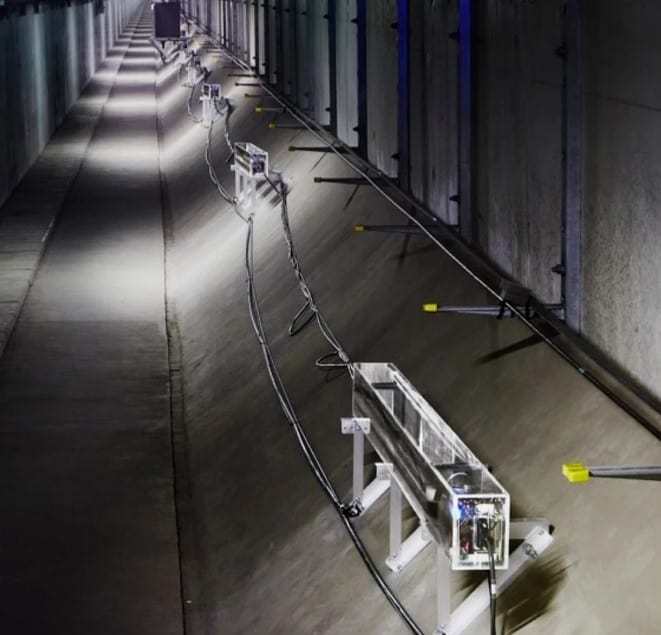
Under the sea: several of the muon detectors in the Tokyo Bay Aqua-Line tunnel. (Courtesy: Tanaka et al/Scientific Reports)
An array of undersea muon detectors that monitors variations in water depth has been created by an international team of researchers. The system comprises a line of sensors that were installed in a road tunnel beneath Tokyo Bay by Hiroyuki Tanaka at the University of Tokyo and colleagues. They used the system to measure how a distant typhoon caused the water level in the bay to oscillate over timescales of several hours. Installing similar detectors worldwide could boost our understanding of weather-related oscillations in the levels of bays and lakes.
High-energy cosmic muons are constantly raining down on Earth and they can travel tens or even hundreds of metres through liquids and solids. However, muons are absorbed by matter and if a muon detector is placed underwater, the number of muons detected will decrease as the depth of water above the detector increases.
In their study, Tanaka’s team explored how muons could be used to study meteotsunamis. These are tsunami-like oscillations in bodies of water that are caused by meteorological effects such as storms, weather fronts and atmospheric gravity waves. Typically, they occur within smaller water bodies such as bays and lakes. The mechanisms that generate meteotsunamis and cause them to propagate are poorly understood.
Expensive to monitor
Depending on local conditions, meteotsunamis can take place over timescales ranging from minutes to several hours. Oscillations can be monitored using tide gauges, buoys and satellites – but these can be costly to build and operate, difficult to access, and do not always provide accurate, real-time measurements.
To create a new way of monitoring water levels, Tanaka’s team placed a line of muon detectors along 200 m of the 9.6 km tunnel portion of the Tokyo Bay Aqua-Line. Called the Tokyo-Bay Seafloor Hyper-Kilometric Submarine Deep Detector (TS-HKMSDD), the array detects cosmic muons that have passed through the water above.
Using this setup, the researchers measured variations in the number of muons reaching the sensors during a meteotsunami that struck Tokyo Bay in 2021. This was triggered by a typhoon passing 400 km away. During the event, the number of muons picked up by the detectors revealed variations in water levels associated with the meteotsunami oscillation. The team’s observations closely matched those made by conventional measurement methods.
Based on their success, they now hope that their low-cost, easily accessible muon sensors can be installed in other tunnels. Possible sites include the Transbay Tube beneath San Francisco Bay and the Channel Tunnel, which connects the UK to France.
In this episode of the Physics World Weekly podcast I report from Edinburgh, where I attended a meeting for student members of the Scottish Centres for Doctoral Training (CDTs) in Condensed Matter Physics and Quantum Materials. While in the Scottish capital I discovered how CDTs are helping students make the most out of their PhDs and I also heard some top tips for making postgraduate life easier.
In the podcast I speak to Alex Coates about the “hidden curriculum” of essential knowledge that no-one tells you when you start a PhD. Coates is doing a PhD at Heriot Watt University and discovered this hidden curriculum during his three years as a postgraduate representative on the students’ union.
But before that, I learn the basics of what a CDT is and why many PhD students choose to join one. That is in a conversation with Chris Hooley, operations director of the Scottish Doctoral Training Centre in Condensed Matter Physics; the University of Edinburgh PhD student Freya Bull; and Ben Gade, who is doing a PhD at the University of St Andrews.