Can energy move from a colder to a hotter region in a material without violating the second law of thermodynamics? Yes, according to physicists from Trinity College Dublin and the Universidad Complutense of Madrid, who discovered that a quantum effect sometimes forces current to flow around the edges of a sample in a way that opposes the normal direction of heat flow. These “edge currents” are remarkably robust, and the physicists say they could be present in a broader class of range of systems than previously thought. If that is the case, such currents might be used to control heat flow through nanostructures and thus help bring about more energy-efficient computer chips or devices to recycle waste heat.
Edge currents occur in so-called topological materials, which are materials whose surface properties are very different to those found in their bulk. They are named after topology – the “rubber sheet geometry” branch of mathematics in which two objects are assumed to be equivalent, or trivial, if they can be continuously deformed into one another by bending, twisting, stretching or shrinking (but not tearing or cutting). In this framework, a circle is topologically equivalent to an ellipse, and a doughnut equivalent to a coffee mug, because these pairs of objects can be deformed into each other by stretching. In contrast, a doughnut cannot be deformed into a ball without ripping it apart because of the hole at its centre. This is an example of “non-trivial” topology.
Topological materials show similar geometries on the molecular scale in their energy spectrum, instead of in physical space. This gives rise to several unusual mechanical and electrical properties. Topological insulators, for example, do not carry electrical currents in their bulk, but current does flow along their surfaces through special “edge” states. The electrons in these states can only travel in one direction, and they also steer around imperfections or defects on the surface without backscattering. Since backscattering is the main energy-dissipating process in electronic devices, these “topologically protected states”, as they are known, might be useful ingredients in next-generation energy-efficient devices.
The “erasure” effect
While researchers have known for decades that robust edge currents exist in topologically non-trivial systems, team member Mark Mitchison of Trinity College’s School of Physics says they did not expect to observe such currents in topologically trivial ones. He and his colleagues discovered that the counterintuitive currents appear if the system is subject to a temperature gradient – that is, if one end is hotter than the other. In their work, they achieved this by coupling each end of a hypothetical sample with so-called quantum Hall bar geometry to two thermal reservoirs at different temperatures and simulating what happened using a computer model. The quantum Hall bar is routinely used in experiments and consists of a two-dimensional electron gas (a scientific model used in solid-state physics) that is contacted by six electrodes. This set-up can be used to measure the transport characteristics of the gas.
“To our surprise, we found that edge currents remain stable, implying that one of them runs against the natural direction of heat flow,” says team member Angel Rivas.
To shed more light on this puzzle – and why it doesn’t go against the second law of thermodynamics – the physicists next considered a more general model that supports two very different phases: a topological insulator phase and a “trivial” band insulator phase. They found that while the current flows in the opposite direction to their expectations on the edge, the overall net transfer of heat is always from the hot to the cold reservoir, meaning that the second law of thermodynamics is never violated.
“We explain this by the ‘erasure’ effect,” team member Miguel Angel Martin-Delgado tells Physics World. “Here, circulating currents cancel out in the bulk but add constructively on the edge, giving rise to the counterintuitive current patterns that we observed.”
Heat management applications
While the Dublin-Madrid team focused on a particular theoretical model, members say the phenomenon is general and could in principle arise in a broad class of materials. Rivas notes that although the team’s results are theoretical, he expects the findings could eventually be useful for controlling heat through small structures. “Heat management at the nanoscale has many useful applications: for example, the design of more energy-efficient computer chips or devices to recycle waste heat,” he says.
The researchers say they will now study other geometries beyond 2D structures. “We have already shown in a recent preprint that crosscurrents can exist in 3D systems, meaning that the current flows from cold to hot throughout an entire 2D surface, instead of just along a 1D line,” explains Martin-Delgado. “But we can even think further and speculate about higher dimensions – for example; a 4D cube which would have a 3D cube as one of its boundaries. Thus, the Second Law could be apparently violated in a 3D world that is the boundary of a 4D system.”
This may sound unrealistic, he admits, but such systems have already been realized in the laboratory using quantum simulators engineered to have “synthetic dimensions”. “Working out how our results could be experimentally implemented in such simulators is another major goal for our future research,” he concludes.
By combining a metamaterial cylinder with artificially grown heart tissue, researchers in the US have developed the miniPUMP – an on-chip device that closely mimics the function of a ventricular chamber. Using an advanced laser writing technique, a team led by Christos Michas at Boston University ensured that the miniPUMP could expand and contract in a cycle reminiscent of the beating human heart.
The latest advances in biomimetic tissue models are leading to increasingly sophisticated artificial organs, along with 3D-printed organ-on-chip models, which allow researchers to study the function of our organs in unprecedented detail. These models are based on induced pluripotent stem cell (iPSC) technology, in which a specific set of genes is introduced to a cell, which allow it to differentiate into a diverse array of stem cells.
For now, iPSC technology can’t be adapted to reproduce the nano- or micro-scale architectures that are widely found in human organs, and are often essential for producing their unique material properties. To address this challenge, Michas and colleagues turned to a technique named two-photon direct laser writing (TPDLW).
Here, the molecules in a photosensitive material are forced to absorb two photons simultaneously, which drastically enhances their responses to light compared with conventional laser writing. As a result, TPDLW allows researchers to carve out precise, nanoscale features within these materials, without the need for complex optical set-ups. TPDLW is particularly well-suited to fabricating metamaterials: whose nano- or micro-scale elements act collectively to produce advanced material properties in the macro-scale material.
In their case, Michas and colleagues applied the technique to recreate the human ventricle – one of two chambers at the bottom of the heart, which expands to draw in blood from one valve, then rapidly contracts to pump it at high speeds through another valve. Named miniPUMP, the device features a millimetre-sized, hollow cylindrical metamaterial, whose nanoscale features allow it to expand and contract perpendicular to its axis. This cylinder was then wrapped in a thick layer of iPSC-derived heart tissue, which expanded and contracted in a closed cycle.
The researchers connected their artificial ventricle to a blood-filled passage, whose one-directional flow was controlled by a pair of 3D-printed valves. In experiments, miniPUMP’s cylinder demonstrated a perfect loop of varying volume and pressure – pumping blood out of the tube in carefully controlled cycles of varying flow rate.
Through further improvements, Michas’ team hopes that miniPUMP will allow researchers to closely study the heart’s function in the lab – potentially providing an ideal platform for testing new treatments for heart disease. Elsewhere, the technology may even be generalized to fabricating on-chip devices that mimic the function of other organs.
As I sat in the undergraduate labs on level 5 of the Blackett Laboratory at Imperial College London, my task was to make an accurate measurement of the gravitational constant. This experiment has been carried out countless times by physics students to demonstrate experimental aptitude as well as an understanding of Newtonian mechanics. The only difference compared with those around me, however, is that I performed the experiment “hands free”. In other words, I gave detailed instructions to my assistant who then helped me to carry out the investigation and the calculations.
I have needed to do experiments this way throughout my education as I have had cerebral palsy since birth. This physical disability means that I have difficulty controlling my muscles, so I use an electric wheelchair to get around and a specialized joystick to operate computers. As I have always had my disability, I have learned how to negotiate my education and so have never had to adjust to a new way of working. This situation is very different, for example, to someone who acquires a disability later in life.
The right support
As we all know, studying physics means scribbling down lots of equations for many hours a week. The idea of dictating equations, experiments and even code may sound strange if you have never had to do it before, but with experience it is possible to find techniques to make it work. When I was studying for my physics undergraduate degree at Imperial, I had to find the right academic assistant to help me with my studies. They not only had to be someone who knew how to write equations, but also understood my speech. Thankfully, I found support that met my individual needs and priorities, but sadly that is not the case for everyone.
Recruiting assistants can be a struggle for universities. Institutions have generally been able to support disabled students for a couple of hours a week, but never for longer periods of more than 50 hours. Universities are simply not set up to provide that level of support. At a different UK university, which shall remain nameless, I was told that I met the entrance requirements but that I would have to delay my entry by a year while they adapted the buildings and recruited assistants to help me access my course.
It is also quite common, for example, to have a university site that is not set up for people who cannot climb stairs. I have been to open days in physics departments where the entrance to a main lecture theatre is on a mezzanine level that is not accessible by a lift. And if there is a lift, it is sometimes not big enough to fit a powered wheelchair. There have been times I cannot get into the building in the first place as it has no accessible entrance.
Beyond labs and lectures
Completing an undergraduate course or carrying out research in the lab is not the only difficulty that scientists who have physical disabilities must overcome. The best ideas can sometimes come not in the office or lab but when socializing. If colleagues go to an inaccessible venue after work, I could ask them to change their plans, but doing so can sometimes feel socially awkward. If I choose not to go, it can be academically isolating.
Another issue is that student and conference timetables that feature venues in multiple locations are also often not planned with people in mind who may need a little extra time to travel between places. At least this problem only requires awareness and forward planning to rectify, rather than bricks and mortar.
Difficulties are also often encountered in publishing where academics are faced with a huge pressure to “publish or perish”. In practice, this means that even if you have interesting ideas, then if the above issues slow your work down, you just won’t get the chance to explore them before you are scooped, which can be very demoralizing. This is a tricky issue to solve, which is certainly not unique to physics.
Conversation opener
The many challenges that people with a physical disability face can only be solved if the correct support structure is in place. Universities should certainly not apply a “one size fits all” approach to catering for students with disabilities and while I don’t expect the problems I mention above to be solved overnight, hopefully talking about these situations can lead to solutions.
I believe that people with physical disabilities will only start to consistently reach the forefront of research when the barriers they face are removed – and that begins at school, which is a whole different issue to be tackled. Increased awareness instead of obliviousness, which is often sadly encountered in academia, can help to create a better working environment – not only for those with disabilities, but for everyone.
This short video features Niels Bultink, co-founder and chief executive of Qblox, a start-up company based in Delft, Netherlands. Speaking at the 2022 March meeting of the American Physical Society in Chicago, Bultink outlines the benefits of Qblox’s control stacks – equipment that is used in quantum computing to generate control signals and interpret the results of algorithms.
As Bultink explains, experimentalists who wanted to build a control stack used to have to tie a lot of different pieces of equipment together with software and wires. “We can now do that with one integrated and modular solution, [which] allows researchers to focus again on the experiments they are doing.” Qblox’s control stacks have been used for everything from semiconductor circuits and quantum dots to NV centres and photonic systems.
In this episode of the Physics World Weekly podcast the Ukrainian glass artist and architect Oksana Kondratyeva talks about the long tradition of stained glass making in Ukraine and how the country’s artistic and historical heritage is threatened by the Russian invasion.
This episode is part of our ongoing coverage of the International Year of Glass and Kondratyeva explains how she creates textured glasswork using acid etching and she contrasts this technique with more traditional methods of stained-glass making. She also talks about the stained glass associated with the Chernobyl nuclear power plant and explains why some of her latest work is inspired by quantum computing.
There is much more about history of stained glass in Ukraine in a paper by Kondratyeva called, “New Light on Ukrainian Stained Glass”, which appeared in the Journal of Stained Glass. It can be downloaded from the British Society of Master Glass Painters for a £5 donation towards providing first-aid kits for communities in Lviv and Kyiv.
Precision radiation-medicine specialist Elekta has long been a main-mover in the field of adaptive radiotherapy (ART), in which delivered dose is monitored for clinical acceptability and modified as needed during the course of treatment. The end-game: better local control of cancer; reduced toxicity and side-effects; and, ultimately, enhanced quality of life for patients.
The Elekta Unity MR-Linac is a notable success story in this regard, one of a new generation of MR-guided radiotherapy (MR/RT) systems transforming patient care and treatment outcomes in the radiation oncology clinic. Think online image guidance and ART tailored to the unique requirements of each patient. In other words, adjusting radiation delivery “on the fly” to address the daily anatomical and functional variation in the tumour and surrounding healthy tissue while allowing adaptation of the plan for tumours that respond rapidly to treatment (as well as those that prove unresponsive to standard doses of radiation).
Yet while Elekta Unity, and MR/RT more generally, have been the big headline in ART of late, it’s evident that technology and clinical innovation in ART are proceeding along multiple coordinates. Take the ongoing development of Monaco – Elekta’s proprietary treatment planning system (TPS) – with a set of tools that enables the clinical team to implement a triggered adaptive workflow on conventional Elekta linacs – most notably the Versa HD (the equipment maker’s high-end platform for advanced stereotactic treatments).
That adaptive workflow, in turn, enables what Elekta calls triggered ART, with regular offline assessment of patient anatomy – including, for example, tumour shrinkage and weight loss – versus the treatment plan for the tumour and organs-at-risk (OARs). All of which is a precursor to online adaptation of the initial treatment plan, yielding reduced uncertainties and risks when it comes to targeting accuracy and dose distribution accuracy over the course of multiple fractions. For the patient, of course, that also points the way to continuous improvement regarding treatment outcomes.
The adaptive mindset
At the clinical sharp-end of the ART development effort is Valentina Vanoni, a radiation oncologist at the Santa Chiara Hospital in Trento, northern Italy. Vanoni is part of a cross-disciplinary radiation oncology team that treats around 1400 patients each year using a suite of four Elekta linacs (all underpinned by the Monaco TPS). The clinic’s specialisms include volumetric modulated arc therapy (VMAT) for head-and-neck (H/N) tumours – the current focus of the ART programme – as well as high-dose-rate brachytherapy for gynaecological cancers and the use of intraoperative radiotherapy for a range of breast indications.
Valentina Vanoni: “ART is a new paradigm in radiation oncology.” (Courtesy: Santa Chiara Hospital)
“ART is a new paradigm in radiation oncology,” explains Vanoni, “but it’s not easy and is not yet deployed as part of the routine clinical practice here.” As such, the Trento team is still very much in evaluation mode, figuring out the path to wider deployment of ART.
While the long-term clinical priority is clear – using ART to minimize dosimetric inhomogeneity to the target while maintaining planned dose to target and the associated OARs – the near-term challenge for Vanoni is more prosaic: how to set up metrics to trigger for offline adaptation of the treatment plan for any given patient.
“Daily adaptation is not an option for us because creating a new treatment plan is still a time-intensive exercise requiring a contingent of dedicated team members,” notes Vanoni. “What we have to do is compromise and adapt the treatment plan only when necessary.”
That’s the cue for Monaco’s triggered adaptive workflow to kick in, with Versa HD’s onboard cone-beam CT capability the key enabling technology for daily imaging and clinical assessment of the patient. “If more investigation is necessary,” explains Vanoni, “we subsequently export the cone-beam CT data set to Monaco to assess the need for adaptation using quantitative evaluation and responsive metrics.” Specifically, that means daily analysis of the dose-volume histogram (DVH) and associated dosimetric parameters of the original treatment plan recalculated on the “anatomy of the day”. It’s at this point that the clinician will make a go/no-go decision regarding offline adaptation of the original treatment plan.
Making the case for ART
For Vanoni and her colleagues in Trento, the priority right now is to develop the evidence case to validate the clinical and operational efficacy of ART. Online assessment, she argues, may ultimately “shift the dial” on image-guided radiotherapy from daily patient positioning to daily patient dosimetry over the medium term. A case in point is the potential for systematic use of ART in cases where the tumour target is near to critical OARs – for example, to fine-tune the dose over time to the paranasal sinus and nasopharynx tumour.
More broadly, improvements in the automatic workflows for ART – including faster, more accurate auto-contouring and ultrafast reoptimization as well as automated plan analysis – will drive the process simplification and streamlining needed for clinical adoption at scale. As for specific ART opportunities, Vanoni reckons the adaptation of the gross tumour volume (GTV) versus imaging changes could be advantageous in allowing dose escalation in radioresistant tumours. “Equally,” she concludes, “frequent adaptation and dose-tracking open up the possibility to further dynamically refine OAR constraints for H/N indications – for example, with respect to the parotid glands.”
An artist’s impression of a superconducting chip. (Courtesy: TU Delft)
An international group of physicists has demonstrated that a very thin layer of quantum-mechanical material sandwiched between two pieces of superconductor can conduct electricity with or without resistance depending on the direction of the voltage applied. The new “Josephson diode” operates in the absence of a magnetic field and could, the team says, lead to a new generation of faster, more energy-efficient electronics.
Conventional diodes are put to a wide range of uses, including the conversion of alternating to direct current, the demodulation of radio signals and as components inside logic gates. They are usually made from a p–n junction; that is, from pieces of positively and negatively doped silicon joined together. With some of the excess “holes” (regions of positive charge) and electrons combining, the region around the join becomes insulating, like undoped silicon. The result is a device that conducts electricity in only one direction when the negative terminal of a battery is connected to the n-type region, such that electrons are pushed into the p-type region.
The ability to transmit such one-way currents in superconducting circuits could save significant amounts of energy. Superconductors are materials that conduct without resistance when cooled below a certain critical temperature at which it becomes energetically favourable for electrons to form pairs that glide unimpeded through the material’s crystal lattice. They are used, for example, to make bits for quantum computers and in high-strength magnets. Since superconducting switches are particularly speedy, a superconducting diode could also lead to faster devices.
Scientists have already demonstrated how superconducting diodes could be made. In 2020, researchers in Japan observed a superconducting current flowing one-way across a thin stack of three different metals. This result came about due to the material’s inherent properties rather than the presence of a junction, but, as with other similar demonstrations, their feat relied on applying a magnetic field across the material.
Field-free flow
In the latest work, Mazhar Ali of the Delft University of Technology in the Netherlands and colleagues in Europe, the US and China note that such a field is needed to carry out the symmetry breaking essential for uni-directional current flow. The “non-centrosymmetric” conductor used in the 2020 demonstration breaks spatial symmetry, meaning it distinguishes between electrons with positive and negative momentum. In addition, however, the system must also break temporal symmetry – allowing spin-up electrons with positive momentum to behave differently from spin-down electrons with negative momentum.
Group members Heng Wu and Yaojia Wang have now shown how to break both types of symmetry using a novel type of Josephson junction. A regular Josephson junction consists of a very thin insulating (or non-superconducting) layer sandwiched between two superconducting layers. In this structure, pairs of superconducting electrons can tunnel across the gap between them as long as the current remains below a certain limit.
The new device instead comprises a flake of niobium bromide just a few atoms thick placed between layers of a superconducting material, niobium diselenide. The niobium bromide, made by group members at Johns Hopkins University in the US, is a two-dimensional quantum material like graphene, and it has been predicted to contain a net electric dipole – thereby exhibiting the symmetry breaking needed to build a superconducting diode.
By carrying out a series of experiments at temperatures as low as 20 millikelvin, the researchers demonstrated that the device functioned as a superconductor when the current flowed in one direction while exhibiting normal resistive behaviour in the other. Notably, they confirmed that no magnetic field was needed to achieve this diode effect – showing that while the effect was present with zero field it disappears when the junction is exposed to higher fields.
An uncertain mechanism
Ali and colleagues report that they have collected very similar data using materials from different batches analysed in different labs – giving them confidence that their results were not due to some artefact of the experimental set-up or to user error. However, they are not entirely sure about the physical mechanism behind the effect. They think that polarization within the three-layer device leads to a similar effect as in the p–n junction of a normal diode, but say that further theoretical and experimental work is needed to confirm this idea.
They add that building a practical device will involve replacing niobium diselenide with a more complex superconductor that operates at higher temperatures – preferably above 77 K, at which point they could use relatively cheap liquid-nitrogen cooling. They will also need to scale up production from the handful of devices they made for their laboratory experiments to chips containing millions of Josephson diodes.
Should they succeed, they reckon that their technology could have major commercial applications. Although likely to be too complex for use in domestic computers, they say that their diodes are potentially well-suited to centralized facilities such as server farms or supercomputers. “The existing infrastructure could be adapted without too much cost to work with Josephson diode-based electronics,” says Ali.
Toshiya Ideue of the University of Tokyo, Japan regards the latest work as “big progress” in the development of superconducting diodes. He thinks that measuring the response of different combinations of superconducting and non-superconducting quantum materials, with varying relative orientations, could help reveal the physical mechanism involved in the field-free diode effect, which would in turn shed light on other exotic properties of such materials. But he cautions that mass-producing devices made from these materials will not be easy. This fabrication challenge, he says, “must be solved for practical use”.
“No-one would have believed in the last years of the 19th century that this world was being watched keenly and closely by intelligences greater than man’s.”
So begins H G Wells’ classic 1897 novel The War of the Worlds, in which terrifying Martians invade our planet. Although the creatures die after being exposed to pathogens to which they have no defence, the notion of aliens eyeing the Earth is a common plot in science fiction. In Childhood’s End, for example, Arthur C Clarke describes extraterrestrials who had secretly watched Earth’s evolution for millions of years from across interstellar space – before invading and becoming our overlords.
In reality, it is we humans who have been looking for distant worlds. Over the past few decades, astronomers have discovered almost 5000 planets circling stars other than our own. And the nature of our interstellar voyeurism is evolving. Not just content with finding and cataloguing these alien exoplanets, we want to characterize them too. Accompanied by artists’ impressions of volcanic landscapes or storms raging above shimmering oceans, such work makes distant planets feel somehow more real.
Yet, despite major investments in new space missions – notably the James Webb Space Telescope (JWST) – exoplanet surveys targeting habitable Earth-like planets are unlikely to resolve much more than dots of light for the foreseeable future. “If I look at the next 50 years, next hundred years maybe, nobody will be able to set up a telescope that’s powerful enough to resolve surface features,” says Jonathan Jiang, an atmospheric scientist at NASA’s Jet Propulsion Laboratory in Pasadena, California, who uses Earth as a laboratory to model exoplanets.
By predicting our planet’s appearance across interstellar space, we can tease out the tell-tale signatures of habitability, biology and even technology
But how can we identify livable worlds – or even signs of life itself – from just a handful of pixels? One approach gaining traction is to become interstellar spies ourselves and determine what the Earth would look like to alien astronomers. By predicting our planet’s appearance across interstellar space, we can tease out the tell-tale signatures of habitability, biology and even technology. Armed with that information, we can then turn the tables and search for alien life among the stars.
New eyes on alien worlds
Two techniques will be particularly fruitful in that quest. One is transmission spectroscopy, which looks at the spectrum of starlight that has passed through an exoplanet’s atmosphere. Specific wavelengths will have been absorbed by atmospheric gases, leaving characteristic absorption lines in the spectrum. The lines form a chemical fingerprint that could be used to find “biosignatures” such as oxygen or ozone. Transmission spectra could even be used to spot “technosignatures”, such as chlorofluorocarbons and nitrogen dioxide, which would be evidence of an advanced civilization that has created industrial pollutants.
Unfortunately, astronomers have not yet been able to record transmission spectra from Earth-like exoplanets around Sun-like stars as their atmospheres are so thin. But the JWST and the European Space Agency’s PLATO mission, set for launch in 2026, should be able to take the first steps. Both missions are targetting smaller “M-dwarf” stars, which are the most common class of stars in our galaxy. These red balls of gas are orbited by many exoplanets that could harbour life – one of the most famous being the TRAPPIST-1 system of seven planets, up to four of which are thought to lie in the star’s habitable zone.
The other promising technique to study exoplanets involves directly imaging these worlds, by capturing photons that have reflected off their surface. The JWST can do this, as should NASA’s forthcoming Nancy Grace Roman Space Telescope (previously known as WFIRST), which is due for launch in the mid-2020s. Direct capture of reflected light is also on the cards with two other potential NASA missions: the Large Ultraviolet Optical Infrared Surveyor (LUVOIR) and the Habitable Exoplanet Imaging Mission (HabEx). These ambitious, high-spec telescopes and their direct-imaging potential is exciting. But entire oceans, continents, atmospheres and even biological signatures will still be boiled down to just a few blurry pixels.
Transmission spectroscopy is limited too. “Light that gets filtered through the [exoplanet] atmosphere is going to be a combination of what’s going on at basically every altitude,” says Laura Mayorga, an astronomer at Johns Hopkins University in Maryland, US. Teasing out the atmospheric conditions right down at the surface of an exoplanet, where life is most likely to exist, will therefore be tricky.
Clouds on an exoplanet will make transmission spectroscopy even harder. Being opaque, they will stop light penetrating through the planet’s atmosphere, limiting how much compositional information can be extracted. What’s more, when astronomers use transmission data to model exoplanetary atmospheres, they are hamstrung by the fact that the amount of sunlight falling on a planet rises and falls – depending on, say, the number of sunspots and solar flares. This often unpredictable level of electromagnetic radiation can hide an intriguing signal or give false positives for potential biosignatures.
Who are you looking at?
Despite these challenges, both Jiang and Mayorga believe that evidence of a potentially habitable world – or even signs of one that already harbours life – can be found among these reflected rays and filtered photons. But to ensure their exoplanetary biosignature techniques work, they first want to test them out on the Earth, which is the only world we know of that does contain life. However, we can’t simply journey to another star system trillions of kilometres away and observe our home planet from there.
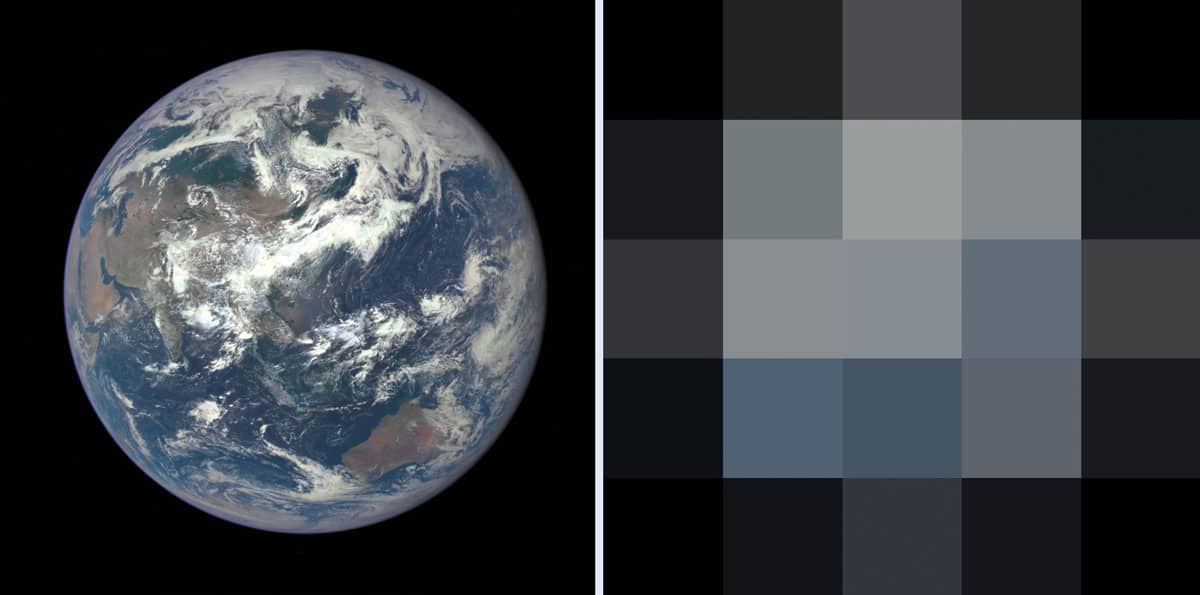
Luckily, in 2015, Jiang had an idea. NASA’s Deep Space Climate Observatory (DSCOVR) had just arrived at the L1 Lagrangian point 1.5 million kilometres from Earth. Designed to monitor space weather, DSCOVR constantly faces the dayside of the Earth, taking wonderful, high-quality pictures of it (figure 1). Why not, Jiang wondered, use these images to work out what our Earth would look like to aliens?
1 The Earth to us and them Clear images of the Earth are not as commonplace as you might think. In fact, only since 2015 have we been able to view our entire planet in one frame, following NASA’s launch of the Deep Space Climate Observatory (DSCOVR). The craft maintains a constant view of our planet as it rotates, observing ozone, vegetation, cloud height and aerosols in the atmosphere. a Taken in August 2015, this image is typical of what DSCOVR can see. b The same image, but reduced to just 25 pixels in size by Stephen Kane and colleagues from the University of California, Riverside, indicating what alien observers might see if they looked at us (arXiv:1511.03779). The DSCOVR data later led Jonathan Jiang from NASA’s Jet Propulsion Laboratory in Pasadena to wonder if the surface details of the planet could be teased out from these blurry pixels. (Courtesy: S R Kane/arXiv:1511.03779)
He and his Caltech colleagues began by averaging two full years of DSCOVR data to create a time series of flickering points of light. Jiang’s team then manipulated the data, altering the proportions of oceans, landmasses and cloud cover to create thousands of fake “exoEarths”. Next, they averaged the information for each fake planet into a single pixel and fed the data to a neural network. The network, they reasoned, ought to be able to train itself on this information so that, when presented with a real single pixel from our planet, it could “reverse engineer” the information and work out what the Earth is like.
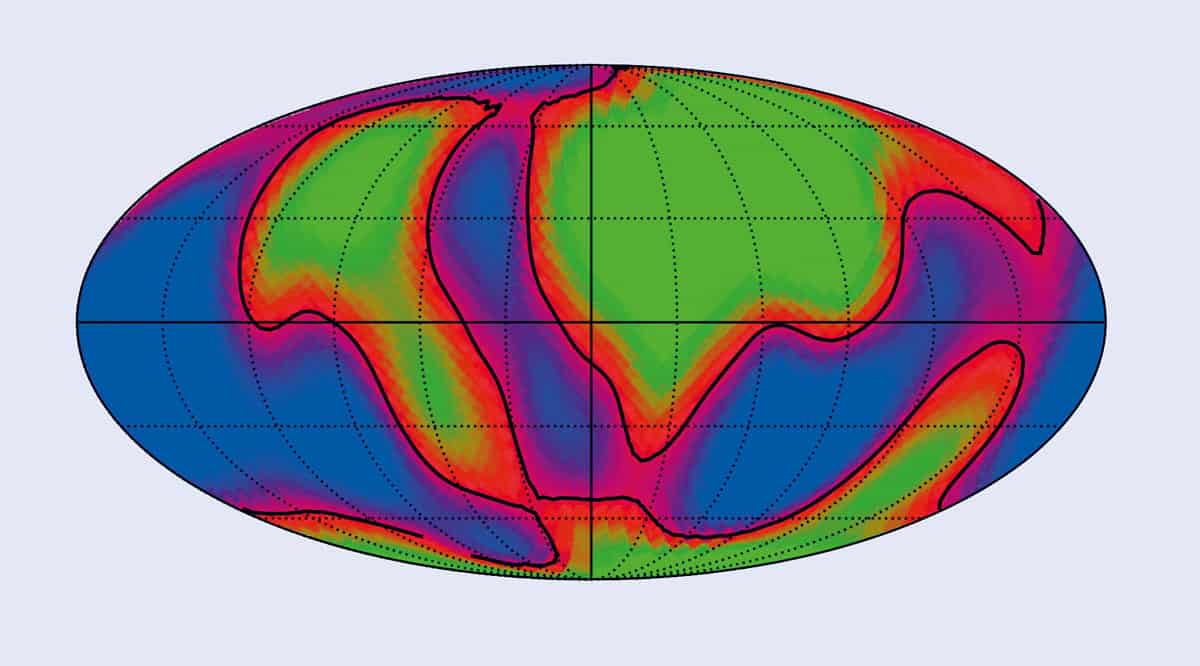
The idea worked and Jiang’s team successfully used their educated algorithms to tease out the repeating 24-hour signature of an Earth day as well as patterns specific to clouds, continents and oceans (figure 2). Jiang then turned to a more metaphysical biosignature – that of “planetary complexity”. As the Caltech astrobiologist Stuart Bartlett suggested, complex interactions between biology, geology and meteorology on inhabited planets should make them appear more complex than uninhabited worlds. Complexity, Bartlett argued, could be a universal signature of life regardless of how Earth-like it is.
To find out if that complexity can indeed be observed across interstellar space, Jiang and Bartlett used a statistical technique known as “Epsilon machine reconstruction” – algorithms designed to calculate complexity. This method let the researchers compute the statistical complexity of not only their fake exoEarths based on the DSCOVR data, but also a fake “exoJupiter” derived from data taken by NASA’s Cassini mission. They were able to show that statistical complexity is indeed an effective measure of the complexity of planetary features. As a lifeless but dynamic world with dramatic storms and 650 km/h winds, an exoJupiter would provide a stern test of Bartlett’s support for complexity as an interstellar biosignature (Astron. J.163 27). But it was a test his idea appears to have passed: Jiang’s exoEarth came out 50% “more complex” than his exoJupiter.
The Moon to the rescue
Jiang’s work suggests a way to search for biology among the stars without having to guess its chemistry or assume that aliens must be similar to us. The only trouble is that the technique is based on data from DSCOVR, whose orbit lies between the Earth and the Sun. The craft therefore never sees our planet pass in front of the Sun, which means it cannot help with transmission spectroscopy.
Thankfully, we can rely on our old friend the Moon, which passes exactly through the Earth’s shadow during a lunar eclipse. When this happens, the Moon doesn’t totally disappear from view but reflects back to us sunlight that has passed through the Earth’s atmosphere. The “blood Moon” looks eerily red, with the light reaching us being our planet’s very own transmission spectrum.
2 This is how we look Astronomers are keen to not just observe exoplanets but also see if those distant worlds have geological features or climate systems that vary across a planet, which could be a sign of life. Extracting such information is, however, difficult as our images of exoplanets are so poor, often consisting of just a single point of light. To help tackle the problem, Jonathan Jiang and colleagues at the California Institute of Technology have boiled down about 10,000 images taken by NASA’s Deep Space Climate Observatory over a two-year period to form a single-point image, indicating how Earth might look to alien astronomers. They then worked backwards to see if they can reconstruct the real features on Earth. This image shows one of the first 2D surface maps, revealing the familiar shape of Earth’s continents (with Africa in the middle) alongside coastlines and oceans. The colours indicate different surface reflectivity. (Courtesy: Fan et al. 2019 ApJL882 L1, reproduced by permission of the AAS)
Ground-based telescopes have recorded the Earth’s transmission spectrum at optical and near-infrared wavelengths during lunar eclipses. But in 2019 a team led by Allison Youngblood from the University of Colorado used eclipse data taken by the Hubble Space Telescope to extract Earth’s transmission spectrum at ultraviolet frequencies. Collecting light of this type could help identify habitable exoplanets as it contains a signal from ozone (O3), which is a byproduct from oxygen gas (O2). Youngblood successfully prized out the signature of Earth’s ozone from our transmission spectrum, paving the way for spotting it on exoplanets too (Astron. J.160 100).
Our growing appetite for new views of exoplanet Earth was recently demonstrated by Mayorga’s proposed launch of a satellite to capture our planet’s passage as it passes in front of the Sun. Dubbed the Earth Transit Observer, it would lie near the JWST and help astronomers to determine how deep into an exoplanet’s atmosphere transmission spectroscopy can probe (Planet. Sci. J. 2 140). The craft could also indicate whether biosignatures leave fingerprints in the easier-to-sample upper atmosphere of distant planets. It could even determine how the strength of a biosignature signal is affected by violent eruptions on the Sun or by changes in cloud conditions on Earth. “This mission would help us set guidelines for what that instrumentation [on future exoplanet projects] needs to look like,” says Mayorga.
A camera on the Moon could help astronomers to distinguish cyclical changes on exoplanets
Another astronomer keen to collect new perspectives on our planet is Patricia Boyd from NASA’s Goddard Space Flight Center in Maryland, who has drawn up plans to install a wide-field optical camera on the surface of the Moon. Dubbed EarthShine, the instrument would measure the light from Earth and average it into a single point so that the signal can be compared with real-time data from Earth-orbiting satellites.
The big advantage of a camera on the Moon is that it would see the Earth in all its different phases – ranging from a thin crescent to a full disc – whereas DSCOVR only ever sees an entire fully illuminated planet. Its data could therefore help astronomers to distinguish similar cyclical changes on exoplanets from natural biological variations, akin to trees changing colour in autumn or algae building up or “blooming”.
Polarization: a new angle on exoplanets
Beyond direct imaging and spectroscopy, there is a third way of analysing exoplanet light. That involves studying its polarization, which changes when light reflects off a surface. Smoother surfaces (such as calm water) generally reflect light waves over a narrow range of polarizations, whilst light bouncing off rougher surfaces (such as rocks or vegetation) arrive at all different angles. One of the first groups of researchers to investigate planetary patterns in polarized light was a team led by Michael Sterzik from the European Southern Observatory in Chile, who studied light that has first been reflected off the Earth and bounces back to us from the Moon (Nature483 64).
That work then inspired researchers from Delft University of Technology in the Netherlands to simulate how light might reflect from rocky exoplanets. Dora Klindzic, an astrophysicist at Delft, believes that ice, liquid water, snow, clouds and even entire continents could all leave detectable imprints on polarized light. Indeed, Klindzic is hatching plans for an instrument on the Moon. Known as the Lunar Observatory for Unresolved Polarimetry of the Earth (LOUPE), the credit-card-sized device would give polarimetry instruments on future exoplanet telescopes like LUVOIR a benchmark signal of Earth. LOUPE could even be fitted to orbiters, landers or rovers to continuously collect Earth-reflected light as our planet rotates, weather patterns evolve and seasons change.
Youngblood is certainly a fan. “It’s important to do experiments like LOUPE now, when the telescopes that will directly image exoplanets are still being designed,” she says. Although LOUPE would capture only linearly polarized light, a group of researchers at Leiden University in the Netherlands are targeting circularly polarized light from exoplanets too. Such data could yield more direct signatures of alien life because light reflecting off plants becomes circularly polarized due to the presence of spiral-shaped green pigments, known as chloroplasts.
“The main difficulty will be to measure these small signals from far away,” admits Willeke Mulder, a PhD student at Leiden who is helping to develop instruments for the mission. Those concerns led her team to fly a prototype instrument containing a mobile polarimeter above the Swiss Alps to see if the concept works. During the trial, the device successfully distinguished between grass fields, forests and urban areas, and even revealed photosynthetic lake organisms (Astron. Astrophys.651 A68). Next, Mulder hopes to take the technology to the International Space Station.
A mind-bending plan
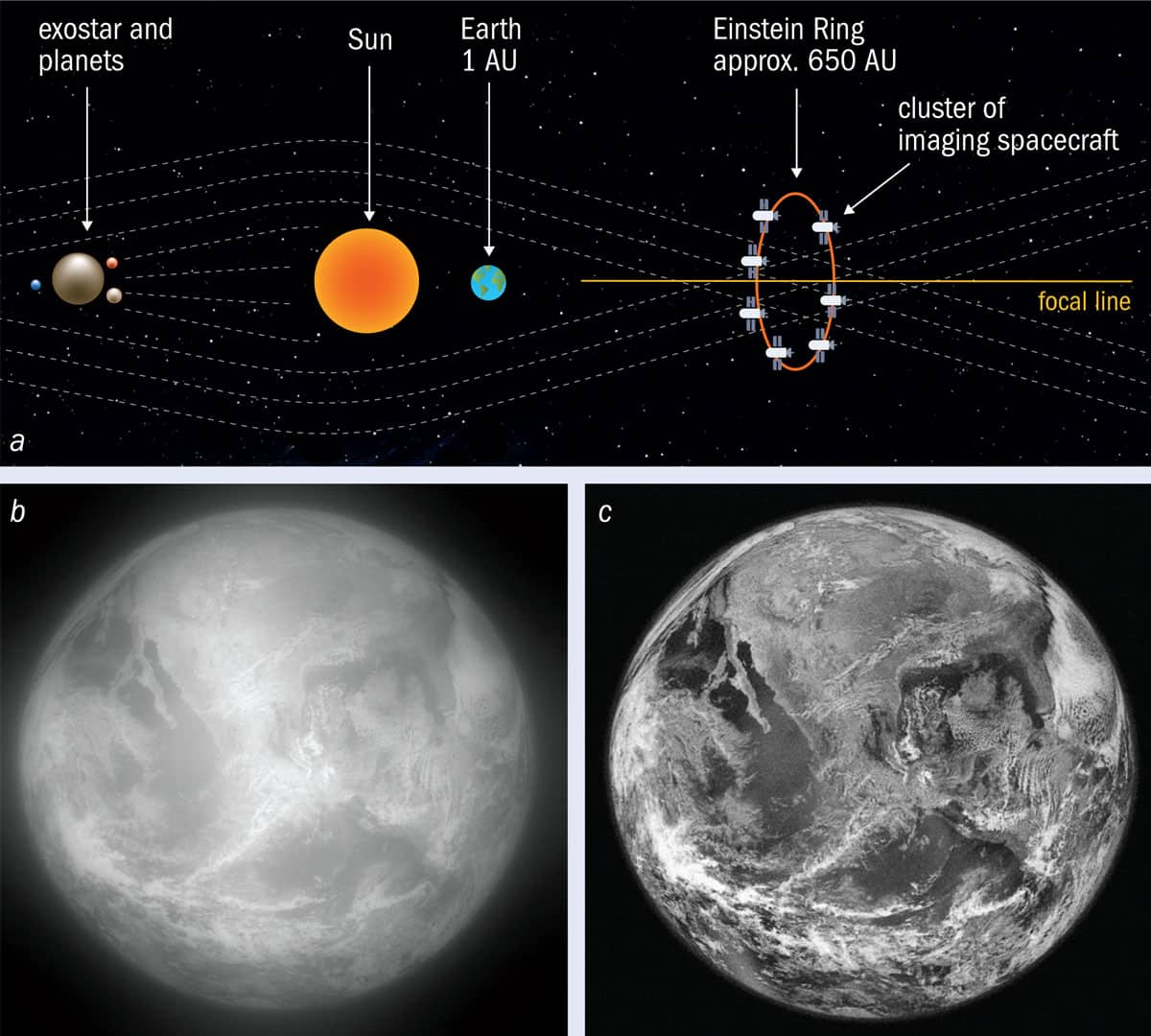
One even crazier idea in the hunt for alien life involves sending craft out into the distant reaches of the solar system, 10 times further from the Sun than Pluto. As first calculated by Albert Einstein in 1936, distant light that skirts the edge of the Sun would be bent by its gravitational field, eventually converging to a focal point about 800 million kilometres from the Sun. In 2017 three researchers at the Jet Propulsion Laboratory at Caltech – Slava Turyshev, Michael Shao and Louis Friedman – realized that if you could place imagers there, it would be the perfect spot for monitoring distant light from an exoplanet that had been bent by the Sun (figure 3).
3 Towards a Solar Gravitational Lensa One ambitious plan to study exoplanets in detail would be to place imagers in the distant solar system, 10 times further from the Sun than Pluto. Starlight that skirts the edge of the Sun gets bent by its gravitational field, converging to a point about 80 billion kilometres from the Sun. Slava Turyshev, Michael Shao and Louis Friedman from the Jet Propulsion Laboratory reckon that distant starlight landing on the imagers could be used to extract detailed information about any planets orbiting the parent star. b Known as the Solar Gravitational Lens (SGL), the project would be a massive engineering challenge and is unlikely to be built any time soon. That hasn’t stopped Turyshev and colleagues from simulating what an Earth-like planet surrounding Proxima Centauri (the closest star to our Sun) would look like to the SGL. c They then deconvoluted the simulation to obtain an accurate picture of the distant Earth. (Courtesy: Reprinted with permission from V Toth and S Turyshev 2021 Phys. Rev. D103 124038. Copyright 2022 by the American Physical Society)
Their project, known as the Solar Gravitational Lens (SGL), would be a massive engineering challenge. But if the facility were ever built, the results would be staggering. A one-metre-diameter telescope facing the Sun at this distance would have the same resolution as a mirror 90,000 km wide located elsewhere in the solar system. Rather than recording a single pixel of light, the SGL would see surface features just tens of kilometres across and map the make-up of the atmosphere at the same scale. Storms, mountain ranges and other features would become visible.
“If there are some irregular structures, such as the Great Wall of China, we’ll see them,” says Turyshev, who is leading a NASA-funded Caltech team to calculate the SGL’s optical properties and mission requirements (Phys. Rev. D96 024008). To garner support for the project, Turyshev has carried out simulations of how a distant, exoplanet version of the Earth would appear if viewed by the SGL. The images would certainly reveal a biological world and perhaps even one home to technological civilizations.
Turyshev, who is 58, is aware that the SGL isn’t going to be built any time soon. “I should be able to see an image of an exoplanet by the time I’m 100,” he jokes. But perhaps, with telescopes using the Sun to focus light, and neural networks detecting life from flickering exoplanet photons, we might one day take up the mantle of the interstellar voyeurs first described all those years ago by H G Wells himself.
Science benefits enormously from supercomputing, which enables researchers to process vast amounts of data and conduct complex simulations. But these machines can be notorious energy guzzlers, with the largest supercomputers consuming as much power as a small city. In this episode of the Physics World Stories podcast, scientists discuss how individuals can reduce the environmental impact of supercomputing without compromising research goals.
Simon Portegies Zwart, an astrophysicist at Leiden University in the Netherlands, says more efficient coding is vital for making computing greener. While for mathematician and physicist Loïc Lannelongue, the first step is for computer modellers to become more aware of their environmental impacts, which vary significantly depending on the energy mix of the country hosting the supercomputer. Lannelongue, who is based at the University of Cambridge, UK, has developed Green Algorithms, an online tool that enables researchers to estimate the carbon footprint of their computing projects.
Researchers from University Hospital Cologne have reported in a proof-of-concept study that two PET/CT radiotracers – F-18 FDG and Ga-68 FAPI-46 – work better together than when used alone for cancer imaging.
The group injected both tracers prior to PET/CT imaging in a small group of patients diagnosed with head-and-neck cancer. Clinical experts visually detected more suspicious tumours on dual-tracer PET/CT scans than on those using F-18 FDG alone, according to the findings published in the Journal of Nuclear Medicine.
“We hereby introduce a practicable single session/dual-tracer protocol combining the strengths of two tracers without losing any diagnostic information relevant to cancer staging,” wrote first author Katrin Roth of University Hospital Cologne and colleagues.
F-18 FDG-PET/CT imaging is a standard approach for therapy planning for various cancers, while Ga-68-labelled fibroblast activation protein inhibitor (Ga-68 FAPI-46) is an experimental PET/CT tracer that binds to fibroblast protein on cancer cells. Ga-68 FAPI-46 has shown promising results in tumour diagnosis over F-18 FDG in PET/CT studies.
However, due to tumour heterogeneity, Ga-68 FAPI-46 PET/CT may not always represent the superior alternative, and the German investigators hypothesized that using the two tracers together may combine their strengths in complementary diagnostic information.
Superior sensitivity: (A) Single-tracer F-18 FDG PET/CT showing a metastasis in the left adrenal gland and liver metastases. (B) Maximum intensity projection (MIP) of single-tracer PET images displaying high uptake in brain tissue, tracer around the injection side, lymph node metastases in the left upper mediastinum and abdomen, and liver metastases. (C) Dual-tracer F-18 FDG and Ga-68 FAPI-46 PET/CT of the same patient. (D) As well as lesions detected with single-tracer PET/CT, MIP of dual-tracer PET/CT visualizes further abdominal lymph node metastasis and liver metastases. (Courtesy: Journal of Nuclear Medicine)
The researchers analysed images and data of six men who underwent two PET/CT scans between March and June 2021 at their hospital. All patients first received F-18 FDG PET/CT and then a dual-tracer PET/CT scan after an additional injection of Ga-68 FAPI-46 immediately following the first scan.
Patients were on average 72.5 years old and underwent imaging prior to radiotherapy, chemotherapy or immunotherapy. One patient had an inoperable oropharynx carcinoma, one had oropharyngeal carcinoma with an additional floor of mouth cancer, and four patients had oesophageal cancer.
Two independent reviewers visually identified all pathological findings on both single-tracer and dual-tracer PET/CT.
Both single and dual-tracer PET/CT were tolerated well by all patients, without any recorded adverse reactions or side effects, and all primary tumours could be clearly detected on both scans. However, in one patient, F-18 FDG revealed metastasis in only one mediastinal lymph node, whereas dual-tracer accumulation revealed two additional lymph nodes of the same drainage region.
One mediastinal lymph node of another patient showed discrete nonsuspicious F-18 FDG tracer accumulation, but suspiciously high dual-tracer accumulation. In addition, dual-tracer PET/CT displayed a higher number of liver metastases than F-18 FDG-PET/CT alone in a patient with a metastasis in the adrenal gland.
“The visual detection rate of suspicious lesions in single- and dual-tracer PET/CT showed equal results in four patients and superior lesion detection with dual-tracer PET/CT in two patients,” the researchers wrote.
Ultimately, the aim of the research is to develop a dual-tracer protocol that exploits the superior lesion detection of Ga-68 FAPI-46 in less FDG-avid malignancies combined with the higher tumour-to-background ratio achieved due to accumulation of both tracers in malignant lesions, the authors wrote.
Since the diagnostic performance of Ga-68 FAPI-46-PET/CT is best shortly after injection and F-18 FDG-PET/CT is currently the gold standard, the authors so far recommend the injection of Ga-68 FAPI-46 as a second tracer after the F-18 FDG-PET/CT scan.
“Future studies may consider simultaneous injection of both tracers and acquisitions of just one single scan, to further simplify the procedure,” Roth and colleagues concluded.