
A new Quantum Monte Carlo method reveals distinct entanglement signatures of different quantum critical points

A critical point is where a material changes phase. For example, water turns to ice below 0°C (273 K) at standard pressure. A quantum critical point occurs at absolute zero (0 K) and, instead of being driven by temperature, is caused by changing another property such as a magnetic field, pressure, or interaction strength. One example is the transition between an ordered magnetic state and a disordered quantum state.
Entanglement entropy is a measure of how much quantum information two parts of a system share. If a system is split into two regions, a low entanglement entropy means that knowing about one half tells you little about the other half, while a high entanglement entropy means that the two halves are strongly connected through quantum mechanics. Entanglement entropy provides important information about quantum phases of matter, quantum critical points, and universal properties of quantum systems. However, calculating entanglement entropy accurately at quantum critical points in two-dimensional quantum systems is very difficult. These systems are commonly described as (2+1)-dimensional because their critical theories involve two spatial dimensions and one time dimension.
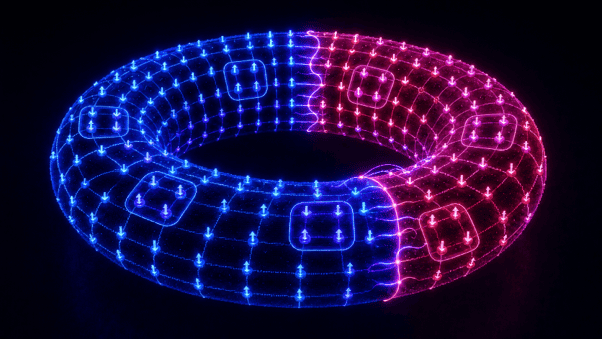
In this work, the researchers developed a novel Quantum Monte Carlo algorithm to calculate entanglement entropy more accurately. Quantum Monte Carlo methods use random sampling to study quantum systems that are too complex to solve exactly. The researchers started with a standard quantum magnet model, the transverse-field Ising model, and added extra interactions that allowed them to study different types of phase transitions, including ordinary Ising critical points and a tricritical point that, in (2+1) dimensions, is described by a Gaussian free theory.
The researchers compared the second Rényi entanglement entropies of two specially chosen regions with the same boundary length. This directly cancelled the dominant area-law contribution, allowing the much smaller universal corner term to become the leading signal. They then used the same approach to obtain a precise value for the Ising critical point. The results showed that the Ising and tricritical/Gaussian critical points have different universal entanglement fingerprints, demonstrating that entanglement can distinguish between different types of quantum critical behaviour. More broadly, the work provides a powerful new method for studying entanglement in strongly interacting quantum systems and for testing theoretical predictions in two-dimensional quantum materials.
Read the full article
Ben Lee-Yeung Ngai et al 2026 Rep. Prog. Phys. 89 068006
Do you want to learn more about this topic?
Dynamical quantum phase transitions: a review by Markus Heyl (2018)
