
Researchers demonstrate electrical control over exciton transport and valley polarisation in a perovskite-WS₂ heterostructure

Information can be transported using electrons, for example in conventional computing, or using light in photonic devices. A third option that researchers are exploring is the use of excitons, which are bound electron-hole pairs created when a material is excited by light. Excitons can be thought of as an intermediate state between light and electrical charge carriers. However, excitons typically recombine quickly and emit light or undergo non-radiative recombination, limiting how far they can travel. One way to extend their lifetime is to separate the electron and hole across two different material layers, creating an interlayer exciton that can transport energy over longer distances.
Previous studies have used stacked transition-metal dichalcogenides such as MoSe₂/WSe₂ or WS₂/WSe₂, which require extremely precise rotational alignment between layers to form prominent interlayer exciton emission. In this work, however, the researchers use a hybrid perovskite-WS₂ heterostructure that does not require such careful twist-angle engineering. They demonstrate a device in which an applied voltage switches between two different exciton states—interlayer excitons and intralayer excitons, allowing them to control whether excitons can move through the material or remain localised.
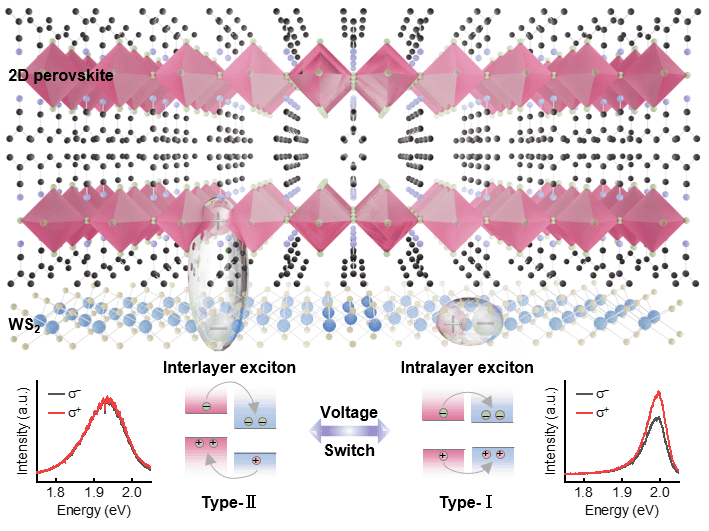
Valley polarisation describes how strongly carriers favour one of two equivalent energy minima, known as valleys. The researchers used voltage to switch the device between low and high valley-polarisation states between these two different exciton states, allowing them to electrically control a form of information carried by excitons. This capability is an important step toward future valleytronic devices, which aim to use valley states for information processing.
More broadly, the research demonstrates a practical way to electrically control both energy transport and information states in a 2D material system, bringing excitonic and valleytronic circuits a step closer to reality.
Read the full article
Yingying Chen et al 2026 Rep. Prog. Phys. 89 078004
Do you want to learn more about this topic?
Valley manipulation in monolayer transition metal dichalcogenides and their hybrid systems: status and challenges by Siwen Zhao et al. (2021)
