
Researchers propose a new way to search for physics beyond the Standard Model by studying quantum-entangled quark pairs produced in electron-positron collisions
A quark is a fundamental building block of matter. There are six types known as flavours of quark: up, down, strange, charm, bottom, and top. Quarks combine to form particles known as hadrons. Most ordinary matter is made from up and down quarks, for example, a proton consists of two up quarks and one down quark, while a neutron consists of one up quark and two down quarks. Electrons belong to a different family of particles called leptons and are not made of quarks.
Particle physicists continuously test the Standard Model of particle physics to search for signs of new phenomena. One possibility is that quarks possess anomalous magnetic or electric dipole moments, which would indicate physics beyond the Standard Model. However, quarks are never observed in isolation because they are confined inside particles such as protons and neutrons.
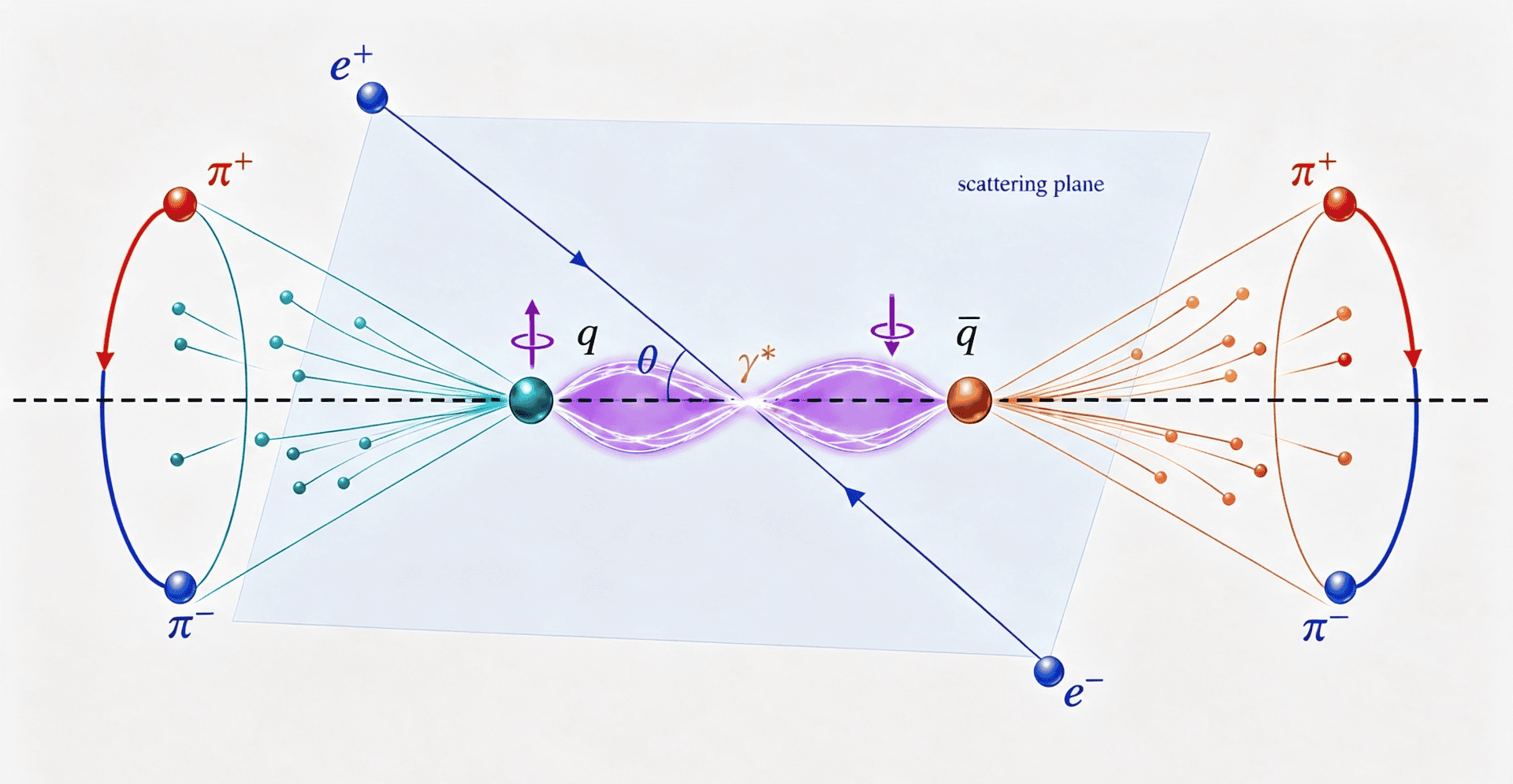
In this work, the authors study electron-positron collisions, which can produce quark-antiquark pairs. These quarks subsequently fragment into hadrons. By analysing the directions in which the hadrons emerge, information about the spins of the original quarks can be reconstructed. The authors show that anomalous magnetic or electric dipole interactions would modify the quantum-entangled spin state of the quark-antiquark pair in a characteristic way, producing either a spin-triplet state (for magnetic dipole interactions) or a spin-singlet state (for electric dipole interactions). These changes lead to measurable signatures in the angular distributions of the resulting hadrons. Rather than searching for an excess of events, the method probes changes in the spin-correlation structure of the quark-antiquark system.
The work introduces a new entanglement-based approach for probing the electromagnetic properties of light quarks. By connecting quantum spin correlations in hadron production with possible quark dipole interactions, it provides a complementary method for searching for physics beyond the Standard Model using collider data.
Read the full article
Qing-Hong Cao et al 2026 Rep. Prog. Phys. 89 080501
Do you want to learn more about this topic?
The sea of quarks and antiquarks in the nucleon by D F Geesaman and P E Reimer (2019)
