
A threshold excess in top-antitop production hints at toponium-like physics
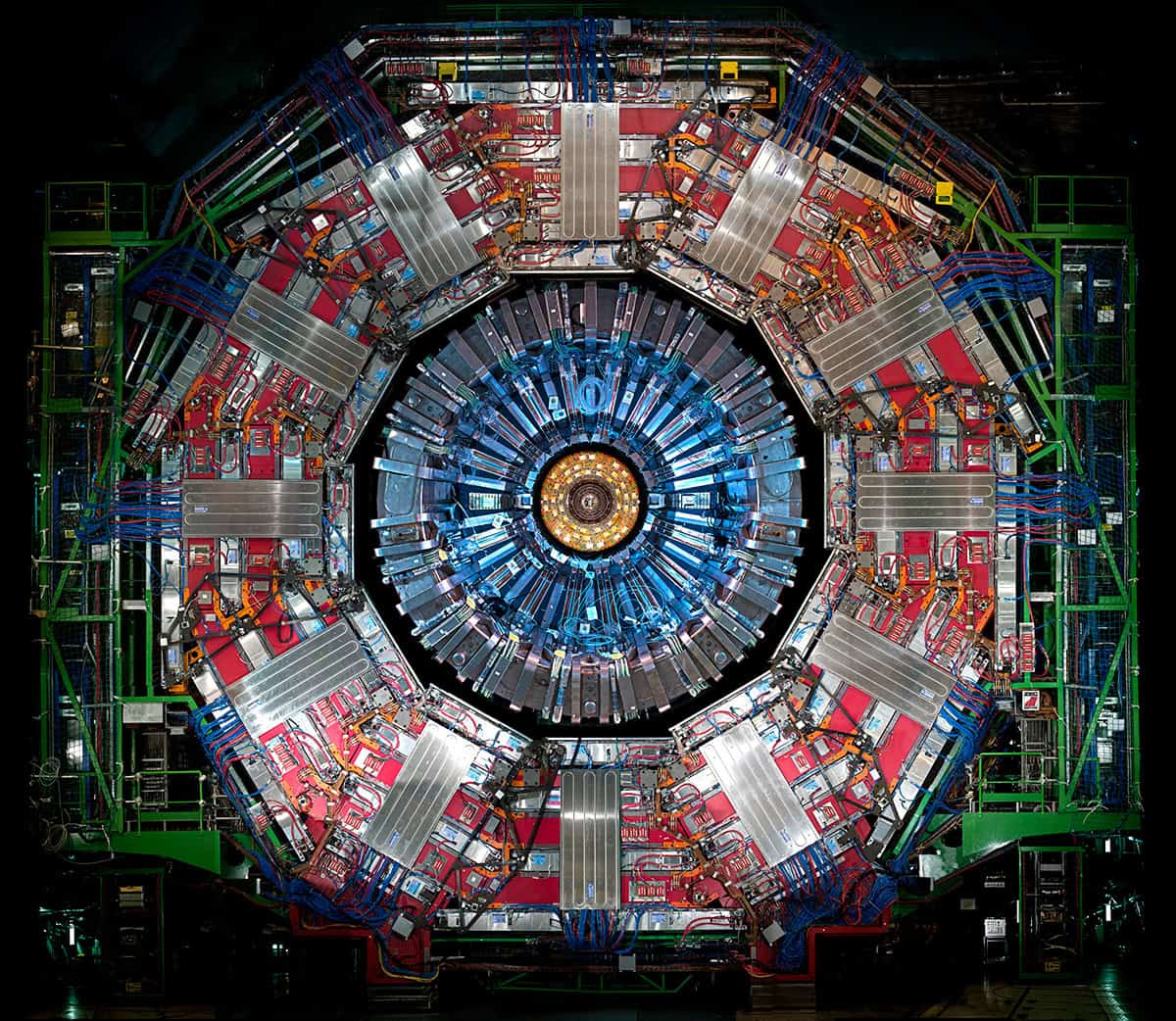
The CMS Collaboration investigated in detail events in which a top quark and an anti‑top quark are produced together in high‑energy proton–proton collisions at √s = 13 TeV, using the full 138 fb⁻¹ dataset collected between 2016 and 2018. The top quark is the heaviest fundamental particle and decays almost immediately after being produced in high-energy collisions. As a consequence, the formation of a bound top–antitop state was long considered highly unlikely and had never been observed. The anti-top quark has the same mass and lifetime as the top quark but opposite charges. When a top quark and an anti-top quark are produced together, they form a top-antitop pair (tt̄).
Focusing on events with two charged leptons (top quarks and anti-top quarks decay into two electrons, two muons or one electron and one muon) and multiple jets (sprays of particles associated with top quark decay), the analysis examines the invariant mass of the top–antitop system along with two angular observables that directly probe how the spins of the top and anti‑top quarks are correlated. These measurements allow the team to compare the data with the prediction for the non resonant tt̄ production based on fixed order perturbative quantum chromodynamics (QCD), which is what physicists normally use to calculate how quarks behave according to the standard model of particle physics.
Near the kinematic threshold where the top–antitop pair is produced, CMS observes a significant excess of events relative to the QCD prediction. The number of extra events they see can be translated into a production rate. Using a simplified model based on non‑relativistic QCD, they estimate that this excess corresponds to a cross section of about 8.8 picobarns, with an uncertainty of roughly +1.2/–1.4 picobarns. The pattern of the excess, including its spin‑correlation features, is consistent with the production of a colour singlet pseudoscalar (a top–antitop pair in the 1S₀ state, i.e. the simplest, lowest energy configuration), and therefore with the prediction of non-relativistic QCD near the tt̄ threshold. The statistical significance of the excess exceeds five standard deviations, indicating that the effect is unlikely to be a statistical fluctuation. Researchers want to find a toponium‑like state because it would reveal how the strongest force in nature behaves at the highest energies, test key theories of heavy‑quark physics, and potentially expose new physics beyond the Standard Model.
The researchers emphasise that modelling the tt̄ threshold region is theoretically challenging, and that alternative explanations remain possible. Nonetheless, the result aligns with long‑standing predictions from non‑relativistic QCD that heavy quarks could form short‑lived bound states near threshold. The analysis also showcases spin correlation as an effective means to discover and characterise such effects, which were previously considered to be beyond the reach of experimental capabilities. Starting with the confirmation by the ATLAS Collaboration last July, this observation has sparked and continues to inspire follow-up theoretical follow-up theoretical and experimental works, opening up a new field of study involving bound states of heavy quarks and providing new insight into the behaviour of the strong force at high energies.
Read the full article
Observation of a pseudoscalar excess at the top quark pair production threshold
The CMS Collaboration 2025 Rep. Prog. Phys. 88 087801
Do you want to learn more about this topic?
The sea of quarks and antiquarks in the nucleon D F Geesaman and P E Reimer (2019)
