
Researchers use 100 coupled lasers to physically realise percolation and uncover how nonlinearities alter collective lasing behaviour

Percolation studies how small connections can group together to form a larger connected system, known as a cluster. In a grid where sites can be turned on or off, turning on more sites leads to the formation of clusters, and at a certain point a giant cluster spanning the system emerges. This behaviour is relevant to many real-world systems where local interactions lead to global effects, such as power grids, disease spreading, forest fires, and brain activity. While percolation is often studied using theoretical models or simulations, real systems are more complex. Nonlinear effects, noise, imperfect connections, and time-dependent dynamics can all shift the tipping point and change how clusters form.
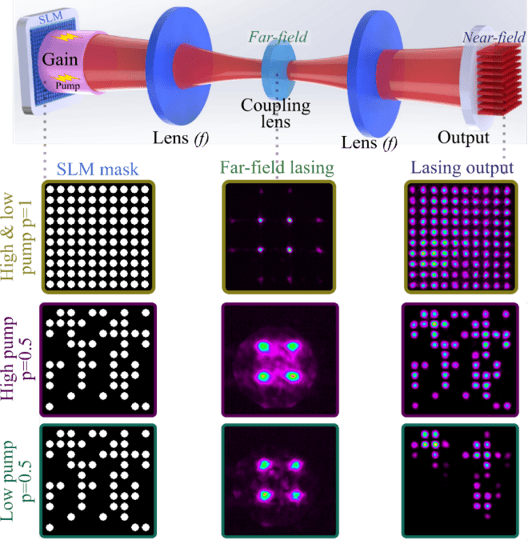
In this work, the researchers built a physical system using a 2D array of 100 coupled lasers to study percolation experimentally. Each laser acts as a site that can be turned on and interacts with its neighbours, making the system a controllable realisation of a percolation grid. They found that when a large connected cluster forms, the lasers also begin to phase-lock, meaning that connectivity and synchronisation emerge together. Normally, these effects are studied separately.
At high pump power (the energy supplied to the lasers), the system behaves like an ideal percolation model, with a clear critical threshold and a smooth (second-order) transition, consistent with theory. However, at low pump power, nonlinear effects become important. The lasers compete more strongly, meaning more active sites are needed to form a spanning cluster, and weaker clusters are suppressed. This shifts the percolation threshold and alters the cluster size distribution, contrary to the usual expectation that nonlinear effects are stronger at higher power.
To explain this, the researchers introduced a simple model where a site only remains active if it has enough active neighbours, effectively modifying the connectivity rules. This reproduces the observed behaviour and shows how nonlinear effects can reshape percolation. Overall, the work demonstrates that real physical systems can significantly modify ideal percolation behaviour, and provides a controllable platform for studying how connectivity, competition, and synchronisation interact in complex networks.
Read the full article
Percolation with coupled lasers: effect of non-linearities on the phase transition
Simon Mahler et al 2026 Rep. Prog. Phys. 89 067901
Do you want to learn more about this topic?
Percolation theory by J W Essam (2018)
