
Physicists have directly imaged a novel laser-driven plasma wakefield, taking a large step towards compact, ultra high energy particle accelerators
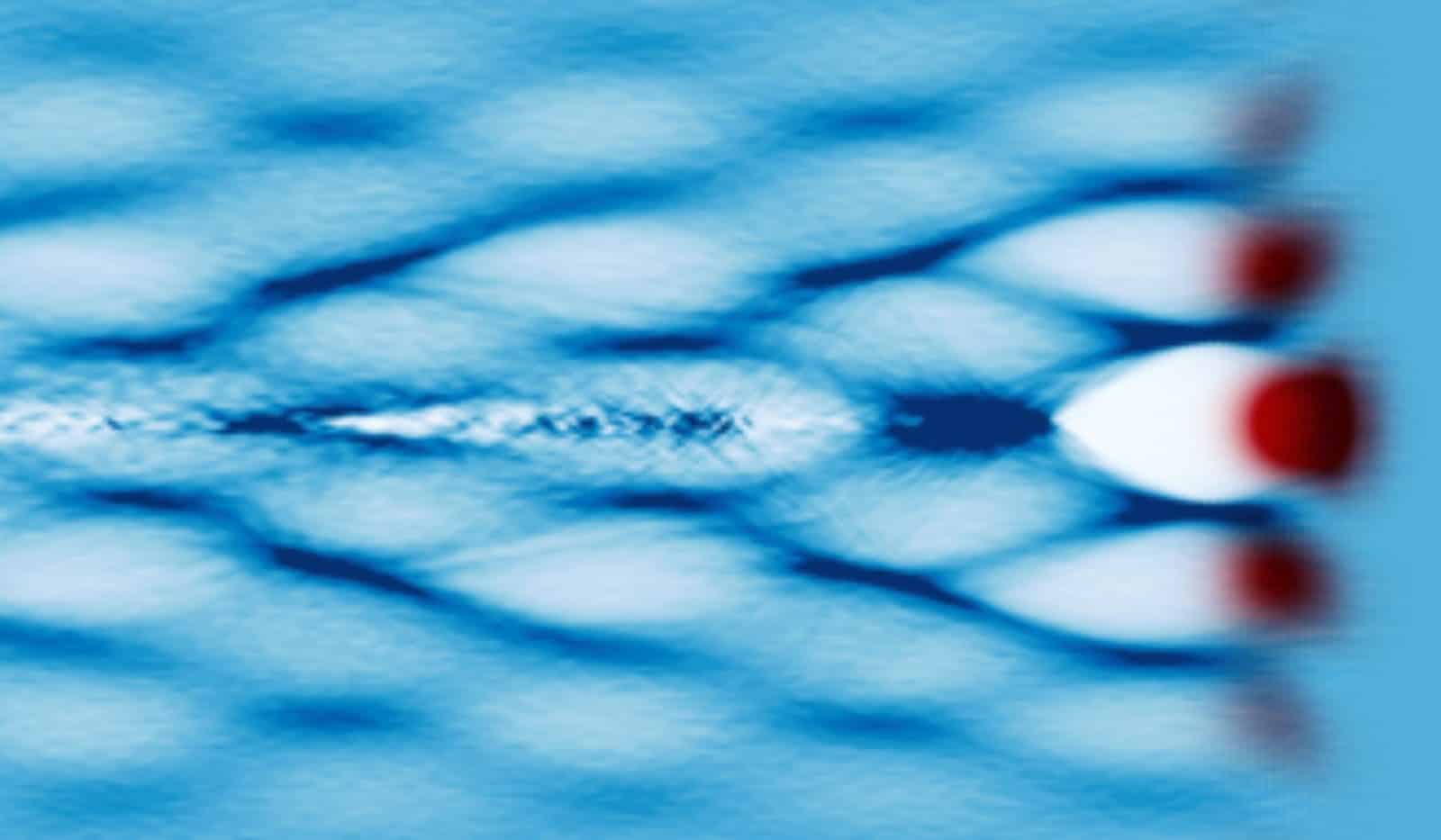
Conventional particle accelerators use radio frequency cavities to push particles to high energies, but these machines are vast and expensive. Laser wakefield accelerators (LWFAs) offer a radically different approach. When an intense laser pulse travels through a plasma, it drives a rippling disturbance called a wakefield. Electrons can be trapped in this plasma wave and surf along it, being boosted to very high energies over just centimetres.
However, these electrons tend to outrun the plasma wave that accelerates them, a limitation known as dephasing. One proposed way around this problem is the flying focus: a laser pulse engineered so that its point of highest intensity moves along the propagation axis at a controllable velocity. By matching this velocity to that of the electrons, the plasma wakefield could, in principle, remain phase locked to the particles, enabling sustained acceleration. While the flying focus concept has been theoretically developed and experimentally demonstrated in principle in recent years, the detailed structure and behaviour of the resulting wakefields has not yet been optimised for applications.
In a new study, a team of researchers from the Weizmann Institute of Science probed these wakefields directly, combining high resolution experiments with advanced simulations. Using femtosecond relativistic electron microscopy, the team sent a separate electron beam through the flying focus wakefield, allowing them to image its electromagnetic structure with micrometre spatial resolution and femtosecond timing.
The results reveal that flying focus wakefields are stable but highly structured, blending linear and nonlinear features and extending off axis in ways not seen in conventional laser driven wakefields. The study also shows that factors such as plasma density, composition and ionisation dynamics can significantly reshape the wake. These effects must be carefully modelled and controlled if the scheme is to deliver on its promise.
By opening a direct experimental window onto flying focus wakefields, the work provides the crucial insight needed to turn a compelling idea into a practical technology.
Read the full article
Probing flying-focus wakefields – IOPscience
Aaron Liberman et al 2026 Rep. Prog. Phys. 89 038501
