
Topological surface states are found to mediate a strong, non‑oscillatory interaction that aligns magnetic moments and enhances ferromagnetic order

In this work the researchers explore what happens when a topological insulator is placed next to a two‑dimensional ferromagnetic insulator. Experiments have shown that this arrangement dramatically increases the ordering temperature of the ferromagnet. The theoretical study demonstrates that the surface electrons of the topological insulator mediate interactions between the magnetic moments in the neighbouring ferromagnetic material, strengthening its overall magnetism.
There are two main ways electrons in a nearby material can act as messengers between magnetic moments. The first is the well‑known Ruderman-Kittel-Kasuya-Yosida interaction, which arises in a metal from electrons at the Fermi level that produce long‑range, oscillatory coupling, typically in a regime when magnetic moments are sparse. The is the often overlooked Bloembergen-Rowland interaction, which in fact turns out to dominate in this system. This mechanism comes from virtual transitions between the valence and conduction bands of the topological insulator surface states and leads to strong, short‑ranged ferromagnetic interactions between the dense magnetic moments.
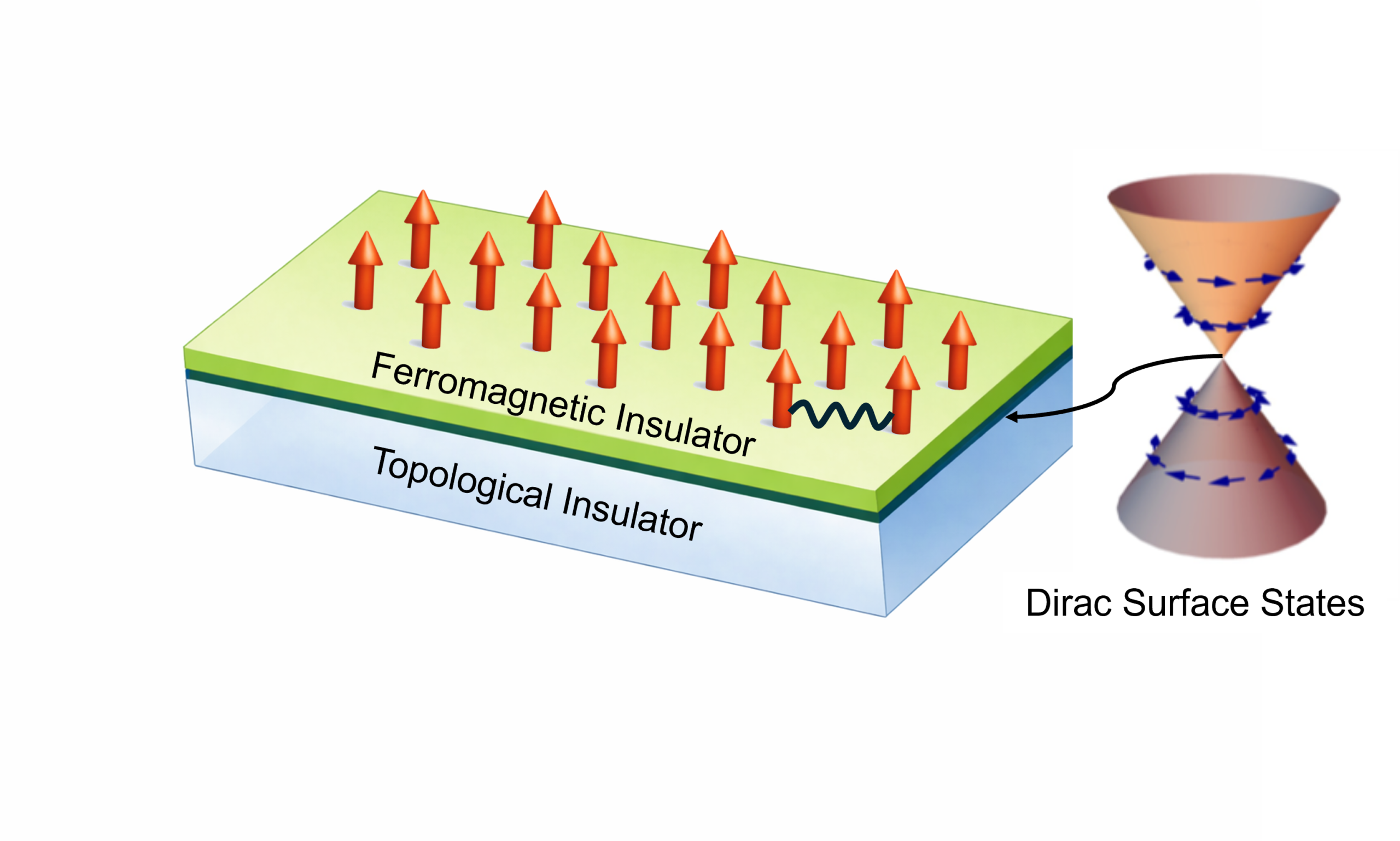
Identifying the Bloembergen-Rowland interaction is significant because it naturally enhances ferromagnetism: it is strong, it does not oscillate, and it keeps the magnetic moments aligned. Due to the spin-momentum locking of the topological insulator’s surface states, this interaction also has a built‑in anisotropy that favours out‑of‑plane magnetic alignment. The researchers show that the increase in the magnetic ordering temperature is directly proportional to the Van Vleck susceptibility of the topological insulator’s surface electrons.
The study also examines how hybridisation between the top and bottom surfaces of a thin topological‑insulator film modifies the mediated interaction and affects the magnetic ordering temperature. This analysis helps explain recent experimental results in heterostructures made from chromium telluride and bismuth-antimony telluride. Overall, the work clarifies how topological surface states influence magnetism in these layered systems and provides a foundation for designing improved devices in spintronics, magnonics, and quantum technologies.
Read the full article
Enhancement of Curie temperature in ferromagnetic insulator-topological insulator heterostructures
Murod Mirzhalilov et al 2026 Rep. Prog. Phys. 89 018004
Do you want to learn more about this topic?
Characteristics and controllability of vortices in ferromagnetics, ferroelectrics, and multiferroics by Yue Zheng and W J Chen (2017)
