
New research shows just how much classical communication is required in future quantum networks
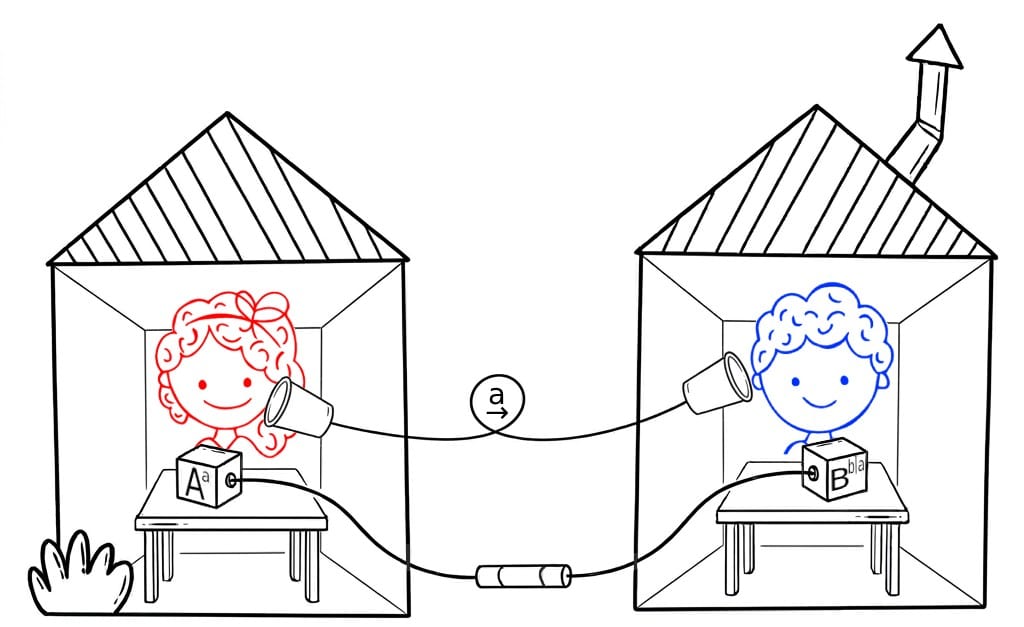
Quantum technologies often imagine distant users – Alice and Bob – sharing entangled particles and trying to learn something about them. In principle, the most powerful measurements are global: Alice and Bob act as if their systems were in the same lab. In reality, they are usually limited to local operations and classical communication (LOCC). This means that each makes measurements locally and sends classical messages back and forth. A long standing debate is how much classical communication is actually required to perform a given quantum task.
In a recent article, Arthur Dutra and colleagues, tackled this question by analysing quantum measurements that use just one round of classical communication. Rather than treating LOCC as an all or nothing option, the team asked more precise questions. Who should measure first? How many classical bits are needed? Does Bob really need to adapt his measurement based on Alice’s message?
Their key contribution is a new mathematical framework that turns these questions into efficiently solvable optimisation problems. Using a hierarchy of semidefinite programmes (a standard tool in quantum information theory) the authors placed tight upper bounds on what one round LOCC measurements can achieve, even when the size and direction of the classical message are fixed.
Applying this framework to the task of guessing which quantum state was prepared (quantum state discrimination) they uncovered several surprises. In some cases, it matters a lot who measures first: Bob first strategies can outperform Alice first ones, even when only one classical bit is exchanged. Perhaps most interestingly, they showed concrete examples of adaptive strategies (those in which Bob’s measurement depends on Alice’s outcome) are provably more powerful than any non adaptive approach.
Beyond these examples, the work offers a general way to quantify classical resources in quantum protocols. As future quantum networks face practical limits on latency, memory, and bandwidth, knowing exactly how many bits must be communicated, and when, may be just as important as entanglement itself.
Read the full article
Arthur C R Dutra et al 2026 Rep. Prog. Phys. 89 037601
