
ATLAS probes top-antitop quark interactions near threshold
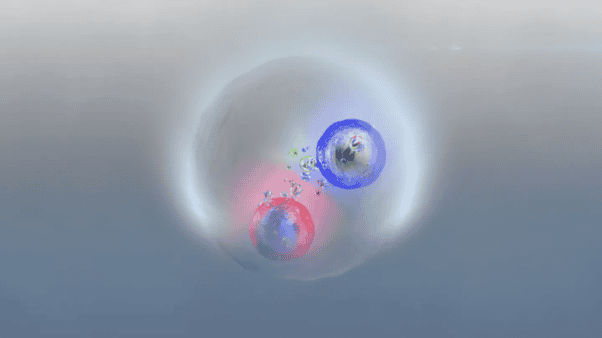
Top quarks are the heaviest known elementary particles. They are produced in pairs with their antiparticle equivalent, the antitop quark. Researchers at the Large Hadron Collider (LHC) smash protons together at extremely high energies in the hope of producing these top-quark pairs. The minimum energy required to create a pair is known as the production threshold (approximately twice the top mass). Near this threshold, the particles move relatively slowly and, because of the strong nuclear force, they may briefly interact strongly enough to form a quasi-bound state before each top quark decays individually.
In this work, researchers used a huge dataset collected with the ATLAS detector at the LHC. Top quark pairs decay far too quickly to be observed directly, so the ATLAS team instead studied their decay products. A top quark usually decays into a W boson and a b-quark, while the antitop quark decays into the corresponding antiparticles. The W bosons then decay further, either through leptonic decay (producing an electron, muon or tau plus a neutrino) or through hadronic decay, which produces jets of particles.
The ATLAS analysis focuses on the case where both W bosons decay leptonically into electrons and muons and reconstructs the invariant mass of the system using the energy and momentum of the decay products.
If non-relativistic QCD effects are included, the event rate near threshold is expected to be higher than that predicted by standard perturbative QCD alone, due to contributions such as the formation of quasi-bound states that are not accounted for in the perturbative framework. The analysis also employs spin-correlation observables to enhance the sensitivity to the unique spin structure of the phenomena. If non-relativitic QCD effects occur near the production threshold, including the formation of quasi-bound states, physicists expect to see an excess of events concentrated at masses close to the minimum energy needed to produce the pair.
The researchers observed significantly more events near the production threshold (∼345 GeV) than standard QCD calculations predicted, confirming a previous similar measurement by the CMS collaboration. The excess matches predictions from non-relativistic QCD that the top and antitop quarks briefly perform non-relativistic QCD interaction, including the formation of quasi-bound states, before separating and decaying. This is important because it provides strong evidence for a subtle quantum effect of the strong force and improves our understanding of top-quark behaviour in an extreme regime. This measurement underscores the capacity of LHC experiments at the precision frontier, reinforcing the vital interplay between theory and experiment in these precision studies.
“This is a very exciting finding that pushes our current understanding of top quark physics and its modelling to the extreme. It has only been made possible by recent efforts to connect quantum information theory and collider physics.” – Yoav Afik, an ATLAS physicist affiliated with the Enrico Fermi Institute at the University of Chicago
“With the newly collected Run 3 dataset, which is more than twice as large as the Run 2 dataset used in this first analysis, we will be able to scrutinize this excess in much greater detail and determine whether it can be described solely by non-relativistic QCD effects, or whether there is something more to it.” – Baptiste Ravina, a Senior Research Fellow at CERN
Read the full article
The ATLAS Collaboration 2026 Rep. Prog. Phys. 89 057801
Do you want to learn more about this topic?
Towards the identification of new physics through quark flavour violating processes by Andrzej J Buras and Jennifer Girrbach (2014)
