
Quantum technologies rely on more than just entanglement. Another, less well-known ingredient is non-stabiliserness, often called magic
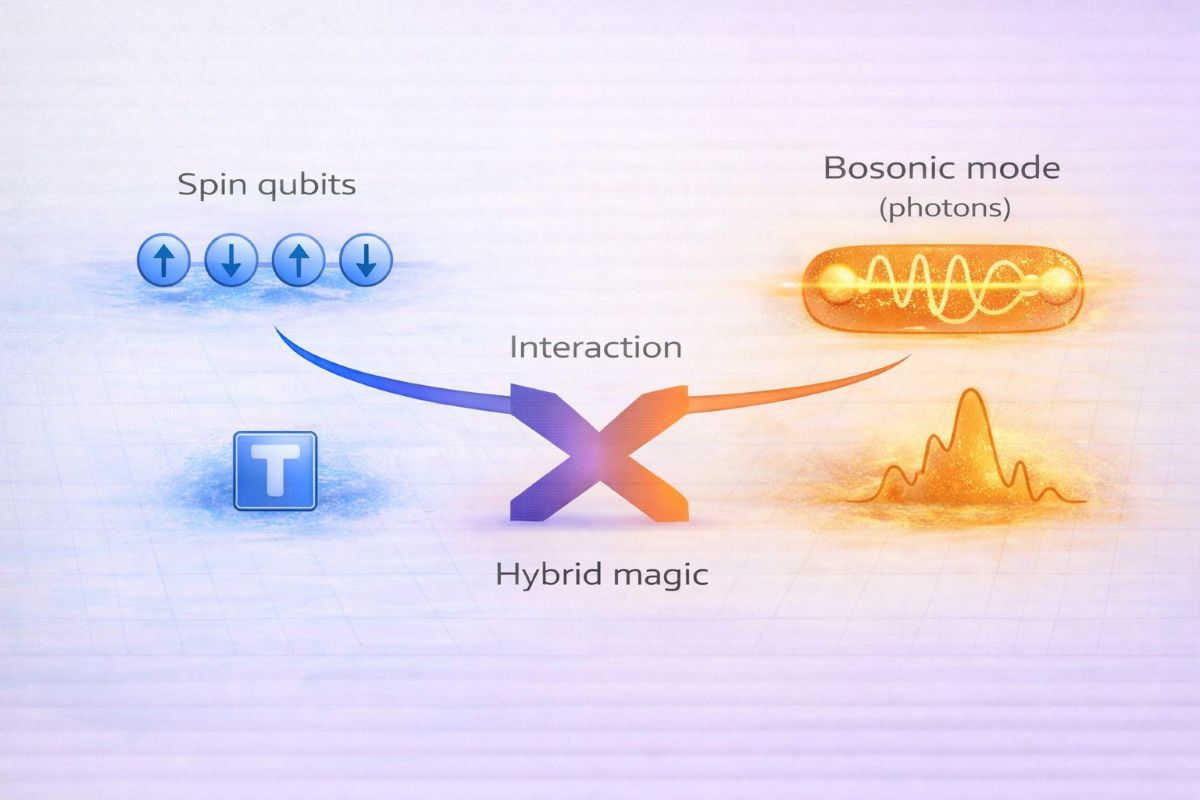
This property determines whether a quantum system can outperform even the fastest classical supercomputer. Until now, scientists could quantify magic in systems of qubits, but not in systems of bosons such as photons or hybrid devices of coupled bosons and spins, like those used in real quantum hardware.
In this new work, a team of researchers from Taiwan and Japan proposed the first unified way to measure magic in systems that combine both spins and bosons. These hybrid platforms appear everywhere from superconducting circuits to trapped ion quantum processors. However the quantum resources inside them have remained difficult to identify.
The team’s new framework uses the shape of a quantum state in phase space to define a family of magic entropies that apply cleanly to qubits, bosons and crucially, the interactions between them.
To test the idea, the researchers examined the Dicke model, a paradigmatic system in which many spins couple to a single light field. As the system approaches a superradiant phase transition (a dramatic collective reorganisation), the shared non-classical behaviour across both spins and photons (the hybrid magic) peaks at this transition. This provides another way to identify the critical point, alongside familiar tools such as entanglement. Another interesting result is that, in the finite systems studied here, the quantum magic in the spin sector increases sharply, while the bosonic magic saturates to a finite value. This contrast suggests that these measures capture different aspects of the quantum state.
The team also analysed how magic evolves dynamically in the Jaynes–Cummings model, where a single spin and a single photon exchange energy. As the two systems swap excitations, magic flows back and forth, and have different behaviours for bosonic and spin parts, providing a picture of how computational power migrates through a quantum device in real time.
As quantum computers grow more complex, scientists and engineers need reliable ways to diagnose which parts of their machines produce genuine quantum advantage. This new framework gives them a powerful tool to do just that, and it’s one that works not just for qubits, but for the hybrid architectures likely to define the next generation of quantum technologies.
Read the full article
Magic entropy in hybrid spin-boson systems – IOPscience
S. Crew et al 2026 Rep. Prog. Phys. 89 027602
