
New STM measurements show that shear strain decisively shapes flat-band structure across multiple magic angle regimes
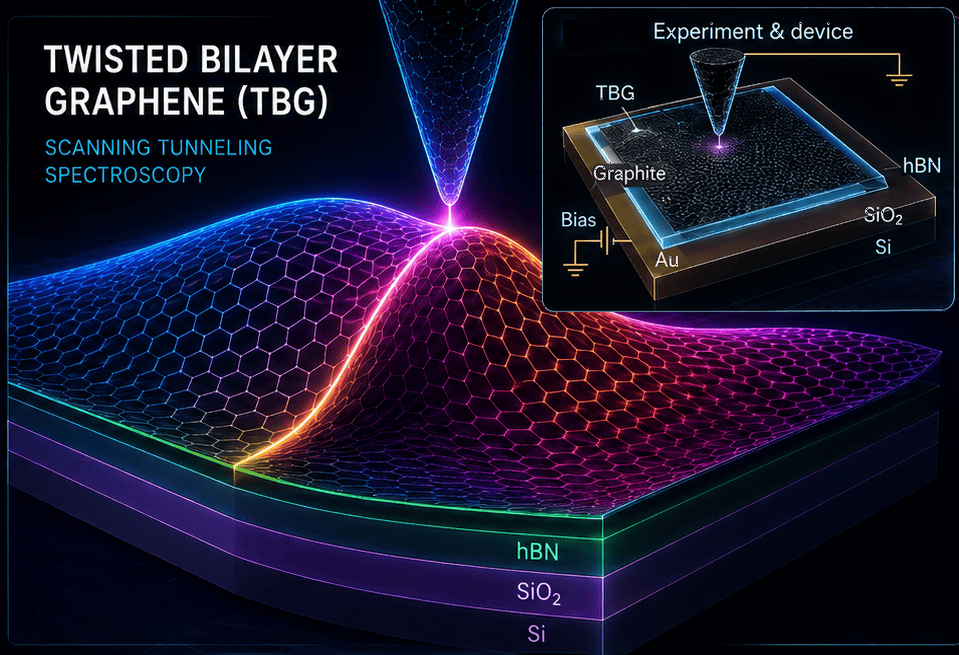
Twisted bilayer graphene has become a key area of research in 2‑dimensional materials. Two graphene sheets are stacked and rotated slightly so their carbon atoms no longer align, creating an interference pattern called a moiré lattice. At specific magic angles (1.1°, 0.55°, 0.37°), the geometry and interlayer coupling slow the electrons dramatically, nearly reducing their velocity to zero. These slowed electrons form flat bands, where interactions become extremely strong and can give rise to exotic phases such as superconductivity and strange‑metal behaviour.
In this work, the researchers examined what happens as the twist angle varies from 0.35° to 1.30°, using scanning tunnelling microscopy (STM) to image individual atoms and local electronic states. STM measures the tunnelling current between a sharp metal tip and the sample, allowing the researchers to map the electronic structure across regions for the first, second, and third magic angles.
They found that shear strain, a sideways distortion where one graphene layer shifts relative to the other, has a far greater impact on the electronic structure than biaxial stretching or compression. Shear strain strongly controls how far apart the flat bands are, how wide they become, and how electrons distribute between them. It enhances the upper flat band while suppressing the lower one, making it a decisive structural factor rather than a minor defect. They also showed that remote bands depend only on twist angle, not strain, making them reliable markers of the local twist. Strain reshapes flat‑band energies within each moiré unit cell, and only a theoretical model combining strain and electron-electron interactions reproduces the full experimental behaviour.
This research demonstrates that shear strain, not just the twist angle, is a critical factor shaping the flat‑band structure in twisted bilayer graphene, redefining how correlated and superconducting states must be engineered.
Read the full article
Strain and twist angle driven electronic structure evolution in twisted bilayer graphene
Jiawei Yu et al 2026 Rep. Prog. Phys. 89 048001
Do you want to learn more about this topic?
Emergent phases in graphene flat bands by Saisab Bhowmik, Arindam Ghosh and U Chandni (2024)
