
New insights into how van der Waals heterostructures manage lattice mismatch at the nanoscale

In 2‑dimensional physics, atomically thin materials (e.g. MoS₂, WS₂, WSe₂) are useful for next‑generation electronics such as flexible devices. Using these materials, scientists can create van der Waals heterostructures, where different 2D materials are stacked in layers and held together by weak intermolecular forces called van der Waals forces. Heterostructures combine different materials to optimise their properties. Unlike single crystals, van der Waals heterostructures are more flexible and less prone to defects. They can also tolerate lattice mismatch, where atoms between layers do not perfectly line up, although this must be controlled to avoid building up strain.
In this work, the researchers studied two systems: MoS₂ on WS₂, where the lattice spacing matches closely, and MoS₂ on WSe₂, where there is a larger mismatch. When the layers fit well together (MoS₂/WS₂), the top layer slightly compresses and the structure remains well aligned. However, when the layers do not fit well (MoS₂/WSe₂), moiré patterns appear, which are large-scale patterns caused by mismatched lattices, and these patterns become bent and irregular. The researchers found that instead of forming defects, the material relieves strain through local rotations and distortions of the lattice.
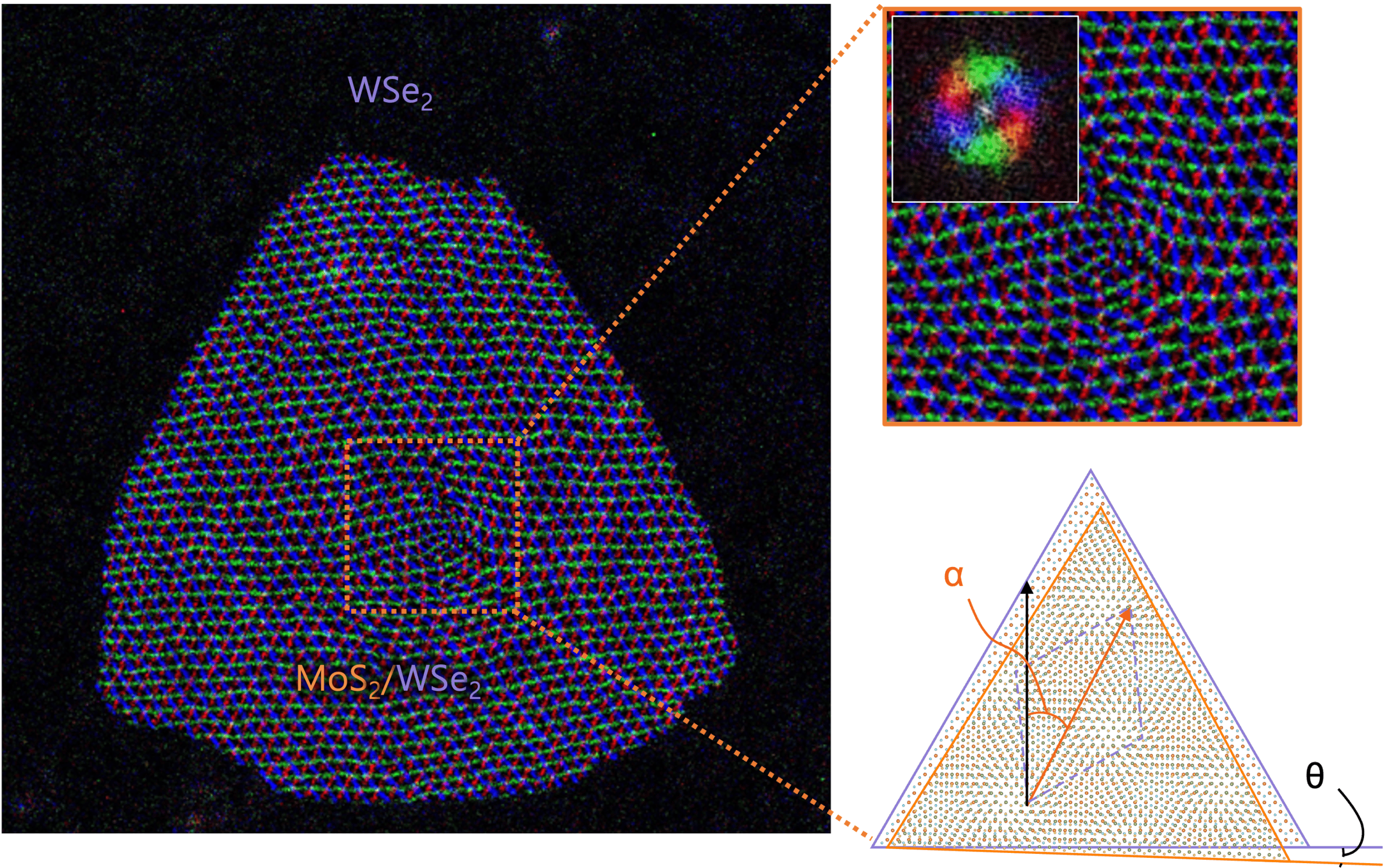
Previous studies had not clearly explained how strain is relieved at the atomic scale, whether it leads to defect formation or alternative mechanisms, or how these distortions vary across nanoscale regions. This research helps scientists better understand and control the behaviour of stacked 2D materials, which is important for designing future ultra-thin electronics, quantum devices, and optoelectronic technologies.
Read the full article
Jinwoo Kim et al 2026 Rep. Prog. Phys. 89 048005
Do you want to learn more about this topic?
Tuning and exploiting interlayer coupling in two-dimensional van der Waals heterostructures by Chenyin Jiao et al. (2023)
