
Adhesive asperities, not abrasion, dominate fault friction and reshape our understanding of stick‑slip behaviour
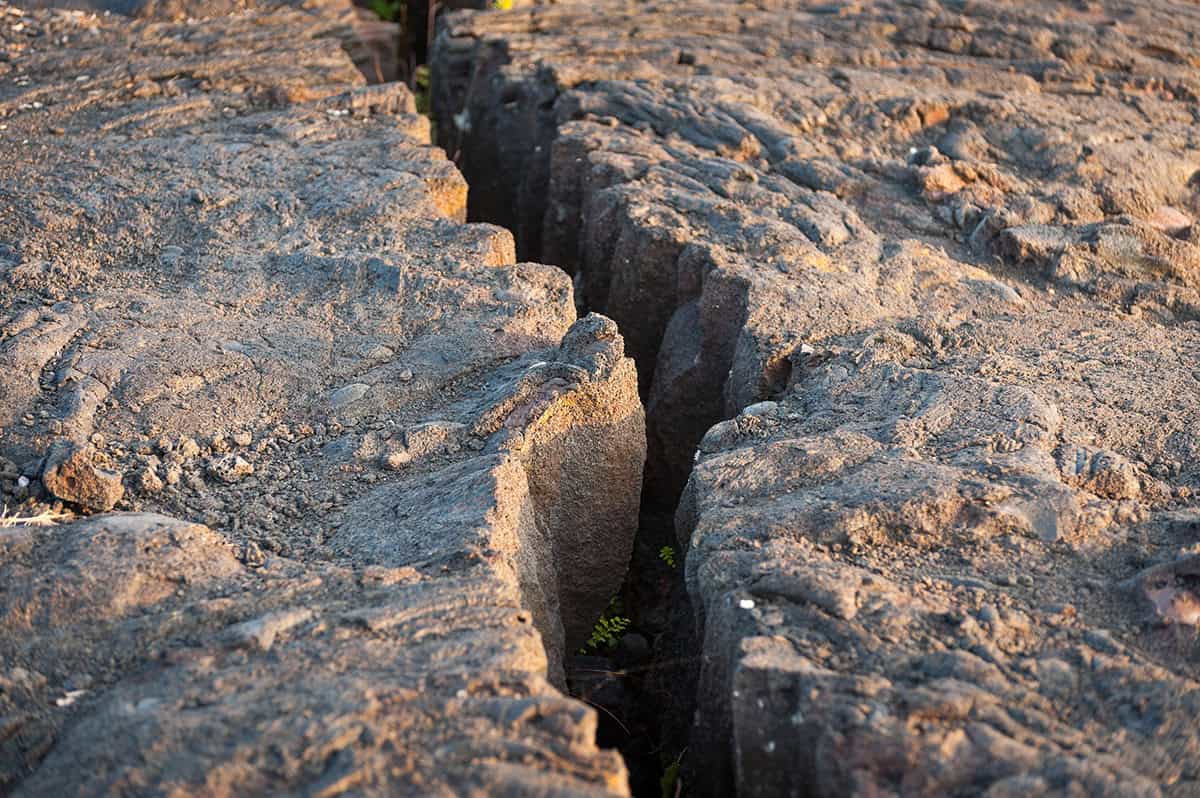
Earthquakes occur when tectonic plates rub against each other, become temporarily stuck, and then suddenly release accumulated stress as they slip. Although earthquakes have been studied for decades, the microscopic mechanics that cause faults to stick, slip, and generate friction are still not fully understood.
In this research, scientists use a granite-on-granite system to investigate these processes. Granite is common in continental crust and mechanically similar to many fault rocks, making it a strong laboratory analogue. The researchers used three complementary approaches. First, they performed controlled experiments measuring friction, wear, and surface roughness as two granite surfaces slid past each other, including tests with water, different temperatures, and different sliding speeds. Second, they ran molecular dynamics simulations of a silica (amorphous SiO₂) tip sliding on quartz (crystalline SiO₂), the dominant mineral in granite, to observe how atomic bonds break, phases transform, heat builds up, and friction emerges. Third, they applied theoretical models of contact mechanics (how surfaces actually touch through tiny asperities) and flash heating (how much local heating occurs and whether it weakens the material).
Traditionally, earthquake models assume that friction comes from mechanical processes such as asperity interlocking (high points locking together), plowing (hard grains digging into the opposite surface), and gouge grinding (crushed particles resisting motion). However, this study shows the opposite of what those models predict: more wear leads to less friction, and less wear leads to more friction. Instead of friction coming from grains digging or grinding, it arises from tiny asperities that plastically flatten, cold‑weld together, and resist sliding because their welded atomic bonds must be broken. This represents a major shift in how fault friction is understood.
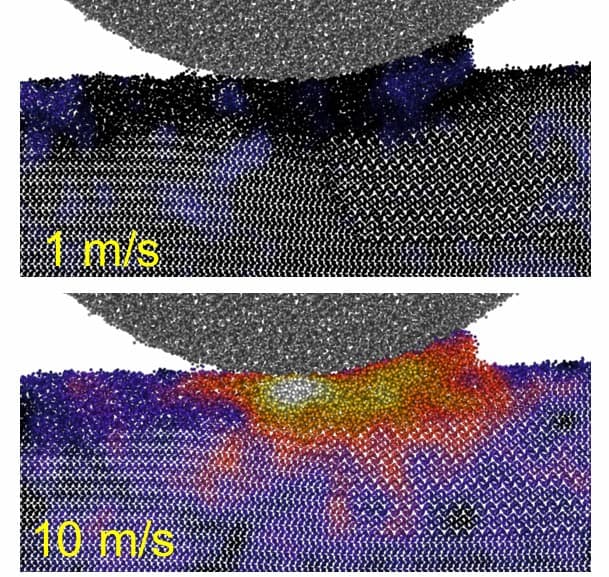
Brighter colours indicate higher temperatures. (Courtesy: Bo Persson/ Chinese Academy of Sciences)
The study also finds that friction is largely insensitive to temperature, sliding speed, and hold time, suggesting that classic rate-state friction laws may not scale to real faults. The simulations identify three main energy dissipation mechanisms which are bond breaking, plastic deformation, and stress‑induced phase changes. This shows that flash heating at laboratory speeds is too small to weaken quartz, whereas earthquake level slip speeds would generate much stronger thermal weakening. They also reveal that certain quartz polymorphs can form purely from stress, meaning their presence in natural faults does not necessarily indicate high temperatures.
Taken together, these results suggest that fault friction is dominated by adhesive bonding at asperities rather than mechanical grinding, and that tectonic motion may be governed more by creep‑slip than classic stick‑slip behaviour.
Read the full article
Sergey V Sukhomlinov et al 2026 Rep. Prog. Phys. 89 038301
Do you want to learn more about this topic?
The physics of earthquakes by Hiroo Kanamori and Emily E Brodsky (2004)
