
Simulations reveal how disordered proteins cluster and form biomolecular condensates
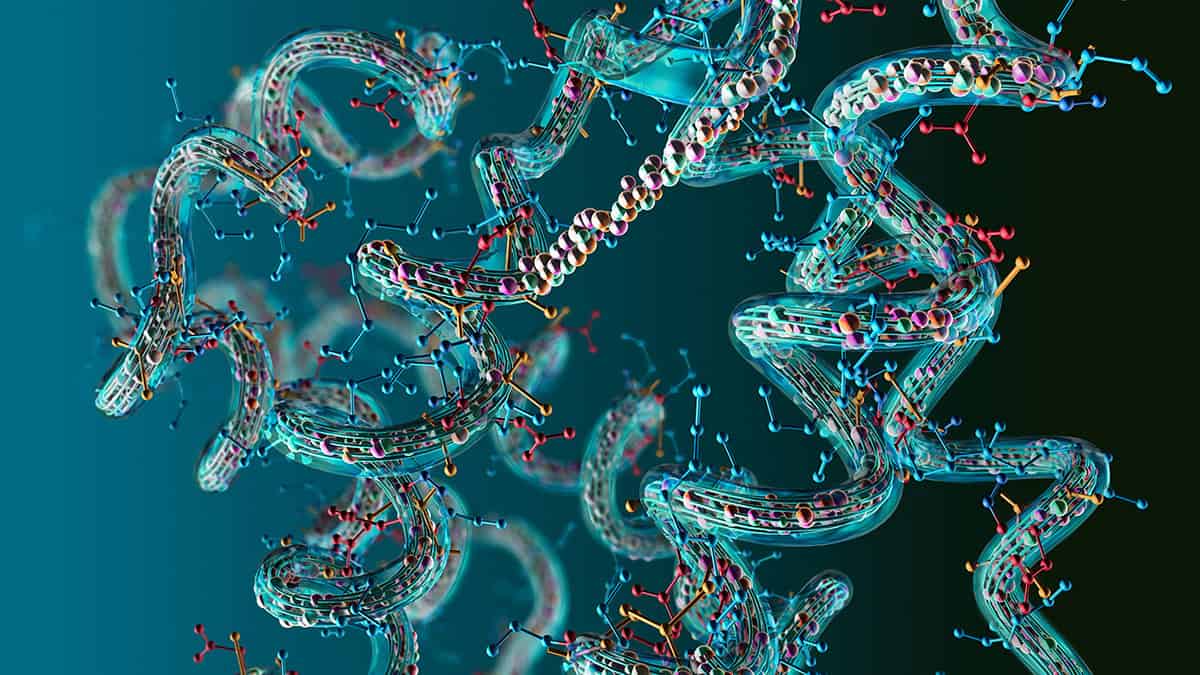
Intrinsically disordered proteins (IDPs) do not form stable 3D structures. Instead, they remain flexible, adopt many conformations, and can interact with multiple molecules. Although proteins were once thought to require a fixed structure to function, many IDPs play essential cellular roles. Some IDPs can assemble into biomolecular condensates, membrane-less compartments that help organise processes such as gene expression and stress responses.
Many IDPs contain prion-like low complexity domains (PLCDs), which have defined sequence features known as molecular grammas. These IDPs are multivalent and can form hierarchies of interactions with one another. These interactions promote clustering and, under the right conditions, phase separation into a protein-rich condensate and a surrounding dilute phase. Dysregulation of condensates has been linked to disease.
In this study, researchers used computer simulations to investigate the PLCD known as A1-LCD. Their aims were to accurately identify the critical point where phase separation ceases, map the full phase diagram, and assess methods used to estimate the theta temperature (Tθ), a measure related to solvent quality and protein interactions.
The simulations revealed three distinct phase-separation regimes: a dilute phase containing mostly isolated proteins, an intermediate regime where clusters form before large condensates appear, and a regime near the critical point characterised by system-spanning networks. The study also showed that condensates behave as percolated networks of interconnected proteins. Importantly, the authors found that commonly used methods for estimating theta temperature may be inaccurate for these systems.
Overall, this work provides new insights into the phase behaviour of condensate-forming proteins and highlights the need for more reliable approaches to assessing solvent quality. These findings could improve future studies of biomolecular condensates and their roles in health and disease.
“Comparative assessments of driving forces for phase separation requires knowledge of IDP-specific critical points. Our application of rigorous finite size scaling methods pioneered by Kurt Binder helped us delineate the critical and mean field regimes and demonstrate how the critical point can be converged upon for realistic approximations of IDPs. This revealed several surprises regarding the complex nature of the coexisting dilute phase. Additionally, we found that calculation of the two-body interaction coefficient provides a computationally tractable approach to compute comparative, sequence-encoded driving forces for phase separation of IDPs. This is directly relevant to inferring how changes to molecular grammars influence phase behaviors driven by homotypic associations.” – Rohit V. Pappu, Washington University in St. Louis
Read the full article
Distinguishing near- versus off-critical phase behaviors of intrinsically disordered proteins
Gaurav Mitra et al 2026 Rep. Prog. Phys. 89 068101
Do you want to learn more about this topic?
Biomolecular dynamics: order–disorder transitions and energy landscapes by Paul C Whitford, Karissa Y Sanbonmatsu and José N Onuchic (2012)
