
CMS researchers probed top‑quark pairs for signs of new scalar and pseudoscalar particles
Particle physicists have been searching for new fundamental scalar and pseudoscalar bosons because, if discovered, they could reveal physics beyond the Standard Model and help explain mysteries such as dark matter and even why the Higgs exists. The Higgs remains the only confirmed scalar boson, and no pseudoscalar bosons have yet been observed, though they are predicted, for example, in theories involving axions and axion‑like particles. One promising way to find them is to look for their decay into a top quark and antiquark pair (tt̄).
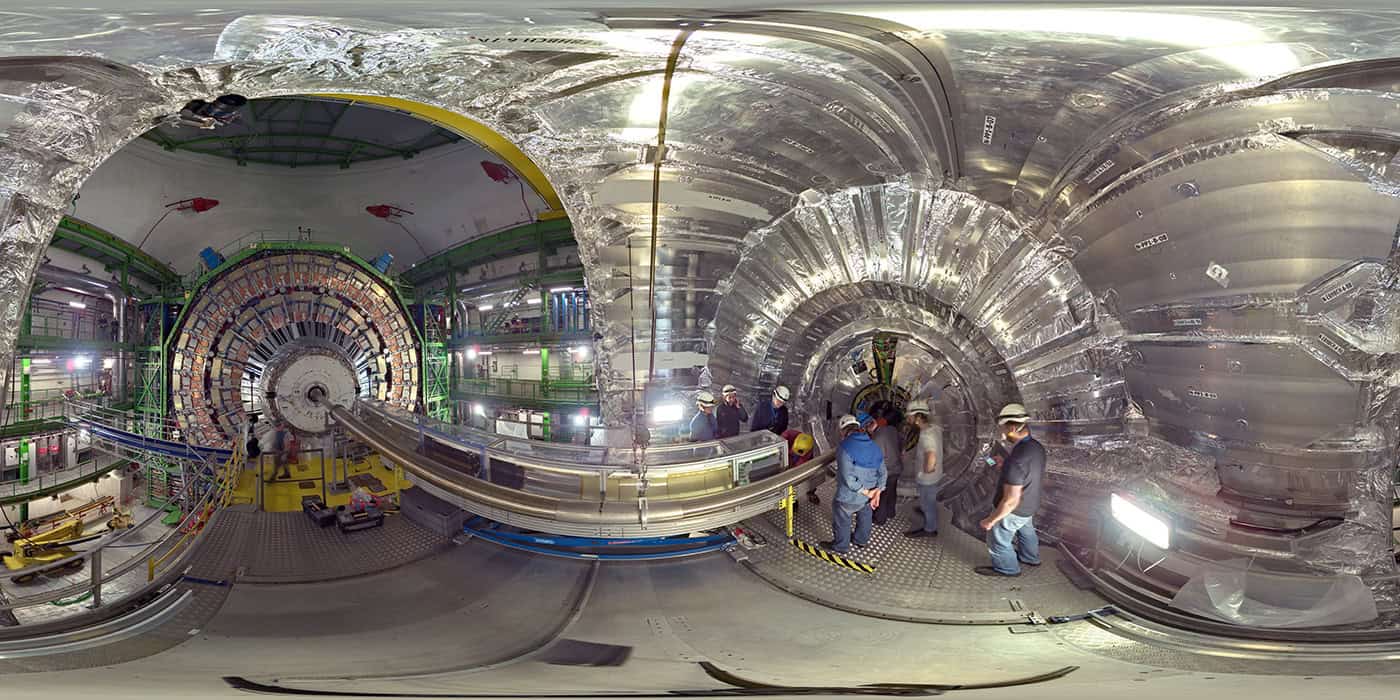
Using the CMS detector at the Large Hadron Collider, researchers analysed 138 fb⁻¹ of proton–proton collision data. They reconstructed the invariant mass of the tt̄ system and used angular variables sensitive to its spin and parity to distinguish potential signals from the Standard Model background. Crucially, the analysis includes interference between any new boson and the Standard Model tt̄ production, which can create peak-dip distortions in the invariant mass of the tt̄ system rather than a simple bump. The observed event yield is consistent with the Standard Model prediction over the majority of the invariant mass spectrum, thus excluding a contribution from a potential new boson.
However, CMS observed a significant excess near the threshold of tt̄ production where the energy of colliding particles is just enough to produce top quarks and antiquarks. This excess has a local significance above five standard deviations and the kinematics of these events is more consistent with a pseudoscalar than a scalar interpretation. However, the excess could also be explained by a predicted tt̄ quasi‑bound state, known as toponium, which fits the data without requiring new particles beyond the Standard Model.
The researchers set upper limits on how strongly new bosons could couple to top quarks across masses from 365 to 1000 GeV and widths from 0.5% to 25%. These constraints exclude couplings down to around 0.3 for pseudoscalars and 0.4 for scalars, providing the most stringent limits to date for scalar resonances decaying to tt̄.
Read the full article
The CMS Collaboration 2025 Rep. Prog. Phys. 88 127801
Do you want to learn more about this topic?
Prospects for Higgs physics at energies up to 100 TeV by Julien Baglio, Abdelhak Djouadi and Jérémie Quevillon (2016)
