
A new proof has emerged, confirming the universal speed limit on quantum relaxation, and providing new insights on how it works
When we interact with everyday objects, we take for granted that physical systems naturally settle into stable, predictable states. A cup of coffee cools down. A playground swing slows down after being pushed. Quantum systems, however, behave very differently.
These systems can exist in multiple states at once, and their evolution is governed by probabilities rather than certainties. Nevertheless, even these strange systems do eventually relax and settle down, losing information about their earlier state. The speed at which this happens is called the relaxation rate.
Relaxation rates tell us how fast a quantum system forgets its past, how quickly it thermalises, reaches equilibrium, decoheres, or dissipates energy. These rates are important not just for theorists but also for experimentalists, who can measure them directly in the lab.
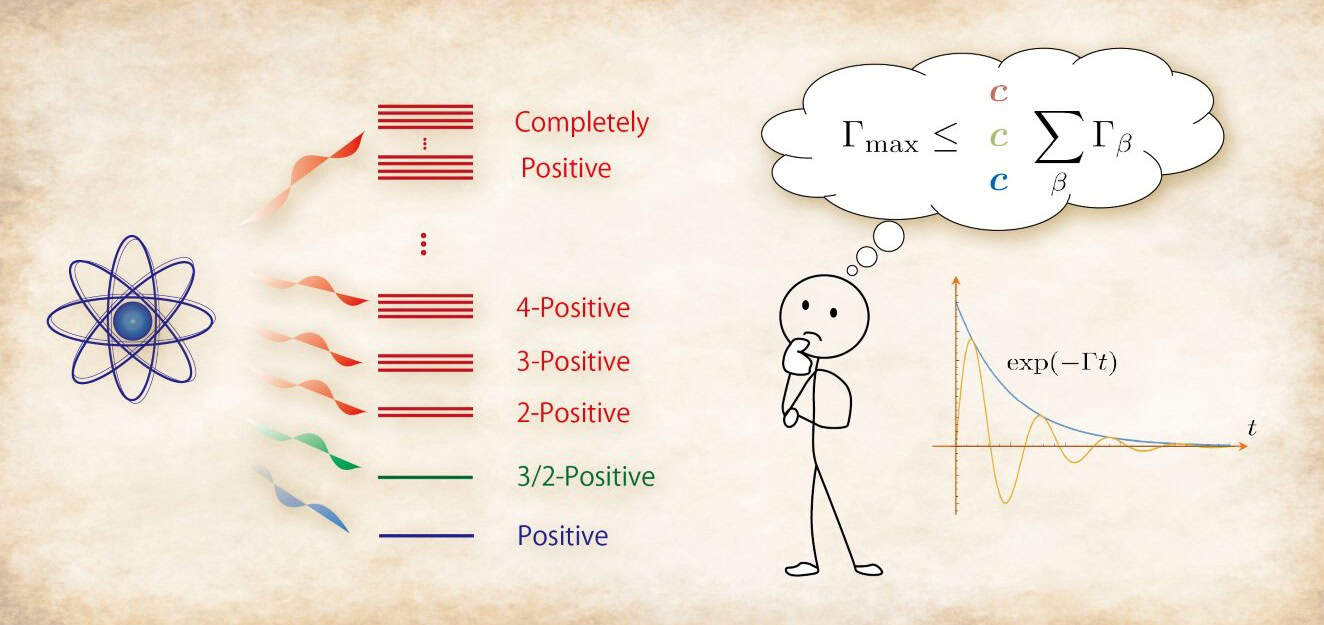
Recently, researchers discovered that these rates obey a surprisingly universal rule. For a broad class of quantum processes (those described by what physicists call Markovian semigroups) the fastest possible relaxation rate cannot exceed a certain limit. Specifically, it must be no larger than the sum of all relaxation rates divided by the system’s dimension. This constraint, originally a conjecture, was first proven using tools from classical mathematics known as Lyapunov theory.
In a new paper published recently, an international team of researchers provided a new, more direct algebraic proof of this universal bound. There are a number of advantages of the new proof compared to the older one, and it can be generalised more easily, but that’s not all.
The very surprising outcome of their work is that the rule doesn’t require complete positivity. Instead, a weaker condition – two‑positivity is enough. The distinction between these two requirements is crucial.
Essentially, both are measures of how well-behaved a quantum system is, how it is protected from providing nonsensical results. The difference is that two-positivity is slightly less stringent but far more general, and hence very useful for many real-world applications.
The fact that the new proof only requires two-positivity means that it this new universal relaxation rate can actually be applied to a lot more scenarios.
What’s more, even when weakened even further, a slightly softer version of the universal constraint still holds. This shows that the structure behind these bounds is richer and more subtle than previously understood.
Read the full article
D. Chruściński et al, 2025 Rep. Prog. Phys. 88 097602
