
A team of researchers have extended Berry’s well-known geometric-dynamic decomposition from the wave-evolution phase to a distinct class of wave scattering problems
In quantum mechanics, a quantum state is a complete description of a system’s physical properties.
If the system changes slowly and returns to its original physical configuration, then its quantum state also returns to its original form except for a phase factor.
In a pioneering work in 1984, physicist Michael Berry discovered that this factor can be separated into two parts: the dynamic and the geometric phase.
The usual dynamic phase depends on energy and time and was already well understood. The new part, the geometric phase (or Berry phase after its discoverer) arises purely from the geometry of the path that the state takes through parameter space.
The Berry phase has profound implications across physics, appearing in phenomena like the quantum Hall effect, molecular dynamics, and polarised light. It reveals deep connections between geometry, topology, and physical observables.
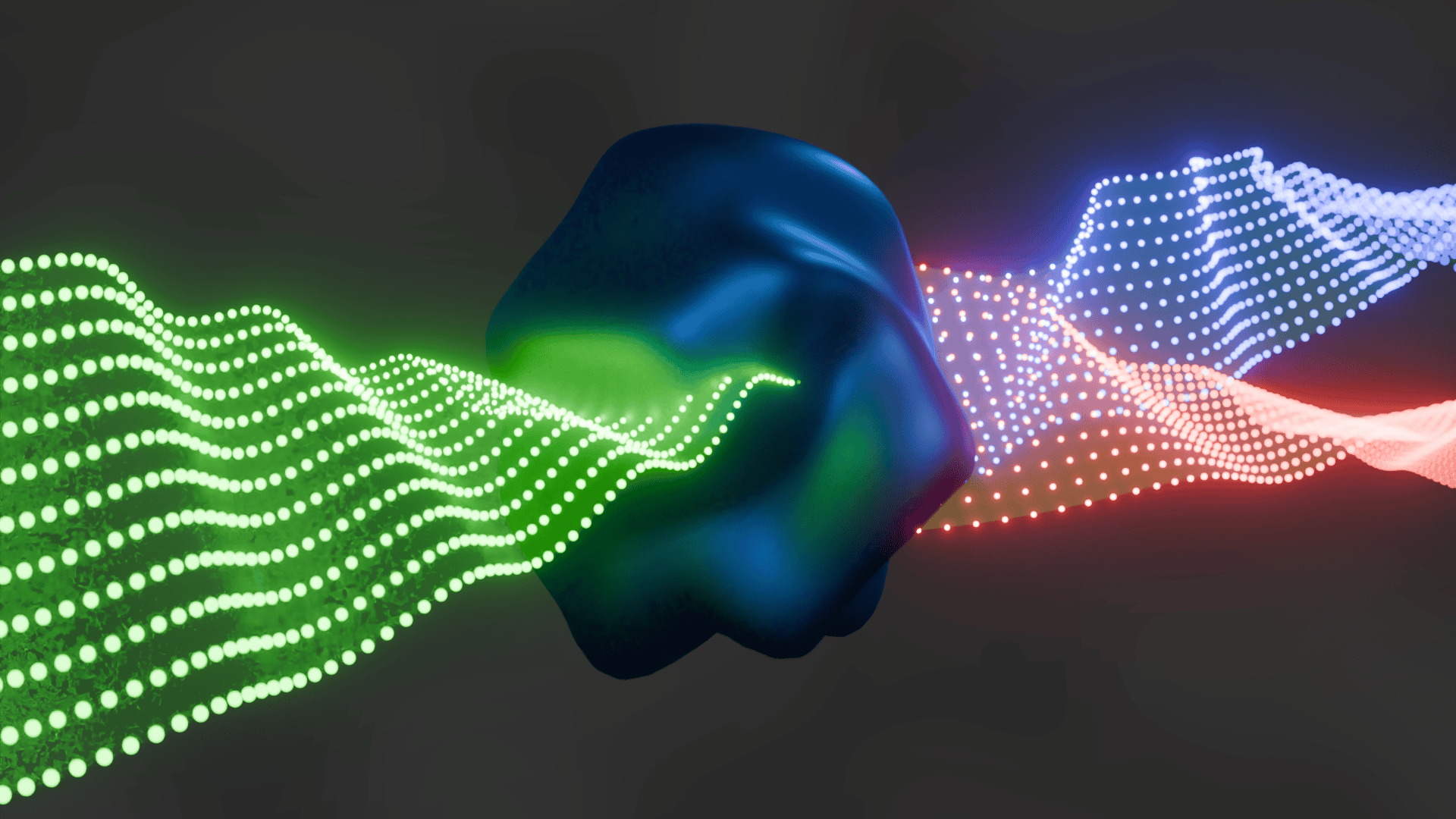
In a recent paper, this concept was extended from wave evolution to certain wave scattering events, where waves bounce off or pass through materials and their properties shift.
In order to do this, the authors used a mathematical tool called a scattering matrix. The matrix encodes all the possible outcomes of a scattering process – reflection, transmission, or deflection -based on the system’s properties.
They showed that these wave shifts can also be split into dynamic and geometric parts. Importantly this splitting can be done in such a way that doesn’t depend on arbitrary choices (i.e., it’s gauge-invariant).
The team demonstrated their idea with known examples like light passing through a changing waveplate, beams reflecting off surfaces, and time delays in 1D systems.
Their approach is not only able to describe known phenomena, but also reveals new physical features, provides new insights, and uncovers previously unnoticed connections.
Going forward, identifying the geometric and dynamic origins of various scattering-induced shifts offers new ways to control wave-scattering phenomena.
This could have applications in photonics, imaging, quantum computing, and micromanipulation.
Read the full article
Dynamic and geometric shifts in wave scattering – IOPscience
K. Y. Bliokh et al, 2025 Rep. Prog. Phys. 88 107901
