Characterising quantum many-body states
A team of researchers have developed a new method for characterising quantum properties of large systems using graph theory
 Read article: Characterising quantum many-body states


A team of researchers have developed a new method for characterising quantum properties of large systems using graph theory
Read article: Characterising quantum many-body states
Protein evolution plays a key role in many biological processes that are essential for life – but what does it have to do with physics?
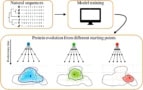 Read article: The link between protein evolution and statistical physics
A research team from China have proposed a new, experimentally feasible, method to encrypt messages using the principles of quantum mechanics
 Read article: Quantum cryptography in practice
The Standard Model of particle physics is a very well-tested theory that describes the fundamental particles and their interactions. However, it does have several key limitations. For example, it doesn’t account for dark matter or why neutrinos have masses. One of the main aims of experimental particle physics at the moment is therefore to search […]
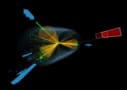 Read article: Using AI to find new particles at the LHC
ATLAS researchers have provided compelling evidence for off-shell Higgs boson production with vastly increased confidence
 Read article: Probing the fundamental nature of the Higgs Boson
New research has emerged proposing a way to consistently generate quantum chaos, a key ingredient in controlling quantum systems
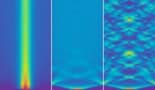 Read article: A recipe for quantum chaos
Researchers from the ATLAS collaboration have introduced a new neural simulation based-inference technique to analyse their datasets
 Read article: Neural simulation-based inference techniques at the LHC
The term dark energy, first used in 1998, is a proposed form of energy that affects the universe on the largest scales. Its primary effect is to drive the accelerating expansion of the universe – an observation that was awarded the 2011 Nobel Prize in Physics. Dark energy is now a well established concept and […]
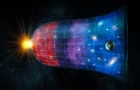 Read article: Further evidence for evolving dark energy?
A research team from China and Denmark have proposed a new, far more efficient, method of detecting ultralight dark matter particles in the lab
 Read article: Searching for dark matter particles
Researchers from China have observed record-breaking in-plane optical anisotropy in a van der Waals crystal
 Read article: A record-breaking anisotropic van der Waals crystal?