Quantum technologies are undoubtedly going to have a large impact on our world, potentially revolutionizing everything from healthcare and the environment, boosting the economy and helping with large-scale optimization challenges. But for them to deliver on these many promises, it will be vital for many countries to train and build a quantum-ready workforce.
There are four pillars to the quantum sector – quantum computing; quantum simulation; quantum communication; and quantum sensing and metrology. But in each case there is a lack of trained individuals who can take on jobs across the board. Indeed, statistics in both the UK and the US suggest there is only one qualified worker for every three quantum jobs. With governments continuing to invest lots of money into national quantum programmes; a growing number of new quantum start-ups being launched; and ever more multi-national firms zoning in on quantum, the shortage of those with the right skills to work across the sector is expanding.
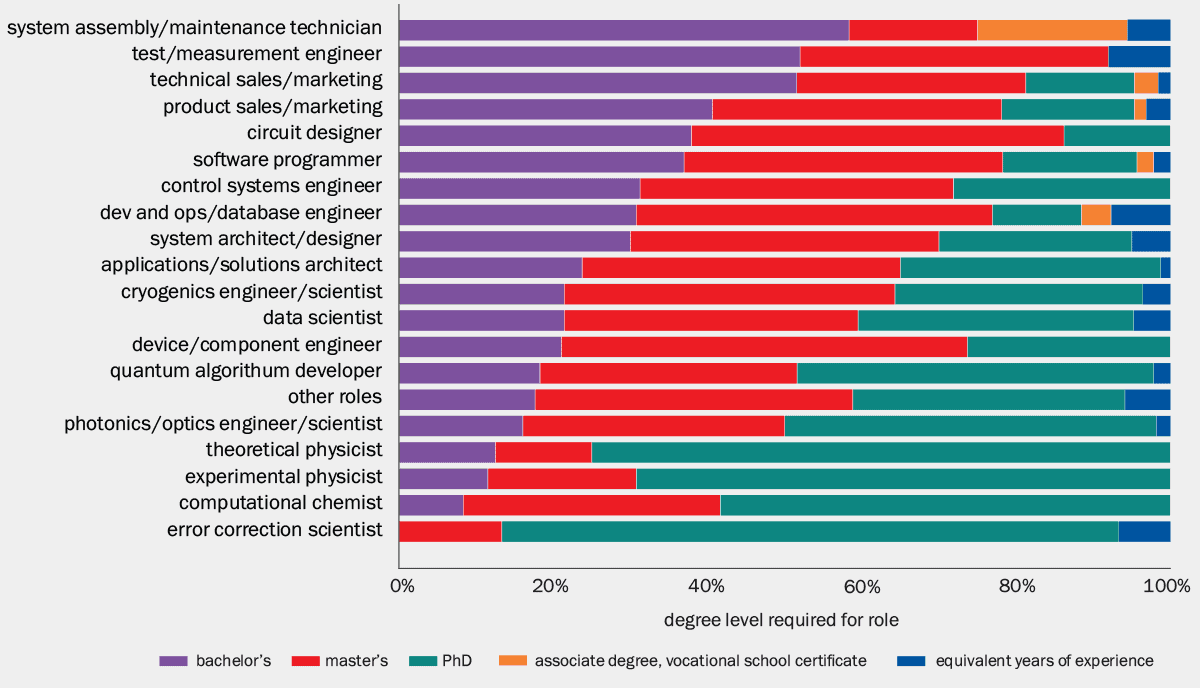
The Colorado School of Mines in the US is now trying to remedy this situation by launching the country’s first bachelor-level quantum systems engineering degree programme, due to start this autumn. An undergraduate degree specializing in quantum and systems engineering might, at first glance, seem odd. But 2021–2023 data from the Chicago Quantum Exchange show that 55% of quantum tech jobs only require a BSc or two-year associate degree. For instance, roles that ask for just a BSc include systems assembly and maintenance, measurement engineers, technical sales and marketing.
“Industry demand especially values engineers with a systems-level understanding of quantum devices, and there is also a need for quantum technicians who can build and maintain quantum hardware,” says Frédéric Sarazin, director of the quantum programme at Colorado School of Mines. As the first standalone bachelor’s degree in quantum systems engineering in the US, the programme is designed specifically to supply industry-ready graduates.
True requirements Distribution of degrees needed for different job roles in the quantum industry. (CC BY 4.0 IEEE Transactions on Education65 592)
The main focus for Sarazin and colleagues was to bring into the programme key aspects of systems engineering – which involves understanding and overseeing all aspects of a complex system, from its inception through to practical production, and even managing the final product. The goal: to help companies get their products and technologies out of the lab and into the marketplace. Rather than focusing on isolated components, systems engineers are trained to understand how complex technologies behave as integrated entities.
“A quantum computer, for example, is more than just its qubits,” says Sarazin. “It’s cryogenics, optics, electronics, control software, signal processing and the user interface, all interacting with each other.” Companies are keen to hire people who can understand and help develop their quantum product as an end-to-end system, bridging the gap between the physics and engineering aspects, as well as making sure the end product is robust, scalable and manufacturable.
The physics may be what Sarazin calls the “secret sauce” – but turning it into a device that is reliable, manufacturable and maintainable is an engineering problem “with a quantum flavour to it”. “What companies want is people who understand the product as a system, from beginning to end,” Sarazin explains.
Quantum hotspot
Colorado, in America’s mid-west, is a quantum innovation hotspot, with quantum companies employing more than 3000 people across the state. To develop the new programme, Sarazin and colleagues carried out an extensive consultation process with companies, institutions and organizations that all look to hire quantum engineers, to get a clear idea of the skills that students should have at the end of their course. They also collaborated with Elevate Quantum – a consortium of 120 organizations advancing quantum workforce development and commercialization in Colorado, New Mexico and Wyoming – to design an interdisciplinary course that will integrate physics, electrical and mechanical engineering, computer science and engineering design.
While the students will learn plenty of foundational quantum physics, they won’t cover the full curriculum of a traditional physics degree. “You’d be talking about a six-year degree if we covered everything,” says Sarazin. Certain advanced topics, such as quantum error correction, remain overwhelmingly in the domain of PhD-level jobs and so are deliberately excluded.
The lab is meant to be a signature experience. It’s where students start interacting with industry in a meaningful way
A key feature of this degree will be hands-on practical engineering experience in the lab. Plans are under way to build a dedicated quantum device laboratory for the students, allowing companies to bring in their tech and partner with the on-campus facilities. “The lab is meant to be a signature experience,” says Sarazin. “It’s where students start interacting with industry in a meaningful way.”
That connection is reinforced through internships and a year-long design project in the final year, with project topics supplied directly by quantum companies. “The junior-to-senior year is when internships really matter,” explains Sarazin. “That’s often what leads directly to a job.”
Future prospects
Although the programme is firmly industry-focused and aims to get graduates straight into the job market, students can progress to the Colorado School of Mines’ existing master’s programme in quantum engineering, launched in 2020. “At the bachelor’s level, you’re building breadth,” says Sarazin. “If students want to specialize further, they absolutely can.”
Many of the skills that the students will develop – from electronics and embedded systems to control software and algorithms – are highly transferable too. “Looking beyond the quantum sector, our systems engineering students will have acquired a set of skills that is highly applicable in other industries,” says Sarazin.
The first cohort will likely be around 15–20 students this year. Looking ahead, Sarazin has a clear benchmark for success: “a near-100% placement in industry at the end of the degree – that’s what we’re aiming for”.
Beyond that, success will mean continuously refining the programme in response to industry feedback. “This isn’t static,” Sarazin says. “If companies tell us something needs adjusting, we want to respond.” For students still hesitant to take the leap into a specialized BSc or the quantum sector, Sarazin’s message is clear: quantum careers are here to stay and the direct path into the industry is starting earlier than ever before.
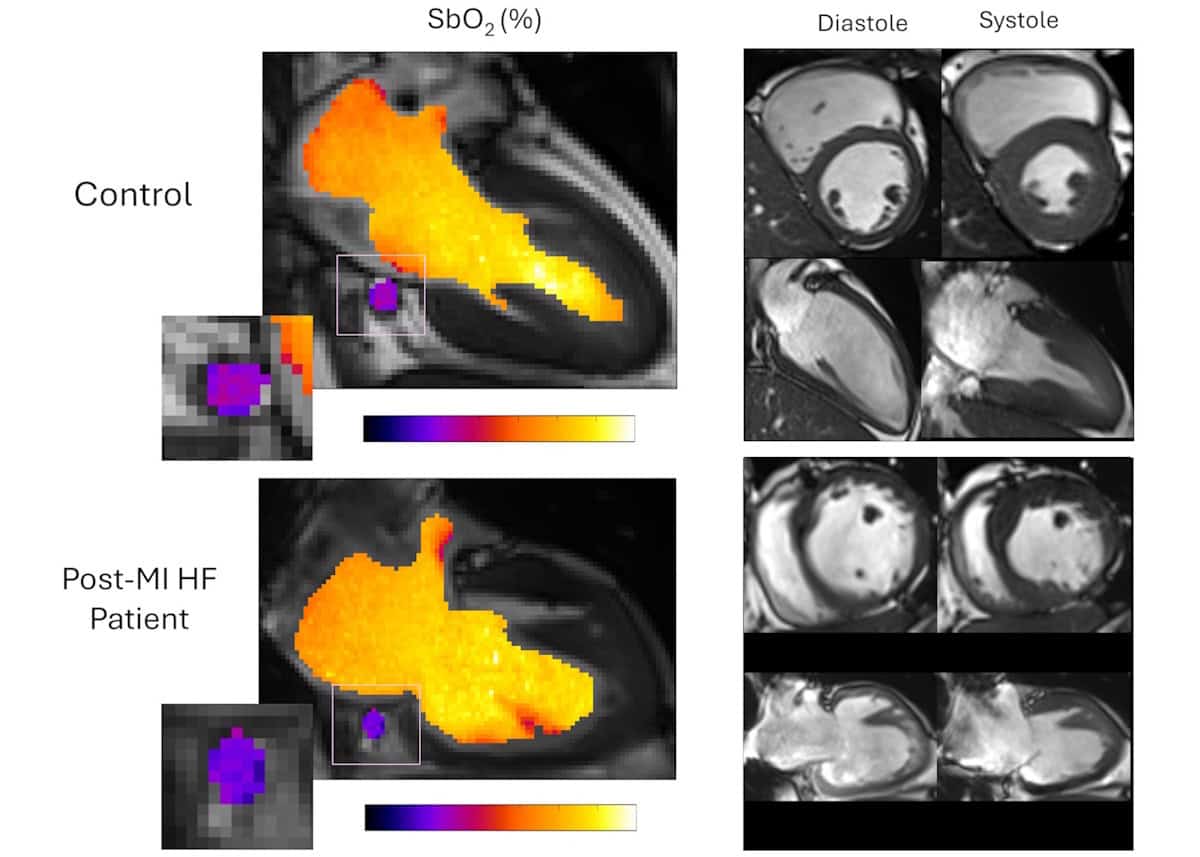
MRI measurements Representative blood oxygen saturation (SbO2) maps and left ventricle (LV) geometry images from a control participant and a patient with heart failure, demonstrating reduced coronary sinus SbO2 and impaired LV contractility in the patient. The colour scale indicates SbO2 of 20 to 100%. (Courtesy: Ting Huang et al. Sci. Trans. Med. 18 eady6269 (2026))
The amount of oxygen that a heart consumes is a key indicator of its health. If the heart is not receiving or using enough oxygen, heart tissue can be damaged, contributing to future heart failure.
With abnormal myocardial oxygen consumption an indicator of potential cardiac dysfunction, its measurement could help in the early detection and treatment of heart failure. And as one in four individuals are likely to develop heart failure in their lifetime, this is of critical importance. But measurement of myocardial oxygen consumption is not a simple process. The gold standard for determining the heart’s oxygen use is cardiac catheterization. But this test – which involves threading a catheter from a patient’s neck or groin into the coronary sinus (CS), the largest coronary vein – is highly invasive, time-consuming and comes with a level of risk.
A new MRI technique may soon offer a rapid, non-invasive alternative. Developed by an international research team headed up at Cedars-Sinai Health Sciences University, the high-resolution MRI method can assess the heart’s oxygen consumption in just three minutes. In an initial study of 22 patients with heart failure, reported in Science Translational Medicine, the team validated its accuracy, feasibility, performance and repeatability.
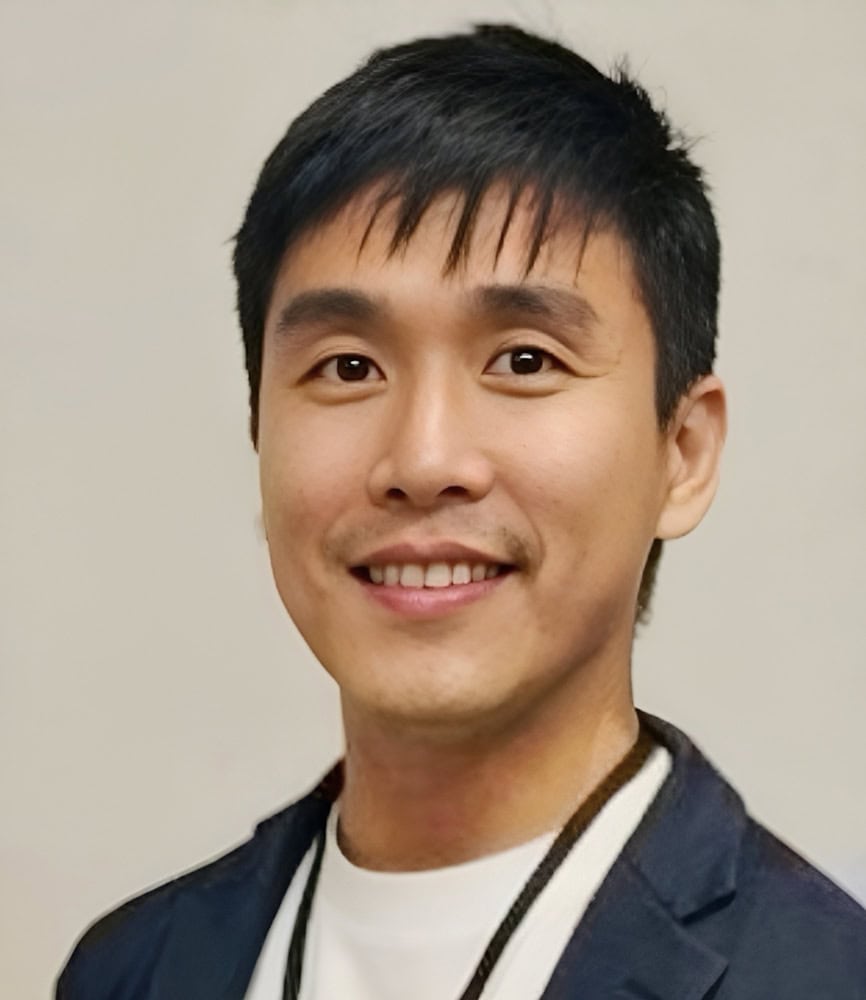
Principal investigator Hsin-Jung Yang is director of cardiac imaging research in the Biomedical Imaging Research Institute at Cedars-Sinai Medical Center.
MRI is sensitive to blood oxygenation via the blood oxygen level–dependent (BOLD) signal, originally developed for mapping brain activity. Use in the heart remains challenging, however, due to the need for complex calibration, motion sensitivity and long acquisition times. Hsin-Jung Yang, of the Biomedical Imaging Research Institute at Cedars-Sinai, and collaborators overcame these obstacles by developing a rapid, self-calibrated cardiac MRI framework that enables free-breathing blood oximetry (measurement of blood oxygen saturation) in the CS and quantification of whole-heart myocardial oxygen extraction, without requiring contrast agents or pharmaceutical stress.
The researchers’ primary objective was to determine the accuracy and precision of MRI-derived measurements of CS blood oxygenation, compared with those obtained by invasive CS catheterization. They also aimed to perform non-invasive quantification of global myocardial oxygen consumption and myocardial oxygen efficiency, with comparisons between healthy controls and patients with heart failure.
To achieve this, they developed a motion-resolved reconstruction algorithm for cardiac BOLD MRI that enables clear imaging of the moving heart during breathing and heartbeats. The team first validated the method in pigs, and then applied it to a group of 22 patients with heart failure and a history of previous heart attack, as well as 11 healthy volunteers.
The researchers acquired clinical cine images to define the cardiac anatomy, localize the CS and measure ventricular function for estimating the oxygen–mechanical work coupling efficiency. Using this approach, they identified impaired myocardial oxygen consumption in the patient group, including those with preserved ejection fraction (how much blood the left ventricle pumps out with each contraction, a low value of which can indicate a heart problem). The finding that impaired oxygen consumption was measurable even before detectable structural or functional decline may facilitate the early detection of cardiac dysfunction.
The researchers note that their self-calibrated MRI framework directly addresses the difficulty of performing quantitative oximetry of the CS – a mobile blood vessel that undergoes marked displacement throughout the cardiac cycle. “Our framework directly addresses these challenges with a continuous, free-breathing, motion-resolved 3D acquisition that retrospectively sorts data across cardiac and respiratory phases, ensuring stable CS tracking despite its complex motion and size variation,” they write.
By eliminating the dependence on gating and calibration, the method could be applied across diverse clinical populations, including those with arrhythmias, intolerance of breath-holding or physiologic stress, for whom conventional gated acquisitions are unreliable. The team suggests that the framework also holds promise for extending oxygen consumption imaging to other moving organs, such as the liver and kidney, and that in the future, the motion-resolved BOLD framework could be applied to tissue-based quantification.
The researchers are performing ongoing clinical studies to evaluate the MRI technique in aortic stenosis (narrowing of the aortic valve) and hypertrophic cardiomyopathy (thickening of the heart muscle), where altered oxygen extraction and metabolic efficiency have revealed disease severity, risk and treatment response beyond conventional imaging.
More broadly, the Yang Lab is extending this approach to characterize oxygen utilization in all cardiometabolic diseases and associated emergent therapies, with the goal of noninvasively defining myocardial energetic supply–demand balance, identifying therapy–response phenotypes, and monitoring disease progression and metabolic remodelling over time.
“By enabling a fast, non-contrast, non-ionizing radioactive method for measuring cardiac oxygen metabolism, [this MRI method] can unlock frontiers for early diagnosis, personalized therapy, and the development of next-generation cardiometabolic treatments to combat the global heart failure epidemic,” the team concludes.
An event was held yesterday – attended by senior officials including CERN director-general Mark Thomson and Dario Gil, undersecretary for science at the US Department of Energy (DOE) – to commemorate the start of moving 4.5 million kilograms of steel beams underground that will be used to hold DUNE’s detectors in place.
In February 2024, excavation work finished on two huge underground spaces for DUNE. Located 1.6 km underground at the Sanford Underground Research Facility in South Dakota and are some 150 m long and seven storeys tall, the spaces will be used to house DUNE’s four neutrino detector tanks that are each filled with 17,000 tonnes of liquid argon and cooled to 88 K.
When complete in 2031, DUNE-LBNF will study the properties of neutrinos in unprecedented detail, as well as the differences in behaviour between neutrinos and antineutrinos.
DUNE will measure the neutrinos that are generated by Fermilab’s accelerator complex, which lies around 1300 km away just outside Chicago.
The cryostat materials, which have been contributed by the CERN, are now scheduled to be moved underground and installed in the next few months.
“Today represents the start of a pivotal phase for DUNE, the development of the far detector structures in South Dakota,” noted Fermilab director Norbert Holtkamp. “Our focus remains on safety, quality and schedule — in that order — to ensure we successfully deliver on behalf of the US Department of Energy, our nation and the world.”
Physicists have determined the mass of the W boson with the highest precision yet by analysing more than a billion proton collision events at CERN’s Large Hadron Collider (LHC). The new result confirms a prediction from the Standard Model of particle physics while refuting a comparably precise measurement made by Fermilab’s CDF Collaboration in 2022. This is significant because the older measurement, which used data from the defunct Tevatron collider, differed from the Standard Model’s predictions by seven standard deviations, suggesting that the W boson might be far heavier than the model allows.
The W boson is one of two elementary particles that acts as a carrier for the weak force (the other is the Z boson). As one of the four fundamental forces in nature, the weak force is what allows protons to change into neutrons (and vice versa), making it the driving factor behind radioactive decay and nuclear fusion. Precise measurements of the W and Z boson basses are therefore important for understanding these processes as well as for testing the Standard Model.
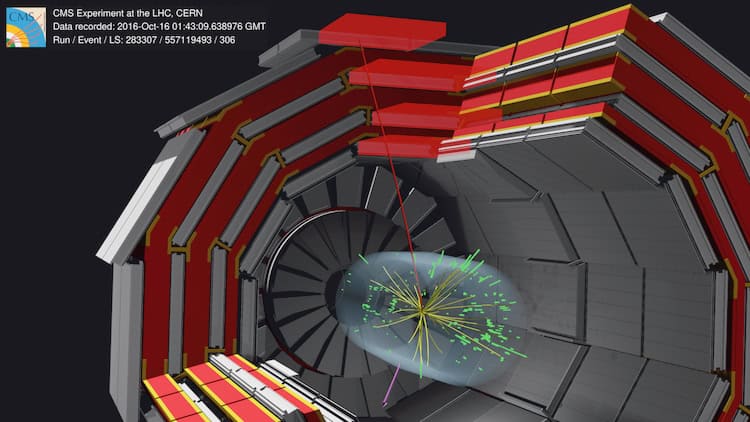
Particles incoming: An event picture showing how the researchers present their recordings digitally to illustrate the detector readings. (Courtesy: C Paus)
While physicists have measured the mass of the Z boson to an extremely high precision of 22 ppm (or 2.0 MeV), measuring the mass of the W boson with the same exactitude has proven more difficult. The main hurdle is that the W boson cannot easily be detected in colliders such as the LHC because it decays almost instantly. Scientists can look for its decay products instead, but that, too, is awkward. In one important channel, for example, it decays into a neutrino and a muon – and neutrinos are even more elusive than W bosons.
A fading mystery
In the new work, CERN’s Compact Muon Solenoid (CMS) Collaboration studied more than a billion proton collision events produced at the LHC in 2016. Amongst these, they identified 100 million as producing a W boson that decayed into a neutrino and a muon.
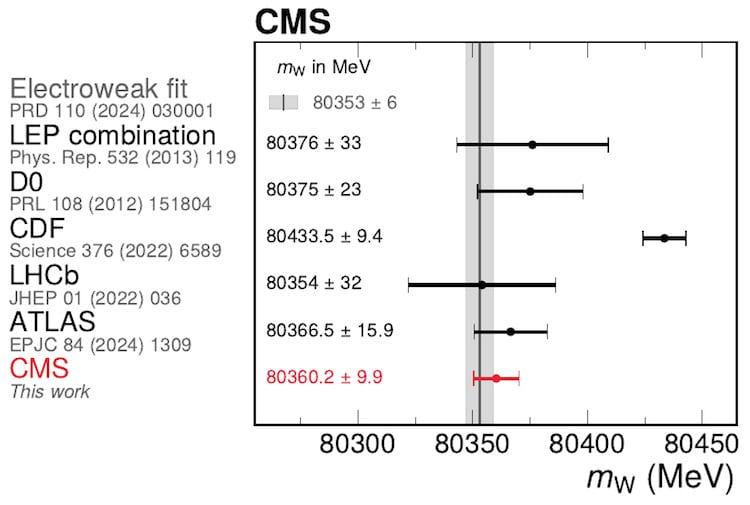
A comparison of the most recent W boson mass result split by experiments (LEP is four experiments combined). Courtesy: C Paus
By analysing these events and simulating all the possible scenarios that could produce them, they measured the mass of the W boson to be 80360.2 ± 9.9 MeV. This is significantly less than the CDF Collaboration’s measurement, but it agrees with other previous experiments. Importantly, it also lies within the range the Standard Model predicts, leaving the CDF result – the most precise measurement before this one – looking like an outlier.
“If you take the CDF measurement at face value, you would say there must be new physics beyond the Standard Model,” says Christoph Paus, a physicist at the Massachusetts Institute of Technology (MIT) in the US and one of the lead investigators of the CMS Collaboration. “And of course, that was the big mystery.”
Now that the new, even more precise measurement agrees well with predicted values for the W boson mass, that mystery is fading, Paus tells Physics World.
Some physicists may find this disappointing. However, study lead author Kenneth Long, who was a senior postdoc in MIT’s Laboratory for Nuclear Science at the time and has since moved to a research position in Lyon, France, says the new result is “just a huge relief to be honest” and “a strong confirmation that we can trust the Standard Model”.
A starting point for precision measurements
To obtain their result, the CMS researchers needed to measure the momentum of the muon and use it to infer the W boson’s mass. This is possible for two reasons. The first is that in the W’s rest frame, its decay energy is shared roughly equally between its two daughter particles (the muon and the neutrino). The second is that muons are charged leptons, and the strong magnetic field inside the CMS detector makes them travel in a path whose curvature is a function of their momentum.
“The momentum is different to the mass, of course, but is strongly correlated with it,” explains Paus. “The challenge is therefore to track the path of the muon and every possible interaction it could have with other particles and its surroundings to estimate a value for its initial momentum.”
The CMS experiment had long planned on doing such a measurement, but it took a while to set up. Now that the measurement is complete, Paus, whose MIT group joined the W boson mass analysis effort in earnest at the end of 2020, describes it as an important starting point for the collaboration. He explains that the result proves it’s possible to measure the W boson in what he calls a “high pile-up environment”, meaning one where many proton-proton collisions overlap in a single recording, without using the Z boson mass as a calibration (as was previously done in analyses at hadron colliders). “It has put the CMS experiment finally on the map for an electroweak precision measurement of this kind,” he says.
The CMS researchers are now collaborating with experimentalist colleagues at CERN’s ATLAS and LHCb detectors, as well as their theorist partners, in hopes of setting a new standard in electroweak precision physics. Their measurement is published in Nature.
Nuclear fusion powers the Sun, and scientists and engineers have long been trying to harness the process to generate clean energy. While much progress has been made, the commercially-viable generation of fusion energy remains elusive.
One important challenge is developing a range of specialized materials that can contain an extremely hot, radiation-emitting plasma in close proximity to ultracold superconducting magnets.
Our guest this week is Jacob John of the UK Atomic Energy Authority, who studies how radiation damages materials. In conversation with Physics World’s Matin Durrani, he talks about the near-oxymoronic materials requirements for fusion reactors and how they can be met.
After 54 years, numerous failed starts and countless abandoned dreams, earlier this year humanity finally returned to the Moon in an epic 10-day flight that gripped the planet. The Artemis II mission and its four astronauts – mission commander Reid Wiseman, pilot Victor Glover and mission specialists Christina Koch and Jeremy Hansen – gave us something to smile about during a dark time of global geopolitical turmoil.
The primary objective of the mission was to fly a crew around the Moon, to demonstrate and test the systems needed to support astronauts in deep-space exploration. In doing so, Wiseman, Glover, Koch and Hansen ventured farther from our planet than any human has ever gone and saw things on the lunar surface that no human eye has seen before.
That the crew did not land and walk on the Moon did not diminish the enthusiasm for the mission. Through today’s online world, the astronauts were able to share their own excitement with the millions watching from Earth with such relatability that the popularity of the mission was cemented in the history books.
Moreover, their voyage and safe return has paved the way for future Artemis missions. These will not only see astronauts set foot on the lunar surface for the first time since 1972, but also include building a permanently crewed outpost at the lunar south pole.
The astronauts of Artemis II
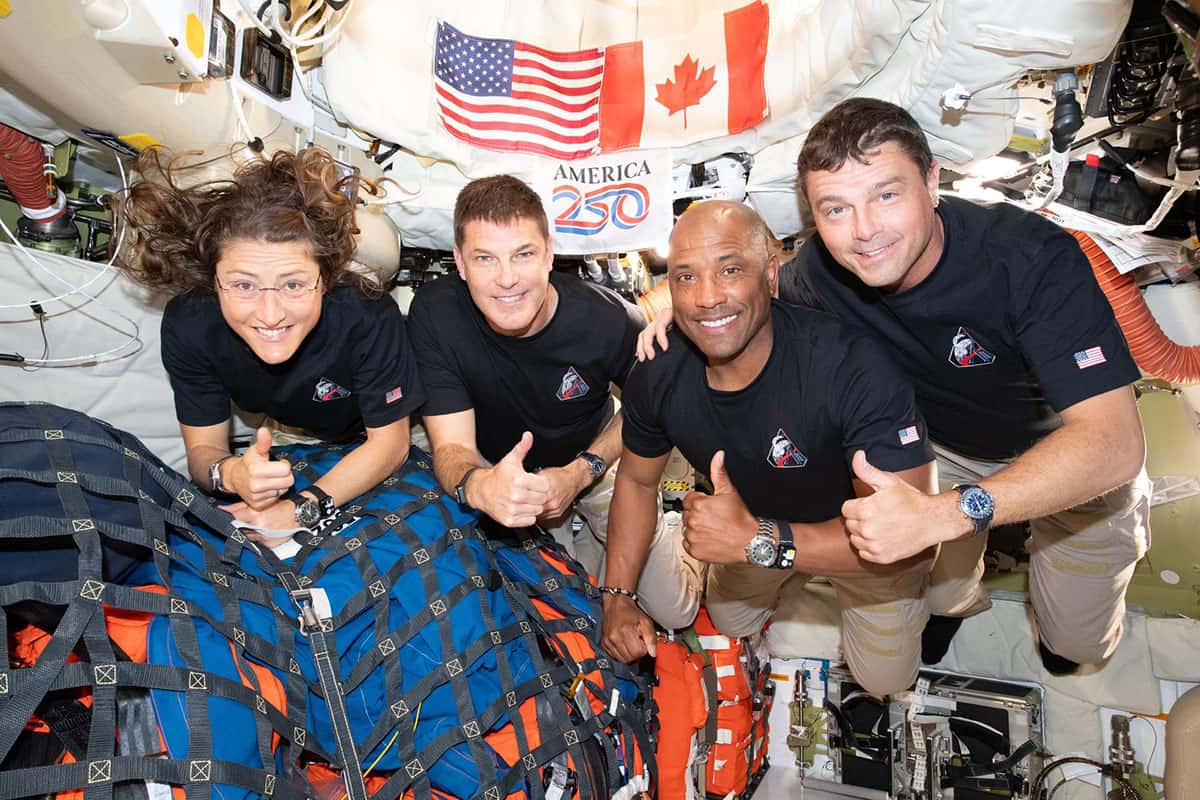
Thumbs up The crew of Artemis II. From left: Christina Koch, Jeremy Hansen, Victor Glover and Reid Wiseman. (Courtesy: NASA)
The Artemis II crew broke records by travelling further from Earth than any humans had before. But they also made history by including the first person of colour, the first woman and the first Canadian to go beyond low Earth orbit, and to travel around the Moon. Here’s who they are:
Reid Wiseman – mission commander
A former US Navy fighter pilot and test pilot, Wiseman was selected as an astronaut by NASA in 2009 and flew to the International Space Station (ISS) in 2014 as part of Expedition 41, where he took part in space walks. He was chief of the Astronaut Office between 2020 and 2022 before being made mission commander on Artemis II. A crater on the Moon seen by the crew of Artemis II has been named after his late wife, Carroll.
Victor Glover – pilot
Having joined NASA’s astronaut corps in 2013, Glover’s first venture into space was as pilot on the first post-certification flight of SpaceX’s Crew Dragon capsule to the ISS. As part of Expeditions 64 and 65, Glover performed four space walks during his time on the station. Like Wiseman, he is also a former US Navy pilot and test pilot.
Christina Koch – mission specialist
In 2019 Koch spent 326 days onboard the ISS as part of Expeditions 59, 60 and 61, setting the record for the longest continuous spaceflight for a female astronaut. During this time she also participated in the first all-female spacewalk. Prior to being chosen as an astronaut in 2013, Koch worked as an electrical engineer at NASA’s Goddard Space Flight Center, and spent time in Antarctica at the Amundsen-Scott South Pole Station and Palmer Station.
Jeremy Hansen – mission specialist
A colonel in the Royal Canadian Air Force, Hansen became an astronaut for the Canadian Space Agency in 2009. His training included taking part in the European Space Agency’s CAVES programme – spending time living underground in Sardinia – and NASA’s NEEMO 19 seven-day undersea mission. Artemis II was Hansen’s first flight into space.
The journey begins
On 1 April 2026 spectators on the ground, millions online and even the crew of the International Space Station (ISS) watched as Artemis II blasted off from pad 39B at the Kennedy Space Center in Florida at 6.35 p.m. EDT.
At launch, the four crew members were safely enclosed in their home for the next 10 days – the Orion spacecraft they had named Integrity. In turn, Integrity sat atop NASA’s gigantic Space Launch System (SLS), a rocket more powerful than the mighty Saturn V. Standing 98 m tall, the SLS was driven by four RS-25 liquid propellant engines and supported by two solid-rocket boosters, producing in excess of 39,000 kN of thrust at lift-off.
It was only the second flight of the SLS following 2022’s Artemis I, an uncrewed Moon-orbiting mission to test the SLS rocket and Orion spacecraft. Yet the Artemis II launch was flawless, with the thunderous roar deafening spectators and astounding the assorted news media present.
As the rocket left the atmosphere, the solid-rocket boosters, protective panels and launch abort system (there in case of ascent emergencies) were all successfully jettisoned, followed by the core stage of the SLS. Next, using the interim cryogenic propulsion stage (ICPS) or upper stage – fuelled by a liquid hydrogen/oxygen mix and powered by a single RL10 engine providing 110 kN of thrust – the mission performed a series of manoeuvres to raise its altitude, reaching an orbital elevation of 74,000 km.
Hello, world A backlit Earth photographed from the Integrity capsule by mission commander Reid Wiseman. Aurorae can be seen at top and bottom. (Courtesy: NASA)
Following that, the upper stage was separated; but before leaving it (and Earth) behind, the astronauts used it as part of their demonstration tests, which included showing they could manually pilot Integrity. While in high orbit, the mission also deployed four cubesats – one each from Argentina, Germany, Saudi Arabia and South Korea – designed to study the effects of space radiation from the Sun and in Earth’s Van Allen radiation belts, and how electrical systems perform in such radiation-drenched environments.
With all that done, it was time to leave Earth’s orbit. On day two, the engine of the service module (constructed by the European Space Agency (ESA)) performed the trans-lunar injection burn – firing for almost six minutes to propel the capsule and crew out of Earth orbit and towards the Moon. Artemis II would not orbit the Moon, but swing around it and head back to Earth, following a flight path known as a free-return trajectory. This means that after the trans-lunar injection burn, Integrity coasted for four days through space with only occasional minor course corrections to keep the Moon dead ahead. No further engine burns were required in order to get home (hence “free”) – their trajectory used lunar gravity to naturally slingshot them around the Moon while Earth’s gravity drew them back home. On a diagram, Integrity’s trajectory looks like a figure 8, which follows gravitational gradients between the Earth and the Moon.
Close encounter
On 6 April the mission flew round the Moon just once, giving the crew a seven-hour fly-by observation period of both the near and far sides.
The astronauts’ view of the lunar surface was “amazing” in the words of mission commander Wiseman. “The four of us have looked at the Moon our entire lives and the way we are responding to what we’re seeing out the window is just like we’re a bunch of kids up here. We cannot get enough of this,” he radioed back to Earth.
For much of the fly-by, the four astronauts were like space paparazzi, taking it in turns to photograph the Moon. Although lunar science wasn’t part of the mission, they had a list of 35 targets to find and record that had been selected by the Artemis II science team led by Kelsey Young from NASA’s Goddard Space Flight Center. Among them were impact craters with radial streaks of ejecta that can help planetary scientists understand how craters evolve over time; and a bright swirly feature known as Reiner Gamma that contains a magnetic anomaly and is a possible future landing site for robotic explorers.
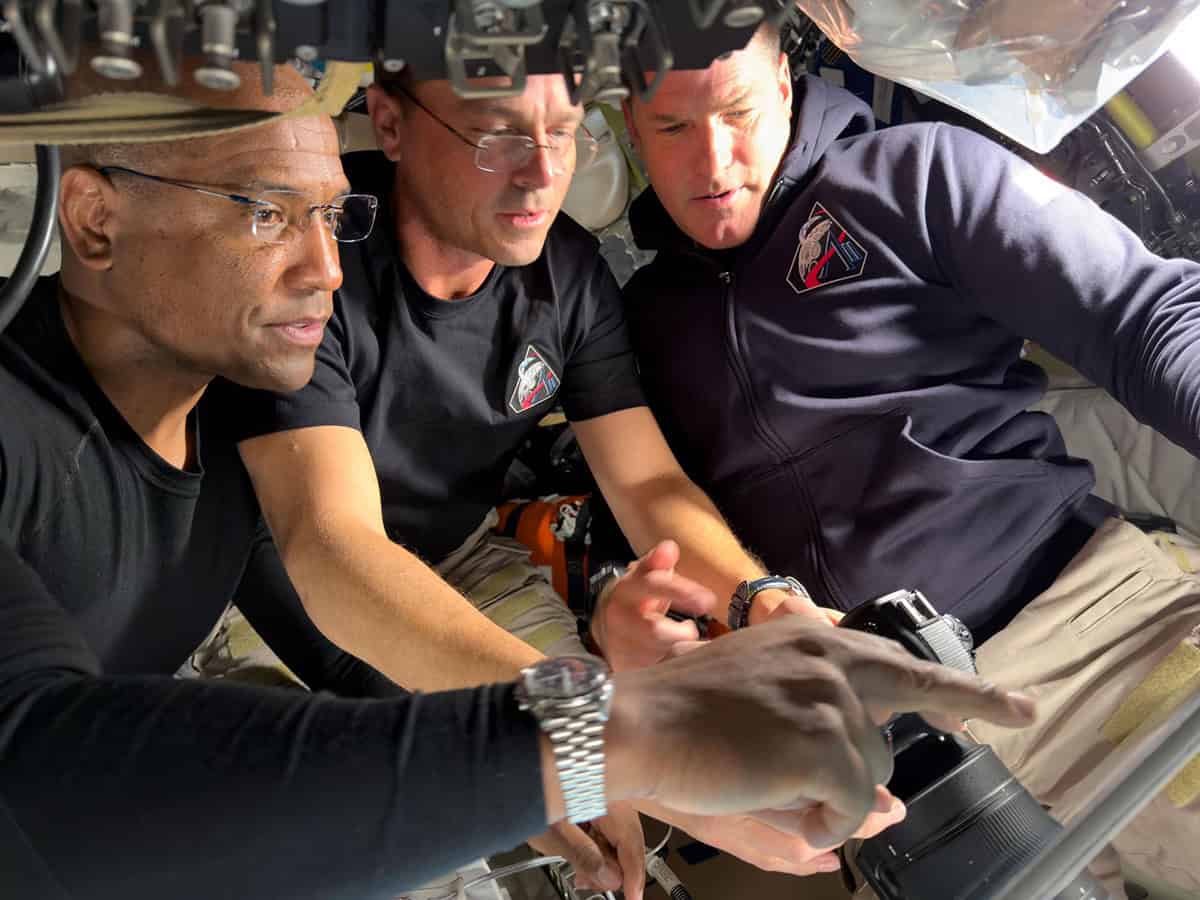
Science ready (From left) Victor Glover, Reid Wiseman and Jeremy Hansen prepare for their journey around the far side of the Moon by configuring their camera equipment shortly before beginning their lunar fly-by observations. (Courtesy: NASA)
The astronauts also targeted parts of the far side that had never before been seen by human eyes because they had been in darkness during the Apollo missions. They were aided in their efforts by a custom-designed app, called the Lunar Targeting Plan, which contained information on the targets, what features to look out for, and how to correctly photograph them – there were even prompts for discussions about what they were seeing.
Some have suggested that the crew’s efforts were more about aesthetics than science, since the entirety of the Moon has previously been mapped by past missions. These include Japan’s Kaguya orbiter, the spacecraft in India’s Chandrayaan programme and Europe’s SMART-1 mission back in 2003. Indeed, none have mapped the Moon as comprehensively as NASA’s Lunar Reconnaissance Orbiter (LRO), which launched in 2009 and to this day continues to map the entire lunar surface to 100-metre resolution, and in some places reaches an unprecedented half-metre resolution.
However, Amanda Hendrix, who is director of the Planetary Science Institute (PSI) in Arizona and who works on LRO, disagrees that lunar science wasn’t a part of the Artemis II mission.
“I think there was science to do on the fly-by,” she says. While LRO’s cameras catch a lot on the lunar surface, particularly how features seem to change with the shortening and lengthening of shadows throughout the lunar day, there’s something very crucial that is missing. “LRO’s instrumentation is limited,” explains Hendrix. “Its cameras don’t have that many filters, so we don’t get that much colour information.”
As it turns out, the Moon isn’t just a boring silver-grey sphere, but a world of many subtle colours, which Apollo 17 astronaut and geologist Harrison Schmitt discovered in 1972, when he found orange regolith made of volcanic beads rich in titanium.
“What the Artemis II crew brought is the spectral coverage that they could see with their eyes that we don’t have with LRO,” says Hendrix. “Plus, we could hear the astronauts talking about how impressed they were with the change in lighting geometry as the spacecraft went around behind the Moon, and how the day/night terminator moved across the surface. So I do think there is new scientific information there.”
The far side
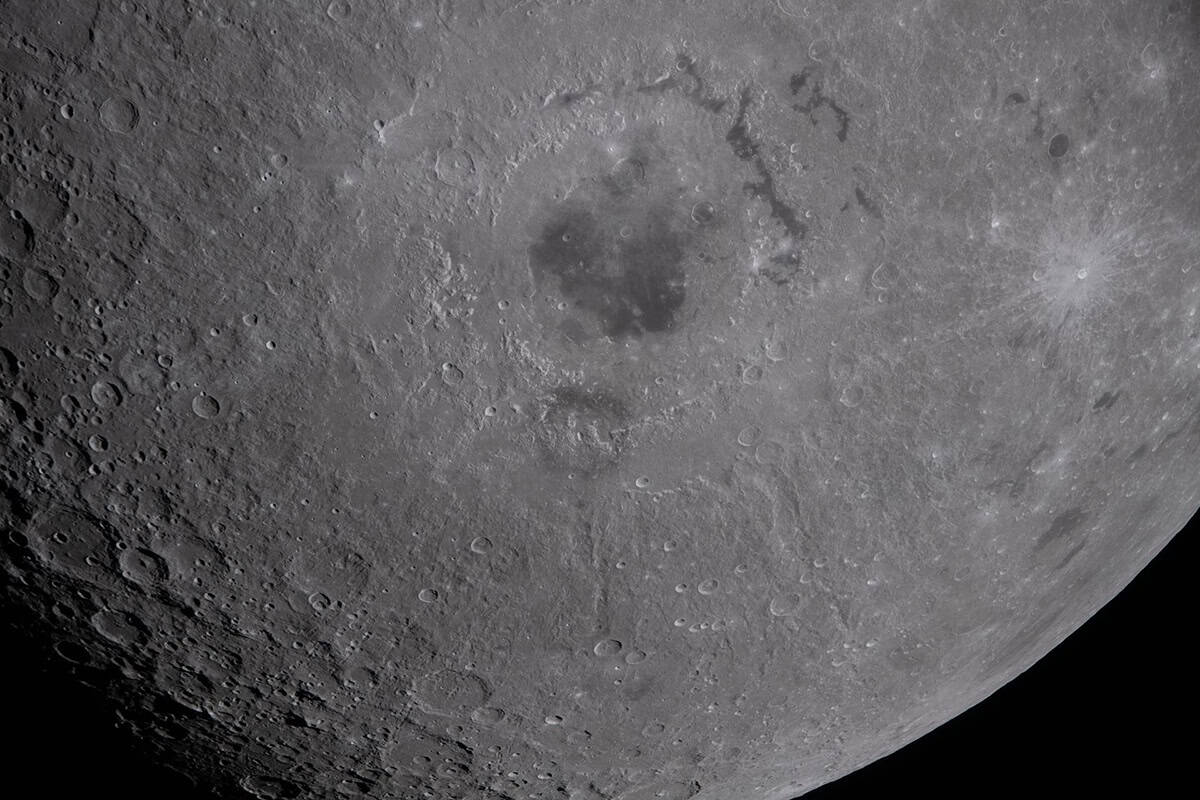
Most of the science targets were found on the far side, including the mighty Orientale impact basin, which is located on the limb of the Moon as seen from Earth. (The limb is what we call the edge of the Moon when we look at it in the sky, but we can’t call it an edge since the Moon, as a sphere, doesn’t have an edge. Features on the limb are foreshortened because of perspective as the lunar surface curves away from us.) Thought to be the youngest of the Moon’s large impacts, Orientale features a lunar sea (known as a mare) at its centre, and a stunning double-ring structure at its edge. The exterior ring has a diameter of 930 km, making it one of the largest impact sites in the entire solar system.
Moonwatch The double-ringed structure of the Orientale basin, with Mare Orientale in the middle. (Courtesy: NASA)
“What really struck me is that this was the first time that humans themselves saw so much of the Moon and I think a lot of people don’t really appreciate that,” says Jeffrey Andrews-Hanna, a planetary scientist at the University of Arizona’s Lunar and Planetary Laboratory. “A great example is the Orientale impact basin. We have an incredible amount of data from orbiting robotic spacecraft, but humans had never actually laid eyes on so much of it until now. The Artemis II astronauts had a prime view looking on the surface and seeing the basin in its entirety.”
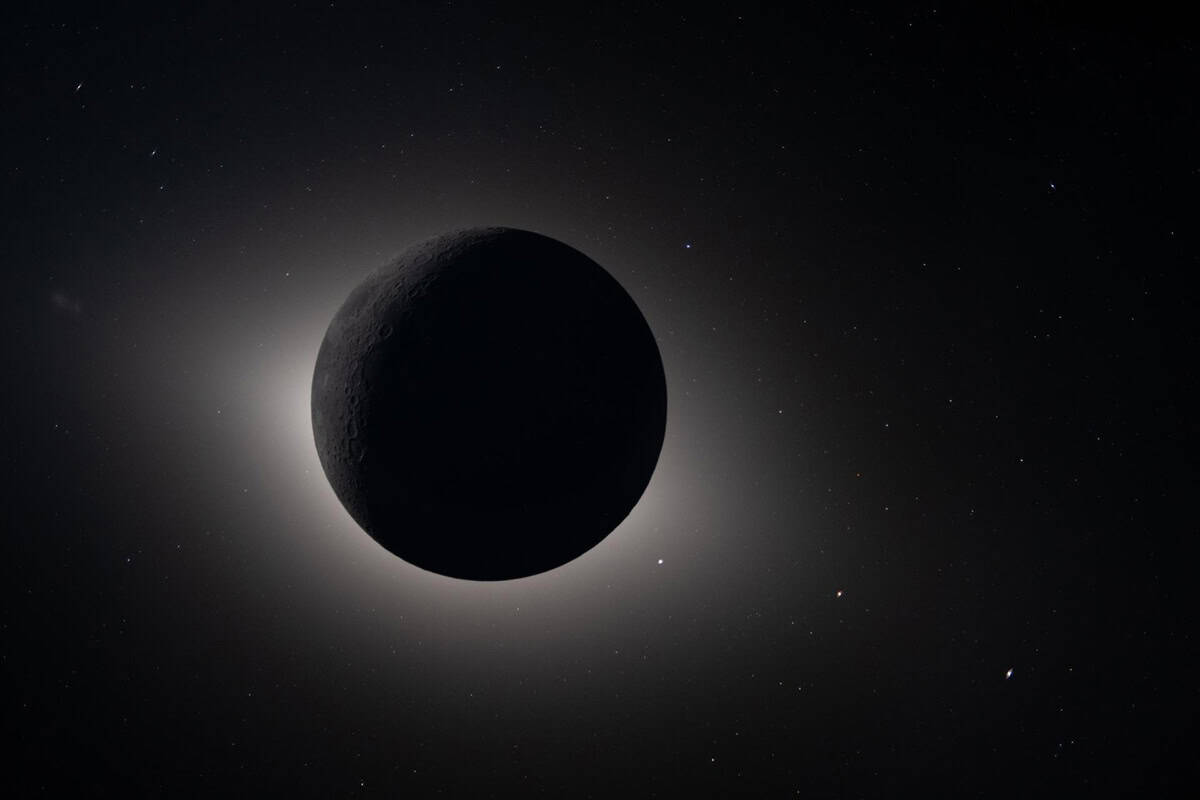
At one point shortly after the closest approach – which saw the astronauts get to within 6545 km of the lunar surface – they witnessed the Sun spectacularly fall into total eclipse behind the Moon. Then, as Integrity was cast into the Moon’s shadow, the crew saw five remarkable events – flashes of light as meteorites slammed into the surface, gouging out small new craters. The flashes were so fast that the crew were unable to catch them on camera, but they knew to be on the lookout for them nevertheless.
Lunar impacts have been sporadically witnessed before by spacecraft and amateur astrophotographers, but this was the first time it has been possible to ascertain the rate of impacts occurring on the Moon.
Eclipse The crew of Artemis II witnessed a 54-minute-long total solar eclipse from the far side of the Moon. The origin of the halo of light remains unclear: is it caused by the solar corona, the zodiacal light, or a combination of the two? (Courtesy: NASA)
“To have seen five of them during that short time frame tells you the rate at which they must be happening all over the Moon, whether you can see them or not,” says Hendrix. “That’s important for telling us how much material is still out there impacting not only the Moon but also Earth, or at least the top of our atmosphere.”
Looking to future Artemis missions that will land on the Moon (currently planned from 2028), Andrews-Hanna sees a way in which the study of meteorite impacts can be enhanced by seismometers placed on the surface. “Understanding the impact flux is important,” he says. “And there’s a lot that can come from linking an impact that is seen with the seismic waves that are measured.”
A seismometer can give some indication of the size of the impacts, providing information about the mass of the meteorites impacting the Moon as well as their frequency. The seismic waves can even be used as probes into the Moon’s interior structure.
Back to Earth
The farthest that Integrity got from Earth was 406,771 km, breaking Apollo 13’s distance record of 401,171 km. While behind the Moon, the crew were out of contact with Earth for 40 minutes (as planned), far from home and completely alone.
That perfect isolation would not last long, and soon Integrity was embarking on the journey home, to arrive on Friday 10 April. Yet even if NASA and the Artemis II crew didn’t show it, there was some nervousness ahead of that return.
During Artemis I the heat shield on the empty Orion capsule suffered serious damage, cracking to the point that large chunks of the heat-resistant Avcoat material ripped dangerously away in temperatures of 2760 °C while plummeting through Earth’s atmosphere. Upon investigation, NASA scientists found that the problem was triggered by the skip guidance entry technique they had used to return Orion to Earth, which involves dipping the capsule in and out of the atmosphere so that atmospheric drag helps slow the re-entry.
In ground tests to simulate the technique, the scientists had used heating rates that had allowed a permeable char layer to form and ablate, releasing gases produced by the Avcoat layer. But in reality, dipping in and out of the atmosphere resulted in less severe heating and slower char formation. Gases accumulated in the Avcoat layer and could not escape, causing cracking.
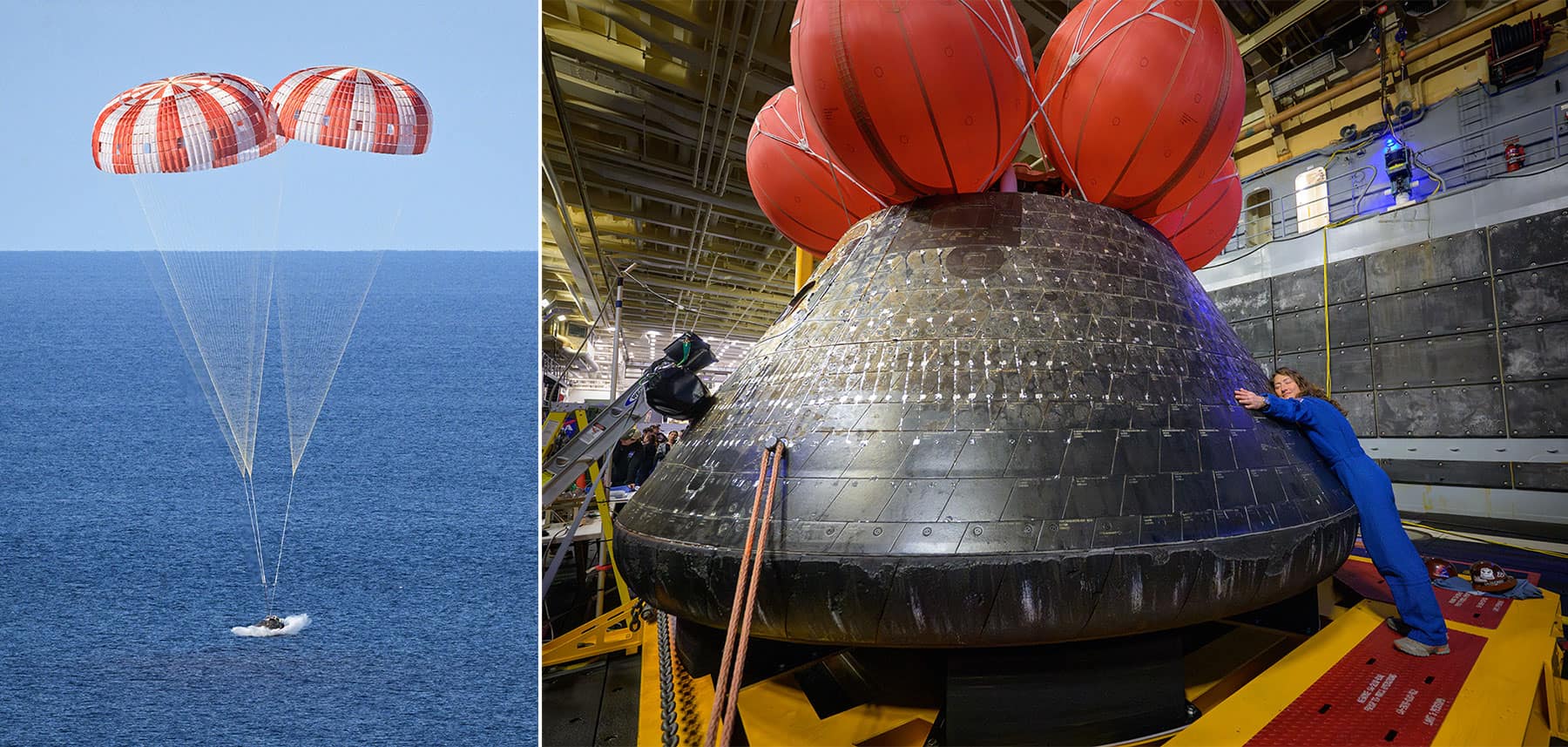
Safe return (left) Integrity splashes down safely into the Pacific Ocean. (right) Christina Koch, Artemis II mission specialist, hugs the Orion spacecraft in the well deck of USS John P Murtha on 11 April 2026. (Courtesy: NASA/Josh Valcarcel; NASA/Bill Ingalls)
Obviously, something needed to be changed for Artemis II. Rather than modify the heat shield that had already been built, NASA decided to change the re-entry profile. Integrity’s trajectory was made steeper, reducing time spent in the part of the atmosphere where Artemis I had problems – however, this would make it the fastest atmospheric entry ever attempted by a crewed spacecraft.
During the 13-minute fall from the sky, the heat shield held up well, staying hot long enough to release the gases. Eleven parachutes in total were deployed, slowing the capsule from 40,230 km/h while 120 km above the Earth, to 523 km/h at 8 km altitude. By the time the main parachute unfurled, Integrity was gently drifting down at less than 32 km/h for a successful splashdown in the Pacific Ocean near San Diego.
From II to V
Artemis II was a success, proving that we can send humans back to the vicinity of the Moon. Artemis III was originally planned to finally land on the lunar surface again, but it has now been repurposed for practising docking and rendezvous procedures in low Earth orbit, just as Apollo 9 did following Apollo 8’s triumphant flight around the Moon. Artemis IV, planned for early 2028, is currently the mission that will land, and hopefully later that year Artemis V will begin construction of a lunar outpost at the South Pole–Aitken Basin, among permanently shadowed craters that harbour water-ice.
After Artemis II, landing on the Moon doesn’t feel as far away as it did
After Artemis II, landing on the Moon doesn’t feel as far away as it did. Certainly, Wiseman is more optimistic now than he ever was. “I’m going to eat these words, but [landing on the Moon] is not the leap I thought it was,” he told journalists at a media conference in Houston a week after splashdown. “Once we were around the Moon in a vehicle that was handling great, if you’d given us the keys to a lander, we would have taken it down and landed on the Moon. It’s going to be extremely technically challenging, but it is absolutely doable, and doable soon.”
Visiting our orbiting companion
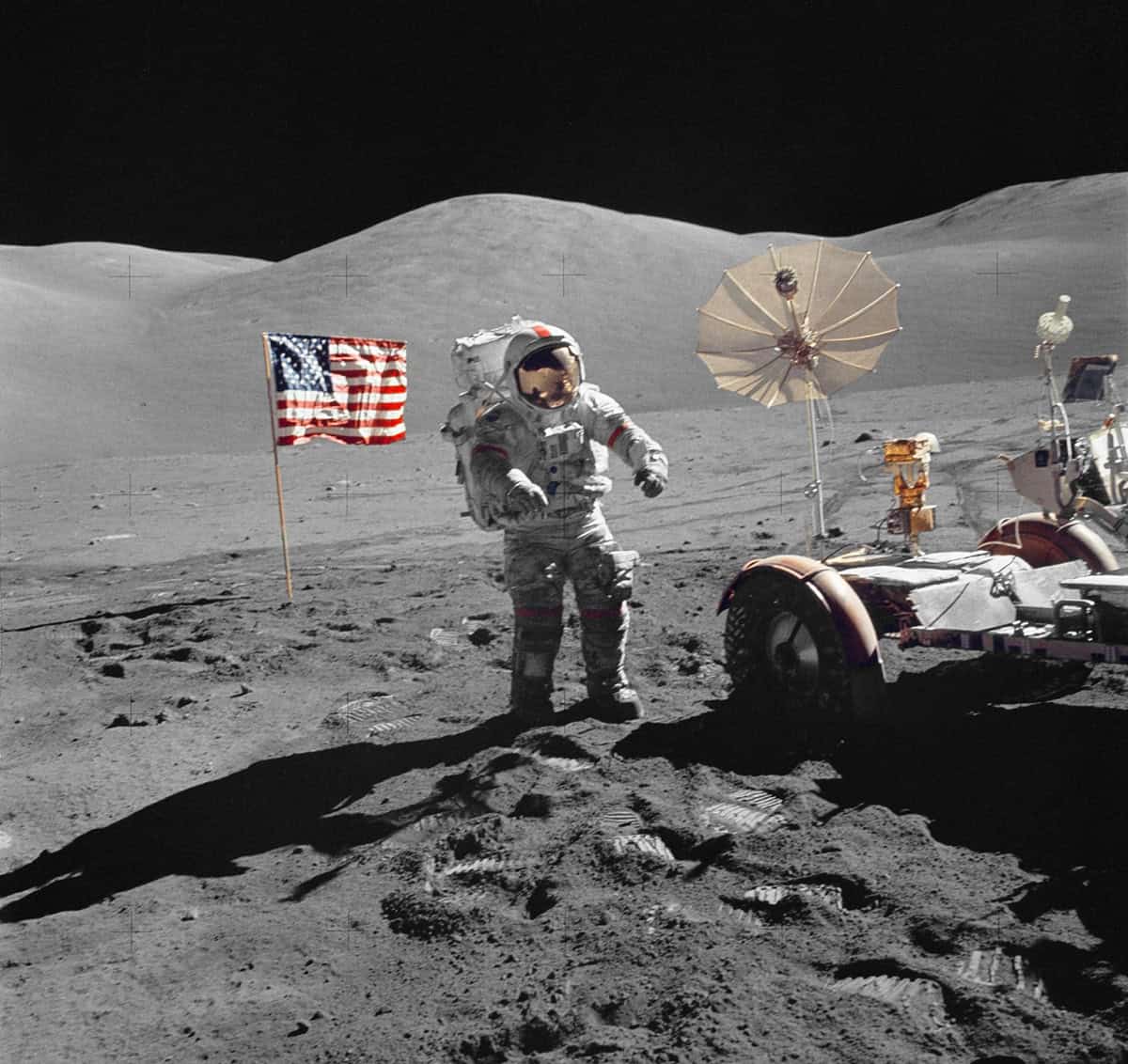
Last man on the Moon Gene Cernan walks on the Moon in December 1972 during the Apollo 17 mission, of which he was mission commander. (Courtesy: NASA/Harrison Schmitt)
The first crewed mission to the Moon took place in December 1968 when NASA’s Apollo 8 entered lunar orbit. Over the next four years, the US sent another eight crewed spacecraft, including the historic Apollo 11 mission that saw Neil Armstrong take humanity’s first steps on the Moon.
But we then stopped sending people to our rocky satellite. The Apollo missions were cancelled due to budget costs and changing political priorities, while the Soviet Union’s efforts to land cosmonauts on the Moon stalled on the launchpad with the failure to develop their N1 heavy lift rocket. Many uncrewed missions from around the world have impacted, orbited, flown by or landed on the Moon, but – until now – none have had human passengers, leaving Gene Cernan as the last person to set foot on the Moon on 13 December 1972 as part of the Apollo 17 mission.
While science was not the priority for Artemis II, the scientific community is already positioning itself to make the most of returning to the Moon. Hendrix points out that three researchers from PSI have been selected as participating scientists for Artemis IV. Meanwhile, tangential to the Artemis programme is the Commercial Lunar Payload Services (CLPS), in which NASA is working with private contractors to build small landers that can take scientific experiments to the Moon. Although their success in landing has been somewhat mixed so far, it opens the Moon up to a wider range of scientists.
That’s important, says Hendrix, because there’s less grant money coming from NASA, which has seen its budget remain more or less the same while shouldering the burden of more large-scale missions.
“There is concern in the planetary science community that opportunities have been shrinking and it is because the budget hasn’t increased enough over the past couple of decades to accommodate all the programmes that are happening,” says Hendrix. There is also great uncertainty in the US science community around funding and budget changes under the current administration. “Planetary scientists can at least do some science on the Artemis missions as part of the landing science team, and they can be part of the science teams for instruments on CLPS missions, and those are the bulk of the opportunities now.”
The US is not the only country with its sights set on the Moon. China is also hoping to send astronauts – or taikonauts – by 2030. They will travel in the Mengzhou seven-person spacecraft, which is currently scheduled to do its first orbital uncrewed test flight in September 2026. The corresponding lunar lander, called Lanyue, is also under development. In the meantime, China has been sending regular robotic missions to both the near and far side of the Moon, and has brought precious lunar samples back to Earth. These missions have involved some – albeit limited – international co-operation, particularly with European scientists who have had experiments flown on the missions.
Inspiring the world from the Moon
Since the safe return of the Artemis II crew, the reaction has been as philosophical as it has been admiring of the technical feats of the mission. This was especially notable during the astronauts’ press conference, in which they discussed not the sights they had seen, but the way the mission had brought the whole world together in support.
“When we came home, we were shocked by the global outpouring of support, of pride, of ownership of this mission,” admitted Wiseman. “The four of us wanted to go out and do something that would bring the world together.”
Public interest is vital if the Artemis programme is to continue being funded, explains Hendrix. “The whole of planet Earth was brought along with them, as we watched on our screens,” she says. “Getting everybody on Earth behind these missions is important, especially the people who make the budget.”
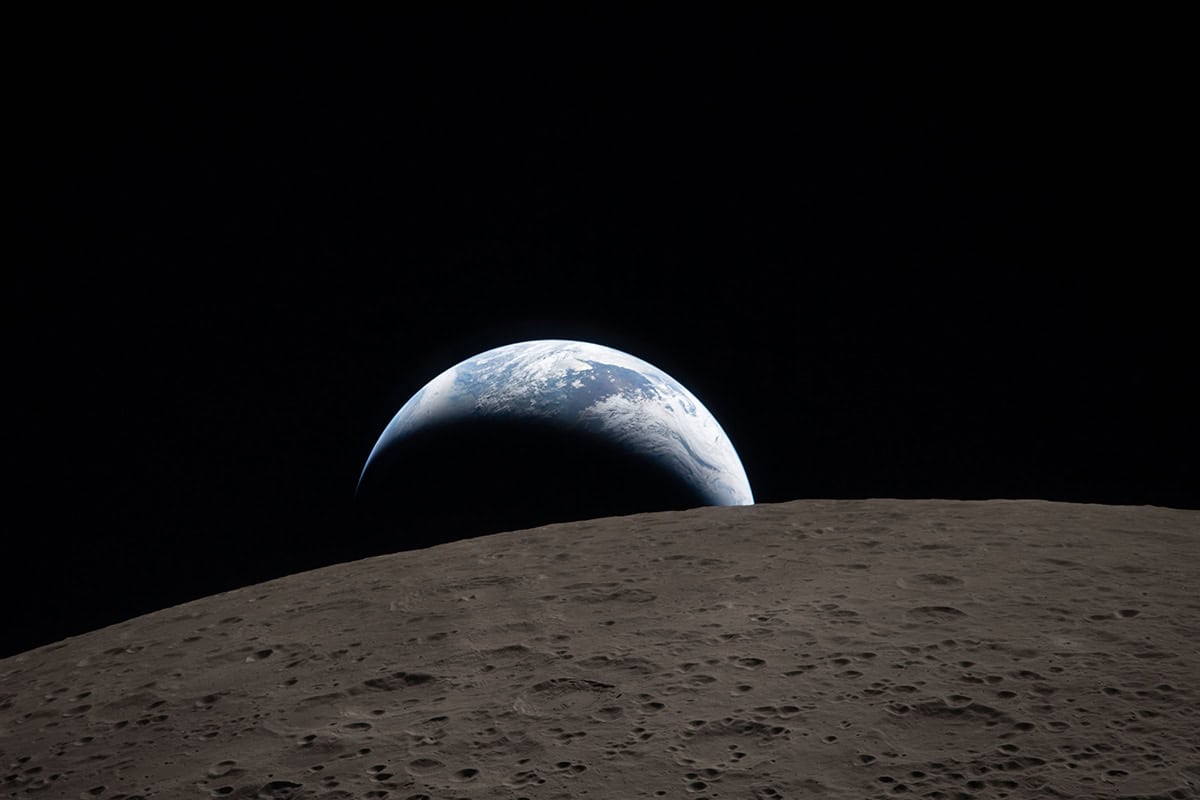
Earthrise This famous photograph of Earth with the Moon as foreground was taken on 24 December 1968 during the Apollo 8 mission. (Courtesy: NASA/Bill Anders)Earthset On 6 April 2026 the Artemis II crew photographed the crescent Earth slipping behind the limb of the Moon as Integrity prepared to loop around the far side. (Courtesy: NASA)
When Apollo 8 took three astronauts around the Moon for the first time during Christmas week of 1968, it brought the American public together during a time of national strife because of the Vietnam War. The famous “Earthrise” photograph taken during the mission also became a rallying cry for the burgeoning environmental movement.
The global circumstances around the time of Artemis II’s launch were not dissimilar, with wars in South-West Asia and Ukraine continuing against a backdrop of impending environmental disaster and social and political strife. Perhaps our return to the Moon will help bring people back on Earth together once again.
A new analysis of data from the IceCube Neutrino Observatory suggests that the energy spectrum of cosmic neutrinos is more complex than was previously thought. Whereas a previous study found that the energies of these ubiquitous, nearly massless particles follow a simple power law distribution, the latest analysis reveals a knee-like bend in the spectrum at around 30 TeV. The discovery could help astrophysicists better understand where cosmic neutrinos come from and what objects and processes in the universe are producing them.
Neutrinos are subatomic particles that are around a million times less massive than electrons. They are known to come in (at least) three different “flavours” – electron, muon and tau – but they have no electrical charge, and they interact with matter only rarely, via the weak nuclear force and gravity. This means they can travel vast distances through the universe without being deflected by magnetic fields or absorbed by interstellar material along the way.
Astrophysicists think cosmic neutrinos are produced in collisions between high-energy cosmic rays and other particles. Since cosmic rays are accelerated by a range of astrophysical sources – including gamma-ray bursts, active galactic nuclei powered by supermassive black holes, and other extreme cosmic processes – the neutrino spectrum is a way of gleaning information about where these sources are and how they work.
The catch is that because neutrinos interact so weakly, they must be studied using detectors with a very large volume. For this reason, neutrino scientists often use natural structures such as deep water or expanses of ice to support their detectors. These locations also have the advantage of being shielded from muons, cosmic rays and other sources of background noise.
Measuring neutrinos since 2010
The 5000 optical sensors that make up the IceCube observatory are suspended within a cubic kilometre of Antarctic ice. They are designed to detect the telltale flashes of visible and ultraviolet light that occur whenever a neutrino interacts with a molecule of ice. During these rare detection events, the neutrino either leaves behind an elongated track or produces a “cascade” in which its energy is contained in a small, spherical volume inside the ice.
IceCube’s detectors have been operating since 2010 and the earliest data they produced suggested that the energies of the detected neutrinos followed a single falling power law distribution. Researchers were initially pleased with this result because it agreed with simple models that related cosmic neutrinos to cosmic rays, says Aswathi Balagopal V, a postdoctoral researcher at the University of Wisconsin, US, and a member of the IceCube collaboration. These models suggested that cosmic ray acceleration takes place exclusively in so-called shock environments where collision events produce neutrinos.
In the new work, Balagopal V and colleagues performed two different, independent, types of analysis on more than 10 years’ worth of neutrino observations in the 1 TeV to 10 PeV range. The first analysis involved measuring a sample of neutrino cascades and a sample of neutrino tracks in the detector. The team then combined the results of both sets of measurements to characterize the neutrino spectrum.
Both analyses arrived at the same conclusion, rejecting a single power law distribution with a confidence of more than 4σ (the usual maximum confidence being 5σ). The best fit for the data was instead a broken power law, with the spectrum of neutrino energies falling more steeply at higher energies than at energies below around 30 TeV, Balagopal V tells Physics World.
“This implies that there are fewer lower energy neutrinos when compared to what one would obtain with a simple extrapolation of the prediction from higher energies,” she says. “This changing shape of the spectrum can indicate several things: either a changing population of cosmic neutrino sources; or a change in their production mechanism.” If cosmic neutrinos come from more than one kind of astrophysical source, she adds, then each type may be accelerating cosmic rays in a different way.
A final option, Balagopal V notes, is that some theories suggest that interactions with dark matter can also produce such a spectral feature. “With these measurements, we have opened up the possibility of discoveries in any of these directions,” she says. “With more detailed analyses, we could identify if there are additional features in the energy spectrum and we are already analysing new IceCube data to this end.”
In the ongoing quest to improve cancer treatments, the radiation oncology community is looking to add to its armoury of radiation-based treatments. In particular, radiopharmaceutical therapy (RPT) – also known as molecular radiotherapy (MRT) – and the emerging sub-field of theranostics are set to play an expanded role as radiation medicine shifts towards a more integrated, multidisciplinary approach.
RPT is an evolving modality that uses a tumour-targeting molecule attached to a therapeutic radioisotope to deliver radiation directly to tumour cells. Theranostics takes this approach a step further, pairing the therapeutic radioisotope with a diagnostic analogue to image the disease before therapy and predict how the radioactive drug will be taken up by a specific patient.
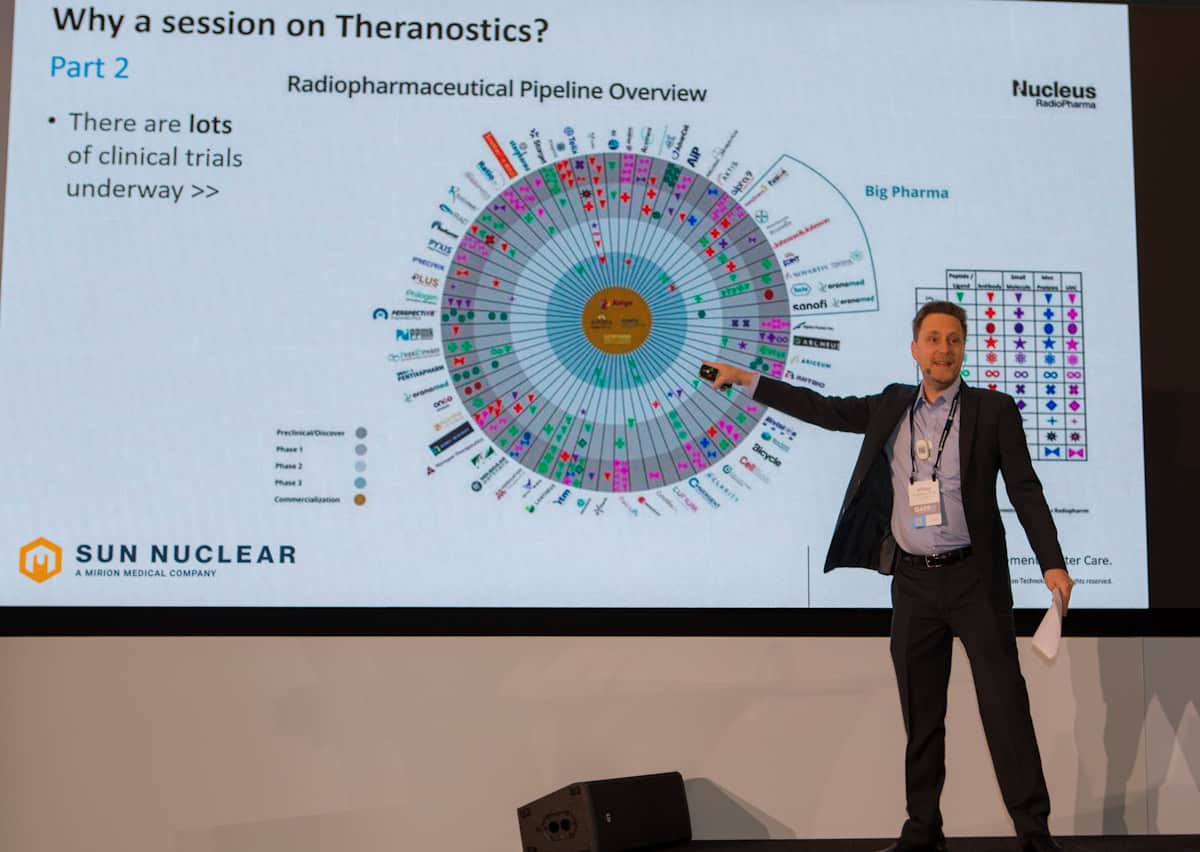
“Interest in theranostics has really exploded since the clinical approvals of two radioactive drugs that are being used right now to treat patients,” explained Jeff Kapatoes, vice-president of regulatory, physics and product at Mirion Medical, at the recent QA & Dosimetry Symposium (QADS) hosted by Sun Nuclear.
The two approved drugs – Lutathera and Pluvicto – are approved for treating neuroendocrine tumours and certain prostate cancers, respectively, currently for later-stage disease but with multiple clinical trials ongoing to expand their remit to early-stage disease. “There are also active trials that treat other disease sites, such as lymphoma, breast and lung,” Kapatoes noted. Alongside, some 70 companies are developing their own therapeutic radiopharmaceuticals, with nine candidates now in phase-three trials and closing in on approval.
Emerging technologies Jeff Kapatoes of Mirion Medical introduced the session on theranostics at the QA & Dosimetry Symposium. (Courtesy: Sun Nuclear)
But despite its vast potential, theranostics is still in the early stages of widespread clinical adoption. While external-beam radiotherapy benefits from established treatment and quality assurance methodologies, this is simply not the case for theranostics. And as demand continues to grow, it’s vital that the full theranostic workflow is standardized – from radioisotope production through to final delivery to the patient.
Mirion Medical can support this integration of theranostics into radiation oncology, offering a broad portfolio of products designed for the entire theranostics lifecycle. The transition will also rely heavily on the contribution of medical physicists, who are uniquely positioned to implement theranostics programmes within their institutions.
Theranostics today
Speaking at the QADS event, John Sunderland from the University of Iowa explained the current situation. “The reality is, in external-beam radiotherapy, there are methods to ensure that the beam reaches the right place and the energy deposited is what you think. In RPT, you don’t control where the dose goes, biology and biochemistry do.”
He described a typical theranostic prostate cancer treatment, which begins with a PET/CT scan to visualize how a diagnostic radioisotope binds to the patient’s prostate cancer cells. Candidate patients are then injected with a therapeutic radioisotope comprising the same cancer-targeting molecule labelled with the beta emitter lutetium-177 (177Lu), which delivers highly localized radiation dose to the tumours. Importantly, this drug can also be imaged, using SPECT/CT to track its delivery.
Serial imaging enables treatment to be tailored to a patient’s response. Sunderland discussed one patient who had almost complete response after three treatments with Pluvicto (which is delivered in up to six cycles of 200 mCi). “There’s no reason to keep giving radiation dose to this patient, which might result in adverse events, we may as well stop,” he explained.
More typically, a patient will exhibit stable disease or a modest response – likely because not enough dose was delivered to the tumour. Simply increasing the amount of injected activity, however, risks increasing the dose to non-target organs such as kidneys or bone marrow. “Instead, we’re trying to move to dosimetry-modulated RPT where you modulate the amount of injected activity based upon the dosimetry in that first cycle,” Sunderland explained. “Then you can optimize the efficacy while maintaining critical organ toxicity levels to below where they might have adverse effects.”
Such dosimetry modulation requires three things: accurate measurement of the injected activity using a radionuclide calibrator; quantitative SPECT mapping of the absorbed radiation dose; and uniform software tools. But challenges remain, due to a lack of standardization at all three stages.
“Even expert physicists making the same dosimetry measurements with the same image data could vary by 20 to 30%, just because of the methodology they choose,” said Sunderland. “We have to standardize. We’re not where the external-beam people are, we’re all doing it differently because it’s so new.”
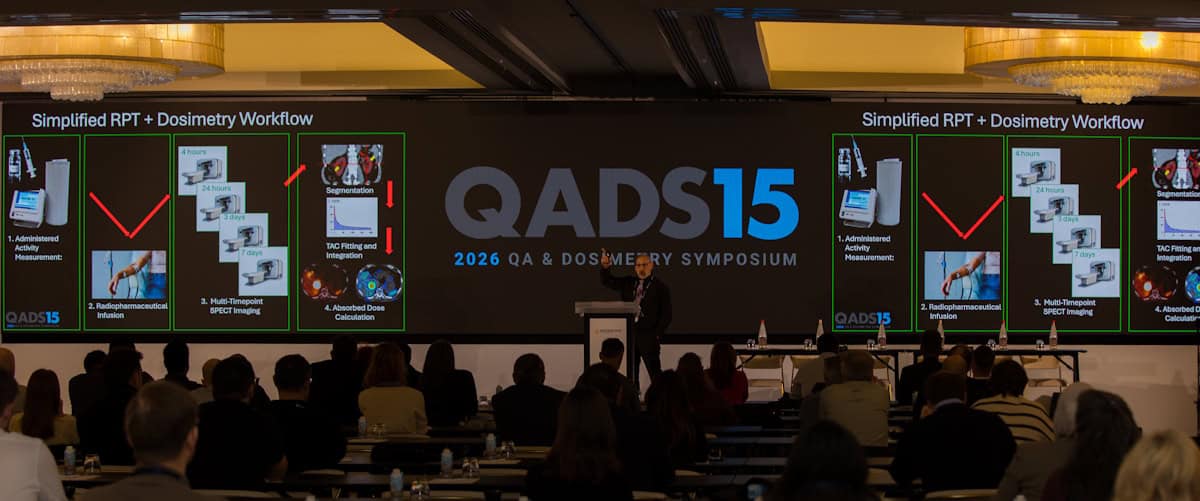
Challenges to address John Sunderland detailed the workflow for dosimetry-modulated radiopharmaceutical therapy. (Courtesy: Sun Nuclear)
The PDIB project
The Precision Dosimetry Imaging Biomarker (PDIB) project hopes to remedy this situation via three parallel projects: establishing a network of secondary standards calibration laboratories (SSCLs); standardization of SPECT/CT scanner calibration procedures; and standardization of dosimetry calculation workflows. “Only if we can do that are we actually going to be able to define our radiation dose-effect curves, as the external-beam field has been doing for years,” said Sunderland.
The first project aims to enable accurate measurement of the injected dose. To achieve this, four SSCLs – at BC Cancer, the University of Iowa, the University of Alabama Birmingham and the Belgian Nuclear Research Centre – will work with the national metrology labs NIST and NPL to support clinical trials worldwide. Using high-purity germanium detectors, the labs will perform absolute activity measurements of the six most commonly used radionuclides (177Lu, 131I, 225Ac, 111In, 203Pb and 212Pb). These samples can then be used by radiopharmacies and imaging/therapy sites to adjust their own dose calibrators to the SSCL measurements, targeting an overall activity uncertainty of less than 3%.
The second project, designed to harmonize quantitative calibration of SPECT/CT for therapeutic radionuclides, involves 12 imaging sites across the US, Europe and Australia. “There’s no standard way to calibrate right now and there’s no way to validate the calibration,” said Sunderland. The plan is to calibrate seven common quantitative SPECT/CT scanner models, using three different phantoms and the six radionuclides, using SSCL-supplied samples to ensure accurate activities.
The final project addresses the dosimetry calculations. Led by five international experts (two in North America, two in Europe and one in Australia), the project will examine 177Lu dosimetry for kidneys, bone marrow and tumours using 20 curated 177Lu-DOTATOC datasets. The teams will use five cases to develop standard operating procedures, then test these procedures on the other 15 cases, using five different dosimetry software packages, to investigate inter-user dosimetry variability.
“Radiopharmaceutical therapy is a big deal,” Sunderland emphasized. “The market for nuclear medicine is growing exponentially; it’s going to be double that of external-beam radiotherapy by 2030. And there are not nearly enough nuclear medicine physicists to do this work.”
In the US, RPT is a shared domain between radiation oncology and nuclear medicine, with active discussion around which department should be handling radiation for therapeutic versus purely diagnostic purposes. In Europe, meanwhile, theranostics generally sits solely within the remit of nuclear medicine.
“We need to recruit the external-beam physicists into the fold,” said Sunderland. “From a dosimetry and physics standpoint, there’s a lot of overlap here and a lot of expertise.”
Supporting the theranostics workflow
This blurring of traditional boundaries between nuclear medicine and radiation oncology creates both opportunities and complexities. With a comprehensive portfolio of products that span both domains, Mirion Medical aims to ease this convergence of disciplines and support the physicists navigating this transition.
Designed to standardize and streamline the full theranostics workflow, ec² Software enables radioisotope manufacturers, radiopharmacies and clinical facilities to provide traceability and support precision, safety and regulatory adherence.
“Products from ec² Software enhance precision through accurate dose tracking and documentation across the radiopharmaceutical lifecycle, improve safety by reducing manual steps, and support regulatory compliance with auditable records,” Kapatoes explained. “Overall, ec² Software helps health systems move from fragmented processes to consistent, scalable operations.”
Meanwhile, Mirion’s broader Radiopharma offering supports the physical and operational infrastructure required for safe and accurate delivery of theranostic procedures. This includes dose calibrators, SPECT calibration phantoms and shielding systems from Capintec, all of which will be key enablers for the introduction of dosimetry-modulated RPT.
“While ec² provides the workflow, traceability and compliance layer, Mirion’s hardware and monitoring solutions address the measurement, protection and safety environment in which those workflows operate,” said Kapatoes. “Together, they create an integrated approach, linking what’s happening operationally with what’s happening physically. This alignment helps health systems standardize processes, reduce variability and maintain compliance as programmes scale.”