Studying the chain of processes that take place when UV or x-ray radiation interacts with solid matter is crucial in various fields from medical physics to materials testing.
The first of these processes is typically photoionisation, where an atom or molecule absorbs a photon and loses one or more electrons as a result.
What comes next can vary depending on the strength of the radiation and the nature of the material, but some of the most important effects are secondary ionisation processes. These often go on to dominate the dynamics of the whole system.
One of these is interatomic Coulombic decay (ICD), in which energy is transferred from one excited atom or molecule to a neighbouring one, which in turn is ionised.
ICD has captured considerable interest since its discovery, not least because it often produces low energy electrons which cause radiation damage in biological matter.
Understanding this phenomenon better was the team’s goal in this latest work. Using the ASTRID2 synchrotron in Aarhus, Denmark, they studied what happened when extreme UV photons interacted with small clusters of helium atoms.
To capture what was going on they used an electron velocity-map imaging spectrometer. This is a powerful diagnostic that measures any emitted electrons’ energy in addition to their angular distribution.
Using this technique, they were able to show that the ICD process is even more efficient than previously thought. The researchers expect it to play a crucial role in other condensed phase systems exposed to ionising radiation as well.
Knowledge gained from studies such as this one is crucial for fields like radiation therapy, where the effects of ionising radiation on human cells must be tightly controlled.
Wireless power transfer (WPT) is increasingly used in consumer electronics, electric vehicles, and medical devices, with technologies like inductive charging and resonant coupling leading the way.
The key to successful WPT technologies is ensuring that a high percentage of the input power is transferred to its intended destination – i.e. it must be efficient.
The idea of parity-time (PT) symmetry helps achieve this goal by offering a way to balance energy gain and loss in a system, which helps maintain stable and efficient power flow – even in the presence of disturbances.
Here parity means spatial reflection (like flipping left and right), and time refers to reversing the direction of time. A PT-symmetric system behaves the same when both of these transformations are applied together.
However, this method has its limitations. It often requires very fine-tuning, it can struggle when devices do not function as idealised resistors,. Most importantly, it falls short of achieving the theoretical maximum efficiency of WPT.
This is where the new paper comes in. They’ve performed a comprehensive experimental and theoretical study demonstrating that dispersive gain can greatly enhance the efficiency of WPT beyond the limits of previous methods.
Dispersive gain describes a type of energy amplification in a system where the gain depends on the frequency of the signal. This means the system amplifies energy differently at different frequencies, rather than uniformly across all frequencies.
This allows the system to naturally shift energy into the most efficient frequency modes for transfer.
Their work could be used to enable new technologies or make existing ones more affordable. It could also open up new possibilities for harnessing dispersion effects across electronics and optics.
A new transition-metal oxide crystal that reversibly and repeatedly absorbs and releases oxygen could be ideal for use in fuel cells and as the active medium in clean energy technologies such as thermal transistors, smart windows and new types of batteries. The “breathing” crystal, discovered by scientists at Pusan National University in Korea and Hokkaido University in Japan, is made from strontium, cobalt and iron and contains oxygen vacancies.
Transition-metal oxides boast a huge range of electrical properties that can be tuned all the way from insulating to superconducting. This means they can find applications in areas as diverse as energy storage, catalysis and electronic devices.
Among the different material parameters that can be tuned are the oxygen vacancies. Indeed, ordering these vacancies can produce new structural phases that show much promise for oxygen-driven programmable devices.
Element-specific behaviours
In the new work, a team of researchers led by physicist Hyoungjeen Jeen of Pusan and materials scientist Hiromichi Ohta in Hokkaido studied SrFe0.5Co0.5Ox. The researchers focused on this material, they say, since it belongs to the family of topotactic oxides, which are the main oxides being studied today in solid-state ionics. “However, previous work had not discussed which ion in this compound was catalytically active,” explains Jeen. “What is more, the cobalt-containing topotactic oxides studied so far were fragile and easily fractured during chemical reactions.”
The team succeeded in creating a unique platform from a solid solution of epitaxial SrFe0.5Co0.5O2.5 in which both the cobalt and iron ions bathed in the same chemical environment. “In this way, we were able to test which ion was better for reduction reactions and whether or not it sustained its structural integrity,” Jeen tells Physics World. “We found that our material showed element-specific reduction behaviours and reversible redox reactions.”
The researchers made their material using a pulsed laser deposition technique, ideal for the epitaxial synthesis of multi-element oxides that allowed them to grow SrFe0.5Co0.5O2.5 crystals in which the iron and cobalt ions were randomly located in the crystal. This random arrangement was key to the material’s ability to repeatedly release and absorb oxygen, they say.
“It’s like giving the crystal ‘lungs’ so that it can inhale and exhale oxygen on command,” says Jeen.
Stable and repeatable
This simple breathing picture comes from the difference in the catalytic activity of cobalt and iron in the compound, he explains. Cobalt ions prefer to lose and gain oxygen and these ions are the main sites for the redox activity. However, since iron ions prefer not to lose oxygen during the reduction reaction, they serve as pillars in this architecture. This allows for stable and repeatable oxygen release and uptake.
Until now, most materials that absorb and release oxygen in such a controlled fashion were either too fragile or only functioned at extremely high temperatures. The new material works under more ambient conditions and is stable. “This finding is striking in two ways: only cobalt ions are reduced, and the process leads to the formation of an entirely new and stable crystal structure,” explains Jeen.
The researchers also showed that the material could return to its original form when oxygen was reintroduced, so proving that the process is fully reversible. “This is a major step towards the realization of smart materials that can adjust themselves in real time,” says Ohta. “The potential applications include developing a cathode for intermediate solid oxide fuel cells, an active medium for thermal transistors (devices that can direct heat like electrical switches), smart windows that adjust their heat flow depending on the weather and even new types of batteries.”
Looking ahead, Jeen, Ohta and colleagues aim to investigate the material’s potential for practical applications.
Optical fibres form the backbone of the Internet, carrying light signals across the globe. But some light is always lost as it travels, becoming attenuated by about 0.14 decibels per kilometre even in the best fibres. That means signals must be amplified every few dozen kilometres – a performance that hasn’t improved in nearly four decades.
Physicists at the University of Southampton, UK have now developed an alternative that could call time on that decades-long lull. Writing in Nature Photonics, they report hollow-core fibres that exhibit 35% less attenuation while transmitting signals 45% faster than standard glass fibres.
“A bit like a soap bubble”
The core of conventional fibres is made of pure glass and is surrounded by a cladding of slightly different glass. Because the core has a higher refractive index than the cladding, light entering the fibre reflects internally, bouncing back and forth in a process known as total internal reflection. This effect traps the light and guides it along the fibre’s length.
The Southampton team led by Francesco Poletti swapped the standard glass core for air. Because air is more transparent than glass, channelling light through it cuts down on scattering and speeds up signals. The problem is that air’s refractive index is lower, so the new fibre can’t use total internal reflection. Instead, Poletti and colleagues guided the light using a mechanism called anti-resonance, which requires the walls of the hollow core to be made from ultra-thin glass membranes.
“It’s a bit like a soap bubble,” Poletti says, explaining that such bubbles appear iridescent because their thin films reflect some wavelengths and lets others through. “We designed our fibre the same way, with glass membranes that reflect light at certain frequencies back into the core.” That anti-resonant reflection, he adds, keeps the light trapped and moving through the fibre’s hollow centre.
Greener telecommunications
To make the new air-core fibre, the researchers stacked thin glass capillaries in a precise pattern, forming a hollow channel in the middle. Heating and drawing the stack into a hair-thin filament preserved this pattern on a microscopic scale. The finished fibre has a nested design: an air core surrounded by ultra-thin layers that provide anti-resonant guidance and cut down on leakage.
To test their design, the team measured transmission through a full spool of fibre, then cut the fibre shorter and compared the results. They also fired in light pulses and tracked the echoes. Their results show that the hollow fibres reduce attenuation to just 0.091 decibels per kilometre. This lower loss implies that fewer amplifiers would be needed in long cables, lowering costs and energy use. “There’s big potential for greener telecommunications when using our fibres,” says Poletti.
Poletti adds that reduced attenuation (and thus lower energy use) is only one of the new fibre’s advantages. At the 0.14 dB/km attenuation benchmark, the new hollow fibre supports a bandwidth of 54 THz compared to 10 THz for a normal fibre. At the reduced 0.1 dB/km attenuation, the bandwidth is still 18 THz, which is close to twice that of a normal cable. This means that a single strand can carry far more channels at once.
Perhaps the most impressive advantage is that because the speed of light is faster in air than in glass, data could travel the same distance up to 45% faster. “It’s almost the same speed light takes when we look at a distant star,” Poletti says. The resulting drop in latency, he adds, could be crucial for real-time services like online gaming or remote surgery, and could also speed up computing tasks such as training large language models.
Field testing
As well as the team’s laboratory tests, Microsoft has begun testing the fibres in real systems, installing segments in its network and sending live traffic through them. These trials prove the hollow-core design works with existing telecom equipment, opening the door to gradual rollout. In the longer run, adapting amplifiers and other gear that are currently tuned for solid glass fibres could unlock even better performance.
Poletti believes the team’s new fibres could one day replace existing undersea cables. “I’ve been working on this technology for more than 20 years,” he says, adding that over that time, scepticism has given way to momentum, especially now with Microsoft as an industry partner. But scaling up remains a real hurdle. Making short, flawless samples is one thing; mass-producing thousands of kilometres at low cost is another. The Southampton team is now refining the design and pushing toward large-scale manufacturing. They’re hopeful that improvements could slash losses by another order of magnitude and that the anti-resonant design can be tuned to different frequency bands, including those suited to new, more efficient amplifiers.
Other experts agree the advance marks a turning point. “The work builds on decades of effort to understand and perfect hollow-core fibres,” says John Ballato, whose group at Clemson University in the US develops fibres with specialty cores for high-energy laser and biomedical applications. While Ballato notes that such fibres have been used commercially in shorter-distance communications “for some years now”, he believes this work will open them up to long-haul networks.
The concept of cause and effect plays an important role in both our everyday lives, and in physics. If you set a ball down in front of a window and kick it hard, a split-second later the ball will hit the window and smash it. What we don’t observe is a world where the window smashes on its own, thereby causing the ball to be kicked – that would seem rather nonsensical. In other words, kick before smash, and smash before kick, are two different physical processes each having a unique and definite causal order.
But, does definite causal order also reign supreme in the quantum world, where concepts like position and time can be fuzzy? Most physicists are happy to accept the paradox of Schrödinger’s cat – a thought experiment in which a cat hidden in a box is simultaneously dead and alive at the same time, until you open the box to check. Schrödinger’s cat illustrates the quantum concept of “superposition”, whereby a system can be in two or more states at the same time. It is only when a measurement is made (by opening the box), does the system collapse into one of its possible states.
But could two (or more) causally distinct processes occur at the same time in the quantum world? The answer, perhaps shockingly, is yes and this paradoxical phenomenon is called indefinite causal order (ICO).
Stellar superpositions and the order of time
It turns out that different causal processes can also exist in a superposition. One example is a thought experiment called the “gravitational quantum switch”, which was proposed in 2019 by Magdalena Zych of the University of Queensland and colleagues (Nat. Comms10 3772). This features our favourite quantum observers Alice and Bob, who are in the vicinity of a very large mass, such as a star. Alice and Bob both have initially synchronized clocks and in the quantum world, these clocks would continue to run at identical rates. However, Einstein’s general theory of relativity dictates that the flow of time is influenced by the distribution of matter in the vicinity of Alice and Bob. This means that if Alice is closer to the star than Bob, then her clock will run slower than Bob’s, and vice versa.
Like with Schrödinger’s cat, quantum mechanics allows the star to be in a superposition of spatial states; meaning that in one state Alice is closer to the star than Bob, and in the other Bob is closer to the star than Alice. In other words, this is a superposition of a state in which Alice’s clock runs slower than Bob’s, and a state in which Bob’s clock runs slower than Alice’s.
Alice and Bob are both told they will receive a message at a specific time (say noon) and that they would then pass that message on to the their counterpart. If Alice’s clock is running faster than Bob’s then she will receive the message first, and then pass it on to Bob, and vice versa. This superposition of Alice to Bob with Bob to Alice is an example of indefinite causal order.
Now, you might be thinking “so what” because this seems to be a trivial example. But it becomes more interesting if you replace the message with a quantum particle like a photon; and have Alice and Bob perform different operations on that photon. If the two operations do not commute – such as rotations of the photon polarization in the X and Z planes – then the order in which the operations are done will affect the outcome.
As a result, this “gravitational quantum switch” is a superposition of two different causal processes with two different outcomes. This means that Alice and Bob could do more exotic operations on the photon, such as “measure-and-reprepare” operations (where a quantum system is first measured, and then, based on the measurement outcome, a new quantum state is prepared). In this caseAlice measures the quantum state of the received photon and prepares a photon that she sends to Bob (or vice versa).
Much like Schrödinger’s cat, a gravitational quantum switch cannot currently be realized in the lab. But, never say never. Physicists have been able to create experimental analogues of some thought experiments, so who knows what the future will bring. Indeed, a gravitational quantum switch could provide important information regarding a quantum description of gravity – something that has eluded physicists ever since quantum mechanics and general relativity were being developed in the early 20th century.
Switches and superpositions
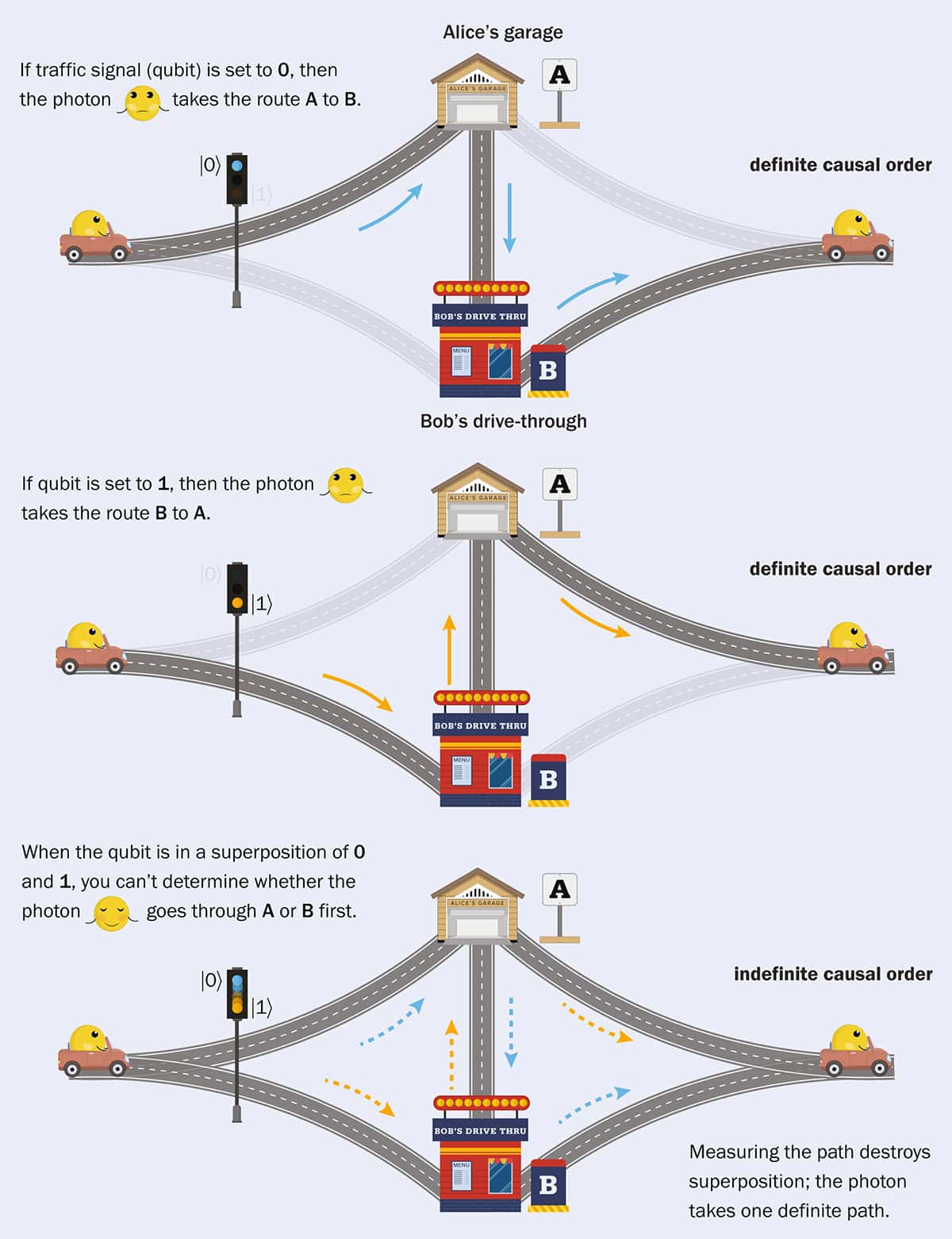
Moving on to more practical ICO experiments, physicists have already built and tested light-based quantum switches in the lab. Instead of having the position of the star determining whether Alice or Bob go first, the causal order is determined by a two-level quantum state – which can have a value of 0 or 1. If this control state is 0, then Alice goes first and if the control state is 1, then Bob goes first. Crucially, when the control state is in a superposition of 0 and 1 the system shows indefinite causal order (see figure 1).
In this illustration of a quantum switch a photon (driving a car) can follow two different paths, each with a different causal order. One path (top) leads to Alice’s garage followed by a visit to Bob’s drive thru. The second path (middle) visits Bob first, and then Alice. The path taken by the photon is determined by a control qubit that is represented by a traffic light. If the value of the qubit is “0” then the photon visits Alice First; if the qubit is “1” then the photon visits Bob first. Both of these scenarios have definite causal order.
However, the control qubit can exist in a quantum superposition of “0” and “1” (bottom). In this superposition, the path followed by the photon – and therefore the temporal order in which it visits Alice and Bob – is not defined. This is an example of indefinite causal order. Of course, any attempt to identify exactly which path the photon goes through initially will destroy the superposition (and therefore the ICO) and the photon will take only one definite path.
The first such quantum switch was created by in 2015 by Lorenzo Procopio (now at Germany’s University of Paderborn) and colleagues at the Vienna Center for Quantum Science and Technology (Nat. Comms6, 7913). Their quantum switch involves firing a photon at a beam splitter, which puts the photon into a superposition of a photon that has travelled straight through the splitter (state 0) and a photon that has been deflected by 90 degrees (state 1). This spatial superposition is the control state of the quantum switch, playing the role of the star in the gravitational quantum switch.
State 0 photons first travel to an Alice apparatus where a polarization rotation is done in a specific direction (say X). Then the photons are sent to a Bob apparatus where a non-commuting rotation (say Z) is done. Conversely, the photons that travel along the state 1 path encounter Bob before Alice.
Finally, the state 0 and state 1 paths are recombined at a second beamsplitter, which is monitored by two photon-detectors. Because Alice-then-Bob has a different effect on a photon than does Bob-then-Alice, interference can occur between recombined photons. This interference is studied by systematically changing certain aspects of the experiment. For example, by changing Alice’s direction of rotation or the polarization of the incoming photons.
In 2017 quantum-information researcher Giulia Rubino, then at the Vienna Center for Quantum Science and Technology, teamed up with Procopia and colleagues to verify ICO in their quantum switch using a “causal witness” (Sci. Adv. 3 e1602589). This involves doing a specific set of experiments on the quantum switch and calculating a mathematical entity (the causal witness) that reveals whether a system has definite or indefinite causal order. Sure enough, this test revealed that their system does indeed have ICO. Since then, physicists working in several independent labs have successfully created their own quantum switches.
Computational speed up?
While this effect might still seem somewhat obscure, in 2019, an international team led by the renowned Chinese physicist Jian-Wei Pan showed that a quantum switch can be very useful for doing computations that are distributed between two parties (Phys. Rev. Lett. 122 120504). In such a scenario a string of data is received and then processed by Alice, who then passes the results on to Bob for further processing. In an experiment using photons, they showed that ICO delivers an exponential speed-up of the rate at which longer strings are processed – compared to a system with no ICO.
Physicists are also exploring if ICO could be used to enhance quantum metrology. Indeed, recent calculations by Oxford University’s Giulio Chiribella and colleagues suggest that it could lead to a significant increase in precision when compared to techniques that involve states with definite causal order (Phys. Rev. Lett.124 190503).
While other applications could be possible, it is often difficult to work out whether ICO offers the best solution to a specific problem. For example, physicists had thought a quantum switch offered an advantage when it comes to communicating along a noisy channel, but it turns out that some configurations of Alice and Bob with definite causal order were just as good as an ICO.
Beyond the quantum switch, there are other types of circuits that would display ICO. These include “quantum circuits with quantum control of causal order”, which have yet to be implemented in the lab because of their complexity.
But despite the challenges in creating ICO systems and proving that they outperform other solutions, it looks like ICO is set to join ranks of other weird phenomena such as superposition and entanglement that have found practical applications in quantum technologies.
The first-ever detection of gravitational waves was made by LIGO in 2015 and since then researchers have been trying to understand the physics of the black-hole and neutron-star mergers that create the waves. However, the physics is very complicated and is defined by Albert Einstein’s general theory of relativity.
Now Jiaxi Wu, Siddharth Boyeneni and Elias Most at the California Institute of Technology (Caltech) have addressed this challenge by developing a new formulation of general relativity that is inspired by the equations that describe electromagnetic interactions. They show that general relativity behaves in the same way as the gravitational inverse square law described by Isaac Newton more than 300 years ago. “This is a very non-trivial insight,” says Most.
One of the fascinations of black holes is the extreme physics they invoke. These astronomical objects pack so much mass into so little space that not even light can escape their gravitational pull. Black holes (and neutron stars) can exist in binary systems in which the objects orbit each other. These pairs eventually merge to create single black holes in events that create detectable gravitational waves. The study of these waves provides an important testbed for gravitational physics. However, the mathematics of general relativity that describe these mergers is very complicated.
Inverse square law
According to Newtonian physics, the gravitational attraction between two masses is proportional to the inverse of the square of the distance between them – the inverse square law. However, as Most points out, “Unless in special cases, general relativity was not thought to act in the same way.”
Over the past decade, gravitational-wave researchers have taken various approaches including post-Newtonian theory and effective one-body approaches to better understand the physics of black-hole mergers. One important challenge is how to model parameters such as orbital eccentricity and precession in black hole systems and how best to understand “ringdown”. The latter is the process whereby a black hole formed by a merger emits gravitational waves as it relaxes into a stable state.
The trio’s recasting of the equations of general relativity was inspired by the Maxwell equations that describe how electric and magnetic fields leapfrog each other through space. According to these equations, the forces between electric charges diminish according to the same inverse square law as Newton’s gravitational attraction.
Early reformulations
The original reformulations of “gravitoelectromagnetism” date back to the 90s. Most explains how among those who did this early work was his Caltech colleague and LIGO Nobel laureate Kip Thorne, who exploited a special mathematical structure of the curvature of space–time.
“This structure mathematically looks like the equations governing light and the attraction of electric charges, but the physics is quite different,” Most tells Physics World. The gravito-electric field thus derived describes how an object might squish under the forces of gravity. “Mathematically this means that the previous gravito-electric field falls off with inverse distance cubed, which is unlike the inverse distance square law of Newtonian gravity or electrostatic attraction,” adds Most.
Most’s own work follows on from previous studies of the potential radio emission from the interaction of magnetic fields during the collision of neutron stars and black holes from which it seemed reasonable to then “think about whether some of these insights naturally carry over to Einstein’s theory of gravity”. The trio began with different formulations of general relativity and electromagnetism with the aim of deriving gravitational analogues for the electric and magnetic fields that behave more closely to classical theories of electromagnetism. They then demonstrated how their formulation might describe the behaviour of a non-rotating Schwarzschild black hole, as well as a black hole binary.
Not so different
“Our work says that actually general relativity is not so different from Newtonian gravity (or better, electric forces) when expressed in the right way,” explains Most. The actual behaviour predicted is the same in both formulations but the trio’s reformulation reveals how general relativity and Newtonian physics are more similar than they are generally considered to be. “The main new thing is then what does it mean to ‘observe’ gravity, and what does it mean to measure distances relative to how you ‘observe’.”
Alexander Phillipov is a black-hole expert at the University of Maryland in the US and was not directly involved with Most’s research. He describes the research as “very nice”, adding that while the analogy between gravity and electromagnetism has been extensively explored in the past, there is novelty in the interpretation of results from fully nonlinear general relativistic simulations in terms of effective electromagnetic fields. “It promises to provide valuable intuition for a broad class of problems involving compact object mergers.”
“Picture the world of Avatar, where glowing plants light up an entire ecosystem,” describes Shuting Liu of South China Agricultural University in Guangzhou.
Instead of coaxing cells to glow through genetic modification, the team instead used afterglow phosphor particles – materials similar to those found in glow-in-the-dark toys – that can absorb light and release it slowly over time.
The researchers then injected the particles into succulents, finding that they produced a strong glow, thanks to the narrow, uniform and evenly distributed channels within the leaf that helped to disperse the particles.
After a couple of minutes of exposure to sunlight or indoor LED light, the modified plants glowed for up to two hours. By using different types of phosphors, the researchers created plants that shine in various colours, including green, red and blue.
The team even built a glowing plant wall with 56 succulents, which was bright enough to illuminate nearby objects.
“I just find it incredible that an entirely human-made, micro-scale material can come together so seamlessly with the natural structure of a plant,” notes Liu. “The way they integrate is almost magical. It creates a special kind of functionality.”
An astrophysics PhD student from County Armagh in Northern Ireland has combined his passion for science with Gaelic football to help his club achieve a historic promotion.
Eamon McGleenan plays for his local team – O’Connell’s GAC Tullysaran – and is a PhD student at Queen’s University Belfast, where he is a member of the Predictive Sports Analytics (PSA) research team, which was established in 2023.
McGleenan and his PhD supervisor David Jess teamed up with GAC Tullysaran to investigate whether data analysis and statistical techniques could improve their training and results.
Over five months, the Queen’s University researchers took over 550 million individual measurements from the squad, which included information such as player running speed, accelerations and heart rates.
“We applied mathematical models to the big data we obtained from the athletes,” notes McGleenan. “This allowed us to examine how the athletes evolved over time and we then provided key insights for the coaching staff, who then generated bespoke training routines and match tactics.”
The efforts immediately paid off as in July GAC Tullysaran won their league by two points and were promoted for the first time in 135 years to the top-flight Senior Football League, which they will start in March.
“The statistical insight provided by PSA is of great use and I like how it lets me get the balance of training right, especially in the run-up to match day,” noted Tullysaran manager Pauric McGlone, who adds that it also provided a bit of competition in the squad that ensured the players were “conditioned in a way that allows them to perform at their best”.
Physicists in Germany say they have measured the correlated behaviour of atoms in molecules prepared in their lowest quantum energy state for the first time. Using a technique known as Coulomb explosion imaging, they showed that the atoms do not simply vibrate individually. Instead, they move in a coupled fashion that displays fixed patterns.
According to classical physics, molecules with no thermal energy – for example, those held at absolute zero – should not move. However, according to quantum theory, the atoms making up these molecules are never completely “frozen”, so they should exhibit some motion even at this chilly temperature. This motion comes from the atoms’ zero-point energy, which is the minimum energy allowed by quantum mechanics for atoms in their ground state at absolute zero. It is therefore known as zero-point motion.
To image the molecular fragments generated by the explosion, the researchers used a customized version of a COLTRIMS reaction microscope. This approach allowed them to reconstruct the molecule’s original structure.
From this reconstruction, the researchers were able to show that the atoms do not simply vibrate individually, but that they do so in correlated, coordinated patterns. “This is known, of course, from quantum chemistry, but it had so far not been measured in a molecule consisting of so many atoms,” Jahnke explains.
Data challenges
One of the biggest challenges Jahnke and colleagues faced was interpreting what the microscope data was telling them. “The dataset we obtained is super-rich in information and we had already recorded it in 2019 when we began our project,” he says. “It took us more than two years to understand that we were seeing something as subtle (and fundamental) as ground-state fluctuations.”
Since the technique provides detailed information that is hidden to other imaging approaches, such as crystallography, the researchers are now using it to perform further time-resolved studies – for example, of photochemical reactions. Indeed, they performed and published the first measurements of this type at the beginning of 2025, while the current study (which is published in Science) was undergoing peer review.
“We have pushed the boundaries of the current state-of-the-art of this measurement approach,” Jahnke tells Physics World, “and it is nice to have seen a fundamental process directly at work.”
For theoretical condensed matter physicist Asaad Sakhel at Balqa Applied University, Jordan, who was not involved in this study, the new work is “an outstanding achievement”. “Being able to actually ‘see’ zero-point motion allows us to delve deeper into the mysteries of quantum mechanics in our quest to a further understanding of its foundations,” he says.
Can artificial intelligence predict future research directions in quantum science? Listen to this episode of the Physics World Weekly podcast to discover what is already possible.
My guests are Mario Krenn – who heads the Artificial Scientist Lab at Germany’s Max Planck Institute for the Science of Light – and Felix Frohnert, who is doing a PhD on the intersection of quantum physics and machine learning at Leiden University in the Netherlands.
Frohnert, Krenn and colleagues published a paper earlier this year called “Discovering emergent connections in quantum physics research via dynamic word embeddings” in which they analysed more than 66,000 abstracts from the quantum-research literature to see if they could predict future trends in the field. They were particularly interested in the emergence of connections between previously isolated subfields of quantum science.
We chat about what motivated the duo to use machine learning to study quantum science; how their prediction system works; and I ask them whether they have been able to predict current trends in quantum science using historical data.
Their paper appears in the journal Machine Learning Science and Technology. It is published by IOP Publishing – which also brings you Physics World. Krenn is on the editorial board of the journal and in the podcast he explains why it is important to have a platform to publish research at the intersection of physics and machine learning.