Read more on IOPscience

How to make new materials by predicting their universal electronic structure

Historically, the majority of studies in condensed matter physics have focused on Hermitian systems – closed systems that conserve energy. However, in reality, dissipative processes or non-equilibrium dynamics are commonly present and so real-world systems are anything but Hermitian.

Recently however people have begun to study non-Hermitian systems in detail and have found a range of interesting topological properties. The term topology was originally used to refer to a branch of mathematics describing geometric objects. Here, however, it means the study of the electron band structure in solids, as well as periodic motion more generally.

Topological arguments are often used to determine universal material properties such as conductivity or magnetic susceptibility. For example, topological insulators are insulating in the bulk but have conducting surface or edge states and can be used in a range of applications, such as quantum computing.

Previous work on non-Hermitian band topology has been restricted to one system at a time, or one property at a time. There’s been no way to link between materials or scenarios and no generalisation.

A research team formed of scientists from the Freie Universität Berlin, the Perimeter Institute, and Stockholm University have now brought everything together by using symmetry arguments to build a general, comprehensive theoretical framework for these exciting new systems.

Predictions made by the authors’ analysis will lead to a better understanding of condensed matter physics and hopefully to new developments in a range of fields including optics, acoustics, and electronics.

Read the full article

Homotopy, symmetry, and non-Hermitian band topology

Kang Yang et al 2024 Rep. Prog. Phys. 87 078002

How to make a motor the size of a molecule

A molecular machine is an assembly of molecular components that produces mechanical movements in response to specific stimuli, similar to everyday objects like hinges and switches.

The power of what can be accomplished with these machines in biology is huge. They are responsible for everything from muscle contraction to DNA replication.

Attaining the same precise control over molecular motion with artificial molecular machines is currently an active area of research.

Researchers from the August Chełkowski Institute of Physics have been studying one component of these machines – rotary molecular motors. As the name suggests, these machines convert chemical or electrochemical energy into mechanical work by rotating one part relative to another.

The team built their motors out of phenylene molecules within a solid crystal and studied them with a technique called broadband dielectric spectroscopy.

This measures how a material responds to a varying electrical field.  In addition to imaging rotational motion, it can detect interactions between the molecular machine and its environment.

The team found several key markers within their data that reflected the strength of these interactions and therefore how well the molecular rotors were able to rotate. Using these markers will be important in optimising the design of future molecular rotors and brings us one step closer towards artificial molecular machines.

Read the full article

Image of the solid-state rotary motion encoded in the dielectric response – IOPscience

M Rams-Baron et al 2024 Rep. Prog. Phys. 87 108002

How wavelike electrons produce quantum light

New techniques have recently allowed the study of the behaviour of electrons in a similar way to how photons are studied in traditional optics. This emerging area of research – called quantum electron optics – focuses on manipulating and controlling electron waves to create phenomena such as interference and diffraction.

These wavelike electrons are fundamentally quantum in nature. This means that they can emit light in unique ways when shaped and modulated by lasers.

In this work, the team found that the rate of light emission by electrons does not depend on the shape of the electron wave, while the quantum state of the emitted light does.

Essentially, this means that by changing the shape of the electron wave, they can control the characteristics of the light produced. The emitted light exhibits non-classical quantum properties, differing significantly from the light we encounter daily, which follows classical physics rules.

To produce a much stronger photon signal, the researchers also took advantage of superradiance, where multiple electrons emit light in a coordinated manner, resulting in a much stronger emission than the sum of individual emissions. Another purely quantum effect.

The excitement around this research is based on its potential to advance quantum computing and communication by providing new tools for controlling the many quantum states that are required to make them work.

It could also lead to the development of new light sources with special properties, useful in a whole range of scientific and technological applications.

Tracking the evolution of quantum topology

Quantum systems tend to become less “quantum-y” as they interact with their environment. So when developing a mathematical description, it’s usually simpler just to view them as being closed off from their surroundings.

But ‘open’ systems are more realistic and sometimes even more interesting. Open quantum systems can be modelled using the so-called Lindblad equation, which describes the quantum evolution with time as both energy and coherence are lost to the environment.

Scientists from Tsinghua University have expanded the Lindblad equation to track the time evolution in an open system of a quantum property that that has become the hottest topic in condensed-matter physics: topology. Topology has formed the basis of numerous exotic states of matter over the last few decades. Now researchers show that an open system can undergo a topological transition as a result of dissipation, or loss.

Read the full article

Symmetry-preserving quadratic Lindbladian and dissipation driven topological transitions in Gaussian states

Liang Mao et al 2024 Rep. Prog. Phys. 87 070501

Synchronising two clocks comes at a thermodynamic cost

Ensuring that different clocks are giving the same time is crucial to enable electronic systems to talk to each other. But what is the cost of this synchronisation at the thermodynamic level?

To answer this question, scientists from the East China Normal University in Shanghai studied two tiny resonating membranes inside an optical cavity. Such optomechanical systems can exhibit quantum properties even on a macroscopic scale, and so they’re an ideal platform for studying ultrasensitive metrology and nonequilibrium thermodynamics. Each of the membranes represented a nanomechanical clock, and the two could be synchronised by increasing their coupling strength by adding more light to the cavity. In this way, the team was able to measure the dependence of the degree of synchronisation on the overall entropy cost.

They hope that this experimental investigation will serve as a starting point to explore synchronisation in navigation-satellite and fibre-optic systems with the aim of improving clock performance.

Read the full article

Anomalous thermodynamic cost of clock synchronization

Cheng Yang et al 2024 Rep. Prog. Phys. 87 080501

Accounting for planetary density variations helps simulate the gravitational field

The Earth is not a perfect sphere. This makes very precise modelling of our planet’s gravitational field rather tricky. To simplify the maths, scientists can consider a so-called Brillouin sphere: the smallest planet-centred sphere that completely encloses the mass composing the planet. In the case of the Earth, the Brillouin sphere touches the Earth at a single point—the top of Mount Chimborazo in Ecuador. The gravitational field outside the sphere can be accurately simulated by combining a series of simple equations called a spherical harmonic expansion.

But does this still hold true for the field inside the Brillouin sphere, which by definition includes the planet’s surface? Scientists from Ohio State University and the University of Connecticut say “no”. The team presented an analytical and numerical study that demonstrates clearly how and why the spherical harmonic expansion leads to prediction errors.

However, all is not lost. Their ultra-accurate simulations of the gravity field offer guidance toward a new mathematical foundation of gravity modelling. An upgraded simulator, which accounts for density variations within planets, will allow rigorous testing of proposed alternative ways to represent the gravity field beneath the Brillouin sphere.

Periodic changes in celestial bodies give away the galaxy’s secrets

Periodic changes in celestial bodies provide astronomers with a great deal of information about the universe. Sporadic alterations in a star’s brightness could be a signature of it being part of a binary system or indicate the presence of an orbiting planet. And the periodic rotation of objects in the Kuiper Belt tells us about planet formation and the development of our solar system. But these changes are rarely perfectly regular, so astronomers have developed a range of statistical methods to characterize aperiodic observations.

Now, mathematical statisticians from North Carolina State University have compared the robustness of these various methods for the first time. The team investigated the success of four different methods using the same simulated data, and were able to develop a list of recommended usage and limitations that will be essential guidance for all observation astronomers.

Read the full article

A statistical primer on classical period-finding techniques in astronomy

Naomi Giertych et al 2024 Rep. Prog. Phys. 87 078401

New open-access journal AI for Science aims to revolutionize scientific discovery

AI for Science journal cover

Are you in the field of AI for science? Now, you have a new place to share your latest work to the world.  IOP Publishing has partnered with the Songshan Lake Materials Laboratory in China to launch a new diamond” open-access journal to showcase how artificial intelligence (AI) is driving scientific innovationAI for Science (AI4S) will publish high-impact original research, reviews and perspectives to highlight the transformative applications and impact of AI.

The launch of the interdisciplinary journal AI4S comes as AI technologies become increasingly integral to scientific research from drug discovery to quantum computing and materials science.

AI is one of the most dynamic and rapidly expanding areas of research so much so that in the last five years the topic has expanded by nearly ten times the rate of general scientific output.  

Gian-Marco Rignanese from École Polytechnique de Louvain (EPL) in Belgium, who is the editor-in-chief of Al4S, says he is “very excited” by AI’s transformative potential for science. “It is really disrupting the way research is being performed. AI excels at processing and analysing large volumes of data quickly and accurately,” he says. “This capability enables researchers to gain insights – or identify patterns – that were previously difficult or impossible to obtain.

Rignanese adds that AI is also accelerating simulations making them “closer to the real world” and large language models and neuro-linguistic programming are changing our way to apprehend the existing literature. “Generative AI holds a lot of promises,” he says.

Rignanese, whose research focuses on investigating and designing advanced materials for electronics, energy storage and energy production in which he uses first-principles simulations and machine learning, says that AI4S “not only targets high standards in terms of quality of the published research” but that it also recognizes the importance of sharing data and software.

The journal recognizes the rapid and multifaceted growth of AI. Notably, in 2025 both the chemistry and physics Nobel prizes went to the science of AI. Research funding is also increasing, with both the US Department of Energy (DOE) and National Science Foundation (NSF) allocating more resources to this field in 2025 than ever before.

In China, AI is emerging as a major priority in which the science community is poised to become a driving force in global development. Reflecting this, AI4S is co-led by editor-in-chief Weihua Wang from the Songshan Lake Materials Laboratory. Songshan Lake Materials Laboratory is a new and leading institute for advanced materials research and innovation that is preparing to focus intensively on AI in the near future.

“Our primary goal with AI for Science is to provide a global forum where scientists can share their cutting-edge research, innovative methodologies, and transformative perspectives,” says Wang The field of AI in scientific research is not only expanding but also evolving at an unprecedented pace, making it vital for professionals to connect and collaborate.”

Wang expressed his optimistic vision for the future of AI in scientific research. “We want AI for Science to be instrumental in creating a more connected and collaborative global community of researchers,” he adds. “Together, we can harness the transformative power of AI to address some of the world’s most pressing scientific challenges and make the field even more impactful.”

Wang notes that the inspiration behind the journal is the potential impact of AI on scientific discovery. “We believe that AI has the power to revolutionize the way research is conducted,” he says. “By providing a space for open dialogue and collaboration, we hope to enable scientists to leverage AI technologies more effectively, ultimately accelerating innovation and improving outcomes across various fields.”

The scope of AI4S is broad yet focused, catering to a wide array of interests within the scientific community. Wang explains that the journal covers various topics. These include: AI algorithms adapted for scientific applications; AI software and toolkits designed specifically for researchers; the importance of AI-ready datasets; and the development of embodied AI systems. These topics aim to bridge the gap between AI technology and its applications across disciplines like materials science, biology and chemistry.

AI4S is also setting new standards for author experience. Submissions are reviewed by an international editorial board together with the support of a 22-member advisory board composed of leading scientists and engineers. The journal also promises a rapid turnaround in which once accepted, articles are published within 24 hours and assigned a citable digital object identifier (DOI). In addition, from 2025 to 2027, all article publication charges are fully waived, paid for by the Songshan Lake Materials Laboratory.

AI4S joins a growing number of journals focused on machine learning and AI. This includes the IOP’s Machine Learning Series: Machine Learning: Science and Technology; Machine Learning: Engineering; Machine Learning: Earth; and Machine Learning: Health.

“AI is a new approach to science which is really exciting and holds a lot of promises,” adds Rignanese, “so I am convinced that there is room for a journal accompanying this new paradigm.”

For more information or to submit your manuscript, click here.

PhD student Ekaterina Shanina wins Early Career Researcher Award for PET phantom study

Ekaterina Shanina, a PhD student at the University of California, Davis, has won the Physics in Medicine & Biology Early Career Researcher Award for her research paper describing a novel brain phantom for positron emission tomography (PET).

Shanina’s study was chosen by Physics in Medicine & Biology’s editorial board as the “best paper” (based on the quality of scientific content and peer review ratings) in the journal’s Early Career Researcher Focus Collection 2024 – a programme established to support and highlight the work of emerging researchers in the medical physics and biomedical engineering community.

“The initiative recognises that early-career researchers often produce cutting-edge, high-impact work but may not yet have widespread visibility,” says Emma Harris, a guest editor on the collection. She explains that while the collection itself showcases a broad range of high-quality work, the award was introduced to further recognise an outstanding contribution from an early-career author – defined this year as someone who completed their PhD in 2018 or later.

“The award serves to highlight exceptional research that stands out for originality, rigour or impact,” says Harris, from the UK’s Institute of Cancer Research and Royal Marsden NHS Trust. “[It will] promote prestige and visibility to the awardee within the international research community, and provide a tangible form of encouragement and recognition that can support academic career progression.”

A new phantom for high-performance PET

In her award winning paper, PICASSO: a universal brain phantom for positron emission tomography based on the activity painting technique, Shanina describes a unique PET phantom called PICASSO and shows how it can be used to model realistic static and dynamic neuroimaging PET studies with excellent quantitative accuracy.

PET imaging offers an invaluable tool for studying the brain, prompting recent interest in developing advanced high-resolution PET scanners dedicated to brain imaging. Such developments create an associated requirement for appropriate imaging phantoms to evaluate and optimize scanner performance. The PICASSO phantom aims to meet these needs.

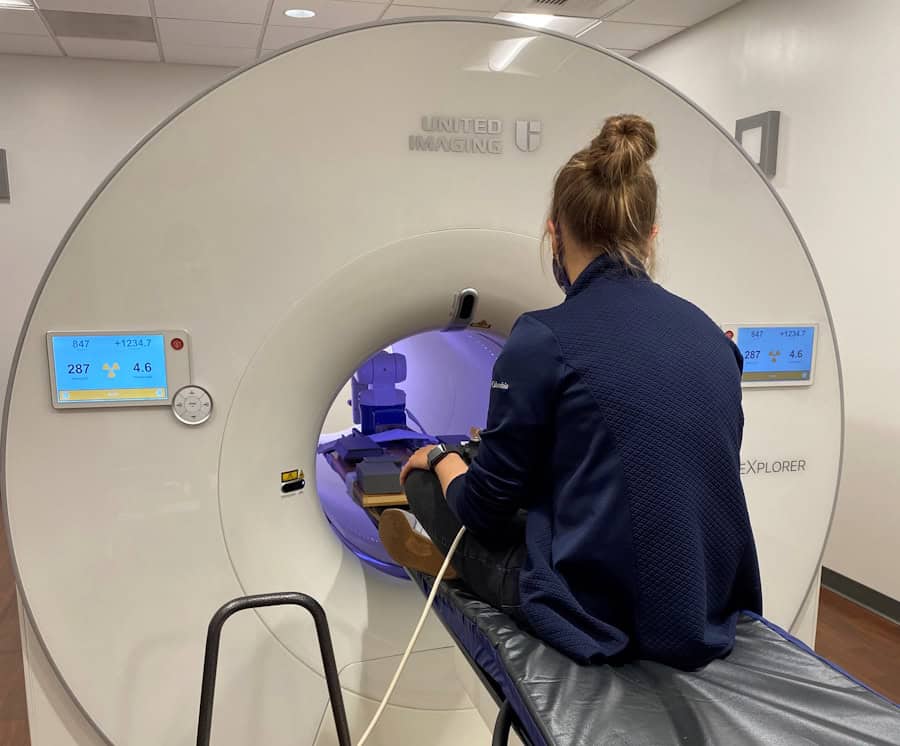
Ekaterina Shanina with the PICASSO phantom

“UC Davis has been collaborating with Yale University and United Imaging Healthcare to develop a new high-performance brain PET scanner called the NeuroEXPLORER,” Shanina explains. “This scanner has high spatial resolution, which renders the most commonly used anthropomorphic brain phantom – the Hoffman phantom – unsuitable for evaluating its performance. At the same time, we wanted to explore the activity painting technique to create this unconventional phantom for PET imaging.”

Most physical PET phantoms need to be filled with a radioactive solution, which means that they can only model one type of tracer and making changes to the phantom structure is challenging. Such phantoms also require walls to separate different regions, which interferes with quantitative image evaluation, and designs with complex internal cavities are hard to fill without residual air bubbles.

“Our PICASSO phantom overcomes many of these limitations,” says Shanina.

It works by moving a 22Na point source around within the field-of-view of a PET scanner to “paint” one high-statistics dataset. The motion of the radioactive source is controlled by a robotic arm and contrast levels are defined by computationally sampling the acquired dataset. This approach can efficiently generate phantoms with arbitrary static and dynamic activity distributions in the brain (or other body regions) using a single PET acquisition.

“PICASSO uses a single dataset acquired with a sealed point source to efficiently generate a variety of activity distributions of various complexities and with arbitrarily fine features,” Shanina explains. “There’s no need for cumbersome phantom preparation, there are no cold walls or air bubbles, and the data contain some of the scanner parameters that are difficult to model analytically. We can even use it to model dynamic studies, which is a very challenging task for conventional phantoms.”

Since the paper was published last year, Shanina and colleagues have extended the two-dimensional PICASSO phantom into a 3D version that can generate whole-brain images. “We are also working on an exciting new application for the phantom, using it to model different time-of-flight resolutions of PET scanners,” she says. “To our knowledge, you cannot do this with any other phantoms that are not simulations.”

Shanina tells Physics World that she is “honoured and humbled” to win the Early Career Researcher Award. “I am very happy that this work keeps attracting people’s attention and interest,” she says. “Of course, I don’t do this all by myself. I am very grateful to have Simon Cherry and Jinyi Qi as my advisors supporting and encouraging me on this journey.”

New mechanism explains behaviour of materials exhibiting giant magnetoresistance

Two distinctive features of materials known as quantum double-exchange ferromagnets are purely due to quantum spin effects and multiorbital physics, with no need for the lattice vibrations previously invoked to explain them. This theoretical result could lead to new insights into these technologically important materials, as it suggests that some of their properties may arise from interactions hitherto regarded as less important.

Quantum double-exchange ferromagnets have interested scientists since the late 1980s, when physicists led by Albert Fert and Peter Grünberg found that their electrical resistance depends strongly on the magnitude of an external magnetic field. This phenomenon is known as giant magnetoresistance (GMR), and its discovery led to an enormous increase in the storage capacity of modern hard-disk drives, which incorporate GMR structures into their magnetic field sensors. It also led, in 2007, to a Nobel Prize for Fert and Grünberg.

Modelling strategies

Despite these successes, however, physicist Jacek Herbrych of the Institute of Theoretical Physics at Wrocław University of Science and Technology in Poland, who led the new research effort, says that these materials remain somewhat mysterious. “They are theoretically complex, and even today, there is no exact solution to fully solve these systems,” he says.

The key question, Herbrych continues, is how Coulomb interactions between many individual electrons lead to the electron spins in these ferromagnets becoming aligned. “Physicists broadly distinguish two mechanisms,” he explains. “For insulating ferromagnets, the Goodenough-Kanamori rules (based on electron shell occupancy and geometrical arguments) can predict spin alignment. For metallic ferromagnets, the double-exchange mechanism is more appropriate.”

In this latter case, Herbrych explains, the electrons’ motion and the alignment of their spins are intrinsically linked, and the electrons often occupy multiple orbitals. This means they need to be modelled in a fundamentally different way.

The approach Herbrych and his colleagues took, which they describe in Rep. Prog. Phys., was conceptually simple, using a basic yet realistic model of interacting electrons to predict the quantum behaviour of electron spins. “In quantum mechanics, ‘simple’ can quickly become complex, however,” Herbrych notes. “Materials in which the double-exchange mechanism dominates typically exhibit multiorbital behaviour, as mentioned. A minimal model must therefore include electron mobility (or ‘itinerancy’), Coulomb interactions and orbital degrees of freedom.”

Two distinctive features

Herbrych and colleagues identified the two-orbital Hubbard-Kanamori model and the Kondo lattice model with interactions as fitting these requirements. They then used these models to explore two distinctive features of quantum double-exchange ferromagnets.

Both features involve magnons, which are collective oscillations of the materials’ spin magnetic moments. In basic “toy” models of ferromagnets, magnons exhibit a well-defined energy-momentum correspondence known as the dispersion relation. Quantum double-exchange ferromagnets, however, experience a phenomenon known as magnon mode softening: at short wavelengths, their magnons become nearly dispersionless, or momentum independent. “This implies that there are fundamental differences between long- and short-distance spin dynamics,” Herbrych says. “Magnons can travel over long distances but appear localized at short scales.”

The second distinctive feature is called magnon damping. This occurs when magnons lose coherence, meaning that the standard picture of spin flips propagating through the material’s lattice breaks down. “It was previously thought that Jahn-Teller phonons (lattice vibrations) were responsible for these features, and that a classical spin model with phonons would do, but our work challenges this view,” says Herbrych. “We show that these phenomena can arise purely from quantum spin effects and multiorbital physics, without requiring lattice vibrations.”

This is, he tells Physics World, “a remarkable result” as it suggests that some experimental features of quantum double-exchange ferromagnets may arise from interactions previously considered secondary.

Limitations and extensions

The researchers’ present work is restricted to one dimension, and they acknowledge that extending it to two or three dimensions will be a challenge. “Still, our approach offers a conceptual framework that can be approximately extended to higher dimensions,” Herbrych says. “The results not only provide insights into the physics of strongly correlated systems, but also into the interplay of competing phases, such as ferromagnetism, orbital order and superconductivity, observed in these materials.”

Copyright © 2026 by IOP Publishing Ltd and individual contributors