

Fancy some more? Check out our puzzles page.
Abdus Salam: Pakistan’s first (and so far only) physics Nobel prize-winner
The facts are simple enough.
Abdus Salam shared the 1979 Nobel Prize in Physics with Sheldon Glashow and Steven Weinberg for “their contributions to the theory of the unified weak and electromagnetic interaction between elementary particles, including, inter alia, the prediction of the weak neutral current”.
What Salam had done was to incorporate the Higgs mechanism – co-discovered by his colleague at Imperial College London Tom Kibble – into electroweak theory, which unifies the electromagnetic and weak forces.
As the Imperial theorist Claudia de Rham said in a 2024 interview with Physics World, Salam’s work “changed the way we see the world by underlining the importance of symmetry and by showing how some forces – which may appear different – are actually linked”.
But Salam, who died in 1996 after suffering from a cruel neurodegnerative disease, did more than unify the weak and electromagnetic interactions. He also became the first – and so far the only – person from Pakistan to win a science-related Nobel prize, yet for a long time remained overlooked in his homeland.
Great minds
Salam was born on 29 January 1926 in the Punjabi city of Jhang in what was then British India. A child genius, he studied mathematics at Government College, Lahore, completing his master’s degree in 1946 with record marks (getting 765/850 or 90%).
Later that year Salam moved to the UK after winning a scholarship to study at St John’s College, Cambridge, studying initially mathematics and then physics, gaining a double first-class honours in 1949.
Back home, India was in turmoil, with a growing demand for independence from the British, and the Muslims seeking a homeland for themselves.
How long did it take for countries to claim a Nobel laureate?
Read more

As a Muslim himself, Salam would no doubt have celebrated when Pakistan was created during the partition of India, with the country coming into existence at the stroke of midnight (0.00 a.m.) on 14 August 1947.
After completing his PhD in quantum electrodynamics at Cambridge in 1951, Salam returned to Pakistan, taking up a teaching post at Government College, keen to establish a research base in the fledgling country. But lacking journals, colleagues or any proper scientific infrastructure in Pakistan, Salam realized he would have to go abroad again.
“Either I must leave my country or leave physics,” he said. “And with great anguish I choose to leave my country.”
In 1954 Salam went back to Cambridge for three years before appointed a professor of applied mathematics at Imperial in 1957. He later switched to Imperial’s physics department, where he set up a renowned theoretical-physics group that he led for much of the rest of his life.
In 1964 Salam also founded the International Centre for Theoretical Physics (ICTP) in Trieste, Italy, to help support physicists from developing nations.
Home at heart
But Pakistan was always in his heart. Salam served for 13 years as presidential science adviser in Pakistan and in the 1970s also played a slighly murky role in the country’s nuclear-weapons programme.
Upon winning a Nobel prize in 1979, Pakistan had existed for only 32 years, meaning it, along with Austria, is the joint 13th quickest nation to win a Nobel Prize in Physics, according to our Physics World infographic.
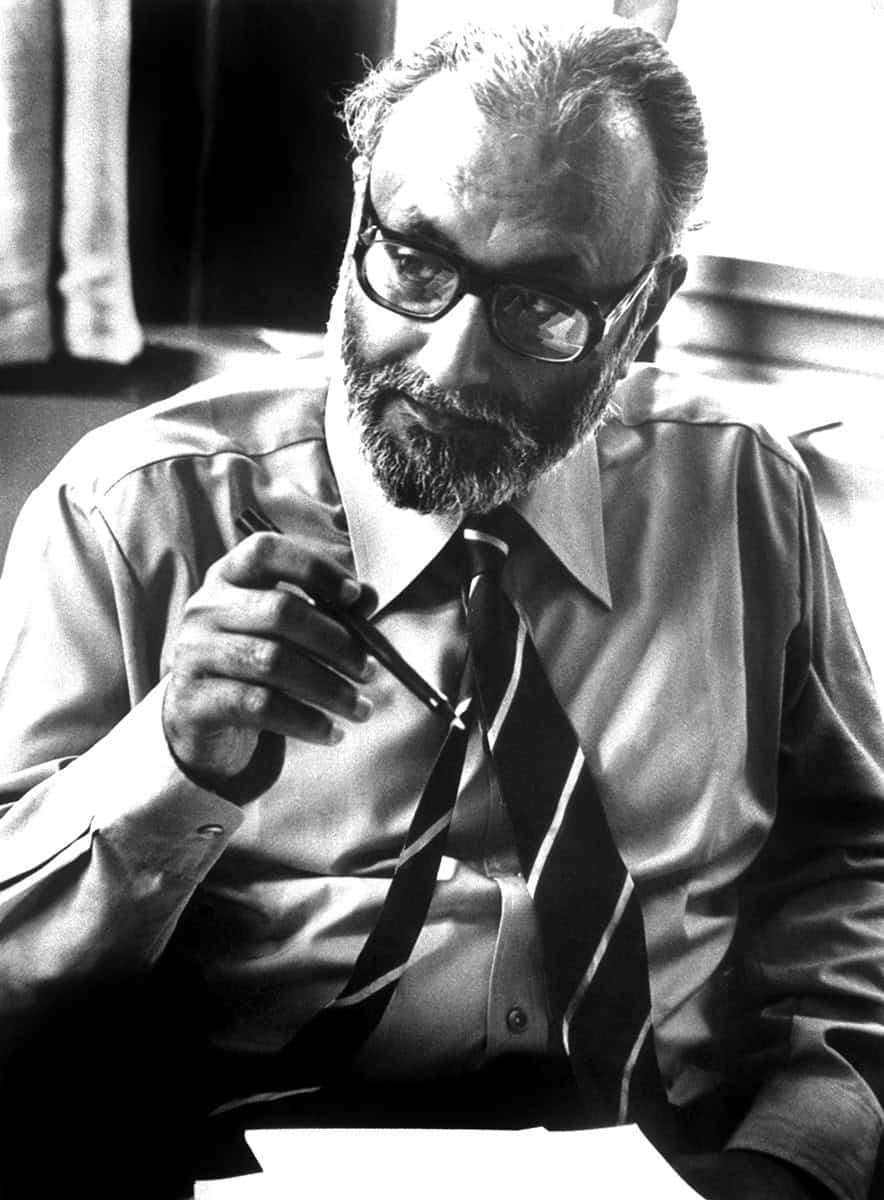
At the official Nobel banquet in Stockholm on 10 December 1979, Salam thanked the Nobel Foundation and the Royal Swedish Academy of Sciences. “Pakistan,” he declared, “is deeply indebted to you for this.”
Yet back home, little was made of Salam’s impressive award. Most Pakistanis are Sunnis but Salam was an Ahmadi, part of a minor Islamic movement founded in the late 19th century by the religious leader Mirzā Ghulām Ahmad (1835–1908).
Such was the opposition in Pakistan to the Ahmadis that in 1974 the country’s parliament declared them non-Muslims – heretics essentially – and the constitution was altered to reflect that fact.
Pakistan’s decision to outcast the Ahmadis profoundly affected Salam. As he wrote in his diary: “Declared non Muslim. Cannot cope.” Having previously been largely a “cultural Muslim”, Salam now saw his religious beliefs re-awakened.
Belatedly, Pakistan did offer some formal recognition in the form of a two rupee stamp in 1998, but it is surprising the country has not done much more. In 2016 Physics World reported that then Pakistani prime minister Nawaz Sharif was going to rename the National Centre for Physics at Quaid-i-Azam University in Islamabad as the Professor Abdus Salam Centre for Physics – but, as far as I can tell, that has not taken place.
Imperial, in contrast, renamed its main library in honour of Salam in 2023 and this year has been celebrating the centenary of his birth. The ICTP was also renamed after him in 1997.
A few years ago Zakir Thaver and Omar Vandal produced a wonderful documentary film called Salam: the First ****** Nobel Laureate. Directed by the physicist Anand Kamalakar, it explores in detail the strange relationship between Salam and Pakistan, which surely should have done more to honour its greatest physicist.
I can’t imagine other countries doing so little for their first Nobel prize winners as Pakistan has for Salam.

SmarAct proudly supports Physics World‘s Nobel Prize coverage, advancing breakthroughs in science and technology through high-precision positioning, metrology and automation. Discover how SmarAct shapes the future of innovation at smaract.com.
Word wave puzzle no.9
Here’s how the game works:
-
- Enter a word guess – in this game the word has six letters.
- After submitting your guess, each letter in the guessed word is coloured to provide feedback:
- Green: The letter is correct and is in the correct position in the target word.
- Yellow: The letter is correct but is in the wrong position in the target word.
- Grey: The letter is not in the target word at all.
- Using this colour feedback, refine your next guess.
- Continue guessing until you correctly identify the hidden word(s) or run out of attempts.
If you want a clue to the answer, read the article here.
Fancy some more? Check out our puzzles page.
C V Raman: the physicist with a ‘Himalayan ego’ who went to Stockholm convinced he’d win a Nobel prize
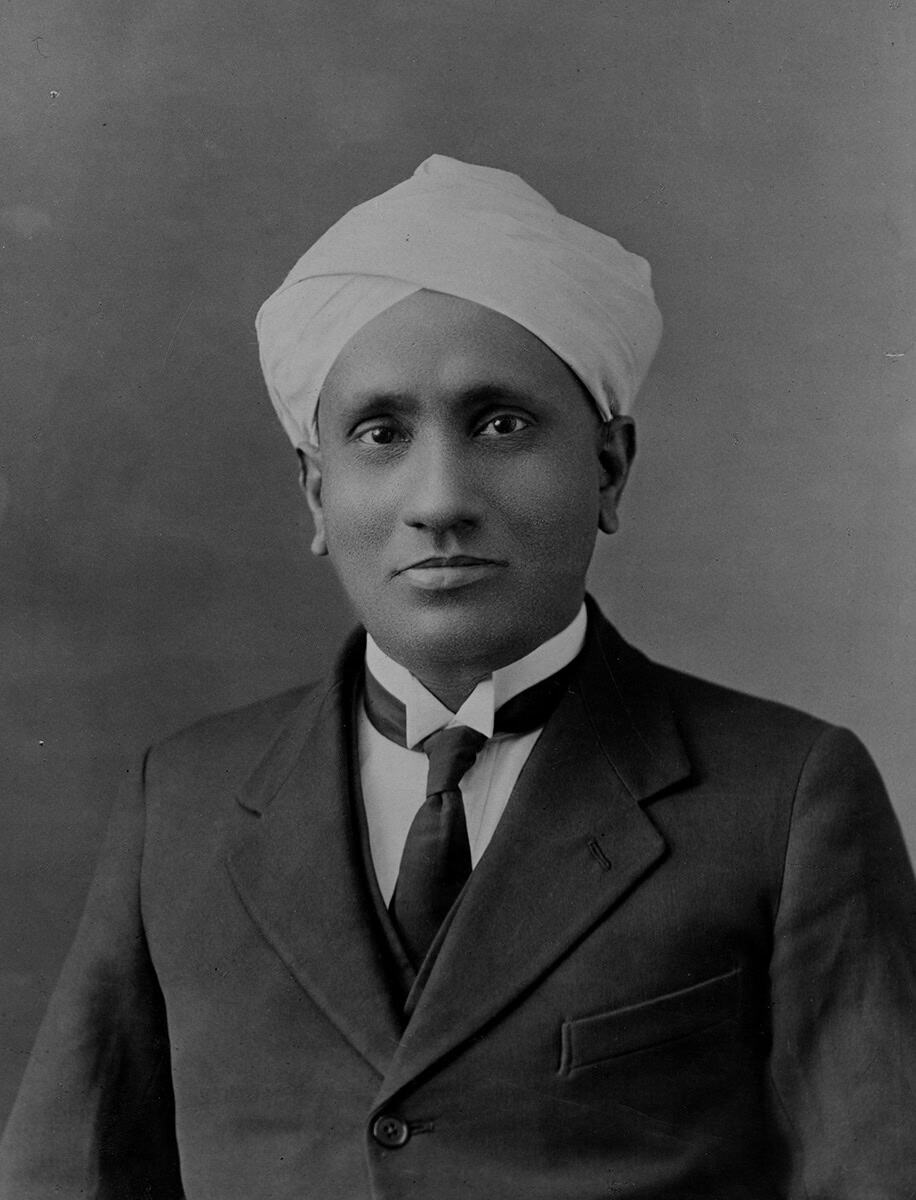
How confident, or perhaps delusional, do you have to be to travel to Stockholm because you’re so certain you’ll be awarded a Nobel prize? Most of us wouldn’t have the time, money or self-belief to go to Sweden and hang out at the Royal Swedish Academy of Sciences on the off-chance that we might win. But one person who did just that was the Indian physicist Chandrasekhara Venkata (C V) Raman in 1930.
Back in those days, travelling from India to Sweden wasn’t a case of jumping on a jet plane, but involved a long, two-month journey by sea. So if he wanted to arrive in Stockholm in time for the award ceremony on 10 December 1930, Raman knew he couldn’t wait until the prize was formally announced in mid-November to set sail. In July 1930 he therefore booked passage for himself and his wife, the couple arriving in Stockholm on 9 December of that year.
Raman’s audacity, belief and the arduous journey paid off. He was duly awarded the 1930 Nobel Prize in Physics “for his work on the scattering of light and for the discovery of the effect named after him”, namely Raman scattering. In doing so, Raman became the first person from India to win a scientific Nobel prize – the poet, playwright and musician Rabindranath Tagore having previously won the 1913 Nobel Prize in Literature.
Obsessive nature
Born on 7 November 1888 in the city of Thiruchchirappalli in Tamil Nadu, Raman was a child prodigy, who at 16 came top in physics at the University of Madras and published his first research paper aged just 18. Appointed a professor of physics at the University of Calcutta in 1913, Raman had a long obsession with winning a Nobel prize. In 1924, upon being elected a fellow of the Royal Society, he was asked during the award ceremony what was next in line for him. “The Nobel prize of course!” he replied.
The discovery that bagged Raman the coveted prize in fact began on another sea voyage
The discovery that bagged him the coveted prize in fact began on another sea voyage. In 1921 Raman was travelling back from Southampton to Bombay (now Mumbai) on the SS Narkunda, having taken part in the Second Congress of the Universities of the Empire in Oxford. Rather than lounging on the sun deck or drinking in the bar, Raman spent the 15-day journey examining and analysing the deep blue colours of the Mediterranean, Red and Arabian seas with his pocket Nicol prisms, a small telescope and a diffraction grating.
In fact, Raman did more than just take data. While on board, he wrote up his findings in a short letter that he mailed to the journal Nature while the ship was docked at Aden in Yemen. Published on 20 October 1921, it gives Raman’s address as “SS Narkunda, near Aden” (Nature 108 242). He then wrote another paper to Nature (108 367) titled “The colour of the sea”, this time with the byline “SS Narkunda, Bombay Harbour”.
The spectrum of blue colours of the vast sea fascinated Raman and made him question the previous belief, primarily from the work by Lord Rayleigh, that the colour is simply due to the reflection of the sky – and has nothing to do with the colour of the water itself. Raman challenged this notion in his follow-up Nature paper, which was published on 17 November 1921.

“It was abundantly clear from the observations,” he writes, “that the blue colour of the deep sea is a distinct phenomenon in itself.” Raman believed that light diffracts as it passes through the water and concluded: “An interesting possibility that should be considered is that the diffracting particles may, at least in part, be the molecules of the water themselves.”
This curiosity led him to a series of experiments over the next few years, primarily carried out by his students at Calcutta University, culminating in the discovery that light changes its wavelength and energy when it passes through any material. The change in wavelength and energy, in fact, is a fingerprint of the material itself.
His discovery of what became known as the Raman effect is what eventually won him his most cherished recognition – the 1930 Nobel Prize in Physics. One of the many applications of Raman’s discovery is Raman spectroscopy, which uses the scattering of laser light to establish the chemical make-up of a material and forms the basis of airport security scanners.
Indian impact
Raman’s Nobel prize was significant not just for the scientific advancements that his discovery enabled, but also for the far-reaching impact it engendered in India, where opposition to the British Raj was gathering speed. In fact, he won the award less than a year after the declaration of Purna Swaraj – complete independence – on 26 January 1930 in a session of the Indian National Congress in Lahore.
For a country reeling under colonial rule and fighting for its identity, Raman’s Nobel prize could not have come at a better time to instil hope and aspirations to millions of people around the country. In fact, he holds the honour of being the first physicist outside western Europe or the US to win the Nobel Prize in Physics.
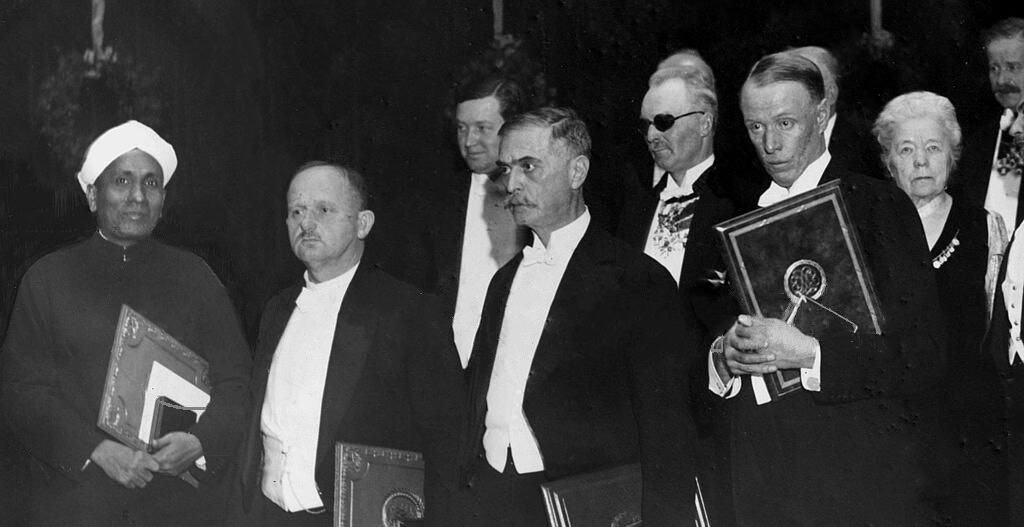
Raman was fully aware of the impact that the prize would have in India, where research was far less developed than that enjoyed by his counterparts in, say, Cambridge, Göttingen or Copenhagen. In 1929 he therefore hesitantly wrote a letter to the Danish Nobel-prize-winner Niels Bohr, asking for his “influential support” for the 1930 Nobel prize. The request of such “personal character”, he explained, was only because he believed that Bohr would “sympathize with the scientific aspirations of India”.
Unbeknownst to Raman, Bohr had already nominated him for a Nobel prize in 1929 – that year’s prize going to Louis de Broglie for wave–particle duality – and he did so again in 1930. We now know a total of 10 different people nominated Raman for that year’s prize, including de Broglie as well as Ernest Rutherford and Charles Wilson.
Raman’s research and notoriety led to many students being attracted to Calcutta, with the physics department becoming a centre of world-class research
Raman’s research and notoriety led to many students being attracted to Calcutta (now Kolkata), with the physics department becoming a centre of world-class research despite its small size and the lack of an established scientific culture and infrastructure in India. Other leading physicists to have worked there include the astrophysicist Meghnad Saha and the theorist Satyendra Nath Bose in what some have touted as a “golden era” for Indian science.
Sadly, it ended prematurely a few years after Raman’s Nobel prize due to conflicts between these three leading scientists. This was partly due to parochialism and partly, as his biographer, the condensed-matter physicist Ganeshan Venkataraman famously put it, Raman’s “Himalayan ego and sharp tongue”.
Moving on
In 1933 Raman left Calcutta, becoming the first Indian director of the Indian Institute of Science (IISc, earlier the Tata Institute of Science) in Bangalore (now Bengaluru). Rutherford, when asked by the institute’s council as to who should replace the outgoing director Martin Forster, had made it clear there was no need to seek directors in Britain when India had a “distinguished candidate in the shape of Raman”.
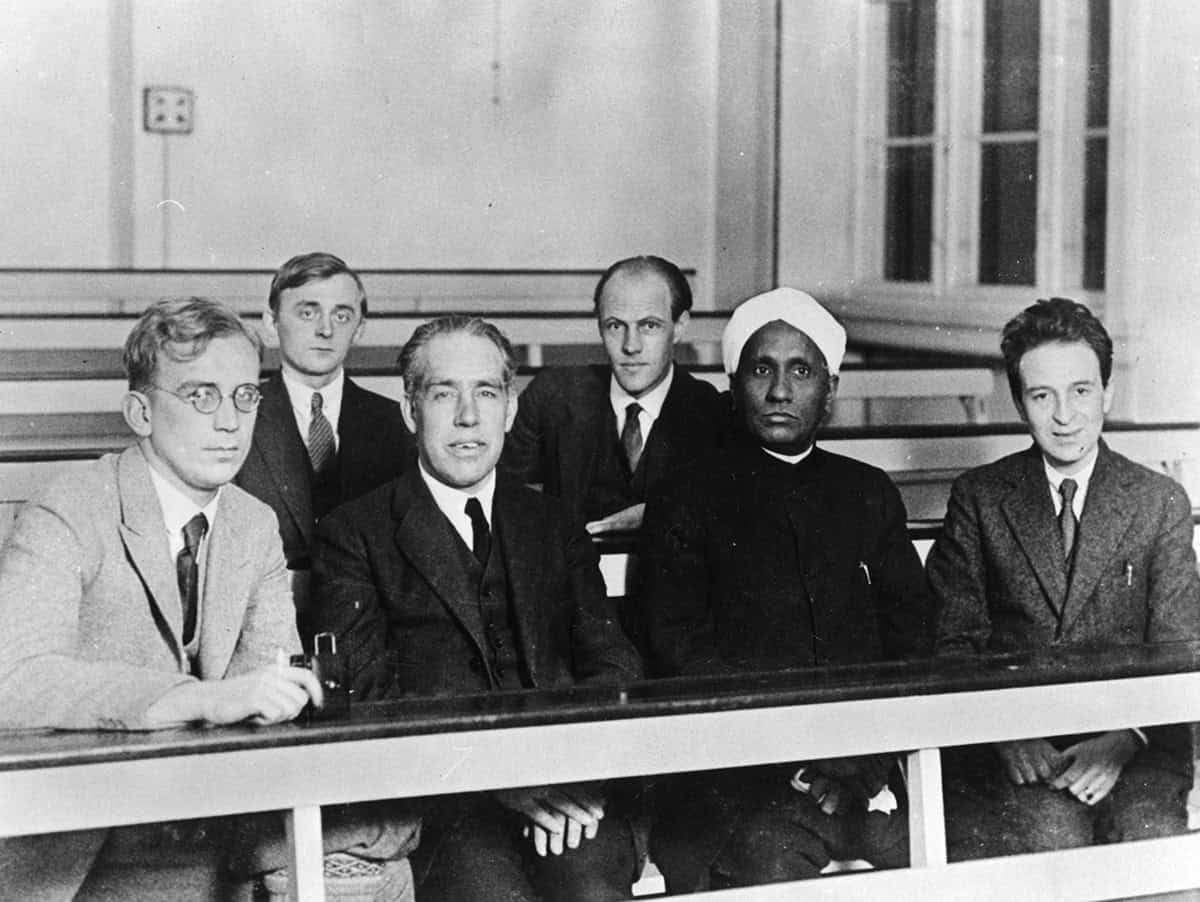
In 1934 he went on to found the Indian Academy of Science, which was significant in that it provided a way for researchers across the country to communicate and discuss research findings. Just as important, however, was the fact that membership of the academy was reserved exclusively for Indian scientists, effectively signalling an act of rebellion against the British.
Raman’s time at the IISc was controversial. On one occasion, he turned down the application for a research fellowship by a female student – the biochemist Kamala Sohonie – because he believed women were not competent to conduct research. Raman reversed his decision, albeit with humiliating conditions, after Sohonie staged a Gandhian-style protest (Satyagraha) outside his office.
Within three years, Raman was forced to resign from the directorship following a fallout with the council, primarily for allegations of bias towards physics research and overshadowing other areas of research of the institute. He remained a professor at the IISc until retiring in 1948. Later that year, he founded the Raman Research Institute with which he was actively involved until his death in 1970 at the age of 82.
Raman’s legacy
Despite his controversial past, Raman is still the flag-bearer of Indian physics, owing to the Nobel prize and the global recognition he enjoyed. India holds a National Science Day every year on 28 February to mark the occasion in 1928 when Raman and his associate Kariamanickam Srinivasa Krishnan announced their discovery of Raman scattering to the media. The work was reported in newspapers on 29 February and was formally published on 31 March 1928 in a paper entitled “A new type of secondary radiation” (Nature 121 502 ).
Almost a century on from his success, however, India has not yet produced another home-grown Nobel-prize-winning physicist. Raman’s nephew Subrahmanyan Chandrasekhar did share the 1983 Nobel Prize in Physics with William Fowler for his work on the evolution of stars, but he was based in the UK and then the US when the work for which he was recognized was carried out.
Raman’s divisive personality and sharp opinions turned more people against him than his ingenuity and scientific legacy ever won over
Sadly, Raman’s divisive personality and sharp opinions turned more people against him than his ingenuity and scientific legacy ever won over. His obsession with global recognition can be sensed from his reaction upon first receiving news of his Nobel prize, which came while he was en route to Stockholm. Learning of the award from his Calcutta collaborator Suri Bhagavantam, Raman’s first reaction was to ask if he was the sole awardee or whether he was to “share the bed with other strangers”.
Given his “Himalayan ego”, it should perhaps come as no surprise that Raman decided to travel to Stockholm on a whim. We do not have any documentation about what he thought or did on that two-month voyage. But for him, at least, it was a journey that was not wasted.
- Find out more from Preetish Kakoty about C V Raman’s life on the Physics World Weekly podcast.
SmarAct proudly supports Physics World‘s Nobel Prize coverage, advancing breakthroughs in science and technology through high-precision positioning, metrology and automation. Discover how SmarAct shapes the future of innovation at smaract.com.
Festival season finds Quantum Software Lab in high spirits
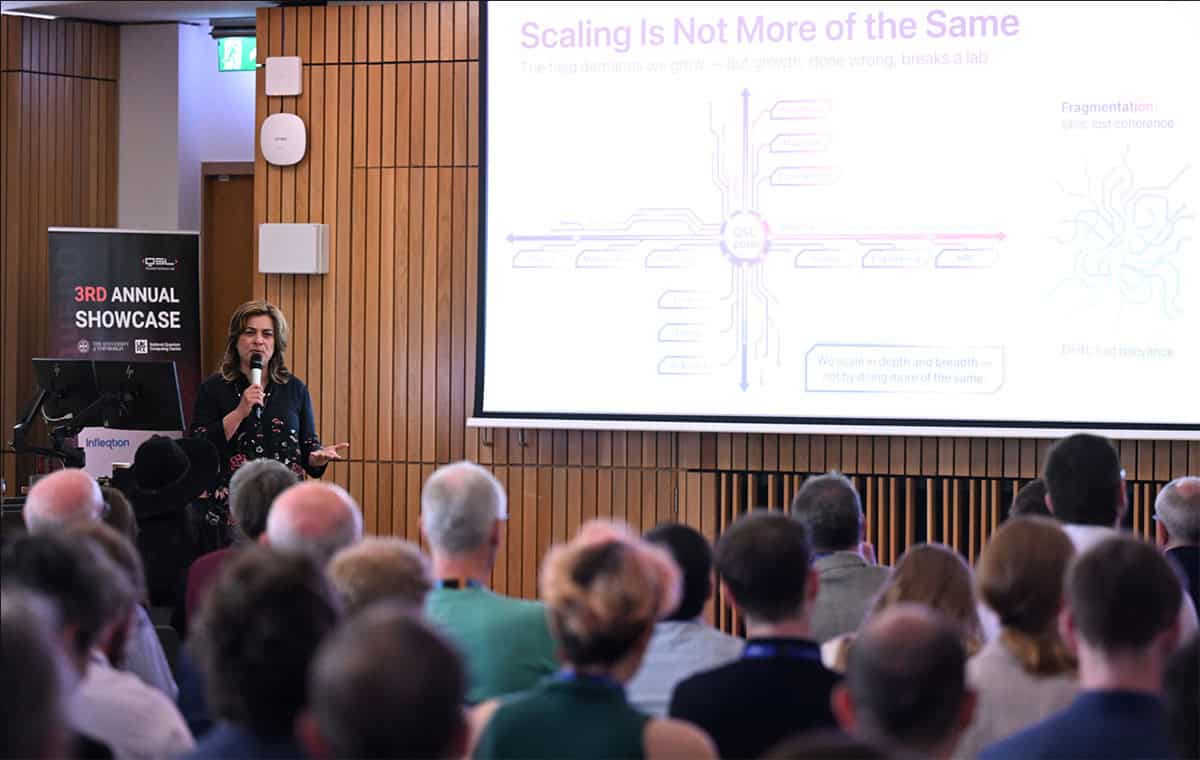
The Quantum Software Lab (QSL) at the University of Edinburgh is going from strength to strength. Buoyed by its strategic partnership with the UK’s National Quantum Computing Centre (NQCC), in just three years the lab has become a globally recognized hub for creating software solutions that generate practical value from emerging quantum computers. With more than 70 researchers working across applications, algorithms and the underpinning theory and software, the QSL is also poised to lead a £20m project that will drive the delivery of tools, methods and systems for useful quantum computing.
The growing momentum at the QSL has also provided the impetus for the Quantum Fringe, a festival of events that debuted in 2025 to mark UNESCO’s International Year of Quantum Science and Technology. Modelled on Edinburgh’s world-famous Fringe festival, the programme provides a showcase for quantum-inspired events that have been convened by different organizations for a diverse range of audiences.
“The Quantum Fringe belongs to everyone who takes part, whether they are researchers, scientists in government and industry, or students at university or school,” says Elham Kashefi, director of the QSL and chief scientist of the NQCC. “That’s the whole point: no-one can do this alone, and each of the 16 events in this year’s festival provided an opportunity for the community to come together.”
That cross-cutting ethos was evident in several collaborative workshops. As an example, a two-day event organized by the research hub for Integrated Quantum Networks (IQN) enabled scientists from different sectors and backgrounds to share expertise on the authentication requirements that will be needed to ensure the security of future quantum communications. Tutorial sessions enabled a broad spectrum of experts to engage meaningfully in technical discussions, while informal networking helped to establish new connections between the research and business communities.
Another workshop, this time organized by the QCi3 research hub, encouraged interactions between academics and industry experts by exploring the applications and integration challenges for quantum computing in the defence sector. Meanwhile, the aptly named TartanQEC workshop, organized by the Universities of Edinburgh and Strathclyde, welcomed more than 120 researchers from the UK and Europe to discuss practical methods for quantum error correction (QEC). Talks spanned hardware co-design, implementations, and software development, and the event was headlined with a keynote on QEC schemes for superconducting quantum computers by Andreas Wallraff of the ETH Zürich in Switzerland.
Building the ecosystem
Experts from start-up companies were involved too, with the QSL convening a workshop that brought together hardware vendors and the research community to discuss scalable frameworks for verifying and benchmarking the performance of rapidly evolving hardware architectures. Legal firm Simmons + Simmons offered start-up firms an insight into the legislation that can protect their core technology and guide their future growth plans, while the regular AIMday provided an opportunity for companies of all sizes to work with academics to explore a series of industry-relevant challenges. This year’s event was the largest yet, with more than 60 participants tackling such problems as using quantum optimization to design a multi-hub logistics network for the UK.
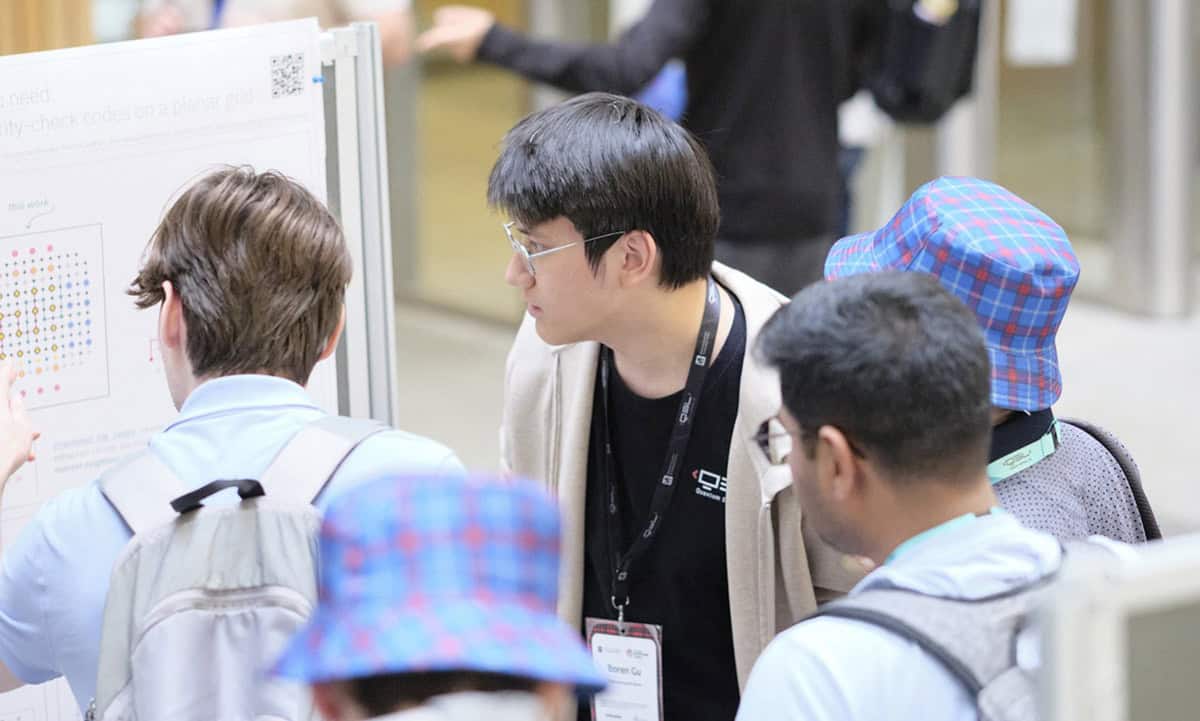
QSL also organized two educational events to inspire the next generation of quantum researchers. A three-day summer school enabled high-school students to find out what a research career might look like, learn the basics of quantum computing from practising scientists, and gain hands-on experience in coding techniques. Meanwhile, a week-long event offered postgraduate students and early-career researchers a deep-dive into quantum informatics within the stunning and peaceful surroundings provided by the Isle of Skye.
Reflecting the eclectic nature of the Edinburgh Fringe, the programme also featured an evening of music and poetry inspired by key concepts in quantum physics. Performed by Erika Andersson, a quantum researcher at Heriot-Watt University, along with computer scientist Ruth Aylett and a group of professional musicians, “Quantum Worlds” offered the audience a creative exploration of complex scientific ideas such as superposition, wave-particle duality, and quantum entanglement. The response was enthusiastic, with audience members commenting that the performance “helped to understand the science” and “made quantum physics feel more approachable”.
Making an impact
Among this multitude of events, the Quantum Fringe offered an opportunity for QSL to mark three years since its launch in 2023. In that time the team has grown from around 15 members to almost 100 researchers working across all facets of quantum software, ranging from foundational quantum theories through to the development of powerful quantum algorithms and real-world applications. “Quantum computing is almost always told as a hardware story, but a machine only matters if it can give you an answer that is useful and that can be trusted,” says Kashefi. “That is a software problem.”
The QSL’s anniversary event showcased some of its key achievements, and highlighted how the lab’s strategic partnership with the NQCC has shaped and enriched its research agenda. One particular benefit has been the opportunity for software specialists at the QSL to work directly with quantum hardware, with the NQCC now hosting seven testbed platforms based on all the leading qubit modalities.
“It is really important for us to build the engineering knowledge and skills needed to work with these machines,” says Caitlin Jones, a senior QSL researcher. “The hardware may not yet be perfect, but if we don’t try to use real devices we might come across unforeseen bottlenecks or miss opportunities that we might not have considered.”
As an example, PhD student Mario Herrero Gonzáles is investigating the use of quantum machine learning to generate new samples that are similar to an existing dataset. Herrero Gonzáles uses a classical computer to train the model and a quantum machine to generate the samples, with the aim of optimizing the quantum part of the solution to run on a neutral-atom platform from Infleqtion. “The Infleqtion team helped Mario to understand the timings of the gate operations and the sources of errors,” explains Jones. “That allowed him to reduce the noise by recompiling the programme to exploit the gate fidelity and connectivity offered by neutral-atom systems.”
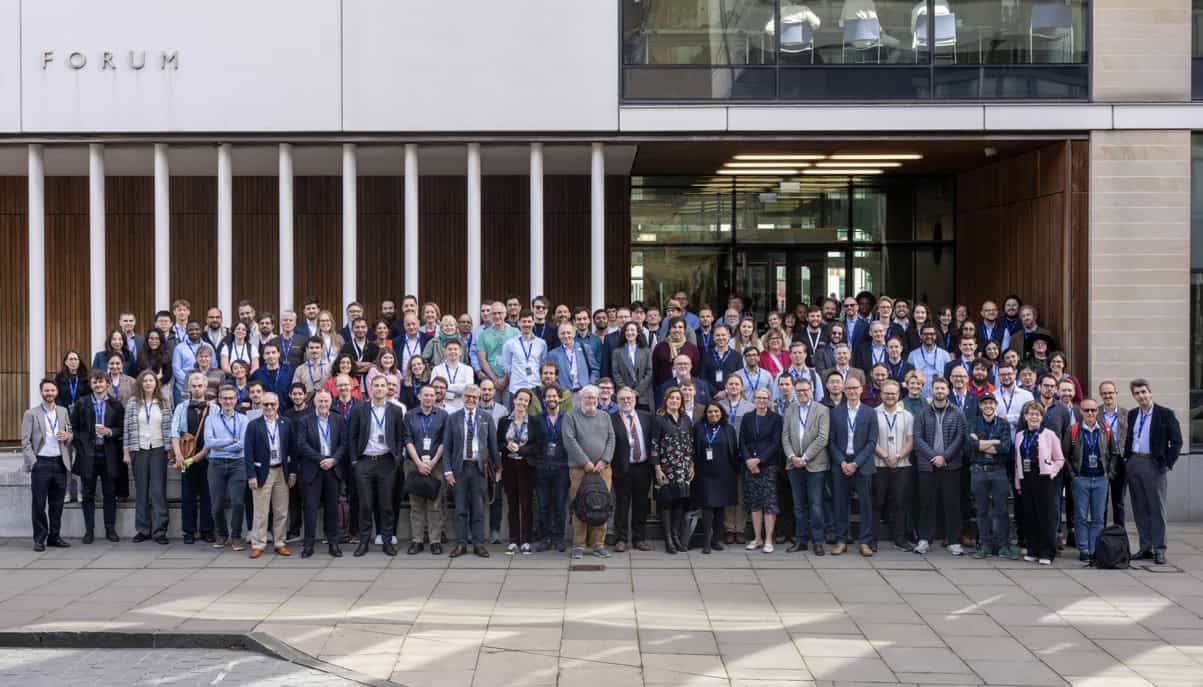
Another project is developing an adaptable computational approach to the problem of classically hard sampling, which is a good match for quantum photonic platforms. A team led by Leo Monbroussou has been working with two of the testbed providers, ORCA Computing and Aegiq, that have developed photonic platforms with different architectures and control mechanisms. “Having a direct dialogue with the hardware experts has really helped to push the research forwards,” says Jones. “Through the collaboration with the NQCC we have been able to embed that knowledge into the way that we approach software development.”
This established operating model provides a strong starting point for the new research programme, called QATCH (short for Quantum Advantage TurboCHarger), that is worth £20m from the UK government over the next four years. “We have an existing body of knowledge on how to run software on real quantum systems, which is really valuable and hard to create from scratch,” says Jones. “QATCH gives us more runway to design more ambitious experiments, such as developing code that will run on different hardware devices for cross-platform benchmarking and optimisation.”
QATCH also marks a change of emphasis for the QSL team. While the first three years focused on exploring potential routes to achieving quantum advantage, QATCH has a clear mission to deliver the tools, methods and systems that will drive real and evidenced impact from quantum computing in the UK. “The QATCH programme will launch the UK’s first full-stack feedback loop, serving as the software engine that translates fundamental theory into verified applications,” says Kashefi. “Through daily co-creation between our researchers, hardware vendors, and industry end-users on the national testbeds, we are ensuring that software actively drives forward the design and utility of these new quantum machines.”
- This year’s Quantum Fringe was supported by the NQCC, Infleqtion, Quantinuum, Riverlane, Classiq, IBM, Institute of Physics, National Physical Laboratory, Nu Quantum, with input from Edinburgh Innovations, the Centre of Doctoral Training in Quantum Informatics, the QCi3 and IQN hubs, the Quantum Software Alliance, and Quantum Computing Application Cluster
Nobel predictions, national firsts and the remarkable story of CV Raman
Next Tuesday the winner(s) of the Nobel Prize in Physics will be announced. To celebrate that most famous of prizes this episode of the Physics World Weekly podcast looks at a few fun aspects of past awards.
I’m joined by my Physics World colleague Matin Durrani to make a few predictions for next week. We also talk about our latest Nobel infographic – which looks at the time it took for countries to claim their first Nobel laureate.
Then I am joined by the Indian engineer Preetish Kakoty to talk about CV Raman, who was India’s first physics laureate. We chat about two ocean voyages that Raman took – journeys that reveal much about his devotion to science and his strong self-belief.
 This podcast is supported by American Elements, the world’s leading manufacturer of engineered and advanced materials. The company’s ability to scale laboratory breakthroughs to industrial production has contributed to many of the most significant technological advancements since 1990 – including LED lighting, smartphones, and electric vehicles.
How long did it take for countries to claim a Nobel laureate?
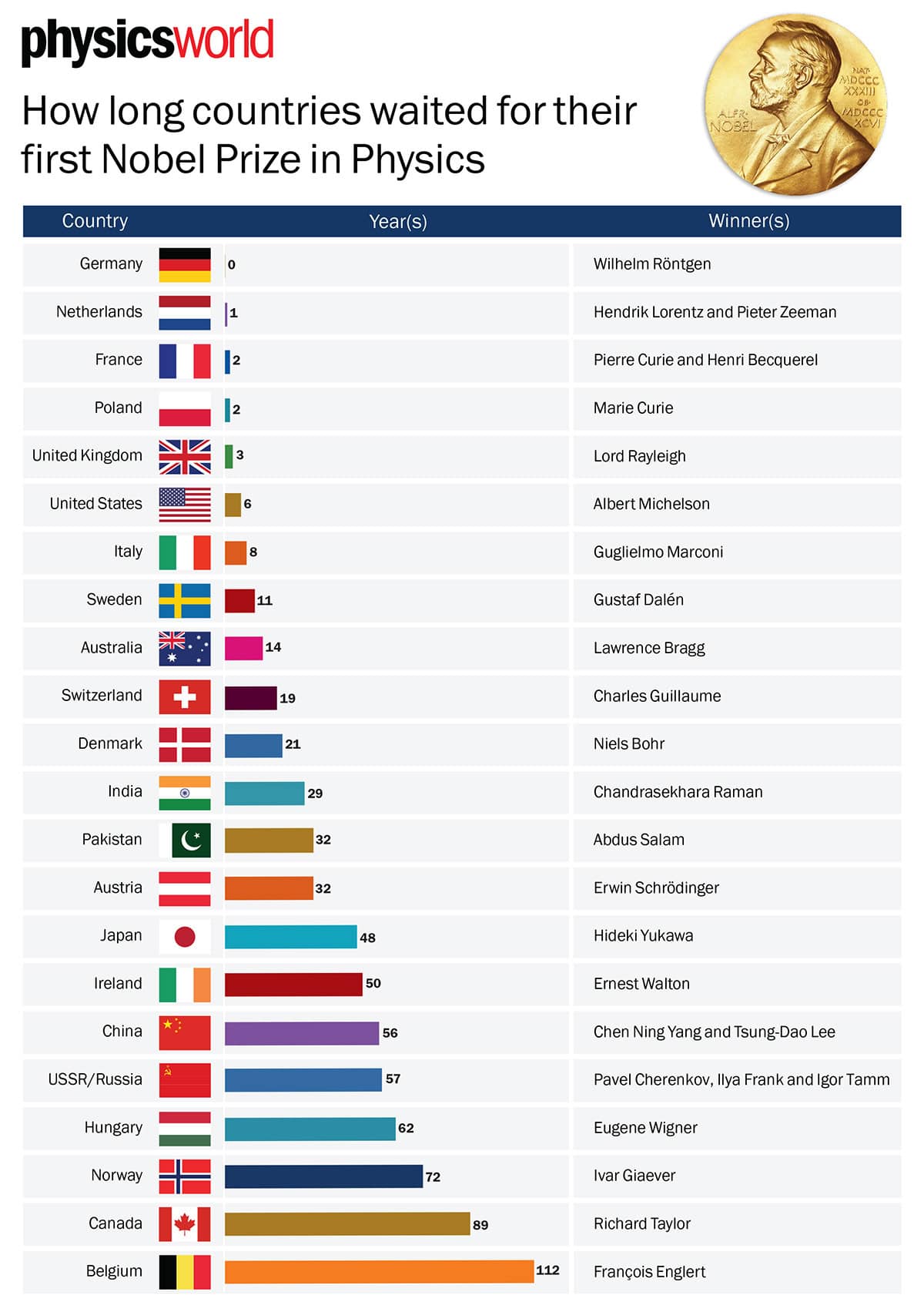
How long did it take for your country to claim a physics Nobel laureate? Or perhaps you live in one of the 170 or so countries that has yet to produce a Nobel prize winner?
The aim of our latest infographic (see figure) is to answer that question by exploring the geographical evolution of laureates. Creating it, however, quickly became an exercise in the history of the past two centuries.
Map-changing wars in Europe, the demise of colonialism, and immigration made it surprising difficult to ascribe some laureates to specific countries and led to at least one debate amongst Physics World colleagues. I will get into some of these idiosyncrasies after I take a general look at the infographic.
What is obvious is the early Nobel physics laureates come from what many call the west. Germany is considered by many to be the birthplace of modern physics, so it is not surprising that the country had the shortest wait – with Wilhelm Röntgen bagging the first prize (in 1901) for his discovery of X-rays.
Until 1930, when the Indian physicist CV Raman won the prize for his eponymous scattering effect, the prize was only awarded to people from western countries. Indeed, of the 22 countries that can claim laureates (by our measures), only five are not in the west. These are India, Pakistan, Japan, Soviet Union/Russia and China. So far, there have been no laureates from Africa, Latin America or much of Asia and Oceania.
While much of this is down to better access to education and research resources in the west, increasing global mobility means that students and researchers from all over the world are working in the west – and wealthy countries like China, South Korea and Japan. So why aren’t they bagging Nobel firsts for their home countries?
Indeed, only three laureates in the infographic who took that route are China’s Chen Ning Yang and Tsung-Dao Lee – who did their prize-winning work in the US – and Abdus Salam, who did much of his prize-winning work in the UK and Italy. Hopefully, this year’s crop of winners will include someone who is not from one of those 22 countries. While it’s likely that they will be working in the west, wouldn’t it be great if they won for work done in their home country.
Established nations
So how did we decide where a laureate is from? To work this out we considered where that person was born, where that place is today and – in some cases – what we know about a laureate’s view on their own nationality.
A case in point is Ernest Walton, who we consider to be the first Irish laureate. He was born in 1903 in Dungarvan, which is on the south-east coast of the Republic of Ireland. At the time of his birth, however, his birthplace was in the United Kingdom of Great Britain and Ireland – as all of Ireland was then a constituent nation of the UK. So Walton was born a British subject.
However, we consider him Irish for several reasons. First, although Ireland was not a sovereign country in 1903, it was a well-established national entity that was on the road to independence before Walton reached adulthood. Second, although Walton did his award-winning research in England, he spent most of his life in Ireland. Third, there is no evidence that he was a unionist – someone who opposes Irish independence and considers themselves British.
The above might upset readers in Scotland and Wales because both of those nations have spawned physics laureates who don’t appear in our infographic. But unlike in international football, rugby and cricket, Scotland and Wales will have to wait for independence from the UK before they get their own laureate teams in our infographic.
Similarly, Marie Curie was born in Poland when it was a part of the Russian Empire. But Poland was identifiable as a country in 1867 and it gained independence during Curie’s lifetime. Indeed, Curie was clearly a proud Pole, because she named the element polonium after her homeland in the hope that Poland would become unified and independent.
We have included Lawrence Bragg as the first Australian to win a Nobel prize. He was born in Adelaide in 1890, when the Australian colonies began the journey to independence from the UK. While Bragg is often considered British, we have decided he is Australian because he left the country for the UK in 1908 – seven years after Federation created the Commonwealth of Australia, which was independent from the UK for domestic issues.
Dealing with decolonization
I mentioned that there are no laureates from Africa in our infographic, but three physics Nobel prize winners were born on the continent. These are Claude Cohen-Tannoudji (born in Algeria), Serge Haroche (born in Morocco) and Pierre Agostini (born in Tunisia). However, all were born when these countries were French colonies and they all left for France when they gained independence.
Some readers might be scratching their heads over how we have dealt with the time Pakistan had to wait for its first Nobel prize. Salam bagged that prize in 1979 – so a 78-year wait from 1901, when the first prize was awarded. So why have we calculated the wait as just 32 years?
The reason is that unlike Ireland, Poland or Australia, the concept of Pakistan didn’t exist when Salam was born in Lahore in the British Raj in 1926. The word Pakistan is thought to have originated in 1933 and the call for a Muslim homeland crystalized in 1940 with the Lahore Resolution. So, we have decided to start the clock for Salam in 1947.
Other laureates who merited scrutiny include Albert Michelson, who was born in Poland but arrived in the US age two. As a result, we consider him to be the first American laureate. Indeed, Michelson wouldn’t appear in the infographic if we considered him a Pole because he was pipped at the post by Marie Curie.
Similarly, Gabriel Lippmann was born Luxembourg to French parents and moved to France age three, so we consider him French and not the first laureate from Luxembourg. However, we are a big fan of Lippmann here at Physics World because of the nature of his award – which was for a still-obscure colour-photography technique.
Indeed, my colleague Margaret Harris bagged an award of her own from Association of British Science Writers for her feature article that explores Lippmann’s prize, and that of Gustaf Dalén – the first Swede to win a physics Nobel prize. That article is called “The physics Nobel prizes you’ve never heard of”.
SmarAct proudly supports Physics World‘s Nobel Prize coverage, advancing breakthroughs in science and technology through high-precision positioning, metrology and automation. Discover how SmarAct shapes the future of innovation at smaract.com.
Exciton wavefunctions come into view
Physicists have experimentally reconstructed the quantum probability distribution of an exciton for the first time using super-fast spectroscopy. By simultaneously capturing the spatial and momentum spreads of these short-lived quasiparticles, the work adds to our understanding of how excitons evolve in complex materials. According to members of the research team, this improved understanding could lead to advances in organic photovoltaic devices.
When light shines on materials such as insulators and semiconductors, the energy from these incident photons can sometimes promote electrons in the material to higher energy bands, leaving behind positively charged holes. The electron and hole can then bind together, forming a neutral excited quasiparticle known as an exciton.
Excitons play a key role in light harvesting in optoelectronics devices, but their quantum mechanical structure has proved notoriously difficult to study. Among other reasons, this is because the excited electrons decay back to their original states within just picoseconds (10-12 s), and standard spectroscopic techniques are not fast enough to simultaneously probe the spatial dimensions of the quasiparticles’ orbits and their momentum profiles within that time limit.
Photoemission orbital tomography
In the new work, physicists led by Peter Puschnig of the University of Graz, Austria, together with colleagues at Marburg University and Forschungszentrum Jülich in Germany, got around this problem thanks to a technique called time-resolved photoemission orbital tomography (trPOT). This technique combines pump-probe photoemission spectroscopy with momentum microscopy and offers resolution at the femtosecond (fs, 10-15 s) scale, making it well-suited to capturing the exciton wavefunction.
Puschnig and colleagues began by applying an ultrashort normal-incidence laser pulse with an energy of 2.35 eV to an organic semiconductor called alpha-sexithiophene, which is employed in optoelectronic applications such as solar cells. This pulse generated the excitons. The next step was to eject the electrons from these excitons using a second, linearly polarized laser pulse with a relatively high energy of 21.7 eV. This process is known as photoemission.
“If we then measure the energy and direction of the ejected electrons, theoretical models allow us to infer their quantum-mechanical state,” Puschnig explains. “And by varying the time between the first and second laser pulses, we are able to obtain snapshots of the exciton at different times after its creation.”
The team found that the exciton in the sexithiophene films initially extends over a distance of approximately 1.5 nm, or roughly three molecules. Within 400 fs of its creation, though, its size contracts by about 25%. “What makes this particularly exciting is that we are not just measuring an energy or lifetime but are also gaining access to the quantum-mechanical wave function of the exciton itself, including its spatial structure and phase,” Puschnig says.
Coordinating demanding experiments and theory
Puschnig says the idea for the experiment grew out of the team’s earlier work on photoemission orbital tomography (POT), including a 2021 proof-of-principle study showing that it could be extended into the ultrafast regime. “The main challenge was coordinating demanding experiments and theory: producing well-defined molecular films; transporting them under ultra-high vacuum from Jülich to Marburg in a vacuum suitcase; performing ultrafast photoemission measurements; and carrying out computationally intensive ab-initio calculations in Graz to interpret the data,” he adds.
The work, which is detailed in Physical Review X, provides a new way to study excitons directly in real space and follow their quantum-mechanical evolution in time. According to the researchers, it could help us understand how excited states evolve into charge-separated states in the donor/acceptor systems that occur in organic photovoltaics, where the electron and hole can begin to separate after photoexcitation.
The researchers say their next goal is to move from the relatively simple exciton they studied to more complex systems. “We want to observe how charge-separation processes are controlled by the molecular and electronic structure of a material,” Puschnig tells Physics World. “Doing this will be particularly interesting because charge separation is the crucial step between absorbing a photon and generating a usable electrical current in an organic solar cell.”
Debating the future of photonics: experts assess the challenges and opportunities ahead
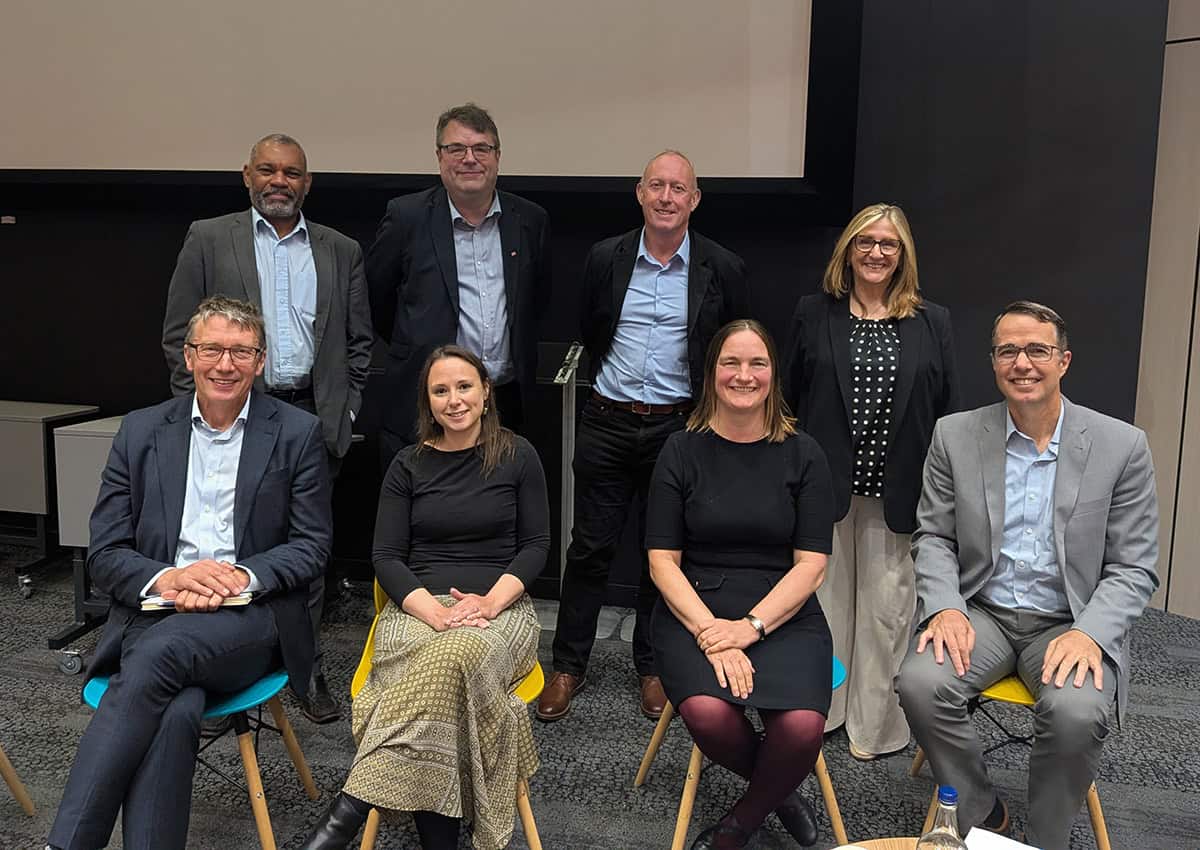
“The UK is really good at photonics and it should be something that the UK celebrates.” That was the verdict of John Lincoln, chief executive of the national network organization UK Photonics Leadership Group (PLG) at a recent meeting of the photonics community in Newcastle. He was speaking in a panel debate at the Photon2026 conference run by the Institute of Physics (IOP) at Newcastle University on 1–4 September. Attended by hundreds of delegates, the meeting focused on the strengths, opportunities and future potential for optics and photonics in the UK and EU.
The photonics industry, which has been in the UK for more than 60 years, is one of the country’s most economically productive sectors. According to the PLG, photonics generated £18.5bn in revenue in 2024 – up 20% from 2022 – and contributed £8.6bn to the UK economy. It now employs more than 75,000 people in over 1200 firms across all UK. Lincoln says that part of the UK’s success is the wide geographical spread of the hundreds of companies involved in photonics. Northern Ireland is Europe’s largest manufacturer of lasers by volume, for example, producing a million lasers per day, and is on course to be the world’s largest by 2028.
A national UK roadmap for photonics is expected to be published soon, which will feature recommendations to further boost the sector. Indeed, by 2035 photonics is estimated to be a £50bn industry where more than 60% of the UK economy will directly depend on photonics to keep it competitive. It is also expected to produce an additional 150,000 direct jobs and be one of the top three most productive manufacturing sectors in the UK.
The panel debate at Photon2026 was co-ordinated by physicist Jolyon De Freitas, chair of the IOP Optical Group, together with the European Optical Society – an umbrella organization for national optical societies across Europe. Speaking at the event, Ruth Oulton from the University of Bristol, who specializes in semiconductor quantum dots, said that many companies, including those in the US, want to move their companies to the UK given its focus and support on photonics and quantum. “The UK government has a very strong and coherent story to tell and it gives a bit of stability and clarity for people coming here, which is really promising,” she added.
Optics and photonics have important applications in several sectors including telecommunications, space and quantum technologies as well as defence and security. John Howell from Chapman University in the US, who is immediate past president of the International Commission for Optics, highlighted that improving access to optics and photonics instrumentation in the developing world can boost environmental and water monitoring and disease detection.
Opportunity knocks
Panel member Laura Young from the University of Newcastle, who works on medical technologies, said that the UK could improve further by making the most of “translational opportunities” when it comes to the application of optics into medical devices and getting those benefits out to patients. “Taking those early developments all the way through to products that have commercial or societal impact also makes it a more inviting domain for new talent to come to the UK,” she said.
That view is backed up by fellow panellist Chris Johnson, chief scientific adviser for the UK’s newly renamed Department of Business, Innovation, Science and Trade, which in July absorbed the science and innovation portfolios of the former Department for Science, Innovation and Technology under new UK prime minister Andy Burnham. Johnson said that photonics still has room for improvement when it comes to applications, pointing to the synthetic biology sector, for example, which has managed to engage with venture capitalist to grow from small, medium enterprises to larger businesses. He said that the photonics sector must have plans in place not only to generate start-ups and spin-outs, but also to plot their trajectory to growth beyond that.
The UK has a strong history in photonics research. Some 20% of global publications in photonics originate in the UK
As well as industry, the UK also has a strong history in photonics research. Some 20% of global publications in photonics originate in the UK. Yet Oulton, who also works at the foreign commonwealth and development office as an adviser on quantum technologies, added that scientists should explain more clearly to policy-makers why support for photonics needs to be continued. Oulton said it’s important that scientists clearly provide evidence for success and make international comparisons, rather than solely providing a wish list of support to government. “Make sure to read white papers the government produces like the modern industrial strategy,” she added.
Lincoln agreed, saying it’s important for researchers to clearly explain how photonics is critical to emerging technologies such as AI, energy, quantum and connectivity. Lincoln added that the government needs to embrace the complexity of photonics and its many varied applications and make sure the talent pipeline exists at all levels. “One of the things we are calling for is to make sure that skills support goes beyond PhD to engineers and technicians,” he said.
Continental effort
The panel debate at Photon2026 – the first time such an event has been hosted at a Photon meeting – was moderated by Anne Crean, associate director for science, business and data insights at the IOP. She noted that the UK and EU are “global leaders” in photonics featuring world-class research institution, innovative companies and strong partnerships, adding that the collaboration between the UK and EU will be “vital” in maintaining and advancing that position.
That collaboration was put to the test in 2016 when the UK voted to leave the EU, bringing with it significant amount of uncertainty not only for academia but industry too. Yet some of those initial issues are beginning to be resolved. Tom Grinyer, chief executive officer of the IOP, said that there are many positives about recent developments. “In 2022 we were outside of the Horizon funding framework and it felt like we were staring through a window,” he says. After negotiating back into the programme in 2024, Grinyer pointed out that the UK has received about 8.7% of optics and photonics funding in Horizon over the past two years, compared to other areas where the UK has received about a 7.6% share.
Lincoln added that it is critical for the UK to address the confusion around the UK’s involvement in the next European framework programme – FP10 – that will run from 2028 to 2034 with a proposed budget of €175bn. Delegates stressed that collaborating with the EU not only bring partnerships but also the ability to “scale” efforts.
“The UK and the EU are quite different in how they operate,” noted Oulton from Bristol. “The EU has scale and is the only body large enough to be competitive with the US and China but it can be quite slow from a policy perspective.” She pointed out that the UK has the ability to move more quickly into new fields, while the EU can piggyback onto those areas that show the most promise.
For all those benefits, Lincoln maintained that funding for photonics in Europe is “slightly out of phase” with the UK given that EU funding for photonics will be wrapped into the European Chips Act, which aims to strengthen the EU’s semiconductor industry and reduce its reliance on foreign suppliers for critical technologies. “We must adapt to a world where photonics is a semiconductor,” said Lincoln.
While collaboration cropped up many times in the discussion, it does bring challenges. Johnson pointed out the importance of photonics to national security, whether it’s the production of chips or its use in defence, and the growing threat of industrial espionage that it brings. Some countries are looking at ways to protect research and innovation from other nations by demanding that collaborative research be limited particularly when it comes to “dual-use” technologies that may also find military applications. Indeed, there is a general move towards requiring dual-use applications when applying for research and development support.
Yet Lincoln urged scientists to “embrace” working in these areas and for policy makers to not see the world as a zero-sum game. “Collaboration makes everyone better,” he said. “Don’t think of it as us versus them, but look at it as how we can both win.”
Bringing together the UK optics and photonics community
The Photon2026 conference was jointly organized by several IOP special interest groups including environmental physics, optical, quantum electronics and photonics, and medical physics. Held in the UK every two years, Photon2026 was the 13th in the series and featured talks from leading physicists and technology experts as well as an exhibition showcasing the latest optics and photonics technologies.
At the conference, theoretical physicist Michael Berry from the University of Bristol delivered the 2025 IOP Isaac Newton Lecture titled “What we learn(ed) from rainbows?” in which he explored how centuries of studying rainbows have bridged connections across physics, mathematics, colour and optical illusions.
Is this the year for a Nobel prize in condensed matter, or maybe particle physics?
Here at Physics World we have had some luck with predicting who is going to win a Nobel Prize in Physics. One successful strategy is to identify top physicists and just keep predicting that they will win – and eventually they do!
For example, we picked Anton Zeilinger for the 2009, 2013, 2014, 2015 and 2019 prizes – and he won in 2022. Clearly, it was a mistake to give up on him in 2020.
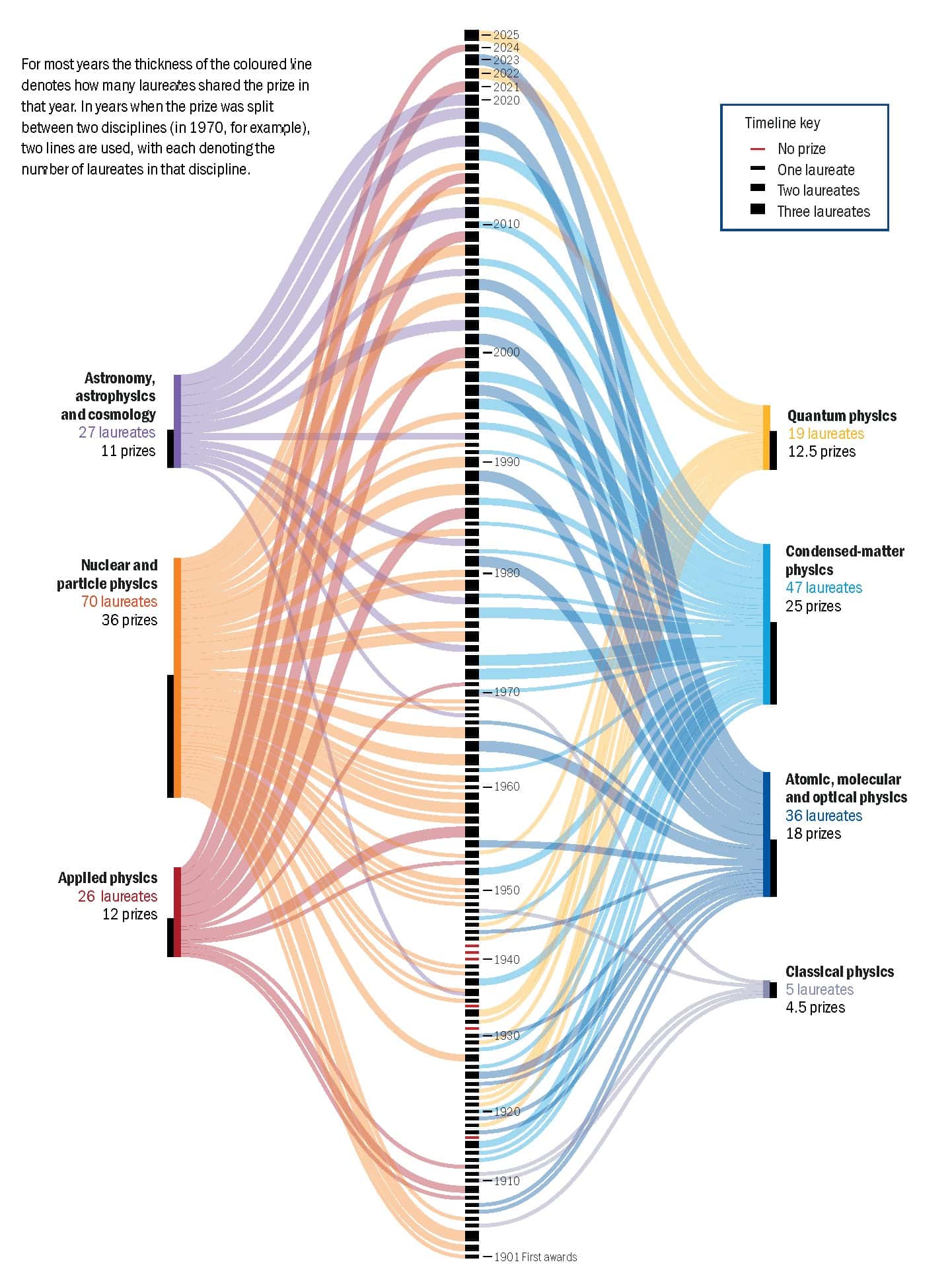
In making our predictions we sometimes rely on an infographic that we have been updating for a decade or so. It shows the chronological progression of Nobel prizes in terms of fields of endeavour – such as condensed matter, particle and nuclear, quantum and more (see figure).
By staring at the infographic for far too long, we have convinced ourselves that there is a regular pattern of gaps between prizes in specific fields. Looking at the latest version of the infographic it appears that both condensed-matter physics, and particle and nuclear physics are due a prize.
I have really struggled to think of a particle and nuclear breakthrough that could bag the 2026 Nobel – but I believe I have come up with one or two contenders. One is a prize for physicists working on CERN’s ATHENA and ALPHA collaborations, who were the first to trap cold antihydrogen atoms and then study them in detail. One laureate would surely be the Denmark-based American physicist Jeffrey Hangst, who is a founder of both collaborations. Making extremely precise comparisons of the properties of antihydrogen and hydrogen could reveal why there appears to be much more matter than antimatter in the universe – an important mystery in physics.
But alas, these and other antimatter experiments have yet to find any significant deviations from the Standard Model description of antihydrogen, so that might preclude a Nobel prize for Hansgt and one or two of his colleagues. And another caveat is one could easily argue that many of the innovations at ATHENA and ALPHA are in the field of atomic and molecular physics, not particle and nuclear physics – so there would be much debate here at Physics World if we had to update our infographic with an antihydrogen prize.
Another potential prize in particle and nuclear physics is for the the creation of the quark–gluon plasma (QGP). This is a state of matter that occurs very briefly when large nuclei (such as lead or gold) are collided at high energies. The result is a soup of quarks and gluons that is thought to resemble the early universe shortly after the Big Bang. Studying the QGP is a fascinating and important area of physics, but because the experimental work has been done by large collaborations at both CERN in Switzerland and at Brookhaven National Laboratory in the US it would be difficult to select just three people as Nobel winners. The fact that scientific breakthroughs in particle and nuclear physics are often made by large collaborations has led some to call for the three-person limit on prize winners to be lifted.
The field of condensed matter is much more fruitful when it comes to potential Nobel prizes. The analytics company Clarivate has released its “Citation laureates 2026 in physics”, which predicts Nobel winners based on the citation impact of their published research. Clarivate (and its predecessor Thomson Reuters) has a reasonably good record of picking winners and this year all three of its predictions are in condensed matter physics.
Organic LEDs
One prediction is a prize to Chihaya Adachi, Stephen Forrest and Mark Thompson for work leading to the development of ultrahigh-efficiency organic light-emitting diodes. The second is to Nicola Spaldin for her theoretical work on room-temperature magnetoelectric multiferroics, which Clarivate says are enabling new energy-efficient device paradigms. The third prediction is to Qikun Xue “for experimental observation of the quantum anomalous Hall Effect”. What all three of these awards have in common is a relatively immediate connection of the development of new technologies.
Spaldin was profiled in Physics World back in 2023 and she talks about the joy that she gets from her research, which combines blue-sky research with the design of real materials.
Other prestigious awards are also a good place to look for potential Nobel winners. The 2026 Kavli Prize in Nanoscience went to the physicists Eva Andrei, Pablo Jarillo-Herrero and Allan MacDonald for their pioneering work on twistronics. This is a burgeoning field that involves rotating the relative angle between two sheets of 2D material such as graphene. Rotations create moiré superlattices with a wide range of electronic properties including superconductivity.
I am also keen on an award for the applied physicist Federico Capasso. As well as developing a wide range of semiconductor technologies – including the quantum cascade laser – Capasso has done seminal work on optical metamaterials. An award for such metamaterials could be shared with John Pendry (a 2024 Kavli nanoscience laureate), who has developed a mathematical framework for designing optical metamaterials. These days prizes are usually awarded to trios, so potential partners for Capasso and Pendry are David Smith – a pioneer in creating metamaterials that operate at microwave frequencies – and Andrea Alù who is a prolific researcher in photonic metamaterials. Other possible winners in this field are Ulf Leohardt, Nader Engheta, George Eleftheriades and Vladimir Shalaev.
Wavelet theory
Finally, a potential prize that I find intriguing is inspired by “Clarivate’s Citation laureates 2025 in physics”. This proposes Ingrid Daubechies, Stéphane Mallat and Yves Meyer “for advancing wavelet theory, a revolution in mathematics and physics with practical applications including image processing”. Such an award would be difficult to shoehorn into a category in our infographic. I think applied physics would be the best fit.
The 2026 Nobel Prize in Physics will be announced on Tuesday 6 October at 10:45 a.m. BST at the earliest.
SmarAct proudly supports Physics World‘s Nobel Prize coverage, advancing breakthroughs in science and technology through high-precision positioning, metrology and automation. Discover how SmarAct shapes the future of innovation at smaract.com.
Copyright © 2026 by IOP Publishing Ltd and individual contributors