Researchers in the Netherlands have shown that they can turn off the dipole moment of molecules that are normally polar, drastically altering the molecules’ behaviour in low-energy collisions. The discovery – which was only possible after the team cleared a major experimental hurdle – has implications for ultracold chemistry and could also lead to a better understanding of polarity, with benefits for quantum simulation and computation.
Chemical reactions are full of complexity and chaos, making them hard to study at the atomic and molecular level. Before attempting to do so, scientists typically cool the reactants to just above absolute zero, which restricts their movement and vibrations. Despite these restrictions, however, interactions between ultracold molecules remain poorly understood, especially when the molecules have an electric dipole moment.
In 2023 experimental physicist Bas van de Meerakker and theorist colleagues at the Radboud University Nijmegen in the Netherlands shone a ray of light on this murky area by studying the collision cross-section (that is, the likelihood that collisions will take place) between molecules of ammonia (NH3) at low energies. Their simulations showed that this cross-section falls off sharply as the energy decreases. This contradicts the classical picture of polarity, which suggests that the cross-section should continuously increase.
A big turn off
The Radboud team explained this discrepancy by noting that in the classical picture, polar molecules such as ammonia have a permanently asymmetric charge distribution – a dipole moment – due to the arrangement of the bonds between their constituent atoms. The quantum mechanical picture, in contrast, depicts an isolated molecule in a specific quantum state as having a definite parity, or symmetry. Because of this symmetry, the molecule’s net dipole moment in the lab frame is exactly zero.
According to this quantum picture, collisions between polar molecules at high speeds (high energies) cause these opposite parity states to mix via interactions between the molecules’ electrostatic fields. In the process, they essentially “turn on” each other’s dipole moments, causing them to attract each other and increasing the collision cross-section. At low speeds, however, the molecules cannot get close enough to trigger this mutual mixing. As a result, their dipole moments effectively switch off, and their collision rates drop drastically.
On a collision course
The Radboud team’s next step was to prove experimentally that this is indeed what happens. However, colliding cold molecules generally requires using electric fields to merge two molecular beams. When molecules in the two beams have very similar dipole moments, this is very difficult, because using an electric field to steer one beam automatically affects the path of the other. The risk is that the beams never overlap at all.
To overcome this obstacle, van de Meerakker and colleagues combined a 2.6 m Stark decelerator, a curved hexapole guide and a merged quadrupole/hexapole trap into a device that can overlap the beams at just the right position, with minimal angle between them. In this way, they achieved sufficient overlap to observe low-energy collisions. They then experimentally verified the predicted energy-dependent changes in cross-section for NH3-NH3 collisions, while also showing that this dependence is different when they replace hydrogen atoms with deuterium (NH3-ND3 or ND3-ND3 collisions).
Under control
According to van de Meerakker, the fact that cross sections drop at low energies could make it hard to perform experiments that require scattering to take place in crossed or merged beams. On the other hand, experiments in which dipolar molecules are stored in traps could benefit, as lower inelastic cross-sections mean fewer molecules are lost from the trap.
As for future work, van de Meerakker says the team plans to add a controlled electric field to the beam overlap region. The mechanism they discovered is expected to respond extremely sensitively to this field, with even small electric fields changing cross sections by orders of magnitude and thereby providing a “knob” with which to control collision outcomes. “It was exactly this type of control that sparked our interest in cold and ultracold molecules two decades ago, and it is very exciting that this is now within reach in our scattering experiments,” van de Meerakker tells Physics World.
Tim Langen, a physicist at Austria’s Vienna University of Technology who was not involved in this research, describes it as important because it provides experimental evidence for a phenomenon that had mainly been discussed theoretically. In his view, the results support the idea that effective dipolar interactions become strongly suppressed at low collision energies. He also finds the experimental approach “impressive” as it enables measurements in a regime that was previously difficult to access. “Overall, I find the work convincing and expect it to be of broad interest to researchers working on cold and ultracold molecules,” Langen concludes.
Protonic ceramic electrochemical cells (PCECs) function as fuel cells, converting hydrogen into electricity, or as electrolysers, where electricity is used to split water into hydrogen and oxygen. This makes them useful in hydrogen energy systems because surplus electricity from integrated energy sources like nuclear, hydropower and geothermal can be converted into hydrogen, stored, and later converted back into electricity. Inside PCECs, two electrodes are separated by a ceramic electrolyte that controls the movement of hydrogen ions, which are protons.
Unfortunately, manufacturing the proton-conducting ceramic electrolyte layer is cumbersome. Long processing times involve multiple steps, including intensive ball-milling and high-temperature sintering, making protonic ceramics expensive to produce. In this work, the researchers investigated how PCECs could be manufactured more affordably, more rapidly and with better performance.
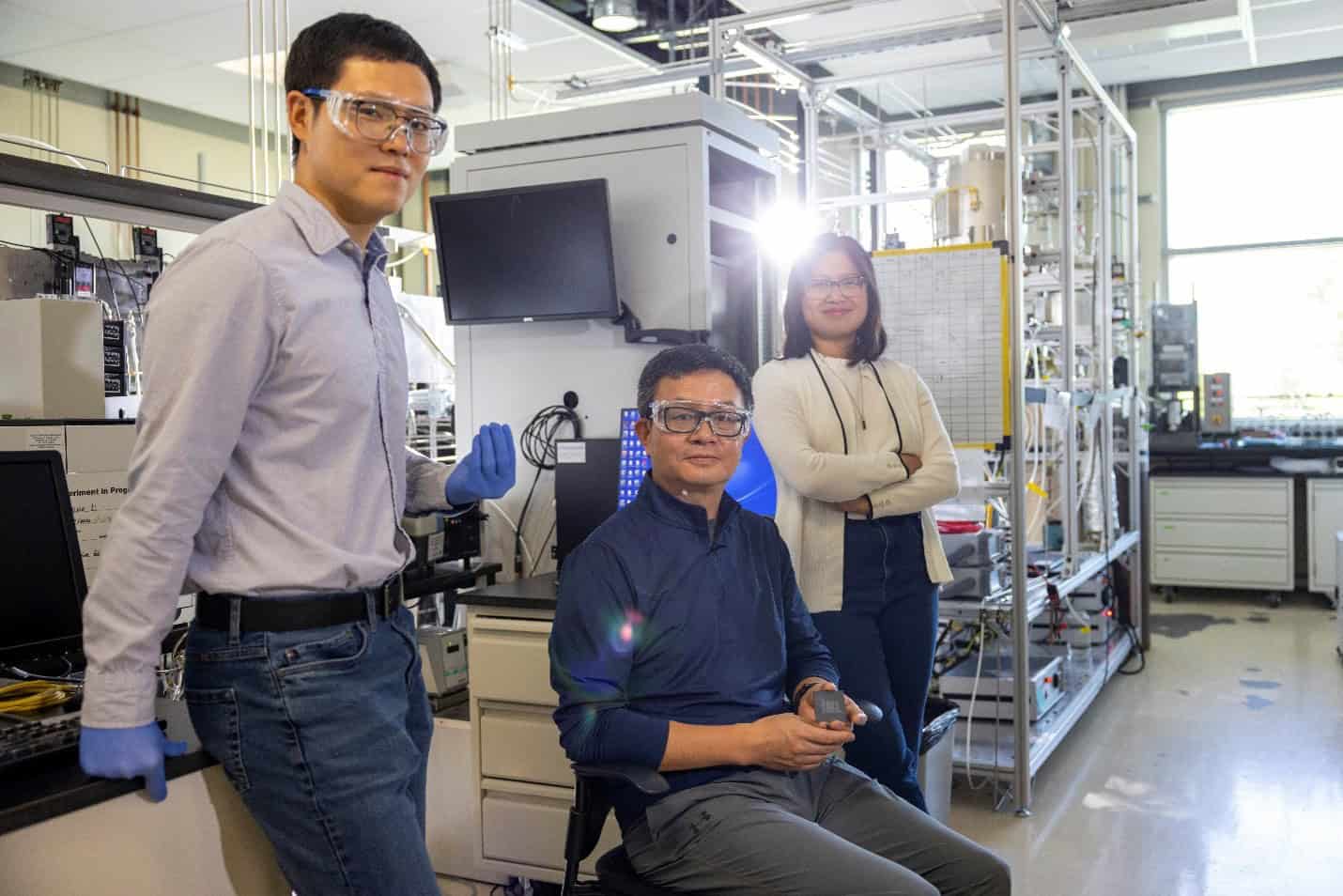
From left to right: Wei Tang, Dong Ding, and Wenjuan Bian, with a 5 cm × 5 cm protonic ceramic electrochemical cell fabricated using the team’s new n-SSR method. (Courtesy: Dong Ding/Idaho National Laboratory)
Instead of using larger precursor particles and grinding them for many hours, they started with nano-sized precursor powders. This enabled them to remove the ball-milling step entirely and reduce production time from 85 hours to 33 hours. In addition, it produced a finer electrolyte powder whose smaller particles packed together and sintered more easily, allowing the ceramic to become dense at temperatures around 100 °C lower than those required by the conventional method. The resulting electrolytes had lower electrical resistance, improving cell performance.
Compared with cells made using the conventional synthesis method, the new cells delivered up to 32% higher peak power density in fuel cell mode and 40% higher electrolysis current density at 600 °C, while maintaining stable operation for more than 500 hours. The process also reduced estimated electrolyte-powder fabrication costs by 25-29% and was successfully demonstrated in larger-area cells. This work could help accelerate the deployment of protonic ceramic electrochemical technologies for hydrogen production and energy conversion.
A quark is a fundamental building block of matter. There are six types known as flavours of quark: up, down, strange, charm, bottom, and top. Quarks combine to form particles known as hadrons. Most ordinary matter is made from up and down quarks, for example, a proton consists of two up quarks and one down quark, while a neutron consists of one up quark and two down quarks. Electrons belong to a different family of particles called leptons and are not made of quarks.
Particle physicists continuously test the Standard Model of particle physics to search for signs of new phenomena. One possibility is that quarks possess anomalous magnetic or electric dipole moments, which would indicate physics beyond the Standard Model. However, quarks are never observed in isolation because they are confined inside particles such as protons and neutrons.
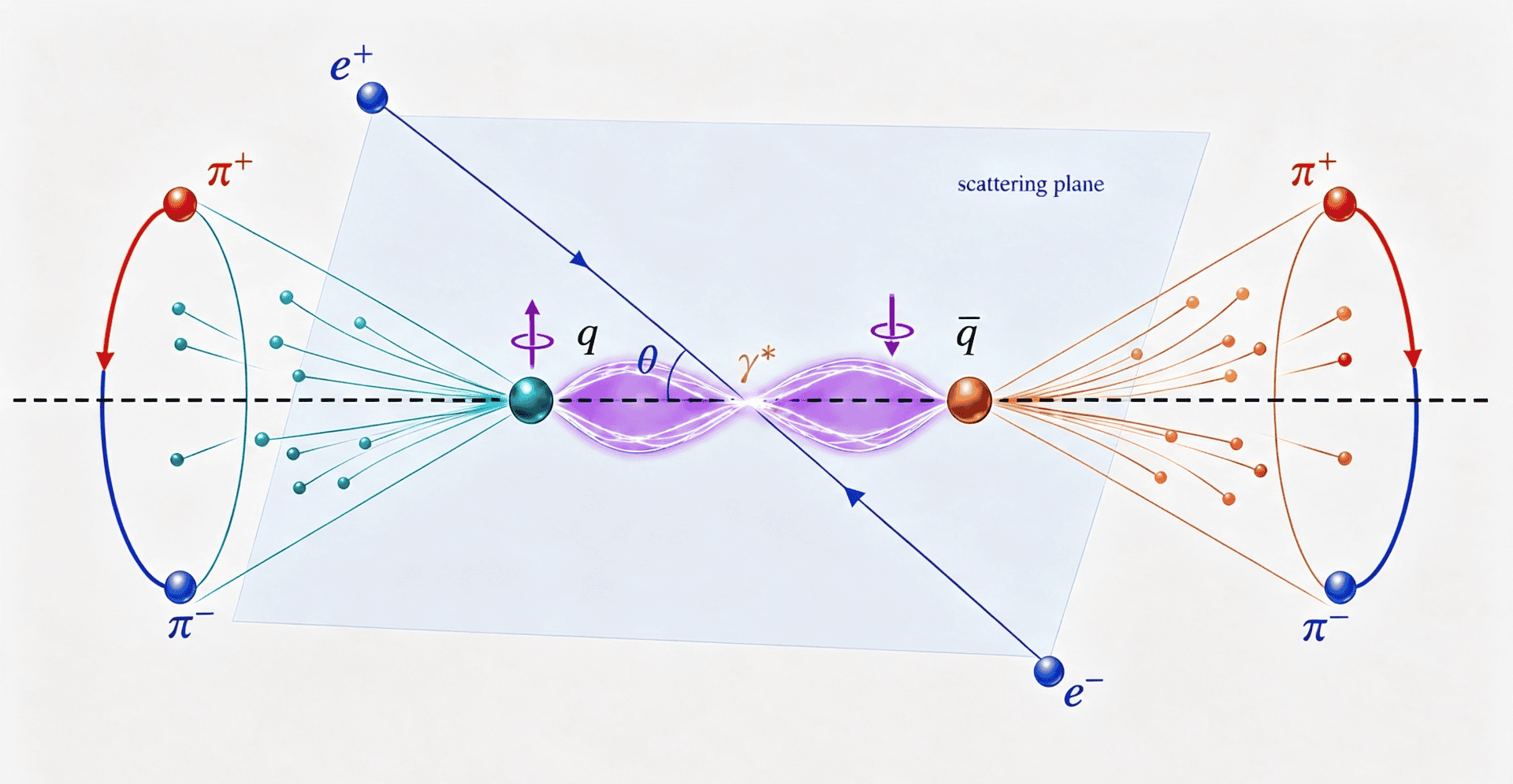
Schematic of the entanglement-based probe for quark electromagnetic dipole interactions. An electron-positron collision produces an entangled quark-antiquark pair. Anomalous magnetic or electric dipole interactions modify the spin correlation of the pair to be opposite orientation, leading to distinct azimuthal angular distributions of the fragmented hadrons. (Courtesy: Xin-Kai Wen/Chinese Academy of Sciences)
In this work, the authors study electron-positron collisions, which can produce quark-antiquark pairs. These quarks subsequently fragment into hadrons. By analysing the directions in which the hadrons emerge, information about the spins of the original quarks can be reconstructed. The authors show that anomalous magnetic or electric dipole interactions would modify the quantum-entangled spin state of the quark-antiquark pair in a characteristic way, producing either a spin-triplet state (for magnetic dipole interactions) or a spin-singlet state (for electric dipole interactions). These changes lead to measurable signatures in the angular distributions of the resulting hadrons. Rather than searching for an excess of events, the method probes changes in the spin-correlation structure of the quark-antiquark system.
The work introduces a new entanglement-based approach for probing the electromagnetic properties of light quarks. By connecting quantum spin correlations in hadron production with possible quark dipole interactions, it provides a complementary method for searching for physics beyond the Standard Model using collider data.
In magnets, the magnetic moments of electrons, known as spins, usually align in an ordered pattern. However, in a spin liquid, the spins never settle into a fixed arrangement. Instead, they continue to fluctuate collectively even at very low temperatures. In a chiral spin liquid, these fluctuations have a preferred handedness, similar to the difference between left and right hands or clockwise and anticlockwise rotation.
This research focuses on the pyrochlore lattice, a three-dimensional structure made of interconnected tetrahedra. Because of this geometry, the spins cannot all simultaneously satisfy their preferred interactions, making the system “frustrated”. This frustration can prevent conventional magnetic order and create the conditions needed for spin-liquid behaviour.
The researchers classified all possible chiral spin-liquid states allowed by the symmetries of the pyrochlore lattice. They then built theoretical models and performed simulations to predict how these states would appear in experiments. One unusual feature of spin liquids is that the collective motion of the spins can behave as if it creates emergent gauge fields, which resemble electromagnetic fields. The researchers found that some chiral spin liquids are dominated by these emergent gauge fields, while others are influenced more strongly by the spin-like excitations themselves.
The researchers showed that different chiral spin liquids have distinct signatures, providing a way to distinguish them experimentally. Their results offer a roadmap for identifying and classifying elusive three-dimensional chiral spin liquids in real materials.
Open-cell metallic structures are widely employed in the aerospace industry and in biomedical applications that require materials to be extremely light as well as strong. In marine infrastructure, however, their usefulness is limited because water quickly fills their interconnected open pores, preventing them from floating even though their bulk density is much lower than that of water.
Engineers in Australia and France have now developed a way around this problem. By combining so-called architected metals with a lightweight polymer foam, they created lightweight, strong, open-cell titanium structures that can float in water, overcoming the density limitation of previous materials while retaining structural performance.
“The innovation opens a new design space for marine structures, vehicles and rescue equipment where we need strength, low weight and buoyancy all at the same time,” says Ma Qian, a materials engineer at the RMIT University in Melbourne who co-led the research.
Beyond Archimedes
According to Archimedes’ principle, an object will float if its effective average density is lower than that of the fluid surrounding it. With open-cell materials, however, it’s more complicated. Because these interconnected frameworks of struts, thin plates or curved surfaces contain interconnected open voids that can fill with water as well as closed voids that cannot, they may fail to float even when their bulk densities (ρbulk) are well below that of water.
In the new work, which is detailed in Advanced Materials, Qian and colleagues at RMIT’s Centre for Additive Manufacturing and the Conservatoire National des Arts et Métiers in France developed an alternative measure of density that incorporates only the water-excluding parts of a structure. If the value of this “skeletal density” ρskeletal is lower than that of the surrounding liquid, then the structure will float even when water flows through all its interconnected open pores.
The team used this new measure to design a structure based on a recently-developed type of metallic open-lattice metamaterial called a hollow-strut lattice (HSL). Unlike conventional solid-strut designs, HSLs contain millimetre- or sub-millimetre-sized channels within their struts. These channels make them stronger than conventional solid-strut lattice materials of the same density, but that isn’t their only attraction. The presence of such channels also means that materials can be injected into them without compromising the HSL’s open-cell architecture – something that is impossible in traditional structures. Thanks to this feature, Qian explains, appropriately designed hybrid HSLs can float in water while remaining permeable.
Foam and titanium
The researchers made their open-cell hybrid lattice metamaterial by injecting expandable polyurethane (PU) foam, which has a density of 0.08–0.11 g/cm3, into a HSL structure made from a titanium alloy, Ti-6Al-4V. At the macro level, Qian explains that the foam completely fills the hollow titanium struts, and microscopic analyses reveal continuous, defect-free interfacial bonding between the foam and the inner walls of the struts, while the foam’s own heterogeneous, closed-cell microstructure incorporates pores ranging from ∼10 µm to 200 µm in size. “The closed-cell PU foam limits water ingress into the internal strut channels while the external open-cell architecture remains permeable, so safeguarding marine buoyancy without notable density gain,” Qian says.
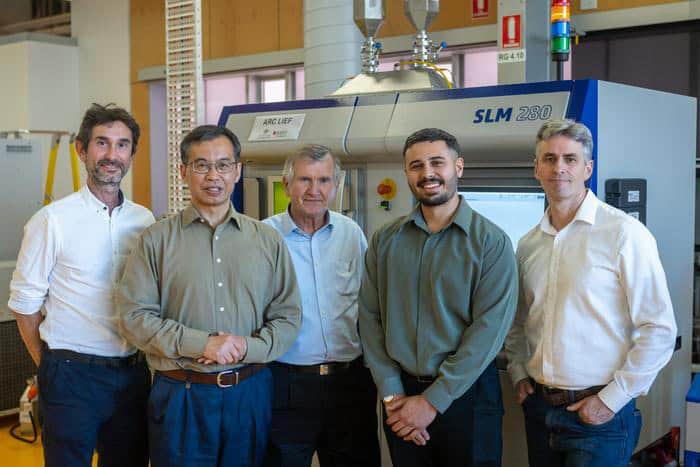
The project team: Andrey Molotnikov, Ma Qian, Milan Brandt, Jordan Noronha and Martin Leary at RMIT’s Centre for Additive Manufacturing. (Courtesy: Sara Tan, RMIT)
The RMIT team submerged both unfilled and foam-filled titanium alloy HSLs in freshwater for more than two months. As expected, all the unfilled HSLs sank when immersed, regardless of strut diameter. The researchers then immersed the materials in natural seawater (which has a measured density of 1.03 g/cm3, slightly higher than the 0.997 g/cm3 they measured for freshwater) over a period of two weeks. They found that the hybrid structures stayed afloat over the experimental period and lost only about 0.15 % of their mass, suggesting they are resistant to corrosion. They also found that the foam-filled HSLs have a higher specific strength than commonly employed marine materials such as high‑density polyethylene and 316L stainless steel.
While the most immediate uses for these new materials will be in seafaring vehicles, lightweight floating structures and rescue equipment, Qian thinks they could have wider applications. “The open-cell architecture allows different materials to be integrated within the same structure,” he tells Physics World. “For example, a biodegradable magnesium scaffold could potentially be combined with a hydrogel containing growth factors for controlled therapeutic delivery during bone regeneration. And in aerospace applications, a hollow-strut titanium lattice might be integrated with a carbon-fibre-reinforced polymer to create lightweight, stiff hybrid structures.”
The researchers now plan to further develop their technology and are seeking collaborations with potential commercial partners. “We want to assess its viability for larger marine applications, including autonomous underwater vehicles and floating platforms and investigate long-term performance under realistic marine conditions,” Qian says. “We also plan to introduce our concepts into our advanced manufacturing and design courses at RMIT to help engineering students and researchers develop new ideas in this emerging field.”
Francis Halzen wins the 2026 Nobel Prize in Physics “for decisive contributions to the IceCube Neutrino Observatory and the discovery of high-energy neutrinos of astrophysical origin”.
The prize will be awarded in Stockholm, Sweden on 10 December and is worth SEK 12 million (about $1.2 million).
Born in Belgium, Halzen is based at the University of Wisconsin–Madison in the US. Nearly four decades ago Halzen realized that the ice at the South Pole could be used to detect cosmic neutrinos. The first attempt was called AMANDA, which was completed in 2000 but not large enough to be up to the task. It was expanded to create IceCube by the end of 2010.
IceCube comprises thousands of light detectors in a cubic kilometre of Antarctic ice. Occasionally a neutrino will interact with the ice and create particles that generate light as they travel through the ice. By tracking these particles, Halzen and colleagues can determine where in the sky the neutrino came from.
Speaking on the telephone shortly after the announcement Halzen said, “It was a great surprise and I didn’t expect it. It’s a great pleasure to hear about this prize.”
“This was an adventure”
He added, “When I reflect on this moment, I have to say how lucky I am. This was an adventure where success was not guaranteed, but we overcame many challenges. It was a long journey. I want to emphasize again how lucky I was to take contributions from collaborators. It feels strange. I hope it reflects on the courageous people who joined me on this project. Many talented people joined me on this journey.”
He was also thankful for the support of his university, “I was lucky to be in the right place [Wisconsin] when this idea [to build IceCube] came up.”
Commenting on whether neutrinos could be used to communicate with extra-terrestrial beings, Halzen quipped, “This has already been proposed by several friends of mine. It has been speculated that this would be an ideal way to communicate with aliens but I don’t think I will go there. I think we have enough realistic problems to deal with right now to make neutrino astronomy a reality.”
When asked what he will do for the rest of today, Halzen replied “I’m working on a proposal. I hope this prize will help get it approved.”
“Halzen had the idea together with a colleague in 1988 to use the ice at the South Pole as a medium to detect neutrinos,” said Mark Pearce, chair of the Nobel Committee for Physics, who is also an astroparticle physicist at KTH Royal Institute of Technology in Stockholm.
International collaboration
Pearce adds, “Halzen has spearheaded an international collaboration of more than 450 people from 58 institutions in 14 countries around the world to realize this enormous neutrino detector.”
Halzen is the first sole winner of the Nobel Prize in Physics since Georges Charpak won it in 1992, with Pierre-Gilles de Gennes being the previous lone laureate in 1991.
This is the fifth Nobel prize related to neutrinos. The first went to the discovery of the muon neutrino, which was recognized by the Nobel committee in 1988. It was followed by the first observation of the neutrino itself (1995), the detection of cosmic neutrinos (2002), and the discovery of neutrino oscillations – the fact that neutrinos can switch from one type to another – in 2015.
Pearce explains why physicists are so fascinated by the elusive subatomic particle: “The neutrino has such peculiar properties, the fact it interacts so infrequently in material, and in this case it’s a way of bringing information about distant cosmic sources that we are unable to acquire in other ways.”
Halzen was born in Tienen, Belgium, in 1944. He graduated with an MSc in physics from the University of Louvain in 1966 and then a PhD from the same university in 1969.
After a stint at the CERN particle-physics lab, he moved to the University of Wisconsin–Madison in 1972, where he also became the principal investigator on the AMANDA neutrino observatory in Antarctica and the IceCube project.
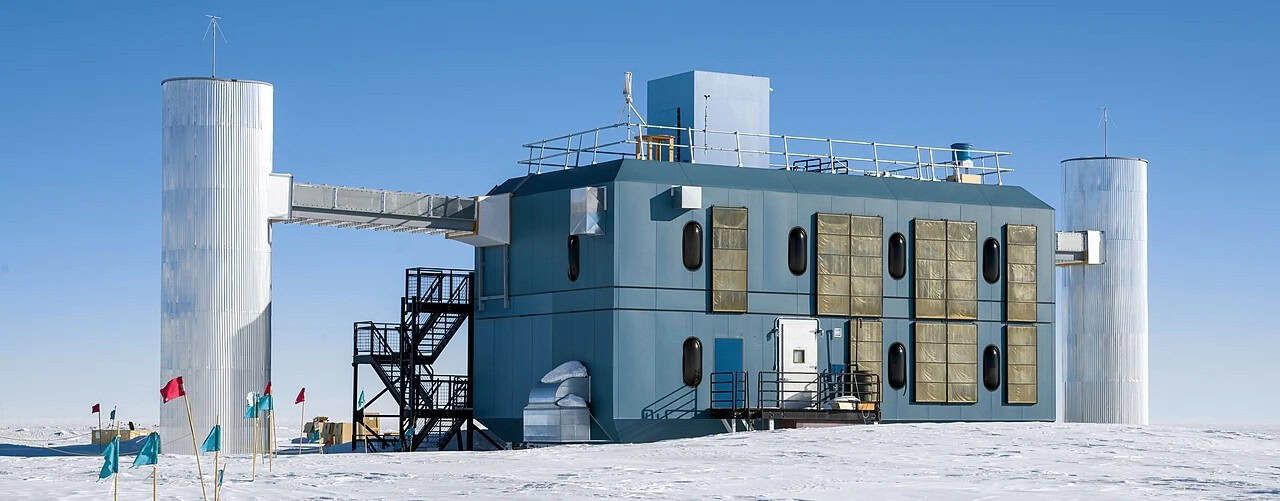
Tip of the iceberg A cubic-kilometre-sized neutrino detector lurks deep within the ice below the IceCube Laboratory building at the South Pole. (Courtesy: Christopher Michel/CC BY-SA 4.0)
IceCube was completed in late 2010. Then, it comprised 5160 digital optical modules suspended along 86 strings, each up to 2.5 km long and embedded under the ice at the Amundsen-Scott South Pole Station. The strings are spaced to create a total detector volume of a cubic kilometre. Neutrinos interact with matter only extremely weakly, so the array instead detects the tiny flashes of Cherenkov light produced when the neutrinos collide with hydrogen or oxygen nuclei inside the ice and create secondary particles. Under ideal circumstances, the detector signal can be used to work out where in the sky the neutrino came from.
In 2013 the IceCube Collaboration published details of its observation of 28 extremely high-energy particle events, created by neutrinos with energies of at least 30 TeV. The findings represented the first evidence for high-energy cosmic neutrinos, which originate from outside the solar system.
Two years later, IceCube confirmed the cosmic origin of high-energy neutrinos with an independent search in the Northern Hemisphere. This study examined muon neutrinos reaching IceCube through the Earth, using the planet to filter out the large background of atmospheric muons. Data analysis suggested that more than half of the 21 neutrinos detected above 100 TeV were of cosmic origin.
In 2018 IceCube, along with astronomers working on two gamma-ray telescopes, found compelling evidence that a known blazar – called TXS 0506+056a and located about 4 billion light-years from Earth – was a source of high-energy neutrinos detected by IceCube. This was an important milestone in multimessenger astronomy, whereby astronomical objects are studied by observing several different types of radiation.
Another breakthrough came in 2021 when IceCube was the first to spot an interaction called a Glashow resonance. This interaction was first predicted in 1960 and involves the collision of high-energy antineutrino with an electron to create a W boson. In 2022 the galaxy NGC 1068 was identified as a source of high-energy neutrinos and in 2023 IceCube showed that the Milky Way is also a source of high-energy neutrinos.
Earlier this year an upgrade of IceCube added more than 600 new light sensors in five new holes drilled in the ice near the centre of the detector.
In 2013 Halzen and his IceCube colleagues won the Physics World Breakthrough of the Year award. Hamish Johnston spoke to him about the experiment in this video:
Physics World is brought to you by IOP Publishing, which has a portfolio of more than 100 journals, around half of which are published jointly with or on behalf of partner societies and research organizations. Francis Halzen has published more than 150 papers with IOP Publishing and you can explore them here.
SmarAct proudly supports Physics World‘s Nobel Prize coverage, advancing breakthroughs in science and technology through high-precision positioning, metrology and automation. Discover how SmarAct shapes the future of innovation at smaract.com.
The 2026 Nobel Prize in Physiology or Medicine has been awarded to Karl Deisseroth, Peter Hegemann and Georg Nagel for “their discoveries concerning light-gated ion channels and optogenetics”.
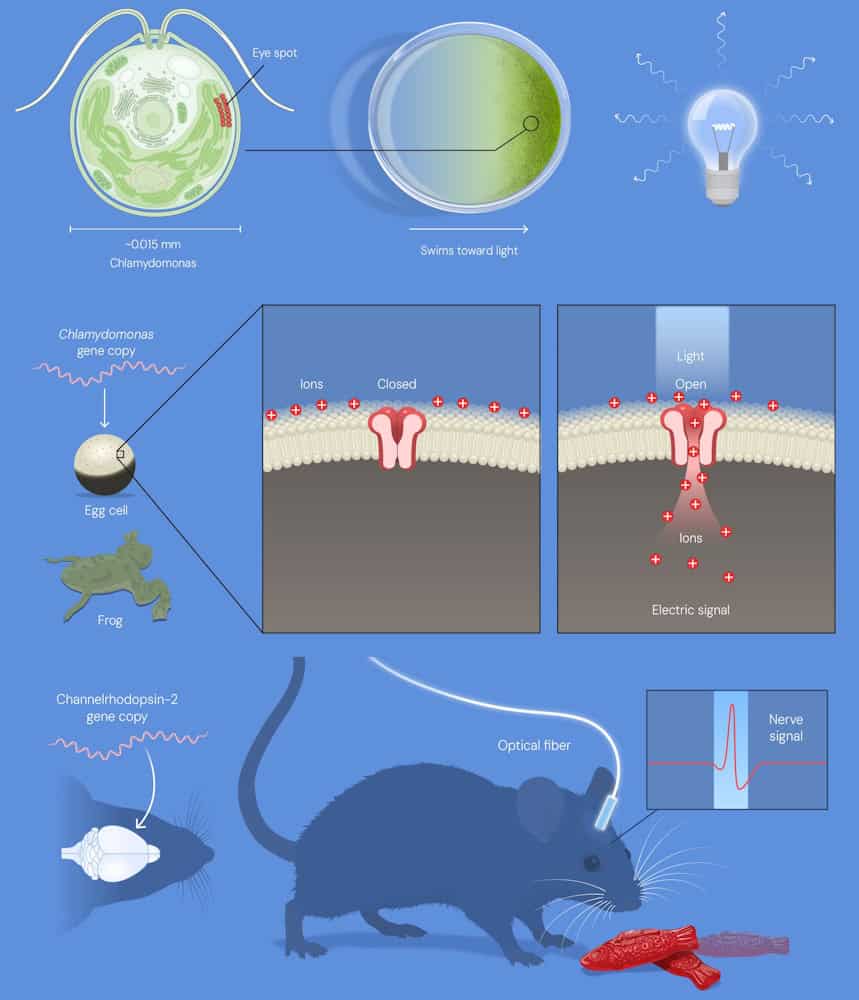
Optogenetics is a method that uses light to characterize and manipulate the activity of neurons in a living brain. Hegemann and Nagel discovered the light-sensitive protein channelrhodopsin, while Deisseroth transformed the protein into a light-controlled switch for nerve cells.
“Optogenetics provides opportunities for mapping the brain in a way that we could once only dream of,” says Per Svenningsson, chair of the Nobel Committee for Physiology or Medicine.
From the pond to the brain
Speaking in the press conference following the announcement, neuroscientist Abdel El Manira from the Karolinska Institute described how the breakthrough began with the study of a single-celled green alga, Chlamydomonas, known for its ability to swim towards light using a tiny “eyespot” on its surface as a sensor. Hegemann was intrigued as to how this simple organism could transform light into action.
Using electrical measurements to solve this mystery, Hegemann discovered that the eyespot contains a light-sensitive protein that almost instantly converts light into an electrical signal, enabling the alga to move. Hegemann next teamed up with Nagel, who used the gene for Chlamydomona to produce the protein in frog egg cells. They discovered that the protein itself was a light-gated ion channel that opens when exposed to light, allowing positively charged ions to flow into the cell and rapidly generate an electrical signal.
“Nagel and Hegemann realised exactly what they had found. They had just discovered the switch neuroscientists had long dreamed of – a light-gated ion channel they named channelrhodopsin,” says El Manira.
Appreciating the potential of this discovery, Deisseroth – at the time studying ways to establish causal links between specific brain circuits and behaviour – decided to test whether channelrhodopsin could be used as a switch to control the activity of neurons with light. By introducing the DNA encoding the protein (supplied by Nagel) into mammalian neurons and illuminating them with light, he observed a remarkable response: the neurons reacted on command, instantaneously and with millisecond precision.
The real test was whether channelrhodopsin could control neurons in living animals. Deisseroth and colleagues demonstrated that this was possible. By introducing the gene for channelrhodopsin into specific nerve cells in the brains of living mice and illuminating these cells via a thin optic fibre, they activated selected group of neurons and elicited a distinct behaviour.
“For the first time, causal links between specific brain circuits and behaviour had been achieved. The technology, which soon became known as optogenetics, transformed neuroscience,” notes El Manira. “Optogenetics was rapidly and widely adopted all over the world.”
Future medical potential
The field of optogenetics has now enabled researchers to establish causal links between neural activity and behaviour, identifying, for instance, neural circuits associated with pain, social behaviours, thirst, food consumption, reward and attention. Beyond the healthy brain, the technique also sheds light on how specific brain circuits can be disrupted and how this impacts psychiatric and neurological conditions.
And while optogenetics is primarily a tool for basic research and understanding of disease, optogenetic therapy is also showing early promise as a medical treatment. In particular, a landmark study has demonstrated partial recovery of visual function in a blind patient with retinitis pigmentosa, by insertion of a channelrhodopsin-like protein in their retina.
“In this disorder, retinitis pigmentosa, patients lose their photoreceptors, the rods and cones in the retina,” explains Svenningsson. “But there are still healthy cells in the retina and researchers have used optogenetics to stimulate these healthy cells and thereby activate the optic nerve and generate vision perception in the brain. This has been done and there are several clinical trials ongoing with this approach.”
Karl Deisseroth was born in 1971 and received his PhD and MD from Stanford University in the US, where he performed the work for which he was awarded the prize. He is currently an investigator at the Howard Hughes Medical Institute and professor at Stanford University.
Peter Hegemann was born in 1954 and received his PhD at the Max-Planck-Institute for Biochemistry in Martinsried, Germany, where he made his prize-awarded discoveries. He is now a senior professor of neuroscience at Humboldt University of Berlin, Germany.
Georg Nagel was born in 1953 and received his PhD at the University of Frankfurt, Germany. His prize awarded discoveries were made at Max Planck Institute for Biophysics in Frankfurt. He is currently professor of molecular plant physiology at the University of Würzburg, Germany.
Thomas Perlmann, secretary-general of the Nobel Assembly, described his call to the laureates earlier this morning: “All three were very surprised and all three said the same thing, that it was absolutely wonderful to receive the prize with the other two, called them ‘my friends’, and that it was such an honour to receive them together”.
Read about the use of organic dyes in optogenetics, in a book chapter co-authored by Peter Hegemann, now free to read on IOP Science.
SmarAct proudly supports Physics World‘s Nobel Prize coverage, advancing breakthroughs in science and technology through high-precision positioning, metrology and automation. Discover how SmarAct shapes the future of innovation at smaract.com.
In the mid-1970s a graduate student wrestling with a deceptively simple quantum problem uncovered one of the most haunting images in modern physics. The pattern seemed almost impossibly intricate: delicate wings assembled from infinitely nested bands and gaps, a self-similar pattern born from the motion of electrons in a crystal under a magnetic field. First published in 1976 (Phys. Rev. B14 2239), it came to be known as Hofstadter’s butterfly, after its discoverer Douglas Hofstadter.
Half a century later, the butterfly has not faded into scientific nostalgia. If anything, it has become even more important – reappearing in new materials, new experiments and in places no-one imagined when it was first plotted. Recent research by Kazuki Ikeda from the University of Massachusetts and Yaron Oz at Stony Brook University suggests that related patterns may even surface in the physics of black holes (J. High Energy Phys.2026 38).
Each new realization adds another chapter to a story that is not really about a single graph, or even a single discovery, but about the unity of patterns across the physical world. A structure first seen in a simple model has become a symbol of how richness can emerge from basic rules, how beauty can arise from constraint, and how the quantum world still harbours forms strange enough to surprise us.
How the butterfly got its wings
What makes Hofstadter’s butterfly so compelling is the remarkable story of its birth and, more importantly, how far it has travelled from its original birthplace. Like many scientific breakthroughs, its discovery was fairly obscure initially and owed a great deal to luck. In 1974 Hofstadter – son of the 1961 Nobel-prize-winning nuclear physicist Robert Hofstadter – had just dropped out of graduate school at Stanford University in the US and was “in despair” according to friend and physicist Francisco Claro.
Having just completed a PhD with the renowned solid-state physicist Gregory Wannier at the University of Oregon, Claro suggested that Hofstadter should approach Wannier as well. As it happened, Wannier had been struggling with a problem that had puzzled him for years: he could not obtain an analytical solution to Harper’s equation, which describes the motion of electrons on a 2D crystal lattice subjected to a perpendicular magnetic field.
Named after P G Harper, who was a graduate student of Rudolf Peierls at the University of Birmingham, UK, this classic “magnetic problem” displayed a mysterious sensitivity to whether the magnetic flux was a rational or irrational number. It was a feature that immediately captured Hofstadter’s imagination and, with the rational–irrational dichotomy echoing in his mind, Hofstadter began his PhD studies at Oregon by immersing himself in solving the problem.
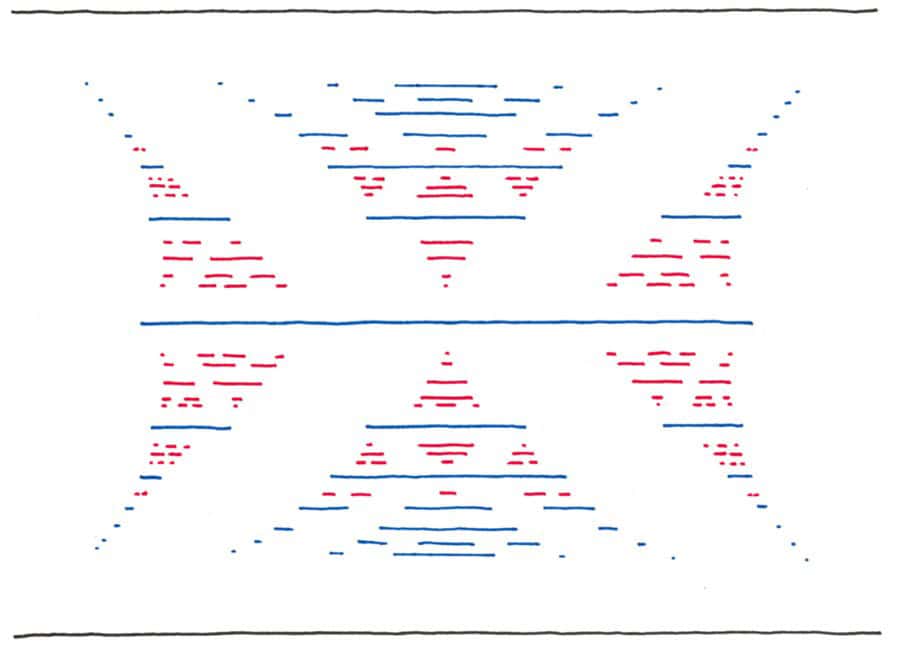
But he soon found himself equally stuck. Frustrated by the analytical approaches often discussed at the time, he pursued a different path: numerical computation. Using a programmable Hewlett Packard desktop calculator that by today’s standards looks laughably primitive, he displayed the numerical solutions graphically as the energy of electrons versus magnetic flux Φ per unit cell of the lattice. At that moment, he became convinced that he had uncovered the true structure of the problem. “All at once my eyes were opened,” Hofstadter recalls.
Beautiful beginning Hofstadter’s butterfly dates back to November 1974 when Douglas Hofstadter, who was then a PhD student at the University of Oregon, was trying to describe the motion of electrons in a 2D crystal lattice under an applied magnetic field. His work led him to produce a primitive, hand-drawn diagram – dubbed “Gplot” – that looked like a butterfly. The original diagram has been lost so Hofstadter created this reconstruction in 2016. (Courtesy: Indu Satija. Permission granted by Douglas Hofstadter)
What he found was a complex recursive shape (or fractal in today’s terminology) hidden within the energy spectrum of electrons in a magnetic field. Resembling a butterfly, Hofstadter brought his hand-plotted diagram, which he codenamed “Gplot”, to Wannier, who was not impressed. According to Hofstadter, Wannier dismissed the result as “numerology” and even threatened to withdraw the PhD student’s funding.
But after nearly a year, Wannier came to recognize the validity and significance of Hofstadter’s work, ultimately awarding Hofstadter his PhD and accepting the butterfly as a legitimate description of the energy spectrum of electrons moving on a 2D lattice in a magnetic field. Wannier even added to the butterfly’s story with a paper titled “A result not dependent on rationality for Bloch electrons in a magnetic field (Phys. Status Solidib88 757). This work, along with further studies with Claro, introduced a set of integers uniquely labelling every gap in the graph, providing a simplified description of the spectrum (Phys. Rev. B 19 6068).
Douglas Hofstadter: in his own words
Ruby celebration Douglas Hofstadter (right) pictured in 2016 with colleagues Indu Satija (centre) and Francisco Claro (left) all wearing T-shirts emblazoned with Hofstadter’s butterfly to celebrate its 40th anniversary. (Courtesy: Indu Satija)
Born in 1945, Douglas Hofstadter discovered his eponymous butterfly while a PhD student at the University of Oregon in 1975, using computational modelling to make his breakthrough (see main text). Four years later Hofstadter published his Pulitzer-prize-winning popular-science book Gödel, Escher, Bach, which tackles cognition, mathematics and symmetry.
Currently a professor of cognitive science and comparative literature at Indiana University in Bloomington, US, Hofstadter is still active as a researcher and wrote a follow-up book I Am a Strange Loop in 2007. On the golden jubilee of the now-famous butterfly named after him, Hofstadter provided the following comment to Physics World.
“This graph was first computed using a programmable desktop calculator and was first plotted by hand using coloured felt-tip pens. I was just extremely relieved that by showing that my ‘Gplot’ graph was made of distorted copies of itself, I would at last be able to get a PhD thesis. I had no idea that Gplot would go on to become well known as the Hofstadter butterfly, and that variations on the theme would proliferate like wildfire over the coming decades.”
“As the years have gone by,” he continues, “articles about Hofstadter’s butterfly have grown more and more numerous and harder and harder for me to follow. For better or for worse, these theories are all way beyond me, but remembering the first wingbeats of the butterfly’s flight cheers me up.”
Statements about states
Hofstadter’s butterfly is more than a beautiful graph. It is a map of what happens when quantum particles are caught between two competing kinds of order: the regular periodicity of a crystal lattice and the circular orbits of a magnetic field. When these two scales contend with one another, the energy spectrum does something extraordinary. Instead of varying smoothly, it fragments into a hierarchy of allowed and forbidden energies, referred to as bands and gaps, respectively.
Zoom in on one region and new structures emerge. Zoom in again and the pattern repeats, endlessly varied yet ruled by strict mathematical order. It is one of the rare instances in which fractal geometry appears not only in abstract mathematics or artistic imagination, but in the measurable behaviour of matter itself.
The deep connection between this theoretical pattern and real-world matter became clear through an exotic quantum phenomenon known as the integer quantum Hall effect. It was discovered experimentally by Klaus von Klitzing at the Max Planck Institute for Solid-State Physics in 1980 – a breakthrough that earned him the Nobel Prize in Physics five years later.
The classical Hall effect is what happens when a voltage is produced in a bulk conductor at right angles to an applied magnetic field. Similarly, the quantum Hall effect is the appearance of a voltage across opposite faces of a thin 2D semiconductor when a current is passed along the plane of the material and a magnetic field applied perpendicularly it. But there is one big difference in the quantum version.
If you slowly increase the power of the magnet, the transverse electrical conductance does not grow steadily. Instead, it jumps up sharply, with plateaus in between like steps on a staircase. In other words, it assumes quantized values given by integer multiples of the fundamental constant e2/h, where h is Planck’s constant and e is the charge on an electron.
In 1982 the British physicist David Thouless and his collaborators at the University of Washington, Seattle, made another remarkable discovery: the effect, they found, is topological. Topology is the study of the global properties of objects and topological invariants are those properties that do not change regardless of how much you try to deform a given object.
Thouless and colleagues found that the integers underlying the quantum Hall effect are topological invariants arising from the global topology of the electronic wave functions. This seminal work, which was published in 1982 (Phys. Rev. Lett.49 405), significantly contributed to Thouless earning the 2016 Nobel Prize in Physics, which he shared with Duncan Haldane and Michael Kosterlitz for their work on “topological phase transitions and topological phases of matter”.
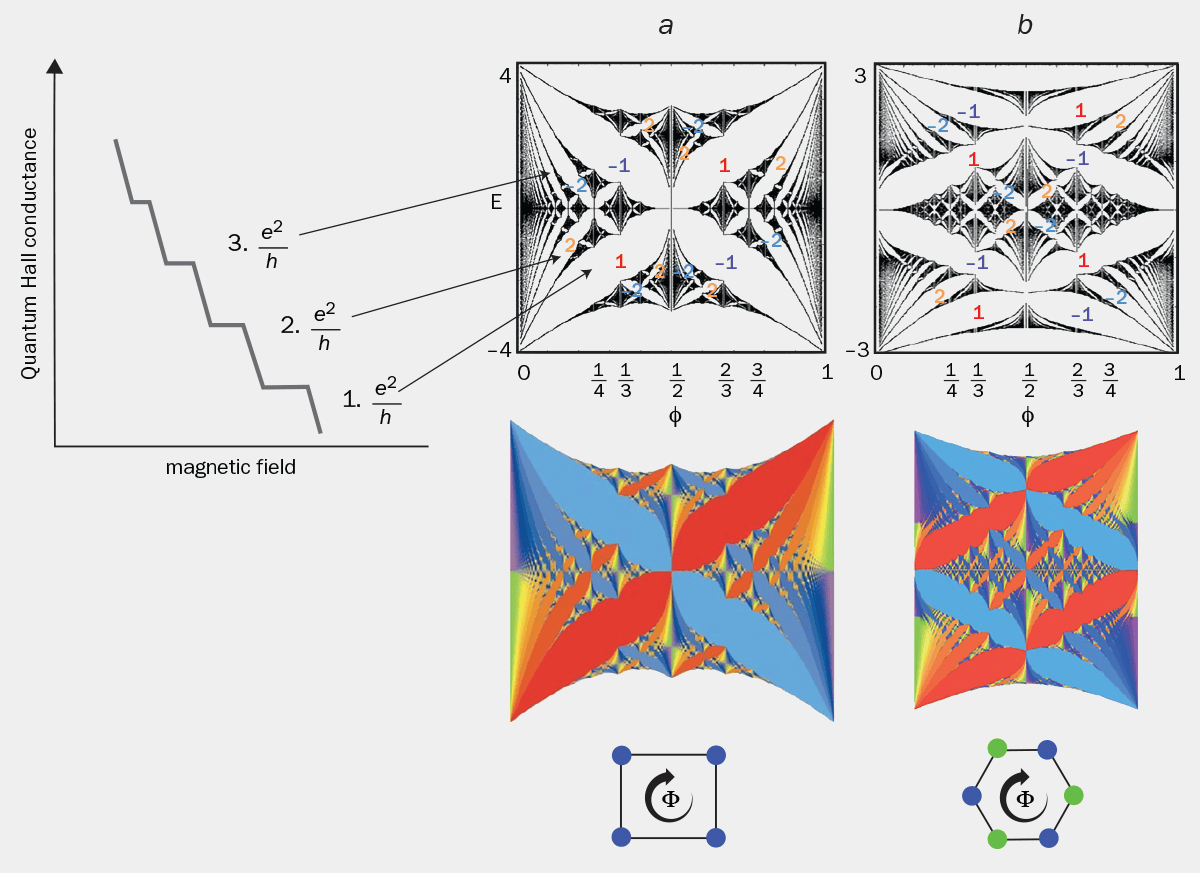
1 Butterfly behaviour
(Courtesy: Indu Satija; CC BY 3.0 New J. Phys.18 103023; J. Stat. Phys. 156 417. Reused with permission from Springer Nature)
Hofstadter’s butterfly, in its original form, refers to the behaviour of electrons in 2D lattices subject to an applied magnetic field. (a and b) Shown here (top row) are graphs of the electrons’ energy (E) plotted against the magnetic flux (Φ) per unit cell for square and honeycomb lattices (bottom row). The relation between the quantum Hall effect (displayed in the staircase-like graph, left) and Hofstadter’s butterfly is shown via the arrows. The colours on the “butterfly graphs” (middle row) correspond to the quantum numbers of the Hall conductivity. Some of these integer labels are shown (colour coded) in the top row.
How all of this relates to Hofstadter’s butterfly is simple: the butterfly model describes all integer quantum Hall states, where the integers of Hall conductivity label the gaps in Hofstadter’s butterfly – the exact same integers that Wannier and Claro introduced in the butterfly spectrum (figure 1). In other words, the butterfly is not merely a chart of recursively split energy levels; it is also a coded map of topology in quantum matter under a magnetic field.
A pattern repeating across physics
That connection places it squarely within one of the central themes of modern condensed-matter physics, namely the realization that certain physical properties are protected not by local details, but by global features of the quantum state. But what is fascinating is that in the 50 years since Hofstadter’s butterfly was discovered, physicists have found that the same spectral architecture in it can also arise in a remarkable range of settings. It has appeared, for example, in other lattice geometries, in engineered semiconductor devices and in so-called moiré materials.
The butterfly’s migration into moiré systems has been especially fruitful. Such materials are created by stacking two atomically thin materials onto each other with a slight twist, creating a moiré pattern with different properties from the individual layers. Utilizing moiré materials, in research that began in 2013 led by Philip Kim of Columbia University (Nature497 598) and continues apace with a team led by Ali Yazdani of Princeton University (Nature639 60), the butterfly structure can now be tuned, probed and in some cases directly imaged on modern quantum platforms.
Over the last 50 years, the butterfly itself has also evolved into other forms. For instance, in some systems, the butterfly emerges without an external magnetic field. As a team of researchers led by Xu-Tao Wan from East China Normal University showed in 2025 (Phys. Rev. Lett.136 033401), the fractal pattern can be controlled by twist angle – that is, by geometry alone.
Each time physicists add a new layer of realism – spin, interactions, periodic driving or lattice complexity – the butterfly adapts, and re-emerges in new forms, so long as it is not overwhelmed by strong interactions, disorder or thermal effects
In other realistic systems, electron spin – the particle’s intrinsic magnetic orientation, absent from the original simplified model – becomes an essential part of the physics. Even when a magnetic field splits the system into spin-up and spin-down states via Zeeman splitting, the butterfly spectrum survives. More striking still, the butterfly can emerge independently for each spin state, as Xiaomeng Liu and Zhida Liu of Cornell University discovered in 2025 (Nature Phys.21 1873).
This persistence of the fractal structure, despite the added complexity introduced by spin, highlights the extraordinary robustness and universality of the underlying quantum phenomenon. More generally, what these new iterations of Hofstadter’s butterfly reveal is that what once looked like a specialized theoretical curiosity now seems more like a recurring motif in quantum matter.
Indeed, this is part of its enduring fascination: each time physicists add a new layer of realism – spin, interactions, periodic driving or lattice complexity – the butterfly adapts, and re-emerges in new forms, so long as it is not overwhelmed by strong interactions, disorder or thermal effects. This durability prompted a friend to once joke that whenever he undergoes an MRI scan, he cannot help wondering what kind of butterfly his body might be producing.
Beauty from simplicity
As my friend’s joke reveals, there is something unmistakably human about the butterfly’s appeal. Physicists are drawn to it not only for its usefulness, but for its beauty. It belongs to that rare class of scientific objects whose visual grace seems to gesture toward deeper truths. And yet its deepest charm may lie in the fact that its immense complexity grows from remarkable simplicity.
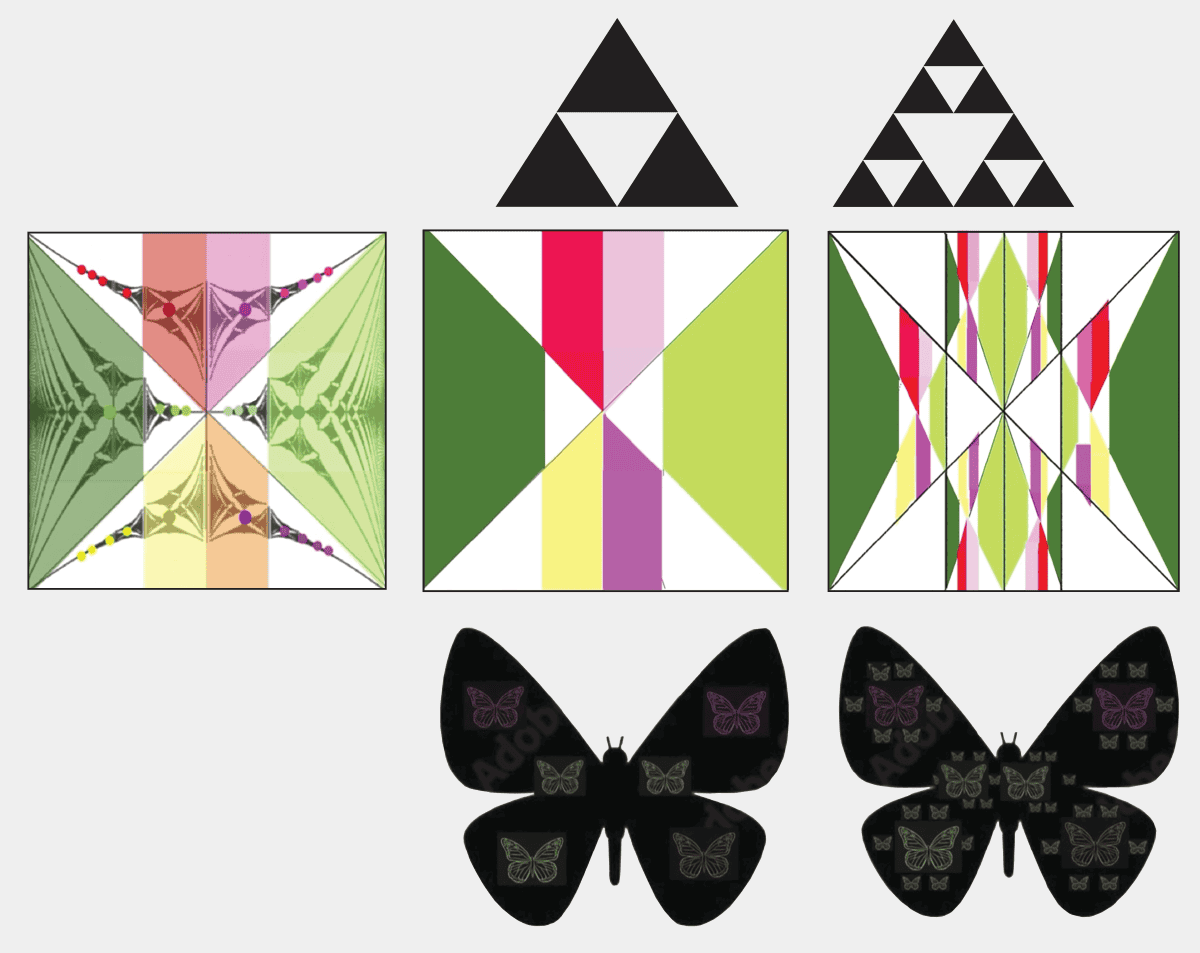
2 Baby butterflies
(Courtesy: Indu Satija)
A simplified representation of Hofstadter’s butterfly, commonly known as the butterfly skeleton, interpreted as a 2D tessellation of trapezoids and triangles. It is shown in parallel with the “Sierpiński gasket” (top), which is made entirely from triangles. The iterative construction underlying this fractal consists of a parent butterfly generating six “baby” butterflies, represented by the six colour-coded trapezoids. Each baby butterfly is accompanied by a tail – an infinite chain of progressively smaller butterflies, indicated schematically by dots in the corresponding colour. The two butterflies at the bottom provide a schematic illustration of the hierarchical organization of the structure.
Beneath the intricate pattern are integers, recursion relations and number-theoretic structures that connect it to fairly simple geometric patterns, including the Farey tree, the tree of Pythagorean triplets and fractal packings such as the Apollonian gasket. In fact, this complicated quantum fractal admits a surprisingly simple geometric description: the butterfly landscape can be organized as a hierarchical lattice of trapezoids, bringing it into close parallel with geometric fractals such as the Sierpiński gasket (figure 2). It is extraordinary to think that this geometric harmony underlies such a complex and beautiful graph.
Fifty years on, Hofstadter’s butterfly remains exactly what great scientific ideas are supposed to be: elegant, prolific and unfinished. That interplay of beauty, mathematics and physical reality is what keeps the butterfly alive. Its evolution under interactions, spin effects and new forms of engineered geometry continues to reveal unexpected physics. And with each turn, the butterfly reminds us of something rare and precious in science: that the universe can hide immense complexity within simple forms, and that sometimes, if we are lucky, those forms are beautiful enough to be unforgettable.
While modern Japan has had a good record in winning Nobel prizes, the country had to wait 48 years since the inception of the awards in 1901 to receive its first Nobel prize.
The accolade went to particle physicist Hideki Yukawa, who published his theory of mesons in the 1930s that explained the interaction between protons and neutrons.
Yukawa was born in Tokyo on 23 January 1907, graduating from Kyoto University in 1929. He then moved to Osaka University in 1933 for a PhD, which is where he did his Nobel-prize-winning work.
As positively charged protons repel each other through electromagnetic force, an issue at the time in nuclear physics was that this should cause the atomic nucleus to fly apart.
In 1935 Yukawa proposed a short-range, highly attractive nuclear force that overcomes this repulsion and suggested this force is created by the exchange of massive subatomic particles between protons and neutrons, which he called mesons.
Yukawa calculated that the mass of these exchange particles should be roughly between an electron and a proton.
Building a legacy
In 1937 three separate research groups conducted cloud-chamber experiments and discovered a new particle with a mass consistent with Yukawa’s prediction, but it was later identified as a muon.
In 1938 Yukawa was awarded a PhD and a year later moved back to Kyoto University but it took a few more years before Yukawa’s particle was finally discovered.
The first evidence of a meson came in 1947 with the discovery of the pi meson (pion) by a research group led by Cecil Powell at the University of Bristol. The team measured the particle by exposing photographic plates to cosmic rays at high altitudes (Powell won the 1950 Nobel Prize in Physics for the work).
Yukawa was then awarded the 1949 Nobel Prize in Physics “for his prediction of the existence of mesons on the basis of theoretical work on nuclear forces”.
The news was met with tremendous joy in Japan and encouraged scientists to continue their research in spite of the economic condition and the challenges of doing experimental science in postwar Japan.
In Yukawa’s honour, the Japanese government built a three-storey building named Yukawa Hall in 1952. Its focus was on developing theoretical physics in Japan and featured lecture halls, seminar rooms, offices and a library.
In 1953 the hall became home to the Research Institute for Fundamental Physics (now the Yukawa Institute for Theoretical Physics), of which Yukawa was the first director – a position he held until retiring in 1970.
The institute invited research scholars from all over Japan and held symposia and seminars on particle physics. It also published the monthly English-language journal Progress of Theoretical Physics (now known as Progress of Theoretical and Experimental Physics), together with the Physical Society of Japan (JPS).
The journal was founded by Yukawa in 1946 to publish results that had remained unpublished because of JPS’s financial difficulties.
As well as the Nobel prize, Yukawa also won many other international prizes and he was also vocal about issues in physics and society. In 1955 Yukawa joined 10 other scientists in signing the Russell–Einstein Manifesto that called for nuclear disarmament.
Yukawa died on 8 September 1981 and since he was awarded the Nobel Prize in Physics, 11 other Japanese-born physicists have gone on to win the physics Nobel – making Japan one of the most successful countries in the world.
SmarAct proudly supports Physics World‘s Nobel Prize coverage, advancing breakthroughs in science and technology through high-precision positioning, metrology and automation. Discover how SmarAct shapes the future of innovation at smaract.com.