

See how much you know about the subject by trying our interactive crossword. Most of the clues are based on the article, but there are a few additional brain teasers thrown in. If you’re feeling stuck, check out the “assist” menu for help.
Researchers print structural colour with an inkjet printer

The majority of printing processes today are performed using different coloured pigments. However, there’s another type of colour called structural colour, which typically uses nanoscale structures that interact with light to produce a colour. By refracting and reflecting light at specific wavelengths, these nanostructures can produce incredibly bright colours that (unlike pigments) do not fade over time, unless the structure is physically altered. Structural colour is often found in nature – creating the brilliant colours of a peacock’s tail feathers, for example – but has been difficult to print using conventional printers.
Most instances of creating structural colour involve diffracting light through periodic polymers or transparent oxide nanostructures, but these approaches cause a strong iridescence – where the colour changes depending upon the viewing angle – which can limit the practicality for some applications. To print structural colour materials, other options are needed.
Researchers from Kobe University in Japan have now achieved this, by developing a Mie-resonant silicon nanoparticle ink that can be printed onto flat or three-dimensional surfaces using an inkjet printer. Mie resonant systems are highly refractive particle systems that enhance light–matter interactions at specific wavelengths and can boost optical effects.
“We undertook this research to bridge fundamental Mie-resonant nanophotonics with scalable printing technologies, enabling structural colour to move from laboratory demonstrations to practical, large-area applications,” explains Hiroshi Sugimoto, one of the study’s lead authors.
The research team at Kobe University has been developing spherical crystalline silicon nanoparticles with a high refractive index and low extinction coefficient that reflect specific wavelengths of light to produce certain colours. These particles, ranging in diameter from 100–200 nm, were used as the basis for the new ink, moving away from more traditional, unprintable structural colour materials.
The researchers wanted to develop structural colour inks that can be processed like conventional inks or paints. However, they initially found that when the solvent dried, the particles tended to aggregate. This aggregation changed how the particles interact with light and degraded the colouration of the ink. To overcome this issue, the team coated the silicon nanoparticles with thick silica shells and formulated them into a water-based acrylic emulsion. Unlike the crystalline silicon particles, the protective shells have a low refractive index so they don’t they don’t bend the light. As such, they provide a transparent coating that prevents aggregation without affecting the structural colour output.
The researchers used the nanoparticle ink to print images on a flat polymer film and a 3D metallic surface, using an inkjet printer at resolutions of between 250 and 125 dots per inch. They found that the images exhibited optical asymmetry – showing a different colour when light passes through the image (transmission) to when it is reflected from above – due to the Mie refraction that the particles exhibit.
The researchers also found that that the hue can be tuned by changing the diameter of the nanoparticles. This allowed them to create multi-colour patterns with tuneable reflection/transmission colour asymmetry by using nanoparticle inks with different particle sizes.
“The most important finding is that we achieved structural colour printing using silicon nanoparticles, overcoming the long-standing reliance on periodic arrays in conventional structural colour systems,” says Sugimoto.
Phase-changing material generates vivid tunable colours
Read more

Potential applications of these tuneable and printable inks include anti-counterfeiting images, semi-transparent smart windows, smart displays and vibrant art pieces (that won’t fade over time). For example, when the ink is printed on to a monitor, the printed images will be invisible when the display is on. However, when the display is turned off, the images become visible, which allows for information display without using any energy.
When asked about where they plan to take the research next, Sugimoto tells Physics World that “building on this work, we aim to further control and exploit this optical asymmetry for multifunctional systems, such as anti-counterfeiting and decorative films on buildings and windows, using scalable nanophotonic printing”.
The research was published in Advanced Materials.
In food physics, connection and collaboration are ingredients for a thriving IOP community
Food physicists have a lot on their plate just now. Across academia and industry, the community faces systemic challenges, not least the obesity epidemic, mounting health-and-safety concerns around ultra-processed foods, and the regulatory backlash against plastic food-packaging waste.
The war in the Middle East is another uncomfortable wake-up call. While the effective closure of the Strait of Hormuz to commercial shipping has sent oil and gas prices soaring, that strategic choke point has also shut off around one-third of the seaborne trade in fertilizers, fuelling price spikes and warnings of global food shortages to come.
All these factors will intensify the push from policymakers and the public for a more sustainable “food system”. The goal is to make better use of water, energy and raw materials, while minimizing environmental impacts like deforestation and pollution.
What’s cooking?
The food-physics community is a diverse mix of senior academics, early-career researchers and R&D scientists from the food-and-drink industry. Many of them came together recently in Leeds, UK, at Food Physics X – the 10th annual conference of the food-physics group of the Institute of Physics (IOP). Top of the agenda was how the food industry can deliver nutritious and tasty products, while at the same time accelerating technology and process innovation to cut manufacturing costs and time-to-market.
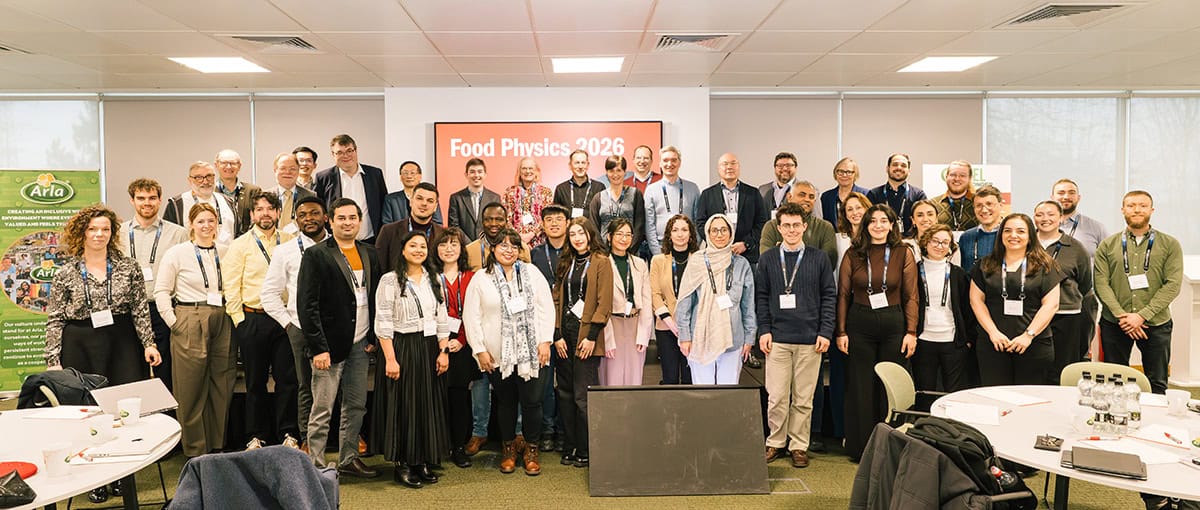
“Food physics and its multidisciplinary practitioners have a key enabling role here,” says Zachary Glover, an industrial biophysicist who has chaired the IOP’s food physics group since 2021. “Collectively, the challenge lies not just in improving food security and resilience of supply, but also in supporting industry R&D initiatives towards enhanced productivity, circularity [to minimize waste] and environmental sustainability.”
Glover is optimistic about the food industry’s ability to reinvent itself, especially when it comes to addressing the growing regulatory and geopolitical challenges through new digital technologies. “AI and machine learning are already transforming best practice in research, publishing and education,” he says. “Our task as a food physics community is to leverage what these tools have to offer to boost innovation and minimize the risks of bland homogeneity in our at-scale food production.”
Yet reinvention for food manufacturers will not be easy. The path to smart manufacturing (what’s sometimes dubbed “industry 4.0”) is more of a digital evolution than a revolution – whether that’s using “cobots” to reduce physical loading during manual-handling operations or exploiting AI to control manufacturing processes.
“Nationally, there is a huge sunk cost in the food industry’s existing manufacturing asset base,” says Glover. “This cannot and will not be replaced wholesale, while economic and geopolitical factors will ultimately dictate the pace at which industry is able to disrupt itself with new digital technologies.”
Out of the lab, into the factory
Despite the conservatism of those in the food industry, academics are pressing ahead, with physics-informed AI and machine learning (PIAI and PIML) fuelling both technology push and food-process innovation. According to University of Leeds food physicist Megan Povey in her keynote presentation at Food Physics X, physicists have integrated fundamental models of transport phenomena with PIML to create hybrid model systems that are both data-efficient and physically consistent. “The payoff is a reduced reliance on costly trial-and-error experimentation,” she says.
Povey uses ultrasound spectroscopy for food characterization and ultrasound processing in food manufacturing R&D. She also focuses on the computer and mathematical modelling of foods, pointing out that PIML can now solve complex partial differential equations relevant to heat transfer, mass transfer, microbial inactivation and structural changes, even when limited data are available.
“PIML has improved the accuracy of forward and inverse modelling, accelerated virtual prototyping of food products, and increasingly supported the development of real-time digital twins [interactive computer simulations] for process optimization,” Povey told delegates at Food Physics X. She and her colleagues are putting such advances to practical use at the Leeds Food AI Lab, which brings together experts from a range of disciplines in sensing, machine learning, optimization and life-cycle assessment.
By training PIML models on food-system-relevant data generated using the lab’s “sensor-fusion” capability, the Food AI Lab and its research partners are, for example, transforming variable, low-value agri-food residues into reliable sources of sustainable protein – what’s known as “agri-food waste upcycling”. The lab also uses near-infrared spectroscopy and machine learning to detect allergens in powdered food and applies ultrasonic sensing, machine learning and Bayesian optimization to cut the cost and environmental impact of industrial cleaning processes.
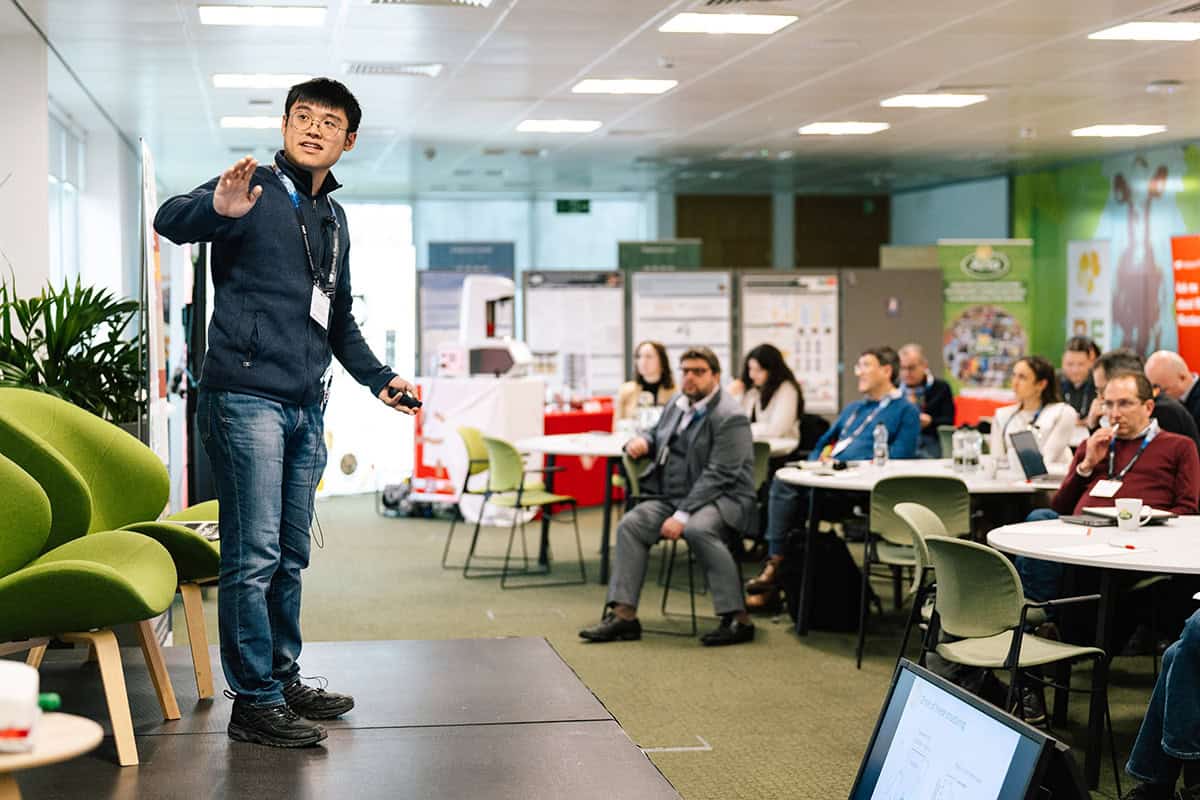
“We are engaged in creating a more sustainable food industry at AI Food Lab,” Povey says. “Along the way, new measurement techniques, advances in mathematics, plus PIAI and PIML innovations will transform our understanding of the physics of food and nutrition.”
For both Povey and Glover, who this summer ends his five-year stint as IOP food physics chair, being part of an organization that promotes and defends physics is integral to their professional identities. “With the help of our colleagues at the IOP, we weathered the COVID years with online events and have had three strong in-person annual conferences since then,” says Glover. “The feedback on our conferences is fantastic and it genuinely feels like our members want to be there, engaging face-to-face with their peers.”
For Glover, the food physics group is all about bringing like-minded scientists and engineers together, with a self-sustaining community of shared practice among the main achievements during his tenure as group chair. “Looking ahead, the group will continue to educate physicists in academia about the richness of questions in food science,” he says. “Just as important, we will engage industry scientists about the role of physics as a ‘quiet enabler’ of technology translation and food-product innovation.”
Food physics: the next generation
One notable feature of the IOP food physics group’s annual gathering is the prominence given to early-career researchers. Food Physics X in February was no different, with the work of two early-career scientists recognized by best poster awards.

Best oral poster: Molly Massey, University of Leeds, UK
The crystallization and melting behaviour of blends of cocoa-butter equivalents and milk fats using small- and wide-angle X-ray scattering (SAXS/WAXS).
The texture, gloss and shelf-life of chocolate are largely governed by fat crystallization during production, with developers’ ability to control the various crystalline forms (or “polymorphs”) of cocoa butter underpinning the quality of the end-product. However, growing demand for plant-based alternatives means that food manufacturers want to replicate the qualities of cocoa butter using cocoa-butter equivalents (CBEs).
With this in mind, Massey is using synchrotron SAXS/WAXS experiments to evaluate the role of anhydrous milk fat – traditionally used in milk chocolate to influence texture, polymorphic transitions and melting profiles – on the crystallization behaviour of CBE blends. Her long-term goal is to replicate those structural and thermal effects in dairy-free material systems that rely on milk-fat replacement blends.
Best paper poster: Ashley Roye, King’s College London, UK
Biomimetic modelling of oral mucus microstructure for understanding lubrication and taste transport.
Roye is investigating the interaction between the mouth’s salivary/mucus layers and “tastant” molecules, which are food compounds that trigger the sensation of taste. Her research focuses on how mucins (large protein molecules with carbohydrate attachments) in saliva and the mucosal lining mediate tastant transport to the taste buds and, in turn, how that process influences lubrication, mouthfeel and textural sensation of different food components.
The weirdness of quantum contextuality is not a bug – it’s a feature
A new study shows that one of quantum mechanics’ strangest properties may be the secret ingredient that makes powerful quantum computers possible. According to research by physicists at A*STAR and the National University of Singapore (NUS), this property, known as contextuality, plays a central role in error-correcting codes – the mathematical tools that protect quantum information from noise. The finding suggests that quantum weirdness is not just an exotic curiosity. Instead, it’s baked into the very structure of the codes that keep quantum computers alive.
The tiniest disturbance – a stray vibration, a fluctuation in temperature – can corrupt the information that quantum computers process. To deal with this, physicists use quantum error correction: a clever strategy that spreads information across many physical quantum bits (qubits) and continuously checks them for faults, without directly reading the data they encode. But there’s a catch. Even a perfectly error-corrected quantum computer isn’t automatically powerful. To run any quantum algorithm you could ever want – what physicists call being “universal” – you need to perform a complete set of operations on your qubits, known as gates. These are the quantum equivalent of the logical operations that underpin classical computing.
It would be nice if we could accomplish this with gates that act independently on each physical qubit, as this would prevent errors from spreading between qubits. Unfortunately, a fundamental theorem called the Eastin-Knill theorem states that no single error-correcting code can implement a universal set of gates using only this type of gates, which are known as transversal gates.
The standard workaround is to use two complementary codes and switch between them, with each one supplying the transversal gates the other cannot. This strategy is called code-switching, and physicists regard it as one of the most promising routes towards truly capable quantum hardware.
For years, though, a basic question lingered: what allows code-switching to work? What resource makes universal fault-tolerant quantum computation possible in the first place?
A quantum resource hiding in plain sight
A new PRX Quantum paper by Kishor Bharti and colleagues at NUS and A*STAR points to a surprising answer: quantum contextuality. This is one of those quantum properties that sounds philosophical but has very real consequences. In everyday life, measuring something – say, the temperature of a room – gives you the same answer regardless of what else you measure at the same time. In contrast, the outcome of a quantum measurement can depend on the context – that is, on which other measurements you perform alongside it.
To make this more concrete, imagine you have two qubits. Some pairs of measurements you can perform on these qubits are incompatible. In mathematical terms, they do not commute with each other, and you cannot perform them simultaneously without one disturbing the other. Position and momentum are good examples: Heisenberg’s uncertainty principle states that they cannot be measured simultaneously at arbitrarily high precision. On the other hand, measuring the spin of qubit 1 along the x-axis and the spin of qubit 2 along the z-axis at the same time is perfectly allowed: these variables commute, so these measurements are compatible.
But here’s the really strange part: the statistics of what you observe for qubit 1 can depend on which measurement you choose to perform on qubit 2, even when the measurements are compatible. This isn’t a matter of ignorance or experimental imprecision. It is a provable, fundamental feature of quantum theory with no counterpart in classical physics, one that was made rigorous by the mathematicians Simon B Kochen and Ernst Specker in 1967 as a generalization of the more famous notion of quantum nonlocality articulated by John Bell.
Contextuality was already known to play a role in specific quantum computing tasks. In particular, it is important for a technique called magic state distillation, which is used to boost the power of fault-tolerant hardware. But the latest work goes much further. It shows that contextuality is not just a useful tool you can optionally invoke. Instead, it is a built-in feature of any error-correcting code capable of supporting universal computation.
A clean threshold with big consequences
Bharti and colleagues studied a broad family of error-correcting codes known as subsystem stabilizer codes, which use a mix of commuting and non-commuting measurements. They found a remarkably clean result: one of these codes is contextual if and only if it has at least two so-called gauge qubits, which are extra degrees of freedom that arise from those non-commuting measurements. Below that, the code’s measurement statistics can always be explained classically. Above it, quantum weirdness is irreducible.
When this criterion is applied to code-switching protocols, the finding becomes even more striking. Every major protocol known to achieve universal quantum computation – including well-studied examples like switching between the Steane code and the Reed-Muller code – sits above this threshold. As team member Andrew Tanggara explains: “We show that a large family of code-switching protocols must necessarily use a contextual subsystem code.” The mathematics suggests this is no coincidence: universality and contextuality appear to be inseparable.
A new lens for quantum hardware design
The team’s result means that contextuality now joins entanglement as a fundamental resource that error-correcting codes possess to enable universal computation. This gives quantum engineers and theorists a powerful new diagnostic tool. If a proposed code architecture turns out to be non-contextual, no amount of clever engineering will make it universal through code-switching alone. Contextuality is not a nice-to-have – it is a prerequisite.
The new findings also deepen our understanding of why quantum computers can do things classical ones cannot. It is not simply because qubits can be in superposition, or because they can be entangled. It is because quantum systems are contextual – and that contextuality, it turns out, is precisely what gets encoded into the structure of the most powerful error-correcting codes we know how to build.
AI could help human scientists pick promising research topics
Large language models (LLMs) could help human scientists identify interesting research topics that have not previously been explored, say scientists at Germany’s Karlsruhe Institute of Technology (KIT). By analysing abstracts in materials science publications and mapping connections between different concepts, the model was able to generate predictions for future areas of interest that the KIT team says are more precise than those produced by traditional, rule-based algorithms.
The number of research articles published each year is increasing so quickly that it is impossible for scientists to keep up with everything, observes team leader Pascal Friederich, who heads a KIT research group on artificial intelligence for materials sciences. While experienced scientists know how to find connections between research areas within their field, identifying links between these and other, unfamiliar topics is a different story.
Training the model
Friederich suspected that machine learning (ML) could help solve this problem by identifying hitherto unthought-of combinations of topics and expanding the list of areas to explore. To test this hypothesis, he and his colleagues used an open-source LLM called LLaMa-2-13B to zoom in on key words and phrases in abstracts of papers in materials science. They then used a database of manually labelled abstracts to train the model, fine-tuning it to focus on only the most relevant concepts. These initial training data can be iteratively extended by adding LLM annotations that have been checked and corrected by human researchers.
Using this model, the KIT team isolated approximately 510 000 chemical formulae and 3 600 000 concepts from the 221 000 abstracts in their database – an average of 2.3 chemical formulae and 16.3 concepts per abstract. After removing duplicates, these numbers dropped to around 52 000 unique formulae and 1 241 000 unique concepts.
The researchers then constructed a graph that included only the concepts that appeared at least three times in the journal articles, and that consisted of at least two words. The resulting knowledge network has approximately 137 000 nodes, one for each key word or phrase.
Connecting the nodes
The team used a second ML model to connect nodes when different terms are often mentioned together. “For example, if our LLM observes that terms like ‘perovskite’ and ‘solar cell’ appear more often together, it will draw a new link in the concept graph,” explains Thomas Marwitz, who began the study as part of his undergraduate thesis. “Then an ML model analyses trends in these links to predict which combinations of scientific concepts could become more significant in the next two or three years.”
Marwitz, who is now studying for a master’s in computer science, explains that the ML model does this by analysing how links between terms change over time. When certain concepts are becoming linked with increasing frequency, this may indicate that a new field of research is developing. On the other hand, a decrease in the number of links might imply than certain topics are attracting less attention.
The results of these analyses suggest that LLMs could indeed be used to direct researchers toward topic combinations that had previously received little attention, Marwitz says. In follow-up interviews conducted as part of the study, researchers in many fields confirmed that at least some of the AI-generated suggestions were genuinely innovative and promising. Some examples include: “conventional ceramic” + ”graphene oxide”, “tensile strain” + ”molecular architecture” and “multiphase structure” + ”selective laser melting”.
Not “an invention machine”
According to Friederich, the concepts extracted are more precise than was possible with rule-based approaches. The LLM’s capabilities also reduced the amount of manual annotation work required. For example, it was able to extract concepts that were not present verbatim in the text, while also removing “filler” words and making plural-to-singular conversions.
However, Friederich stresses that the technique is not an “invention machine” for automating scientific discoveries. “It is simply an analytic tool that can help to identify new ideas and opportunities for collaboration more effectively,” he says. “Our aim is to provide targeted support for scientific creativity.”
The study, which is detailed in Nature Machine Intelligence, is clearly only a first step on the way to true AI-supported science, he tells Physics World. “Much still needs to be done to improve the methodology behind our approach, extend its scope beyond just core materials science and extend the capabilities of the AI system from idea generation to autonomous hypothesis formulation, planning, execution, and analysis,” Friederich says.
He adds that the study was a departure from the group’s usual research, and it was not easy to get funding for it. “I hope that more such bold and exploratory research ideas will receive support in the future, given that LLM-based agentic systems are starting to perform standard research tasks with increasing reliability and complexity,” he says.
Evidence for a ‘forbidden range’ of black hole masses emerges in gravitational wave observations

Predictions that black holes cannot form within a certain “forbidden zone” of stellar masses have gained support thanks to a new analysis of gravitational waves detected by the LIGO–Virgo–KAGRA network of observatories. The analysis, which was conducted by researchers at Australia’s Monash University, adds weight to the theory that stars between 50 and 130 times more massive than our Sun end their lives in a type of supernova that was predicted in the 1960s but has never been directly observed.
Most massive stars collapse at the end of their lives to form black holes. Theories of stellar evolution, however, suggest that stars in a middling-to-higher range of masses will instead explode as so-called “pair-instability” supernovas. These events are so powerful that they completely destroy the star, leaving nothing – not even a black hole – in its wake.
If this explanation is correct, there should be a gap in the observed range of black hole masses. Finding evidence of such a gap is not easy, but in recent years, researchers have developed a way of searching for it using observations of gravitational waves – the tiny ripples in space-time produced when super-heavy objects like black holes collide.
A mass gap for secondary black holes
In the new work, researchers led by Hui Tong analysed data from LIGO–Virgo–KAGRA’s fourth Gravitational-Wave Transient Catalog (GWTC-4), which contains information on the distribution of masses within binary black hole systems. Based on these data, the team report that there is indeed a gap in the masses of the smaller of the two black holes in the binary. None of these so-called secondary black holes had masses between 44 and 116 times the solar mass, M⊙.
The masses of the primary (that is, larger mass) black holes in the binaries showed no such gap. However, the Monash researchers argue that their findings nevertheless support the “forbidden zone” theory. They point out that the mass range they identified is very similar to the range over which primary black holes in a binary start to spin more rapidly. According to Tong, this shift could mean that these black holes formed via a different mechanism. For example, they may have formed from merging black holes rather than directly from collapsing stars.
If confirmed, Tong says this hypothesis could change our understanding of how massive stars evolve and how black holes are born. “We are essentially using something invisible, black holes, as a record of some of the brightest explosions in the universe,” he says. “Instead of observing the explosion directly, we infer its effect from what is left behind in the black hole population. In doing so, we can connect the properties of these remnants to what happened inside the star at the moment of explosion.”
The challenge of detecting an absence
Although pair-instability supernovae were predicted six decades ago, Tong says that traditional light-based (electromagnetic) telescopes struggle to detect them because they are rare, distant and leave little direct trace that can be uniquely identified. In this respect, he says that gravitational-wave astronomy could be game-changing: “The detection of gravitational waves allows us to ‘hear’ the violent collisions of the most compact objects in the universe and directly measure the properties of black holes across cosmic time.”
Even with this new tool, though, the work was not without difficulties. One of the biggest challenges, Tong recalls, was figuring out whether patterns observed in the black hole masses were real. “A large part of our work therefore involved testing different assumptions in our models and checking whether the results still held,” he says. “That process takes time, but it’s essential for building confidence that we’re truly uncovering how black holes form and evolve.”
“Next generation gravitational wave observatories will be transformative”
Tong hopes that future gravitational-wave observations will steadily increase the number of detected black hole mergers, allowing researchers to build a much clearer picture of black hole mass distribution. “In the near term, current detectors such as LIGO will continue to improve this picture by finding more events and reducing uncertainties, helping us confirm how robust the features really are,” he explains. “Then, next generation gravitational wave observatories planned for the 2030s will be transformative. With their much greater sensitivity, they will be able to detect black hole mergers from across a large fraction of the observable universe, potentially observing tens of thousands of merging black holes per year.”
Turning gravitational wave astronomy from a field with hundreds of detections into one with an almost continuous stream of black hole signals would bring enormous advantages, he adds. “It would allow us to see far more distant and fainter systems, including black holes formed when the universe was only a few billion years old (compared to its current age of about 13.8 billion years), during its early and more active stages of star formation and trace how stars evolve over the history of the cosmos.”
The present work is described in Nature.
Oppenheimer unfiltered: rare recordings released to the public
The latest episode of Physics World Stories dives into a remarkable archival release. A series of audio interviews with Robert Oppenheimer, recorded in the 1960s, is now accessible through the American Institute of Physics (AIP). Made available for non-commercial use in collaboration with the Oppenheimer family, these recordings offer a rare chance to hear the physicist’s voice and experience his unfiltered thoughts.
AIP digital archivist Allison Buser guides listeners through the significance of the collection, interspersed with clips. The first interview (1960) captures Oppenheimer reflecting on the lead-up to and aftermath of the Trinity test. A 1963 oral history with science historian Thomas S Kuhn shifts focus to Oppenheimer’s personal journey and his views on quantum and nuclear physics. The final interview (1966), sees him discussing Enrico Fermi’s legacy and the physics community of his era.
Hosted by Andrew Glester, this episode provides a rare glimpse into one of the most consequential scientists of the 20th century. You can find links to the full archive material in the AIP newsletter, along with further context in this article by Allison Buser. You can also hear an interview with Kai Bird, co-author of American Prometheus, the book that inspired the 2023 blockbuster film Oppenheimer.
The Physics World 2026 Particle and Nuclear Briefing is out now
Since taking up the role of CERN director-general earlier this year, Mark Thomson has already had to contemplate the consequences of funding changes within the UK’s research councils.
Late last year, UK Research and Innovation, the umbrella organization for the UK’s research councils, did not commit any further contributions towards a major £150m upgrade to the LHCb detector – one of the four large experiments at the Large Hadron Collider that continues to do pioneering science.
As we report in the Physics World 2026 Particle & Nuclear Briefing, unless the decision is overturned or other avenues of funding are found, the experiment will now finish operations in 2033 and not take advantage of the High-Luminosity LHC (HL-LHC) that is currently being installed at CERN.
Another item in Thomson’s in-tray will be setting the course for the next flagship collider at CERN after the HL-LHC finishes operations in the 2040s.
In the ongoing process to update the European Strategy for Particle Physics, the Future Circular Collider (FCC) is the preferred option. Constructed near the LHC, this huge 91 km circumference electron–positron collider will come with a significant cost of $18bn. Thomson could find it a hard sell with some of the funding needing to come from outside CERN’s 24 member states.

As physicist and historian Michael Riordan points out in the briefing, the eye-watering cost of the FCC together with the worsening geopolitics of a fragmenting world order could make funding and building such colliders risky.
There are still many open questions over building the FCC, and indeed the future of particle physics, and some of those issues are set to be discussed at the 17th International Particle Accelerator Conference, which will be held in Deauville, France, from 17-22 May.
Elsewhere in the briefing, we talk to six physicists working across the nuclear energy industry, highlighting how a background in physics can open many doors in this expanding sector, and take a look at an obscure theory of elementary particles that proved to be key to China’s re-emergence as a scientific nation after the Cultural Revolution had stalled its development.
- The free-to-read Physics World 2026 Particle & Nuclear Briefing is available here.
Strain engineered single crystal silver films
It is straightforward to produce polycrystalline metal films on wafers but producing single‑crystal metal films is far more challenging. Because single crystals have no grain boundaries (the joints between differently oriented crystal regions in polycrystalline materials), they offer much better electrical performance: higher conductivity, lower resistive losses, improved high‑frequency behaviour (important for high‑speed communication and 5G), and reduced noise for quantum technologies. As a result, methods for reliably producing single‑crystal films are highly sought after.
Single‑crystal silver and copper films are particularly valuable. Silver is an exceptional conductor of both electricity and light, while copper provides excellent thermal management and reduces resistive heating. However, growing silver on copper is notoriously difficult because the two materials have a large lattice mismatch (13%), which normally introduces strain, defects, dislocations, and rough, low‑quality films. This makes conventional epitaxy essentially impossible.
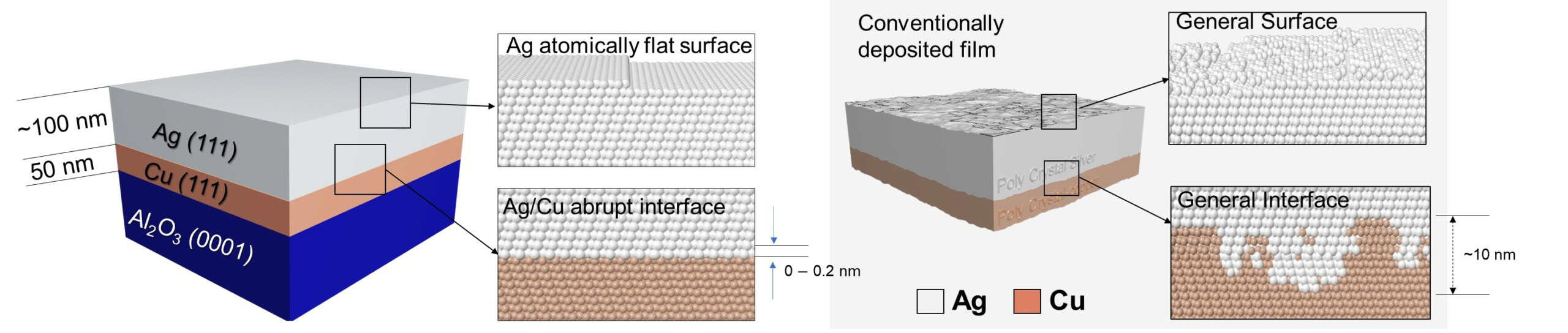
In this work, the researchers overcame this barrier using Atomic Sputtering Epitaxy, which allows precise atomic deposition, combined with post‑annealing to reduce twin boundaries. They discovered that the mismatch strain is absorbed entirely within the first atomic layer of silver. This occurs because the atoms at the interface shift sideways in a periodic, controlled pattern that releases the strain. This represents a new form of heteroepitaxy in which two materials with different lattice periodicities can still grow together seamlessly.
They demonstrated wafer‑scale, defect‑free single‑crystal silver films on copper despite the huge lattice mismatch, enabling ultra‑high quality metal films for advanced optical and electronic technologies. This approach opens the door to new heteroepitaxial systems and provides a route to producing silver films with exceptional optical and electronic performance.
“What we find most notable is that a 13% lattice mismatch, which would normally prevent clean heteroepitaxy, is absorbed almost entirely within the first monoatomic Ag layer at the Ag/Cu interface, allowing the film above to grow as if on its own native lattice and yielding wafer-scale, grain-boundary-free films with atomically flat surfaces. We hope this concept of a strain-absorbing monolayer interface can be extended to other dissimilar metal pairs.” – Professor Young-Min Kim, Sungkyunkwan University
Read the full article
Su Jae Kim et al 2026 Rep. Prog. Phys. 89 028002
Do you want to learn more about this topic?
Si/Ge nanostructures by Karl Brunner (2001)
A new standard for p‑wave scattering theory
Physicists study ultracold lithium‑6 because it is a fermionic isotope of lithium: its nucleus contains three protons and three neutrons, giving it a half‑integer total spin. This makes lithium‑6 behave like other fundamental fermions such as electrons, protons, and neutrons, in contrast to lithium‑7, which has an integer spin and is a boson. According to the Pauli exclusion principle, fermions cannot occupy the same quantum state, so lithium‑6 provides a clean, controllable system for exploring how fermionic particles behave. It is also relatively easy to cool to ultracold temperatures, and its interactions can be tuned very precisely using magnetic fields. At these temperatures, atomic motion slows dramatically, allowing quantum mechanical effects to become directly observable.
In this work, the researchers studied three‑body recombination processes, where three atoms collide and two of them form a molecule while the third atom carries away the excess energy. The escaping atom has information about how the three atoms interacted. By tuning the interactions with a magnetic field using a Feshbach resonance, the researchers were able to access a p‑wave resonance (where atoms collide with orbital angular momentum) rather than the more common s‑wave (head‑on collisions). P‑wave interactions are especially important because they are linked to exotic quantum systems such as topological superfluidity and strongly correlated fermionic phases.
The researchers developed a highly stable technique to measure how often atoms are lost due to three‑body recombination for different orbital orientations of the collision. This high‑precision method allowed them to distinguish the orbital components, measure how the recombination rate changes with temperature and magnetic field and extract microscopic parameters that characterize p‑wave interactions. This work establishes a precise benchmark for p‑wave scattering theory, introduces a powerful method for probing direction‑dependent interactions, and lays the groundwork for exploring complex quantum phenomena such as anisotropic pairing, few‑body universality, and topological superfluidity relevant to future quantum technologies.
Read the full article
Orbital-resolved three-body recombination across a p-wave Feshbach resonance in ultracold 6Li
Shaokun Liu et al 2026 Rep. Prog. Phys. 89 020502
Do you want to learn more about this topic?
Single atom detection in ultracold quantum gases: a review of current progress by Herwig Ott (2016)
Copyright © 2026 by IOP Publishing Ltd and individual contributors