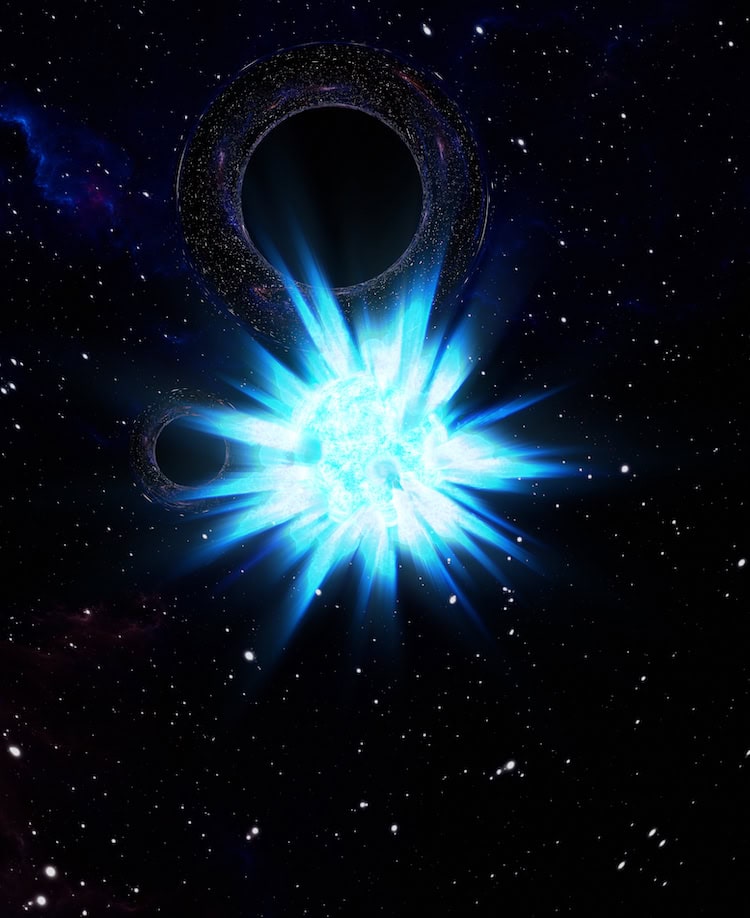
Predictions that black holes cannot form within a certain “forbidden zone” of stellar masses have gained support thanks to a new analysis of gravitational waves detected by the LIGO–Virgo–KAGRA network of observatories. The analysis, which was conducted by researchers at Australia’s Monash University, adds weight to the theory that stars between 50 and 130 times more massive than our Sun end their lives in a type of supernova that was predicted in the 1960s but has never been directly observed.
Most massive stars collapse at the end of their lives to form black holes. Theories of stellar evolution, however, suggest that stars in a middling-to-higher range of masses will instead explode as so-called “pair-instability” supernovas. These events are so powerful that they completely destroy the star, leaving nothing – not even a black hole – in its wake.
If this explanation is correct, there should be a gap in the observed range of black hole masses. Finding evidence of such a gap is not easy, but in recent years, researchers have developed a way of searching for it using observations of gravitational waves – the tiny ripples in space-time produced when super-heavy objects like black holes collide.
A mass gap for secondary black holes
In the new work, researchers led by Hui Tong analysed data from LIGO–Virgo–KAGRA’s fourth Gravitational-Wave Transient Catalog (GWTC-4), which contains information on the distribution of masses within binary black hole systems. Based on these data, the team report that there is indeed a gap in the masses of the smaller of the two black holes in the binary. None of these so-called secondary black holes had masses between 44 and 116 times the solar mass, M⊙.
The masses of the primary (that is, larger mass) black holes in the binaries showed no such gap. However, the Monash researchers argue that their findings nevertheless support the “forbidden zone” theory. They point out that the mass range they identified is very similar to the range over which primary black holes in a binary start to spin more rapidly. According to Tong, this shift could mean that these black holes formed via a different mechanism. For example, they may have formed from merging black holes rather than directly from collapsing stars.
If confirmed, Tong says this hypothesis could change our understanding of how massive stars evolve and how black holes are born. “We are essentially using something invisible, black holes, as a record of some of the brightest explosions in the universe,” he says. “Instead of observing the explosion directly, we infer its effect from what is left behind in the black hole population. In doing so, we can connect the properties of these remnants to what happened inside the star at the moment of explosion.”
The challenge of detecting an absence
Although pair-instability supernovae were predicted six decades ago, Tong says that traditional light-based (electromagnetic) telescopes struggle to detect them because they are rare, distant and leave little direct trace that can be uniquely identified. In this respect, he says that gravitational-wave astronomy could be game-changing: “The detection of gravitational waves allows us to ‘hear’ the violent collisions of the most compact objects in the universe and directly measure the properties of black holes across cosmic time.”
LIGO could observe intermediate-mass black holes using artificial intelligence
Even with this new tool, though, the work was not without difficulties. One of the biggest challenges, Tong recalls, was figuring out whether patterns observed in the black hole masses were real. “A large part of our work therefore involved testing different assumptions in our models and checking whether the results still held,” he says. “That process takes time, but it’s essential for building confidence that we’re truly uncovering how black holes form and evolve.”
“Next generation gravitational wave observatories will be transformative”
Tong hopes that future gravitational-wave observations will steadily increase the number of detected black hole mergers, allowing researchers to build a much clearer picture of black hole mass distribution. “In the near term, current detectors such as LIGO will continue to improve this picture by finding more events and reducing uncertainties, helping us confirm how robust the features really are,” he explains. “Then, next generation gravitational wave observatories planned for the 2030s will be transformative. With their much greater sensitivity, they will be able to detect black hole mergers from across a large fraction of the observable universe, potentially observing tens of thousands of merging black holes per year.”
Turning gravitational wave astronomy from a field with hundreds of detections into one with an almost continuous stream of black hole signals would bring enormous advantages, he adds. “It would allow us to see far more distant and fainter systems, including black holes formed when the universe was only a few billion years old (compared to its current age of about 13.8 billion years), during its early and more active stages of star formation and trace how stars evolve over the history of the cosmos.”
The present work is described in Nature.