Since taking up the role of CERN director-general earlier this year, Mark Thomson has already had to contemplate the consequences of funding changes within the UK’s research councils.
Late last year, UK Research and Innovation, the umbrella organization for the UK’s research councils, did not commit any further contributions towards a major £150m upgrade to the LHCb detector – one of the four large experiments at the Large Hadron Collider that continues to do pioneering science.
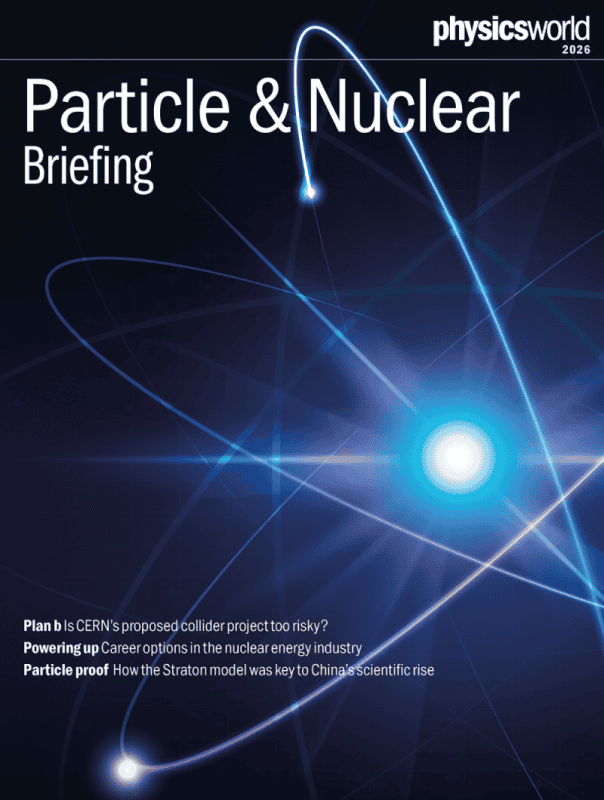
As we report in the Physics World 2026 Particle & Nuclear Briefing, unless the decision is overturned or other avenues of funding are found, the experiment will now finish operations in 2033 and not take advantage of the High-Luminosity LHC (HL-LHC) that is currently being installed at CERN.
Another item in Thomson’s in-tray will be setting the course for the next flagship collider at CERN after the HL-LHC finishes operations in the 2040s.
In the ongoing process to update the European Strategy for Particle Physics, the Future Circular Collider (FCC) is the preferred option. Constructed near the LHC, this huge 91 km circumference electron–positron collider will come with a significant cost of $18bn. Thomson could find it a hard sell with some of the funding needing to come from outside CERN’s 24 member states.
As physicist and historian Michael Riordan points out in the briefing, the eye-watering cost of the FCC together with the worsening geopolitics of a fragmenting world order could make funding and building such colliders risky.
There are still many open questions over building the FCC, and indeed the future of particle physics, and some of those issues are set to be discussed at the 17th International Particle Accelerator Conference, which will be held in Deauville, France, from 17-22 May.
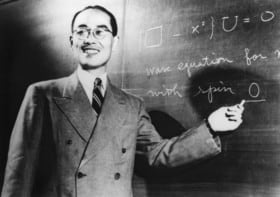
Elsewhere in the briefing, we talk to six physicists working across the nuclear energy industry, highlighting how a background in physics can open many doors in this expanding sector, and take a look at an obscure theory of elementary particles that proved to be key to China’s re-emergence as a scientific nation after the Cultural Revolution had stalled its development.
- The free-to-read Physics World 2026 Particle & Nuclear Briefing is available here.