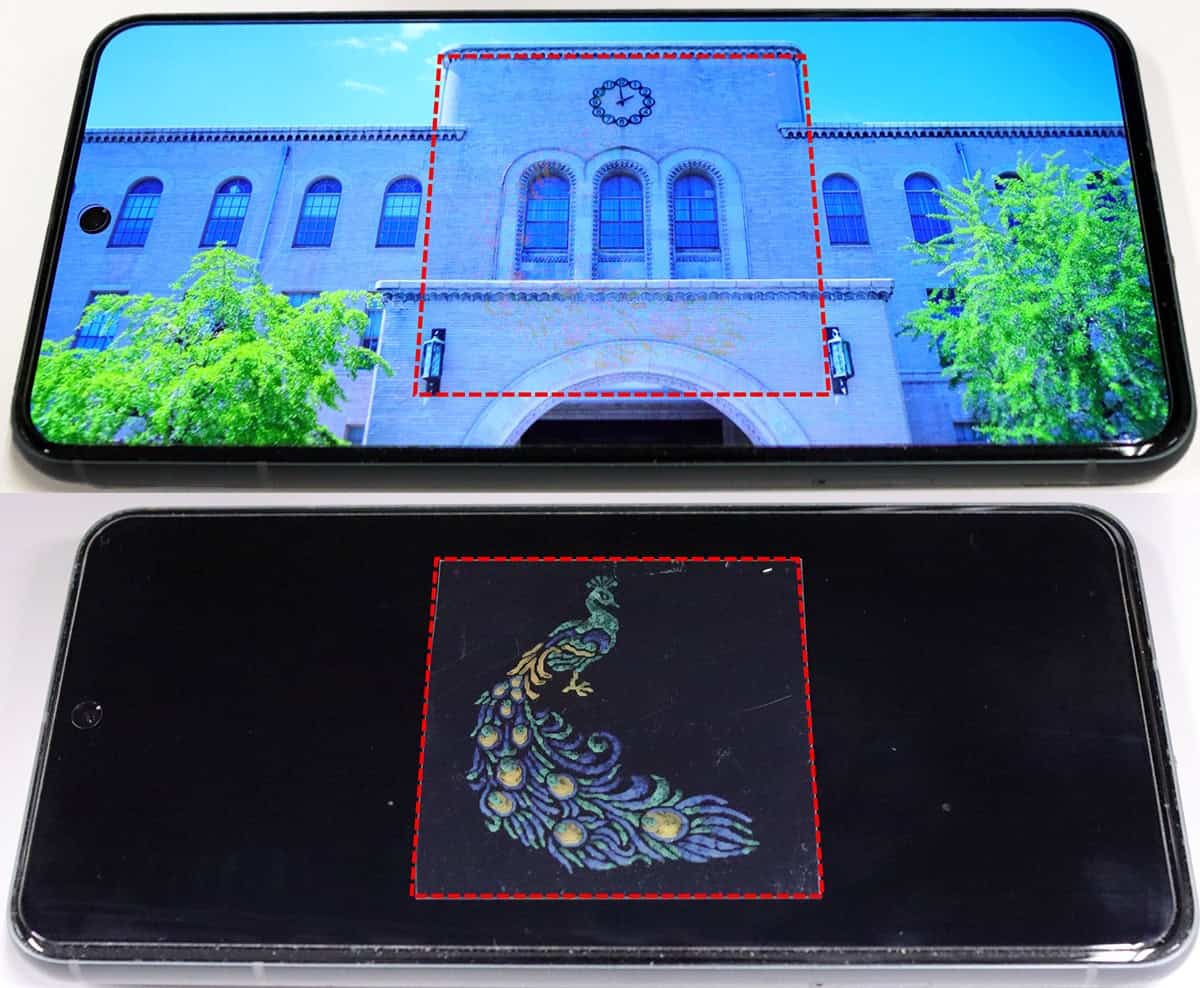
The majority of printing processes today are performed using different coloured pigments. However, there’s another type of colour called structural colour, which typically uses nanoscale structures that interact with light to produce a colour. By refracting and reflecting light at specific wavelengths, these nanostructures can produce incredibly bright colours that (unlike pigments) do not fade over time, unless the structure is physically altered. Structural colour is often found in nature – creating the brilliant colours of a peacock’s tail feathers, for example – but has been difficult to print using conventional printers.
Most instances of creating structural colour involve diffracting light through periodic polymers or transparent oxide nanostructures, but these approaches cause a strong iridescence – where the colour changes depending upon the viewing angle – which can limit the practicality for some applications. To print structural colour materials, other options are needed.
Researchers from Kobe University in Japan have now achieved this, by developing a Mie-resonant silicon nanoparticle ink that can be printed onto flat or three-dimensional surfaces using an inkjet printer. Mie resonant systems are highly refractive particle systems that enhance light–matter interactions at specific wavelengths and can boost optical effects.
“We undertook this research to bridge fundamental Mie-resonant nanophotonics with scalable printing technologies, enabling structural colour to move from laboratory demonstrations to practical, large-area applications,” explains Hiroshi Sugimoto, one of the study’s lead authors.
The research team at Kobe University has been developing spherical crystalline silicon nanoparticles with a high refractive index and low extinction coefficient that reflect specific wavelengths of light to produce certain colours. These particles, ranging in diameter from 100–200 nm, were used as the basis for the new ink, moving away from more traditional, unprintable structural colour materials.
The researchers wanted to develop structural colour inks that can be processed like conventional inks or paints. However, they initially found that when the solvent dried, the particles tended to aggregate. This aggregation changed how the particles interact with light and degraded the colouration of the ink. To overcome this issue, the team coated the silicon nanoparticles with thick silica shells and formulated them into a water-based acrylic emulsion. Unlike the crystalline silicon particles, the protective shells have a low refractive index so they don’t they don’t bend the light. As such, they provide a transparent coating that prevents aggregation without affecting the structural colour output.
The researchers used the nanoparticle ink to print images on a flat polymer film and a 3D metallic surface, using an inkjet printer at resolutions of between 250 and 125 dots per inch. They found that the images exhibited optical asymmetry – showing a different colour when light passes through the image (transmission) to when it is reflected from above – due to the Mie refraction that the particles exhibit.
The researchers also found that that the hue can be tuned by changing the diameter of the nanoparticles. This allowed them to create multi-colour patterns with tuneable reflection/transmission colour asymmetry by using nanoparticle inks with different particle sizes.
“The most important finding is that we achieved structural colour printing using silicon nanoparticles, overcoming the long-standing reliance on periodic arrays in conventional structural colour systems,” says Sugimoto.
Phase-changing material generates vivid tunable colours

Potential applications of these tuneable and printable inks include anti-counterfeiting images, semi-transparent smart windows, smart displays and vibrant art pieces (that won’t fade over time). For example, when the ink is printed on to a monitor, the printed images will be invisible when the display is on. However, when the display is turned off, the images become visible, which allows for information display without using any energy.
When asked about where they plan to take the research next, Sugimoto tells Physics World that “building on this work, we aim to further control and exploit this optical asymmetry for multifunctional systems, such as anti-counterfeiting and decorative films on buildings and windows, using scalable nanophotonic printing”.
The research was published in Advanced Materials.