Quantum error correction codes protect quantum information from decoherence and quantum noise, and are therefore crucial to the development of quantum computing and the creation of more reliable and complex quantum algorithms. One example is the five-qubit error correction code, five being the minimum number of qubits required to fix single-qubit errors. These contain five physical qubits (a basic off/on unit of quantum information made using trapped ions, superconducting circuits, or quantum dots) to correct one logical qubit (a collection of physical qubits arranged in such a way as to correct errors). Yet imperfections in the hardware can still lead to quantum errors.
A method of testing quantum error correction codes is self-testing. Self-testing is a powerful tool for verifying quantum properties using only input-output statistics, treating quantum devices as black boxes. It has evolved from bipartite systems consisting of two quantum subsystems, to multipartite entanglement, where entanglement is among three or more subsystems, and now to genuinely entangled subspaces, where every state is fully entangled across all subsystems. Genuinely entangled subspaces offer stronger, guaranteed entanglement than general multipartite states, making them more reliable for quantum computing and error correction.
In this research, self-testing techniques are used to certify genuinely entangled logical subspaces within the five-qubit code on photonic and superconducting platforms. This is achieved by preparing informationally complete logical states that span the entire logical space, meaning the set is rich enough to fully characterize the behaviour of the system. They deliberately introduce basic quantum errors by simulating Pauli errors on the physical qubit, which mimics real-world noise. Finally, they use mathematical tests known as Bell inequalities, adapted to the framework used in quantum error correction, to check whether the system evolves in the initial logical subspaces after the errors are introduced.
Extractability measures tell you how close the tested quantum system is to the ideal target state, with 1 being a perfect match. The certification is supported by extractability measures of at least 0.828 ± 0.006 and 0.621 ± 0.007 for the photonic and superconducting systems, respectively. The photonic platform achieved a high extractability score, meaning the logical subspace was very close to the ideal one. The superconducting platform had a lower score but still showed meaningful entanglement. These scores show that the self-testing method works in practice and confirm strong entanglement in the five-qubit code on both platforms.
This research contributes to the advancement of quantum technologies by providing robust methods for verifying and characterizing complex quantum structures, which is essential for the development of reliable and scalable quantum systems. It also demonstrates that device-independent certification can extend beyond quantum states and measurements to more general quantum structures.
For almost a century, physicists have tried to understand why and how materials become magnetic. From refrigerator magnets to magnetic memories, the microscopic origins of magnetism remain a surprisingly subtle puzzle — especially in materials where electrons behave both like individual particles and like a collective sea.
In most transition-metal compounds, magnetism comes from the dance between localized and mobile electrons. Some electrons stay near their home atoms and form tiny magnetic moments (spins), while others roam freely through the crystal. The interaction between these two types of electrons produces “double-exchange” ferromagnetism — the mechanism that gives rise to the rich magnetic behaviour of materials such as manganites, famous for their colossal magnetoresistance (a dramatic change in electrical resistance under a magnetic field). Traditionally, scientists modelled this behaviour by treating the localized spins as classical arrows — big and well-defined, like compass needles. This approximation works well enough for explaining basic ferromagnetism, but experiments over the last few decades have revealed strange features that defy the classical picture. In particular, neutron scattering studies of manganites showed that the collective spin excitations, called magnons, do not behave as expected. Their energy spectrum “softens” (the waves slow down) and their sharp signals blur into fuzzy continua — a sign that the magnons are losing their coherence. Until now, these effects were usually blamed on vibrations of the atomic lattice (phonons) or on complex interactions between charge, spin, and orbital motion.
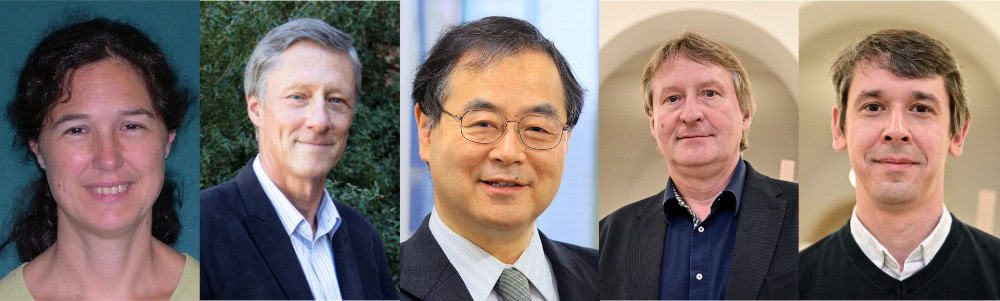
Left to right: Adriana Moreo and Elbio Dagotto from University of Tennessee (USA), Takami Tohyama from Tokyo University of Science (Japan), and Marcin Mierzejewski and Jacek Herbrych from Wrocław University of Technology (Courtesy: Herbrych/Wrocław University of Science and Technology)
A new theoretical study challenges that assumption. By going fully quantum mechanical — treating every localized spin not as a classical arrow but as a true quantum object that can fluctuate, entangle, and superpose — the researchers have reproduced these puzzling experimental observations without invoking phonons at all. Using two powerful model systems (a quantum version of the Kondo lattice and a two-orbital Hubbard model), the team simulated how electrons and spins interact when no semiclassical approximations are allowed. The results reveal a subtle quantum landscape. Instead of a single type of electron excitation, the system hosts two. One behaves like a spinless fermion — a charge carrier stripped of its magnetic identity. The other forms a broad, “incoherent” band of excitations arising from local quantum triplets. These incoherent states sit close to the Fermi level and act as a noisy background — a Stoner-like continuum — that the magnons can scatter off. The result: magnons lose their coherence and energy in just the way experiments observe.
Perhaps most surprisingly, this mechanism doesn’t rely on the crystal lattice at all. It’s an intrinsic consequence of the quantum nature of the spins themselves. Larger localized spins, such as those in classical manganites, tend to suppress the effect — explaining why decoherence is weaker in some materials than others. Consequently, the implications reach beyond manganites. Similar quantum interplay may occur in iron-based superconductors, ruthenates, and heavy-fermion systems where magnetism and superconductivity coexist. Even in materials without permanent local moments, strong electronic correlations can generate the same kind of quantum magnetism.
In short, this work uncovers a purely electronic route to complex magnetic dynamics — showing that the quantum personality of the electron alone can mimic effects once thought to require lattice distortions. By uniting electronic structure and spin excitations under a single, fully quantum description, it moves us one step closer to understanding how magnetism truly works in the most intricate materials.
Using a new type of low-power, compact, fluid-based prism to steer the beam in a laser scanning microscope could transform brain imaging and help researchers learn more about neurological conditions such as Alzheimer’s disease.
“We quickly became interested in biological imaging, and work with a neuroscience group at University of Colorado Denver Anschutz Medical Campus that uses mouse models to study neuroscience,” Gopinath tells Physics World. “Neuroscience is not well understood, as illustrated by the neurodegenerative diseases that don’t have good cures. So a great benefit of this technology is the potential to study, detect and treat neurodegenerative diseases such as Alzheimer’s, Parkinson’s and schizophrenia,” she explains.
The researchers fabricated their patented electrowetting prism using custom deposition and lithography methods. The device consists of two immiscible liquids housed in a 5 mm tall, 4 mm diameter glass tube, with a dielectric layer on the inner wall coating four independent electrodes. When an electric field is produced by applying a potential difference between a pair of electrodes on opposite sides of the tube, it changes the surface tension and therefore the curvature of the meniscus between the two liquids. Light passing through the device is refracted by a different amount depending on the angle of tilt of the meniscus (as well as on the optical properties of the liquids chosen), enabling beams to be steered by changing the voltage on the electrodes.
Beam steering for scanning in imaging and microscopy can be achieved via several means, including mechanically controlled mirrors, glass prisms or acousto-optic deflectors (in which a sound wave is used to diffract the light beam). But, unlike the new electrowetting prisms, these methods consume too much power and are not small or lightweight enough to be used for miniature microscopy of neural activity in the brains of living animals.
In tests detailed in Optics Express, the researchers integrated their electrowetting prism into an existing two-photon laser scanning microscope and successfully imaged individual 5 µm-diameter fluorescent polystyrene beads, as well as large clusters of those beads.
They also used computer simulation to study how the liquid–liquid interface moved, and found that when a sinusoidal voltage is used for actuation, at 25 and 75 Hz, standing wave resonance modes occur at the meniscus – a result closely matched by a subsequent experiment that showed resonances at 24 and 72 Hz. These resonance modes are important for enhancing device performance since they increase the angle through which the meniscus can tilt and thus enable optical beams to be steered through a greater range of angles, which helps minimize distortions when raster scanning in two dimensions.
Bright explains that this research built on previous work in which an electrowetting prism was used in a benchtop microscope to image a mouse brain. He cites seeing the individual neurons as a standout moment that, coupled with the current results, shows their prism is now “proven and ready to go”.
Gopinath and Bright caution that “more work is needed to allow human brain scans, such as limiting voltage requirements, allowing the device to operate at safe voltage levels, and miniaturization of the device to allow faster scan speeds and acquiring images at a much faster rate”. But they add that miniaturization would also make the device useful for endoscopy, robotics, chip-scale atomic clocks and space-based communication between satellites.
The team has already begun investigating two other potential applications: LiDAR (light detection and ranging) systems and optical coherence tomography (OCT). Next, the researchers “hope to integrate the device into a miniaturized microscope to allow imaging of the brain in freely moving animals in natural outside environments,” they say. “We also aim to improve the packaging of our devices so they can be integrated into many other imaging systems.”
Marking 100 years since the advent of quantum mechanics, IYQ aims to raise awareness of the impact of quantum physics and its myriad future applications, with a global diary of quantum-themed public talks, scientific conferences, industry events and more.
You can find out more about the contributions of Indian physicist Satyendra Nath Bose to quantum science; explore weird phenomena such as causal order and quantum superposition; and discover the latest applications of quantum computing.
A century after quantum mechanics was first formulated, many physicists are still undecided on some of the most basic foundational questions. There’s no agreement on which interpretation of quantum mechanics holds strong; whether the wavefunction is merely a mathematical tool or a true representation of reality; or what impact an observer has on a quantum state.
Some of the biggest unanswered questions in physics – such as finding the quantum/classical boundary or reconciling gravity and quantum mechanics – lie at the heart of these conundrums. So as we look to the future of quantum – from its fundamentals to its technological applications – let us hope that some answers to these puzzles will become apparent as we crack the quantum code to our universe.
Unless you’ve been living under a stone, you can’t have failed to notice that 2025 marks the first 100 years of quantum mechanics. A massive milestone, to say the least, about which much has been written in Physics World and elsewhere in what is the International Year of Quantum Science and Technology (IYQ). However, I’d like to focus on a specific piece of quantum technology, namely quantum computing.
I keep hearing about quantum computers, so people must be using them to do cool things, and surely they will soon be as commonplace as classical computers. But as a physicist-turned-engineer working in the aerospace sector, I struggle to get a clear picture of where things are really at. If I ask friends and colleagues when they expect to see quantum computers routinely used in everyday life, I get answers ranging from “in the next two years” to “maybe in my lifetime” or even “never”.
Before we go any further, it’s worth reminding ourselves that quantum computing relies on several key quantum properties, including superposition, which gives rise to the quantum bit, or qubit. The basic building block of a quantum computer – the qubit – exists as a combination of 0 and 1 states at the same time and is represented by a probabilistic wave function. Classical computers, in contrast, use binary digital bits that are either 0 or 1.
Also vital for quantum computers is the notion of entanglement, which is when two or more qubits are co-ordinated, allowing them to share their quantum information. In a highly correlated system, a quantum computer can explore many paths simultaneously. This “massive scale” parallel processing is how quantum may solve certain problems exponentially faster than a classical computer.
The other key phenomenon for quantum computers is quantum interference. The wave-like nature of qubits means that when different probability amplitudes are in phase, they combine constructively to increase the likelihood of the right solution. Conversely, destructive interference occurs when amplitudes are out of phase, making it less likely to get the wrong answer.
Quantum interference is important in quantum computing because it allows quantum algorithms to amplify the probability of correct answers and suppress incorrect ones, making calculations much faster. Along with superposition and entanglement, it means that quantum computers could process and store vast numbers of probabilities at once, outstripping even the best classical supercomputers.
Towards real devices
To me, it all sounds exciting, but what have quantum computers ever done for us so far? It’s clear that quantum computers are not ready to be deployed in the real world. Significant technological challenges need to be overcome before they become fully realisable. In any case, no-one is expecting quantum computers to displace classical computers “like for like”: they’ll both be used for different things.
Yet it seems that the very essence of quantum computing is also its Achilles heel. Superposition, entanglement and interference – the quantum properties that will make it so powerful – are also incredibly difficult to create and maintain. Qubits are also extremely sensitive to their surroundings. They easily lose their quantum state due to interactions with the environment, whether via stray particles, electromagnetic fields, or thermal fluctuations. Known as decoherence, it makes quantum computers prone to error.
That’s why quantum computers need specialized – and often cryogenically controlled – environments to maintain the quantum states necessary for accurate computation. Building a quantum system with lots of interconnected qubits is therefore a major, expensive engineering challenge, with complex hardware and extreme operating conditions. Developing “fault-tolerant” quantum hardware and robust error-correction techniques will be essential if we want reliable quantum computation.
As for the development of software and algorithms for quantum systems, there’s a long way to go, with a lack of mature tools and frameworks. Quantum algorithms require fundamentally different programming paradigms to those used for classical computers. Put simply, that’s why building reliable, real-world deployable quantum computers remains a grand challenge.
What does the future hold?
Despite the huge amount of work that still lies in store, quantum computers have already demonstrated some amazing potential. The US firm D-Wave, for example, claimed earlier this year to have carried out simulations of quantum magnetic phase transitions that wouldn’t be possible with the most powerful classical devices. If true, this was the first time a quantum computer had achieved “quantum advantage” for a practical physics problem (whether the problem was worth solving is another question).
There is also a lot of research and development going on around the world into solving the qubit stability problem. At some stage, there will likely be a breakthrough design for robust and reliable quantum computer architecture. There is probably a lot of technical advancement happening right now behind closed doors.
The first real-world applications of quantum computers will be akin to the giant classical supercomputers of the past. If you were around in the 1980s, you’ll remember Cray supercomputers: huge, inaccessible beasts owned by large corporations, government agencies and academic institutions to enable vast amounts of calculations to be performed (provided you had the money).
And, if I believe what I read, quantum computers will not replace classical computers, at least not initially, but work alongside them, as each has its own relative strengths. Quantum computers will be suited for specific and highly demanding computational tasks, such as drug discovery, materials science, financial modelling, complex optimization problems and increasingly large artificial intelligence and machine-learning models.
These are all things beyond the limits of classical computer resource. Classical computers will remain relevant for everyday tasks like web browsing, word processing and managing databases, and they will be essential for handling the data preparation, visualization and error correction required by quantum systems.
And there is one final point to mention, which is cyber security. Quantum computing poses a major threat to existing encryption methods, with potential to undermine widely used public-key cryptography. There are concerns that hackers nowadays are storing their stolen data in anticipation of future quantum decryption.
Having looked into the topic, I can now see why the timeline for quantum computing is so fuzzy and why I got so many different answers when I asked people when the technology would be mainstream. Quite simply, I still can’t predict how or when the tech stack will pan out. But as IYQ draws to a close, the future for quantum computers is bright.
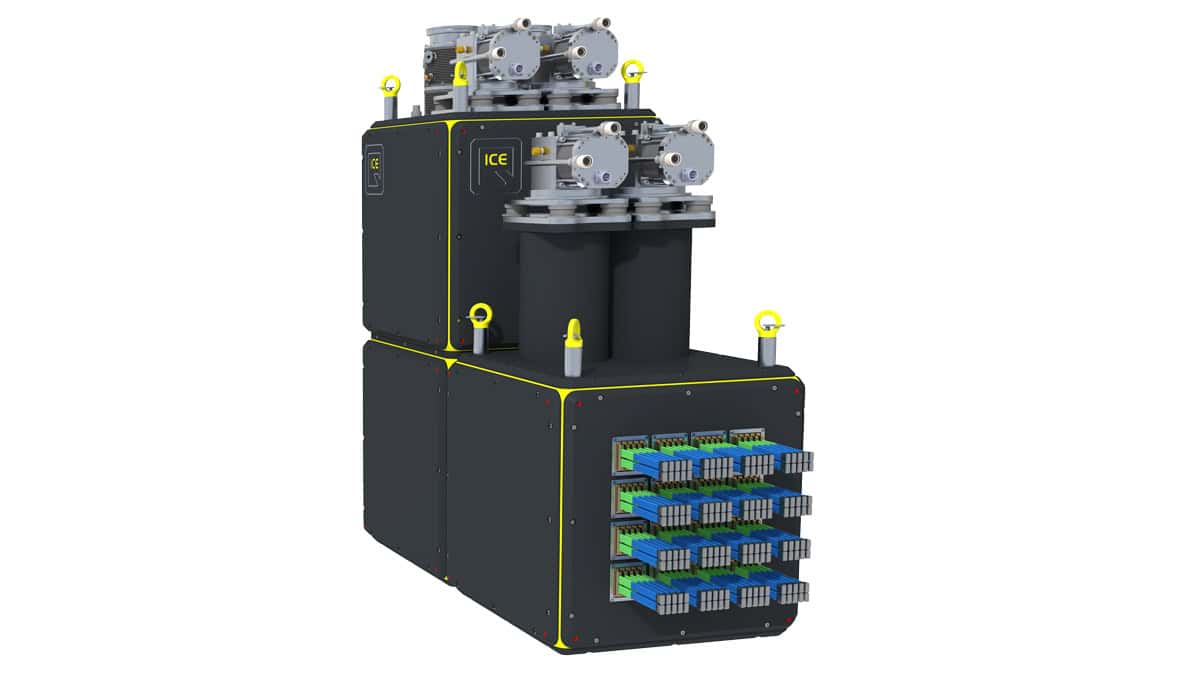
Modular and scalable: the ICE-Q cryogenics platform delivers the performance and reliability needed for professional computing environments while also providing a flexible and extendable design. The standard configuration includes a cooling module, a payload with a large sample space, and a side-loading wiring module for scalable connectivity (Courtesy: ICEoxford)
At the centre of most quantum labs is a large cylindrical cryostat that keeps the delicate quantum hardware at ultralow temperatures. These cryogenic chambers have expanded to accommodate larger and more complex quantum systems, but the scientists and engineers at UK-based cryogenics specialist ICEoxford have taken a radical new approach to the challenge of scalability. They have split the traditional cryostat into a series of cube-shaped modules that slot into a standard 19-inch rack mount, creating an adaptable platform that can easily be deployed alongside conventional computing infrastructure.
“We wanted to create a robust, modular and scalable solution that enables different quantum technologies to be integrated into the cryostat,” says Greg Graf, the company’s engineering manager. “This approach offers much more flexibility, because it allows different modules to be used for different applications, while the system also delivers the efficiency and reliability that are needed for operational use.”
The standard configuration of the ICE-Q platform has three separate modules: a cryogenics unit that provides the cooling power, a large payload for housing the quantum chip or experiment, and a patent-pending wiring module that attaches to the side of the payload to provide the connections to the outside world. Up to four of these side-loading wiring modules can be bolted onto the payload at the same time, providing thousands of external connections while still fitting into a standard rack. For applications where space is not such an issue, the payload can be further extended to accommodate larger quantum assemblies and potentially tens of thousands of radio-frequency or fibre-optic connections.
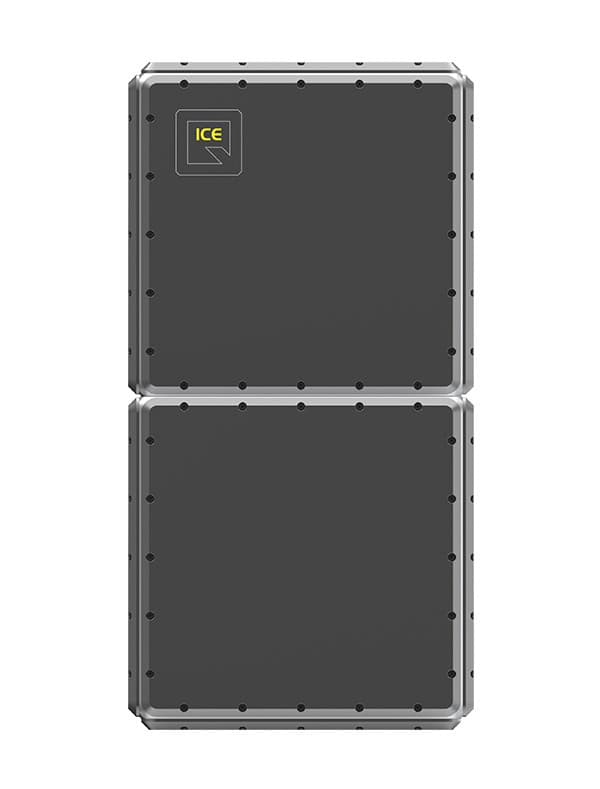
The cube-shaped form factor provides much improved access to these external connections, whether for designing and configuring the system or for ongoing maintenance work. The outer shell of each module consists of panels that are easily removed, offering a simple mechanism for bolting modules together or stacking them on top of each other to provide a fully scalable solution that grows with the qubit count.
The flexible design also offers a more practical solution for servicing or upgrading an installed system, since individual modules can be simply swapped over as and when needed. “For quantum computers running in an operational environment it is really important to minimize the downtime,” says Emma Yeatman, senior design engineer at ICEoxford. “With this design we can easily remove one of the modules for servicing, and replace it with another one to keep the system running for longer. For critical infrastructure devices, it is possible to have built-in redundancy that ensures uninterrupted operation in the event of a failure.”
Other features have been integrated into the platform to make it simple to operate, including a new software system for controlling and monitoring the ultracold environment. “Most of our cryostats have been designed for researchers who really want to get involved and adapt the system to meet their needs,” adds Yeatman. “This platform offers more options for people who want an out-of-the-box solution and who don’t want to get hands on with the cryogenics.”
Such a bold design choice was enabled in part by a collaborative research project with Canadian company Photonic Inc, funded jointly by the UK and Canada, that was focused on developing an efficient and reliable cryogenics platform for practical quantum computing. That R&D funding helped to reduce the risk of developing an entirely new technology platform that addresses many of the challenges that ICEoxford and its customers had experienced with traditional cryostats. “Quantum technologies typically need a lot of wiring, and access had become a real issue,” says Yeatman. “We knew there was an opportunity to do better.”
However, converting a large cylindrical cryostat into a slimline and modular form factor demanded some clever engineering solutions. Perhaps the most obvious was creating a frame that allows the modules to be bolted together while still remaining leak tight. Traditional cryostats are welded together to ensure a leak-proof seal, but for greater flexibility the ICEoxford team developed an assembly technique based on mechanical bonding.
The side-loading wiring module also presented a design challenge. To squeeze more wires into the available space, the team developed a high-density connector for the coaxial cables to plug into. An additional cold-head was also integrated into the module to pre-cool the cables, reducing the overall heat load generated by such large numbers of connections entering the ultracold environment.
Flexible for the future: the outer shell of the modules is covered with removable panels that make it easy to extend or reconfigure the system (Courtesy: ICEoxford)
Meanwhile, the speed of the cooldown and the efficiency of operation have been optimized by designing a new type of heat exchanger that is fabricated using a 3D printing process. “When warm gas is returned into the system, a certain amount of cooling power is needed just to compress and liquefy that gas,” explains Kelly. “We designed the heat exchangers to exploit the returning cold gas much more efficiently, which enables us to pre-cool the warm gas and use less energy for the liquefaction.”
The initial prototype has been designed to operate at 1 K, which is ideal for the photonics-based quantum systems being developed by ICEoxford’s research partner. But the modular nature of the platform allows it to be adapted to diverse applications, with a second project now underway with the Rutherford Appleton Lab to develop a module that that will be used at the forefront of the global hunt for dark matter.
Already on the development roadmap are modules that can sustain temperatures as low as 10 mK – which is typically needed for superconducting quantum computing – and a 4 K option for trapped-ion systems. “We already have products for each of those applications, but our aim was to create a modular platform that can be extended and developed to address the changing needs of quantum developers,” says Kelly.
As these different options come onstream, the ICEoxford team believes that it will become easier and quicker to deliver high-performance cryogenic systems that are tailored to the needs of each customer. “It normally takes between six and twelve months to build a complex cryogenics system,” says Graf. “With this modular design we will be able to keep some of the components on the shelf, which would allow us to reduce the lead time by several months.”
More generally, the modular and scalable platform could be a game-changer for commercial organizations that want to exploit quantum computing in their day-to-day operations, as well as for researchers who are pushing the boundaries of cryogenics design with increasingly demanding specifications. “This system introduces new avenues for hardware development that were previously constrained by the existing cryogenics infrastructure,” says Kelly. “The ICE-Q platform directly addresses the need for colder base temperatures, larger sample spaces, higher cooling powers, and increased connectivity, and ensures our clients can continue their aggressive scaling efforts without being bottlenecked by their cooling environment.”
You can find out more about the ICE-Q platform by contacting the ICEoxford team at iceoxford.com, or via email at sales@iceoxford.com. They will also be presenting the platform at the UK’s National Quantum Technologies Showcase in London on 7 November, with a further launch at the American Physical Society meeting in March 2026.
Due to government shutdown restrictions currently in place in the US, the researchers who headed up this study have not been able to comment on their work
Laser plasma acceleration (LPA) may be used to generate multi-gigaelectronvolt muon beams, according to physicists at the Lawrence Berkeley National Laboratory (LBNL) in the US. Their work might help in the development of ultracompact muon sources for applications such as muon tomography – which images the interior of large objects that are inaccessible to X-ray radiography.
Muons are charged subatomic particles that are produced in large quantities when cosmic rays collide with atoms 15–20 km high up in the atmosphere. Muons have the same properties as electrons but are around 200 times heavier. This means they can travel much further through solid structures than electrons. This property is exploited in muon tomography, which analyses how muons penetrate objects and then exploits this information to produce 3D images.
The technique is similar to X-ray tomography used in medical imaging, with the cosmic-ray radiation taking the place of artificially generated X-rays and muon trackers the place of X-ray detectors. Indeed, depending on their energy, muons can traverse metres of rock or other materials, making them ideal for imaging thick and large structures. As a result, the technique has been used to peer inside nuclear reactors, pyramids and volcanoes.
As many as 10,000 muons from cosmic rays reach each square metre of the Earth’s surface every minute. These naturally produced particles have unpredictable properties, however, and they also only come from the vertical direction. This fixed directionality means that can take months to accumulate enough data for tomography.
Another option is to use the large numbers of low-energy muons that can be produced in proton accelerator facilities by smashing a proton beam onto a fixed carbon target. However, these accelerators are large and expensive facilities, limiting their use in muon tomography.
A new compact source
Physicists led by Davide Terzani have now developed a new compact muon source based on LPA-generated electron beams. Such a source, if optimized, could be deployed in the field and could even produce muon beams in specific directions.
In LPA, an ultra-intense, ultra-short, and tightly focused laser pulse propagates into an “under-dense” gas. The pulse’s extremely high electric field ionizes the gas atoms, freeing the electrons from the nuclei, so generating a plasma. The ponderomotive force, or radiation pressure, of the intense laser pulse displaces these electrons and creates an electrostatic wave that produces accelerating fields orders of magnitude higher than what is possible in the traditional radio-frequency cavities used in conventional accelerators.
LPAs have all the advantages of an ultra-compact electron accelerator that allows for muon production in a small-size facility such as BeLLA, where Terzani and his colleagues work. Indeed, in their experiment, they succeeded in generating a 10 GeV electron beam in a 30 cm gas target for the first time.
The researchers collided this beam with a dense target, such as tungsten. This slows the beam down so that it emits Bremsstrahlung, or braking radiation, which interacts with the material, producing secondary products that include lepton–antilepton pairs, such as electron–positron and muon–antimuon pairs. Behind the converter target, there is also a short-lived burst of muons that propagates roughly along the same axis as the incoming electron beam. A thick concrete shielding then filters most of the secondary products, letting the majority of muons pass through it.
Crucially, Terzani and colleagues were able to separate the muon signal from the large background radiation – something that can be difficult to do because of the inherent inefficiency of the muon production process. This allowed them to identify two different muon populations coming from the accelerator. These were a collimated, forward directed population, generated by pair production; and a low-energy, isotropic, population generated by meson decay.
Many applications
Muons can be used in a range of fields, from imaging to fundamental particle physics. As mentioned, muons from cosmic rays are currently used to inspect large and thick objects not accessible to regular X-ray radiography – a recent example of this is the discovery of a hidden chamber in Khufu’s Pyramid. They can also be used to image the core of a burning blast furnace or nuclear waste storage facilities.
While the new LPA-based technique cannot yet produce muon fluxes suitable for particle physics experiments – to replace a muon injector, for example – it could offer the accelerator community a convenient way to test and develop essential elements towards making a future muon collider.
The experiment in this study, which is detailed in Physical Review Accelerators and Beams, focused on detecting the passage of muons, unequivocally proving their signature. The researchers conclude that they now have a much better understanding of the source of these muons.
Unfortunately, the original programme that funded this research has ended, so future studies are limited at the moment. Not to be disheartened, the researchers say they strongly believe in the potential of LPA-generated muons and are working on resuming some of their experiments. For example, they aim to measure the flux and the spectrum of the resulting muon beam using completely different detection techniques based on ultra-fast particle trackers, for example.
The LBNL team also wants to explore different applications, such as imaging deep ore deposits – something that will be quite challenging because it poses strict limitations on the minimum muon energy required to penetrate soil. Therefore, they are looking into how to increase the muon energy of their source.
The early years of the Nobel prize read like a Who’s Who in modern physics. The inaugural physics prize, in 1901, went to Wilhelm Röntgen for discovering X-rays. Subsequent recipients included Henri Becquerel, Marie and Pierre Curie, Lord Rayleigh and several others who likewise lent their names to scientific units and physical phenomena.
Look a little further down the list of laureates, though, and you’ll find two names that stand out not because they’re famous, but because they aren’t. The first is Gabriel Lippmann, who received the 1908 Nobel Prize for Physics “for his method of reproducing colours photographically based on the phenomenon of interference”. The second is Gustaf Dalén, who got the 1912 Nobel “for his invention of automatic valves designed to be used in combination with gas accumulators in lighthouses and buoys”.
If you’ve never heard of Lippmann photographs or Dalén valves – if their names do not trip off your tongue like Lorentz contractions or Zeeman shifts – you’re in good company. Lippmann’s invention was never commercially successful. Dalén’s was, but it faded from use around 50 years ago, and in physics terms it is undeniably much less important than contemporaneous advances in quantum mechanics and relativity. Why, then, did the Royal Swedish Academy of Sciences deem these inventions worthy of the most prestigious prize in physics?
A colourful but puzzling prize
The strangest thing about Lippmann’s prize is that by the time he received it, his version of colour photography was already obsolete – and he knew it. Four days after picking up his award in Stockholm, Lippmann, a Frenchman with a waxed moustache that would shame a silent film villain, ended his Nobel lecture with the verbal equivalent of a Gallic shrug. Despite nearly 20 years of work, he acknowledged that the minimum exposure time for his photographs – one minute in full sunlight – was still “too long for the portrait”. Though further improvements were possible, he concluded, “Life is short and progress is slow.”
Capturing colour A still life taken by Lippmann using his method sometime between1890 and 1910. By the latter part of this period, the method had fallen out of favour, superseded by the simpler Autochrome process. (Photo in public domain)
To understand why the Academy bestowed its physics prize on a method of colour photography that not even its inventor seemed to believe in, let’s begin with the method itself. Unlike other imaging processes, Lippmann photography directly records the entire colour spectrum of an object. It does this by using standing waves of light to produce interference fringes in a light-sensitive emulsion backed by a mirrored surface. The longer the wavelength of light given off by the object, the larger the separation between the fringes. It’s an elegant application of classical wave theory. It’s easy to see why Edwardian-era physicists loved it.
Lippmann’s method also has an important practical advantage. Because his photographs don’t require pigments, they retain their colour over time. Consequently, the images Lippmann showed off in his Nobel lecture look as brilliant today as they did in 1908.
The method’s disadvantages, though, are numerous. As well as needing long exposure times, the colours in Lippmann photographs are hard to see. Because they are virtual, like a hologram, they are only accurate when viewed face-on, in perpendicular light. Lippmann’s original method also required highly toxic liquid mercury to make the mirrored back surface of each photographic plate. Though modern versions have eliminated this, it’s not surprising that Lippmann’s method is now largely the domain of artists and hobbyists.
If technical merit can’t explain Gabriel Lippmann’s Nobel, was it perhaps due to politics?
A French connection
If technical merit can’t explain Lippmann’s Nobel, was it perhaps due to politics? The easiest way to find out is to look in the Nobel archives. Although the names of Nobel prize nominees and the people who nominated them are initially secret, this secrecy is lifted after 50 years. The nomination records for Lippmann’s era are therefore very much available, and they show that he was a popular candidate. Between 1901 and 1908, he received 23 nominations from 12 different people – including previous laureates, foreign members of the Academy, and scientists from prestigious universities invited to make nominations in specific years.
Funnily enough, though, all of them were French.
Faced with this apparent conspiracy to stamp the French tricolour on the Nobel medal, Karl Grandin, who directs the Academy’s Center for History of Science, concedes that such nationalistic campaigns were “quite common in the first years”. However, this doesn’t mean they were successful: “Sometimes when all the members of the French Academy have signed a nomination, it might be impressive at one point, but it might also be working in the opposite way,” he says.
A clash of personalities
Because Nobel Foundation statutes stipulate that discussions and vote numbers from the prize-awarding meeting of the Academy are not recorded, Grandin can’t say exactly how Lippmann came out on top in 1908. He does, however, have access to an illuminating article written in 1981 by a theoretical physicist, Bengt Nagel.
Drawing on the private letters and diaries of Academy members as well as the Nobel archives, Nagel showed that personal biases played a significant role in the awarding of the 1908 prize. It’s a complicated story, but the most important strand of it centres on Svante Arrhenius, the Swedish physical chemist who’d won the Nobel Prize for Chemistry five years earlier.
Today, Arrhenius is best known for predicting that putting carbon dioxide in the Earth’s atmosphere will affect the climate. In his own lifetime, though, Arrhenius was also known for having a long-running personality conflict with a Swedish mathematician called Gustaf Mittag-Leffler.
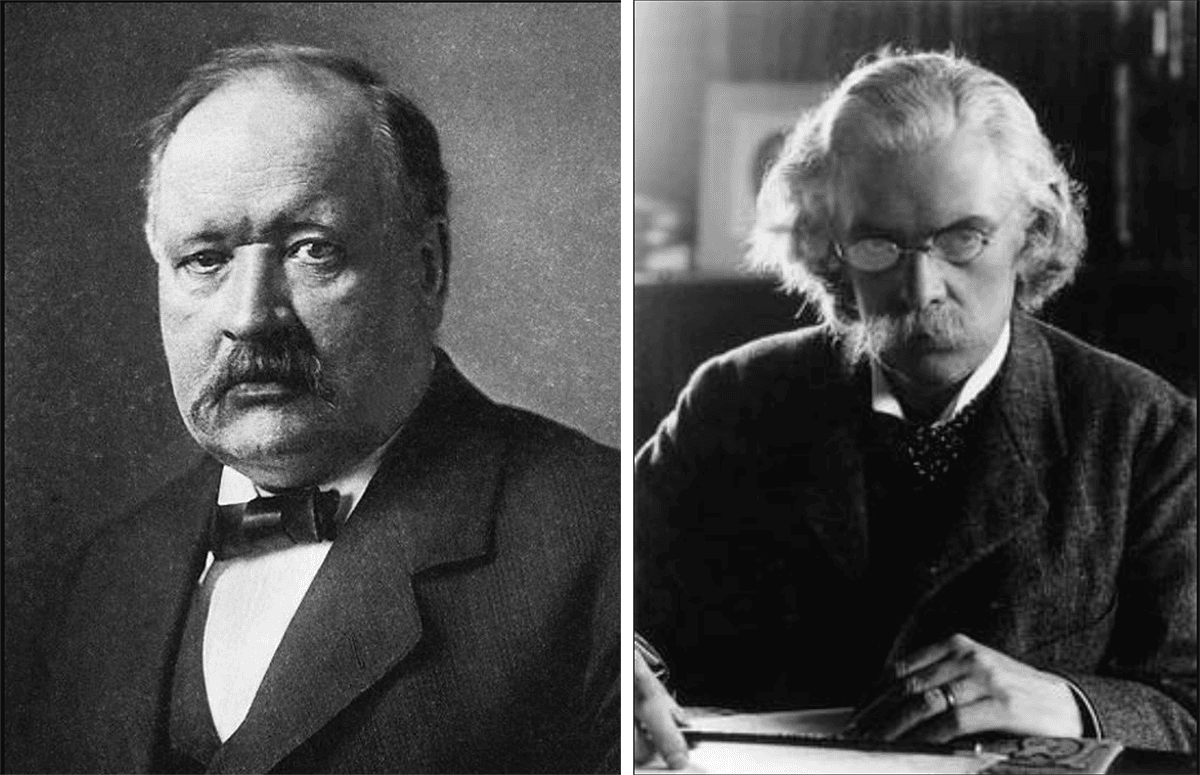
Double trouble The feuding between Svante Arrhenius (left) and Gustaf Mittag-Leffler played a major role in Gabriel Lippmann winning the Nobel Prize for Physics. (Courtesy: Images in public domain)
“Stockholm at the time was a small place,” Grandin explains. “Everyone knew each other, and it wasn’t big enough to host both Arrhenius and Mittag-Leffler.”
Arrhenius wasn’t the chair of the Nobel physics committee in 1908. That honour fell to Knut Angstrom, son of the Angstrom the unit is named after. Still, Arrhenius’ prestige and outsized personality gave him considerable influence. After much debate, the committee agreed to recommend his preferred choice for the prize, Max Planck, to the full Academy.
This choice, however, was not problem-free. Planck’s theory of the quantization of matter was still relatively new in 1908, and his work was not demonstrably guiding experiments. If anything, it was the other way around. In principle, the committee could have dealt with this by recommending that Planck share the prize with a quantum experimentalist. Unfortunately, no such person had been nominated.
That was awkward, and it gave Mittag-Leffler the opening he needed. When the matter went to the Academy for a vote, he used members’ doubts about quantum theory to argue against Arrhenius’ choice. It worked. In Mittag-Leffler’s telling, Planck got only 13 votes. Lippmann, the committee’s second choice, got 46.
A consensus laureate
Afterwards, Mittag-Leffler boasted about his victory. “Arrhenius wanted to give it to Planck…but his report, which he had nevertheless managed to have unanimously accepted by the committee, was so stupid that I could easily have crushed it,” he wrote to a French colleague. “Two members even declared that after hearing me, they changed their opinion and voted for Lippmann. I would have had nothing against sharing the prize between [quantum theorist Wilhelm] Wien and Planck,” Mittag-Leffler added, “but to give it to Planck alone would have been to reward ideas that are still very obscure and require verification by mathematics and experimentation.”
Lippmann’s work posed no such difficulties, and that seems to have swung it for him. In a letter to a colleague after the dust had settled, Angstrom called Lippmann “obviously a prizeworthy candidate who did not give rise to any objections”. However, Angstrom added, he “could not deny that the radiation laws constitute a more important advance in physical science than Lippmann’s colour photography”.
Much has been written about excellent scientists getting overlooked for prizes because of biases against them. The flip side of this – that merely good scientists sometimes win prizes because of biases in their favour – is usually left unacknowledged. Nevertheless, it happens, and in 1908 it happened to Gabriel Lippmann – a good scientist who won a Nobel prize not because he did the most important work, but because his friends clubbed together to support him; because Academy members were wary of his quantum rivals; and above all because a grudge-holding mathematician and an egotistical chemist had a massive beef with each other.
And then, four years later, it happened again, to Gustaf Dalén.
The unlikeliest laureate
Dalén was, by some margin, history’s unlikeliest physics Nobel laureate. He wasn’t a physicist, for starters. He wasn’t even a chemist. He was an inventor, and the invention that won him the prize was closely connected – in more ways than one – to an industrial accident that almost cost him his life.
Like Alfred Nobel, Dalén was Swedish, born in 1869 in the small farming community of Stenstorp. Located around 140 km north-east of Gothenburg, Stenstorp is now home to a museum in Dalén’s honour. As a young man, though, he did not seem like museum material. On the contrary, he was incredibly lazy – so lazy, in fact, that he invented a machine to make coffee and turn the light on for him in the mornings.
This ingenious device brought Dalén some local notoriety, but his big break came when Sweden’s most famous inventor at the time, Gustaf de Laval, saw him demonstrate a device for measuring milk fat content. Encouraged by de Laval to attend university, Dalén sold his family’s farm and enrolled at what is now the Chalmers University of Technology. After spending an additional year at ETH Zürich in Switzerland, he returned to Sweden to set up his first engineering firm.
A light in the darkness
The engineering challenge that set Dalén on the path to the Nobel was hugely important in a country like Sweden with a long, complex coastline. Years before the advent of GPS, or even reliable radio communications, lighthouses were the main way of warning ships away from danger. However, they were extremely expensive and hard to maintain. As well as needing 24-hour attention from skilled and hardy humans, they required huge amounts of propane fuel, necessitating frequent (and frequently dangerous) resupply trips.
The obvious way of reducing these costs was to make lighthouses burn something else. Acetylene was attractive because it could be manufactured in industrial quantities, and it produced a bright light when burned. Unfortunately, it was also highly explosive, meaning it couldn’t be safely bottled or shipped.
Let there be light The first light designed to use Gustaf Dalén’s technology is located near Djurgården in Stockholm, Sweden. It has since been converted to run on electricity. (CC BY-SA 3.0 Holger Ellgard)
To tame the acetylene dragon, Dalén developed three separate inventions. The first was a combination of asbestos and diatomaceous earth that he called “agamassan” after his company (Aktiebolaget Gasaccumulator) and the Swedish word for compound, massan. By filling a container with agamassan, wetting it with acetone and then forcing acetylene into the container under pressure, Dalén showed that the acetylene would dissolve in the acetone and become trapped within the agamassan like water in a sponge. Under these conditions, it could be shipped, stored and even dropped without exploding.
Having made acetylene safe to use, Dalén turned to making it economical. His second invention was a device that automatically turned the acetylene supply on and off. This saved fuel and enabled the light to flash (distinguishing it from other light sources on the shore) without the need for cumbersome rotation mechanisms.
Dalén’s third invention enabled even greater automation. Rather than relying on lighthouse keepers to switch acetylene burners on at night and off in the morning, Dalén developed a valve that could do it automatically. This valve worked by means of a set of metal rods, one of which was blackened while the others were polished. When the blackened rod absorbed enough heat from the Sun, it expanded and closed the valve. At dusk, or in foggy conditions, the blackened rod returned to the temperature of the others, contracted, and opened the valve.
The committee’s call
While Dalén was perfecting the use of acetylene gas for lighthouses, the Nobel physics committee was getting on with its usual business of recommending candidates for the prize. In 1909 the committee suggested the radio pioneer Guglielmo Marconi and his academic counterpart Karl Ferdinand Braun. The wider Academy accepted this choice. In 1910 the committee recommended Johannes Diderik van der Waals, the father of modern molecular science. He also won the Academy’s approval. In 1911 Wien, whose joint nomination with Planck in 1908 provoked such bitter disputes that neither of them got the prize, finally got the nod from both the committee and the Academy (Planck’s prize would have to wait until 1918).
By the early autumn of 1912, there was every indication that the Academy would again accept the committee’s recommendation: Heike Kammerlingh Onnes, who had liquefied helium for the first time in 1908 and subsequently used it to discover superconductivity. Although Dalén had also been nominated, Mats Larsson, a physicist at Stockholm University who served on the committee between 2016 and 2023, says he wasn’t a serious contender.
“It’s clear from the report from the Nobel committee to the Academy that they recognize there is an importance to Dalén’s inventions, but it doesn’t reach the standard for a Nobel prize,” says Larsson. With only a single nomination from a member of the Academy’s technical section, Larsson adds, “Dalén is not even on the shortlist.”
An industrial accident
Then, before the Academy could vote, tragedy struck. On 27 September 1912, during an experiment so risky it was performed in a quarry rather than in Aktiebolaget Gasaccumulator’s Stockholm factory, an explosion left Dalén seriously injured. The next day, Sweden’s national paper of record, Dagens Nyheter, put the accident on its front page, describing Dalén’s face as “unrecognizable” and his right side as “horribly massacred and burned”. Though conscious and talking when taken to hospital, he was not expected to survive.
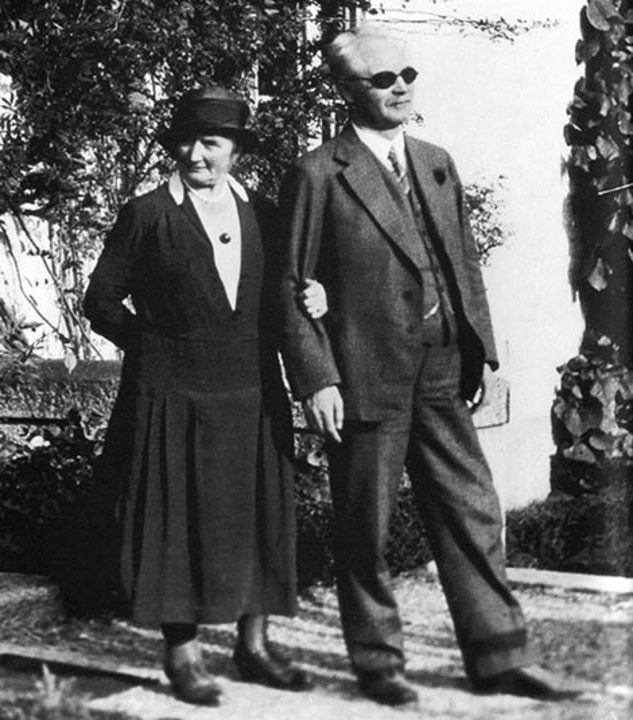
A devoted couple Gustaf Dalén and his wife Elma outside their home in 1937. (Photo in public domain)
Nobel prizes cannot be awarded posthumously. If Dalén had died of his injuries, it is unlikely that his colleagues would have voted to honour him. But though Dalén’s doctors could not save his eyesight, they did save his life. By the time the Academy convened a few weeks later to vote on the 1912 Nobel prizes, he was recovering in the care of his family and very much on the minds of his sympathetic colleagues.
We don’t know exactly what happened next. “The material [in the Nobel archives] is very meagre,” Larsson explains. “It just says there was a vote and Dalén won the prize.”
Still, it’s easy to imagine that someone in the Academy must have pled Dalén’s cause. “This is our national hero who fought the war against ignorance and against darkness,” agrees Grandin. “And he loses his sight in the purpose of bringing light to the world. It was a symbolic thing.”
Warmth as well as light
Dalén was too unwell to attend the usual Nobel prize celebrations in Stockholm. Instead, he sent his brother, a physician, to accept the prize on his behalf. Eventually, though, he recovered enough to resume his duties at Aktiebolaget Gasaccumulator. In time, he even returned to inventing. And herein lies the final twist in his story.
During his convalescence, the blind Dalén noticed something that had apparently escaped his attention when he could see. His wife, Elma, worked very hard around the house, and cooking for him and their four children was especially tiresome. It would be much easier, Dalén decided, if she had a device that could cook several dishes at once, at different temperatures.
Gustaf Dalén may be the least likely physics Nobel laureate in history, but it would be facile to dismiss him as unworthy
In 1922, ten years after losing his sight and winning the Nobel prize, Dalén unveiled the invention that would become his most enduring. Named, like agamassan, after the initials of his company, the AGA cooker is still sold today, bringing warmth to kitchens just as its inventor brought safe and economical illumination to lighthouses. Dalén may be the least likely physics Nobel laureate in history, but it would be facile to dismiss him as unworthy. After all, how many other physics laureates saved hundreds of thousands of lives at sea, while also relieving the drudgery of hundreds of thousands back home?
The verdict of history
Lippmann and Dalén received their Nobel prizes more than a century ago, but many of the factors that contributed to them remain relevant today. Though Larsson is tight-lipped when asked if there have been any recent dust-ups like the one in 1908, or sympathy votes like the one in 1912, he acknowledges that Nobel’s request that the prize go to “the person who made the most important discovery or invention in the field of physics during the preceding year” still creates some conflict.
There is, he says, frequently a debate between honouring discoveries (which can, in principle, endure forever) and recognizing inventions (most of which eventually become obsolete). “If we award a discovery prize, there are people who think, ‘Oh, there should be more invention prizes,’” he says. “There is always a little bit of this tension.”
A more troubling continuity concerns the role of bias. Despite measures to diversify the pool of Nobel nominators, Grandin says that getting broad perspectives remains a challenge. “How on Earth should this small community of physicists and chemists in this small country, Sweden, be able to make this decision every year?” he asks. It is, he adds, “a big, big task”.
For the record, Larsson says that Nobel committee members take their task very seriously, with many “long and intense discussions” before recommending new laureates. Even so, he and his colleagues are human, and humans are, on our worst days, prone to all sorts of biases: good at avoiding tough decisions; suspicious of new facts that don’t fit our worldviews; and inclined to favour people who remind us of ourselves. In Dalén’s case, these biases got refracted through a lens of humanitarian spirit rather than partisan spite, but even so, Grandin says that his prize and Lippmann’s demonstrate the importance of keeping the Nobels in perspective.
“Sometimes I have to say, it’s just a prize,” he says. “It’s not the correct answers to all questions in physics.”
When it comes to building a fully functional “fault-tolerant” quantum computer, companies and government labs all over the world are rushing to be the first over the finish line. But a truly useful universal quantum computer capable of running complex algorithms would have to entangle millions of coherent qubits, which are extremely fragile. Because of environmental factors such as temperature, interference from other electronic systems in hardware, and even errors in measurement, today’s devices would fail under an avalanche of errors long before reaching that point.
So the problem of error correction is a key issue for the future of the market. It arises because errors in qubits can’t be corrected simply by keeping multiple copies, as they are in classical computers: quantum rules forbid the copying of qubit states while they are still entangled with others, and are thus unknown. To run quantum circuits with millions of gates, we therefore need new tricks to enable quantum error correction (QEC).
Protected states
The general principle of QEC is to spread the information over many qubits so that an error in any one of them doesn’t matter too much. “The essential idea of quantum error correction is that if we want to protect a quantum system from damage then we should encode it in a very highly entangled state,” says John Preskill, director of the Institute for Quantum Information and Matter at the California Institute of Technology in Pasadena.
There is no unique way of achieving that spreading, however. Different error-correcting codes can depend on the connectivity between qubits – whether, say, they are coupled only to their nearest neighbours or to all the others in the device – which tends to be determined by the physical platform being used. However error correction is done, it must be done fast. “The mechanisms for error correction need to be running at a speed that is commensurate with that of the gate operations,” saysMichael Cuthbert, founding director of the UK’s National Quantum Computing Centre (NQCC). “There’s no point in doing a gate operation in a nanosecond if it then takes 100 microseconds to do the error correction for the next gate operation.”
At the moment, dealing with errors is largely about compensation rather than correction: patching up the problems of errors in retrospect, for example by using algorithms that can throw out some results that are likely to be unreliable (an approach called “post-selection”). It’s also a matter of making better qubits that are less error-prone in the first place.
Qubits are so fragile that their quantum state is very susceptible to the local environment, and can easily be lost through the process of decoherence. Current quantum computers therefore have very high error rates – roughly one error in every few hundred operations. For quantum computers to be truly useful, this error rate will have to be reduced to the scale of one in a million; especially as larger more complex algorithms would require one in a billion or even trillion error rates. This requires real-time quantum error correction (QEC).
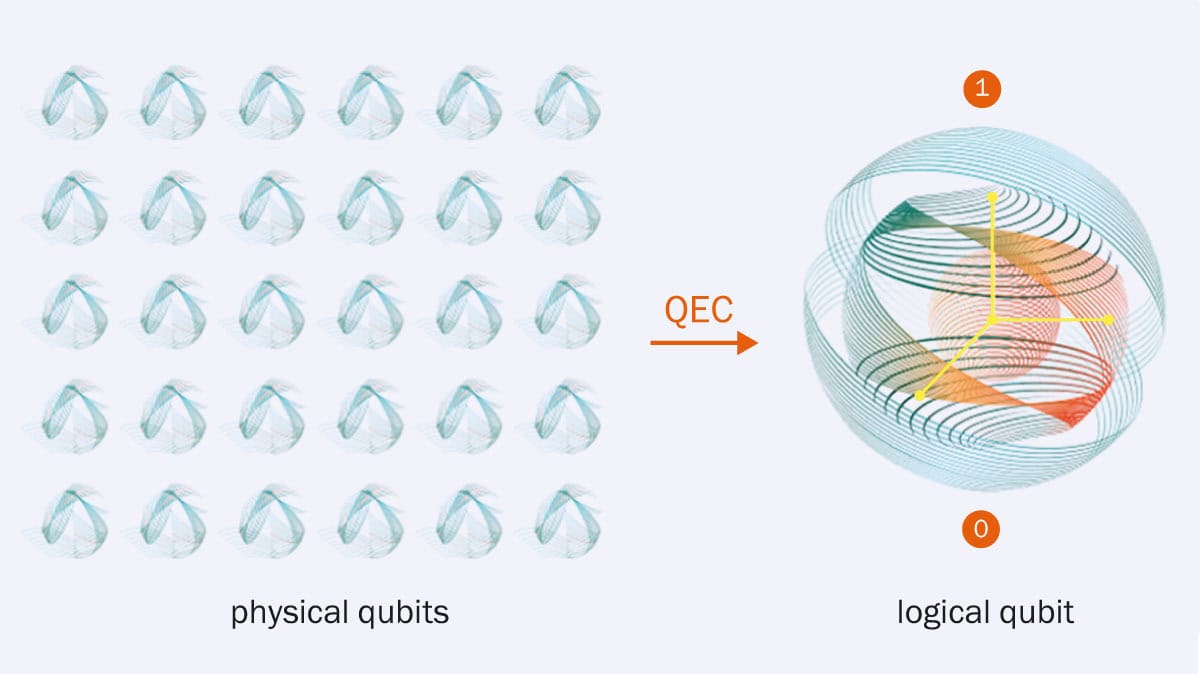
To protect the information stored in qubits, a multitude of unreliable physical qubits have to be combined in such a way that if one qubit fails and causes an error, the others can help protect the system. Essentially, by combining many physical qubits (shown above on the left), one can build a few “logical” qubits that are strongly resistant to noise.
According to Maria Maragkou, commercial vice-president of quantum error-correction company Riverlane, the goal of full QEC has ramifications for the design of the machines all the way from hardware to workflow planning. “The shift to support error correction has a profound effect on the way quantum processors themselves are built, the way we control and operate them, through a robust software stack on top of which the applications can be run,” she explains. The “stack” includes everything from programming languages to user interfaces and servers.
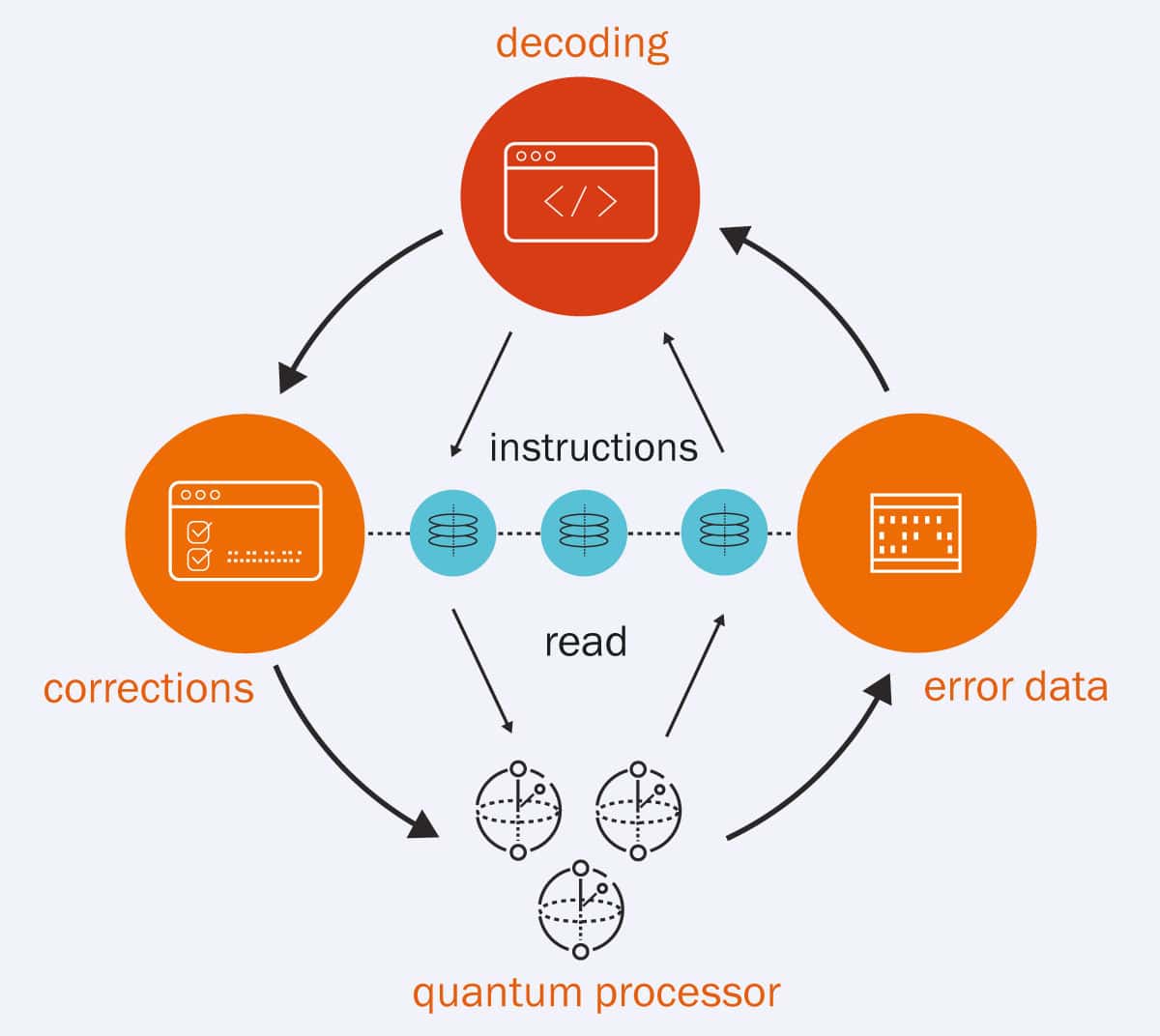
With genuinely fault-tolerant qubits, errors can be kept under control and prevented from proliferating during a computation. Such qubits might be made in principle by combining many physical qubits into a single “logical qubit” in which errors can be corrected (see figure 1). In practice, though, this creates a large overhead: huge numbers of physical qubits might be needed to make just a few fault-tolerant logical qubits. The question is then whether errors in all those physical qubits can be checked faster than they accumulate (see figure 2).
The illustration gives an overview of quantum error correction (QEC) in action within a quantum processing unit. UK-based company Riverlane is building its Deltaflow QEC stack that will correct millions of data errors in real time, allowing a quantum computer to go beyond the reach of any classical supercomputer.
Fault-tolerant quantum computing is the ultimate goal, says Jay Gambetta, director of IBM research at the company’s centre in Yorktown Heights, New York. He believes that to perform truly transformative quantum calculations, the system must go beyond demonstrating a few logical qubits – instead, you need arrays of at least a 100 of them, that can perform more than 100 million quantum operations (108 QuOps). “The number of operations is the most important thing,” he says.
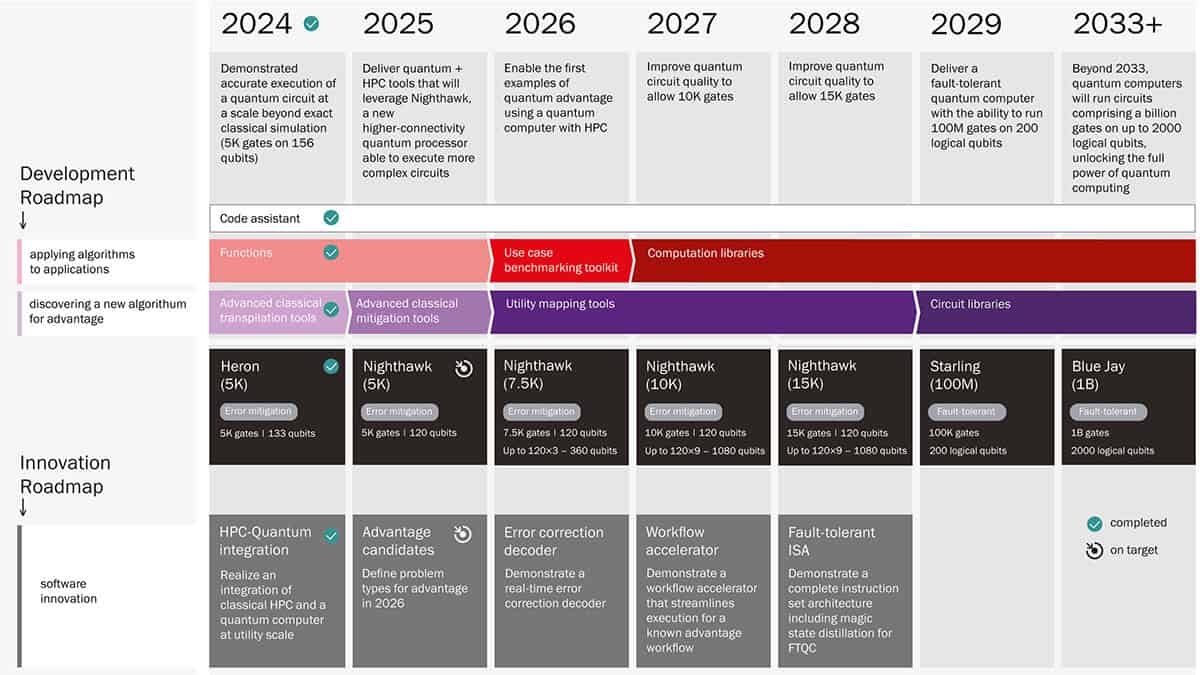
It sounds like a tall order, but Gambetta is confident that IBM will achieve these figures by 2029. By building on what has been achieved so far with error correction and mitigation, he feels “more confident than I ever did before that we can achieve a fault-tolerant computer.” Jerry Chow, previous manager of the Experimental Quantum Computing group at IBM, shares that optimism. “We have a real blueprint for how we can build [such a machine] by 2029,” he says (see figure 3).
Others suspect the breakthrough threshold may be a little lower: Steve Brierley, chief executive of Riverlane, believes that the first error-corrected quantum computer, with around 10 000 physical qubits supporting 100 logical qubits and capable of a million QuOps (a megaQuOp), could come as soon as 2027. Following on, gigaQuOp machines (109 QuOps) should be available by 2030–32, and teraQuOps (1012 QuOp) by 2035–37.
Platform independent
Error mitigation and error correction are just two of the challenges for developers of quantum software. Fundamentally, to develop a truly quantum algorithm involves taking full advantage of the key quantum-mechanical properties such as superposition and entanglement. Often, the best way to do that depends on the hardware used to run the algorithm. But ultimately the goal will be to make software that is not platform-dependent and so doesn’t require the user to think about the physics involved.
“At the moment, a lot of the platforms require you to come right down into the quantum physics, which is a necessity to maximize performance,” says Richard Murray of photonic quantum-computing company Orca. Try to generalize an algorithm by abstracting away from the physics and you’ll usually lower the efficiency with which it runs. “But no user wants to talk about quantum physics when they’re trying to do machine learning or something,” Murray adds. He believes that ultimately it will be possible for quantum software developers to hide those details from users – but Brierley thinks this will require fault-tolerant machines.
“In due time everything below the logical circuit will be a black box to the app developers”, adds Maragkou over at Riverlane. “They will not need to know what kind of error correction is used, what type of qubits are used, and so on.” She stresses that creating truly efficient and useful machines depends on developing the requisite skills. “We need to scale up the workforce to develop better qubits, better error-correction codes and decoders, write the software that can elevate those machines and solve meaningful problems in a way that they can be adopted.” Such skills won’t come only from quantum physicists, she adds: “I would dare say it’s mostly not!”
Yet even now, working on quantum software doesn’t demand a deep expertise in quantum theory. “You can be someone working in quantum computing and solving problems without having a traditional physics training and knowing about the energy levels of the hydrogen atom and so on,” says Ashley Montanaro, who co-founded the quantum software company Phasecraft.
On the other hand, insights can flow in the other direction too: working on quantum algorithms can lead to new physics. “Quantum computing and quantum information are really pushing the boundaries of what we think of as quantum mechanics today,” says Montanaro, adding that QEC “has produced amazing physics breakthroughs.”
Early adopters?
Once we have true error correction, Cuthbert at the UK’s NQCC expects to see “a flow of high-value commercial uses” for quantum computers. What might those be?
In this arena of quantum chemistry and materials science, genuine quantum advantage – calculating something that is impossible using classical methods alone – is more or less here already, says Chow. Crucially, however, quantum methods needn’t be used for the entire simulation but can be added to classical ones to give them a boost for particular parts of the problem.
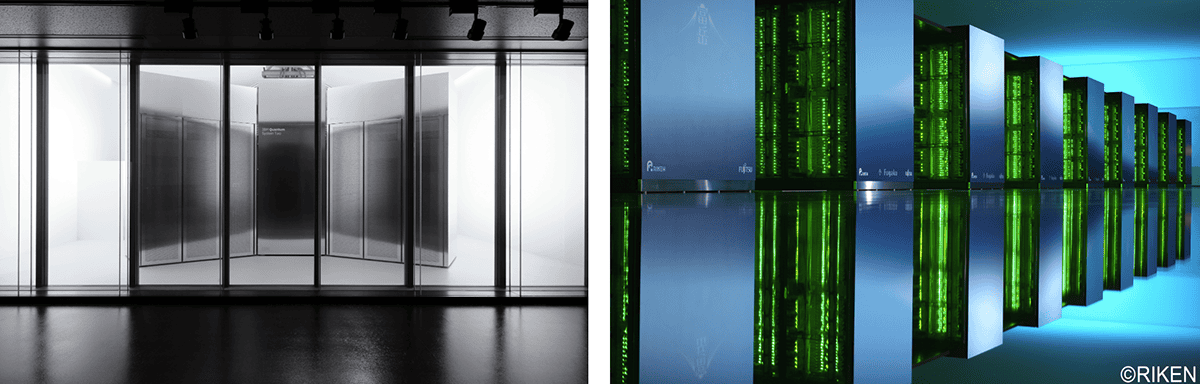
Joint effort In June 2025, IBM in the US and Japan’s national research laboratory RIKEN, unveiled the IBM Quantum System Two, the first to be used outside the US. It involved IBM’s 156-qubit IBM Heron quantum computing system (left) being paired with RIKEN’s supercomputer Fugaku (right) — one of the most powerful classical systems on Earth. The computers are linked through a high-speed network at the fundamental instruction level to form a proving ground for quantum-centric supercomputing. (Courtesy: IBM and RIKEN)
For example, last year researchers at IBM teamed up with scientists at several RIKEN institutes in Japan to calculate the minimum energy state for the iron sulphide cluster (4Fe-4S) at the heart of the bacterial nitrogenase enzyme that fixes nitrogen. This cluster is too big and complex to be accurately simulated using the classical approximations of quantum chemistry. The researchers used a combination of both quantum computing (with IBM’s 72-qubit Heron chip) and RIKEN’s Fugaku high performance computing (HPC). This idea of “improving classical methods by injecting quantum as a subroutine” is likely to be a more general strategy, says Gambetta. “The future of computing is going to be heterogeneous accelerators [of discovery] that include quantum.”
Likewise, Montanaro says that Phasecraft is developing “quantum-enhanced algorithms”, where a quantum computer is used, not to solve the whole problem, but just to help a classical computer in some way. “There are only certain problems where we know quantum computing is going to be useful,” he says. “I think we are going to see quantum computers working in tandem with classical computers in a hybrid approach. I don’t think we’ll ever see workloads that are entirely run using a quantum computer.” Among the first important problems that quantum machines will solve, according to Montanaro, are the simulation of new materials – to develop, for example, clean-energy technologies (see figure 4).
“For a physicist like me,” says Preskill, “what is really exciting about quantum computing is that we have good reason to believe that a quantum computer would be able to efficiently simulate any process that occurs in nature.”
3 Structural insights
(Courtesy: Phasecraft)
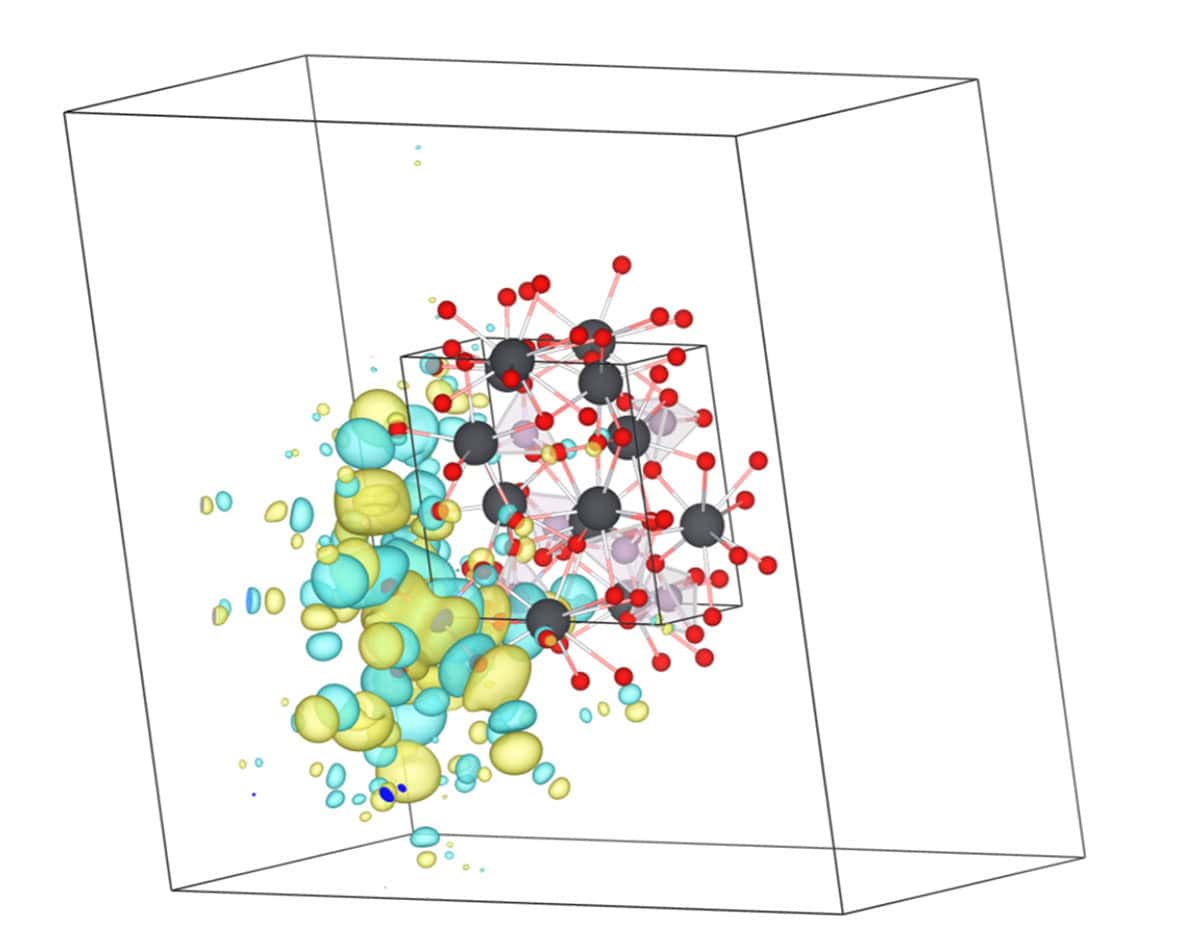
A promising application of quantum computers is simulating novel materials. Researchers from the quantum algorithms firm Phasecraft, for example, have already shown how a quantum computer could help simulate complex materials such as the polycrystalline compound LK-99, which was purported by some researchers in 2024 to be a room-temperature superconductor.
Using a classical/quantum hybrid workflow, together with the firm’s proprietary material simulation approach to encode and compile materials on quantum hardware, Phasecraft researchers were able to establish a classical model of the LK99 structure that allowed them to extract an approximate representation of the electrons within the material. The illustration above shows the green and blue electronic structure around red and grey atoms in LK-99.
Montanaro believes another likely near-term goal for useful quantum computing is solving optimization problems – both here and in quantum simulation, “we think genuine value can be delivered already in this NISQ era with hundreds of qubits.” (NISQ, a term coined by Preskill, refers to noisy intermediate-scale quantum computing, with relatively small numbers of rather noisy, error-prone qubits.)
One further potential benefit of quantum computing is that it tends to require less energy than classical high-performance computing, which is notoriously high. If the energy cost could be cut by even a few percent, it would be worth using quantum resources for that reason alone. “Quantum has real potential for an energy advantage,” says Chow. One study in 2020 showed that a particular quantum-mechanical calculation carried out on a HPC used many orders of magnitude more energy than when it was simulated on a quantum circuit. Such comparisons are not easy, however, in the absence of an agreed and well-defined metric for energy consumption.
Building the market
Right now, the quantum computing market is in a curious superposition of states itself – it has ample proof of principle, but today’s devices are still some way from being able to perform a computation relevant to a practical problem that could not be done with classical computers. Yet to get to that point, the field needs plenty of investment.
The fact that quantum computers, especially if used with HPC, are already unique scientific tools should establish their value in the immediate term, says Gambetta. “I think this is going to accelerate, and will keep the funding going.” It is why IBM is focusing on utility-scale systems of around 100 qubits or so and more than a thousand gate operations, he says, rather than simply trying to build ever bigger devices.
Montanaro sees a role for governments to boost the growth of the industry “where it’s not the right fit for the private sector”. One role of government is simply as a customer. For example, Phasecraft is working with the UK national grid to develop a quantum algorithm for optimizing the energy network. “Longer-term support for academic research is absolutely critical,” Montanaro adds. “It would be a mistake to think that everything is done in terms of the underpinning science, and governments should continue to support blue-skies research.”
The road ahead IBM’s current roadmap charts how the company plans on scaling up its devices to achieve a fault-tolerant device by 2029. Alongside hardware development, the firm will also focus on developing new algorithms and software for these devices. (Courtesy: IBM)
It’s not clear, though, whether there will be a big demand for quantum machines that every user will own and run. Before 2010, “there was an expectation that banks and government departments would all want their own machine – the market would look a bit like HPC,” Cuthbert says. But that demand depends in part on what commercial machines end up being like. “If it’s going to need a premises the size of a football field, with a power station next to it, that becomes the kind of infrastructure that you only want to build nationally.” Even for smaller machines, users are likely to try them first on the cloud before committing to installing one in-house.
According to Cuthbert , the real challenge in the supply-chain development is that many of today’s technologies were developed for the science community – where, say, achieving millikelvin cooling or using high-power lasers is routine. “How do you go from a specialist scientific clientele to something that starts to look like a washing machine factory, where you can make them to a certain level of performance,” while also being much cheaper, and easier to use?
But Cuthbert is optimistic about bridging this gap to get to commercially useful machines, encouraged in part by looking back at the classical computing industry of the 1970s. “The architects of those systems could not imagine what we would use our computation resources for today. So I don’t think we should be too discouraged that you can grow an industry when we don’t know what it’ll do in five years’ time.”
Montanaro too sees analogies with those early days of classical computing. “If you think what the computer industry looked like in the 1940s, it’s very different from even 20 years later. But there are some parallels. There are companies that are filling each of the different niches we saw previously, there are some that are specializing in quantum hardware development, there are some that are just doing software.” Cuthbert thinks that the quantum industry is likely to follow a similar pathway, “but more quickly and leading to greater market consolidation more rapidly.”
However, while the classical computing industry was revolutionized by the advent of personal computing in the 1970s and 80s, it seems very unlikely that we will have any need for quantum laptops. Rather, we might increasingly see apps and services appear that use cloud-based quantum resources for particular operations, merging so seamlessly with classical computing that we don’t even notice.
That, perhaps, would be the ultimate sign of success: that quantum computing becomes invisible, no big deal but just a part of how our answers are delivered.
In the first instalment of this two-part article, Philip Ball explores the latest developments in the quantum-computing industry
When a star rapidly accumulates gas and dust during its early growth phase, it’s called an accretion burst. Now, for the first time, astronomers have observed a planet doing the same thing. The discovery, made using the European Southern Observatory’s Very Large Telescope (VLT) and the James Webb Space Telescope (JWST), shows that the infancy of certain planetary-mass objects and that of newborn stars may share similar characteristics.
Like other rogue planets, Cha1107-7626 was known to be surrounded by a disk of dust and gas. When material from this disk spirals, or accretes, onto the planet, the planet grows.
What Almendros-Abad and colleagues discovered is that this process is not uniform. Using the VLT’s XSHOOTER and the NIRSpec and MIRI instruments on JWST, they found that Cha1107-7626 experienced a burst of accretion beginning in June 2025. This is the first time anyone has seen an accretion burst in an object with such a low mass, and the peak accretion rate of six billion tonnes per second makes it the strongest accretion episode ever recorded in a planetary-mass object. It may not be over, either. At the end of August, when the observing campaign ended, the burst was still ongoing.
An infancy similar to a star’s
The team identified several parallels between Cha1107-7626’s accretion burst and those that young stars experience. Among them were clear signs that gas is being funnelled onto the planet. “This indicates that magnetic fields structure the flow of gas, which is again something well known from stars,” explains Scholz. “Overall, our discovery is establishing interesting, perhaps surprising parallels between stars and planets, which I’m not sure we fully understand yet.”
The astronomers also found that the chemistry of the disc around the planet changed during accretion, with water being present in this phase even though it hadn’t been before. This effect has previously been spotted in stars, but never in a planet until now.
“We’re struck by quite how much the infancy of free-floating planetary-mass objects resembles that of stars like the Sun,” Jayawardhana says. “Our new findings underscore that similarity and imply that some objects comparable to giant planets form the way stars do, from contracting clouds of gas and dust accompanied by disks of their own, and they go through growth episodes just like newborn stars.”
The researchers have been studying similar objects for many years and earlier this year published results based on JWST observations that featured a small sample of planetary-mass objects. “This particular study is part of that sample,” Scholz tells Physics World, “and we obtained the present results because Victor wanted to look in detail at the accretion flow onto Cha1107-7626, and in the process discovered the burst.”
The researchers say they are “keeping an eye” on Cha1107-7626 and other such objects that are still growing because their environment is dynamic and unstable. “More to the point, we really don’t understand what drives these accretion events, and we need detailed follow-up to figure out the underlying reasons for these processes,” Scholz says.