The University of Tennessee at Chattanooga is partnering with industry, utilities, national laboratories and government to establish a regional powerhouse in quantum science and technology
Think big, win big. The University of Tennessee at Chattanooga (UTC) is ticking both boxes, it seems, with a programme of strategic investments spanning quantum research, education, workforce development and academic-industry partnerships. By 2030, the hope is that those investments will pay out, putting Chattanooga on the fast-track to becoming the “Quantum Capital of the South” – a destination where researchers, students, entrepreneurs, industry leaders, national laboratories and public-sector partners work together to accelerate quantum discovery and deployment.
“Success will be measured not only through research funding and scholarly output, but also through the strength of the quantum ecosystem and the opportunities it creates throughout the region,” says Mina Sartipi, UTC’s interim vice-chancellor for research. Equally important, early-career faculty and researchers will have the opportunity to make an outsized impact. “They are not entering an environment where every role has already been defined,” she adds. “They are helping to build the future of quantum science and engineering in Tennessee, delivering a long-term vision that extends well beyond the university.”
Quantum excellence
The UTC Quantum Initiative got under way in 2022 and, two years later, was followed by the establishment of UTC Quantum Center. The latter provides the engine-room for UTC’s quantum ambitions, bringing together a cross-disciplinary mix of departments and colleges across the university to support targeted development efforts in research infrastructure, translational R&D and education. “Ultimately, we want UTC Quantum Center to be recognized as a destination for top quantum talent,” says Sartipi. “A virtuous circle that will see us attracting outstanding faculty, students and research partners from across the country and internationally.”

That quantum vision has already yielded significant outcomes at UTC, including Tennessee’s first undergraduate certificate in quantum information science and engineering (with a focus on quantum programming languages); a cross-disciplinary PhD programme in quantum science and technology; as well as eye-catching research collaborations with the likes of EPB (Chattanooga’s municipal energy and communications utility) and Oak Ridge National Laboratory (ORNL) in eastern Tennessee
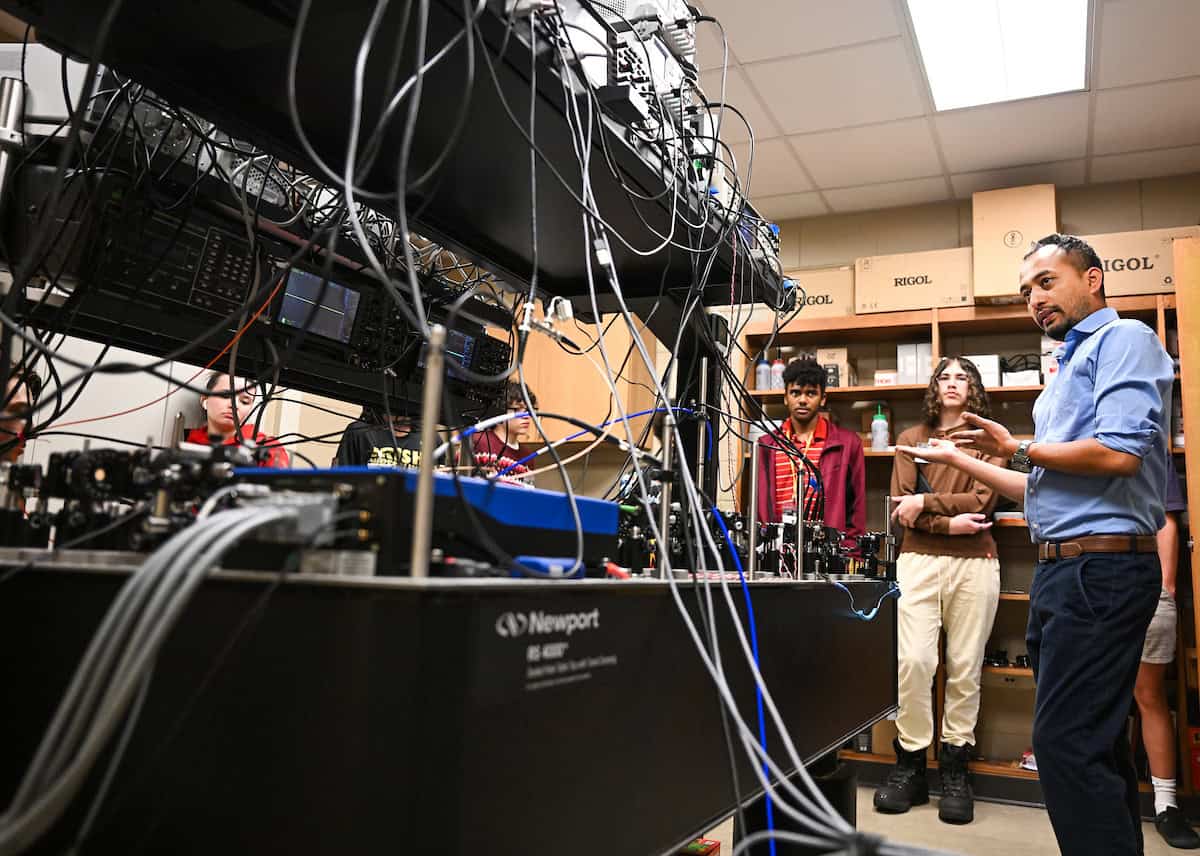
As the inaugural director of UTC Quantum Center, Rick Mukherjee is tasked with implementing and delivering UTC’s quantum growth plan. “The priority is to put Chattanooga on the map in terms of quantum science and technology innovation,” he notes. “We’re creating a quantum centre-of-excellence at UTC where interdisciplinarity underpins everything we do, engaging associated faculty and research students from core disciplines like physics, mathematics, electrical engineering and computer science.”
Entangled pathways
If that’s the back story, what of the detail? The research effort at UTC Quantum Center is organized around four headline themes: quantum networking; quantum imaging and sensing; quantum information theory; and quantum simulation of many-body phenomena (using one quantum system to emulate another).
The collaboration with EPB is pivotal in each case, with UTC Quantum Center providing one of the nodes on the utility’s metro-area quantum network (the first commercial quantum network of its kind in the US) and, by extension, gaining priority access to EPB’s in-house quantum computer (an IonQ trapped-ion system with 36 physical qubits).
The EPB network, which runs across a pre-installed fibre-optic base, is effectively a proof-of-principle testbed for national and international quantum connectivity. “This is one brick in the wall towards next-generation quantum networking applications – from quantum key distribution and quantum cryptography to distributed quantum computing and the quantum Internet,” notes Mukherjee.
A case in point: one of the first experiments that UTC Quantum Center performed in collaboration with ORNL involved the development of an automatic system that continuously corrects for distortions in fibre-optic cables and, in so doing, allows quantum information to transit reliably across a city-scale network. The system maintained high-quality quantum entanglement for more than 30 hours, demonstrating a key capability for future quantum communication networks.
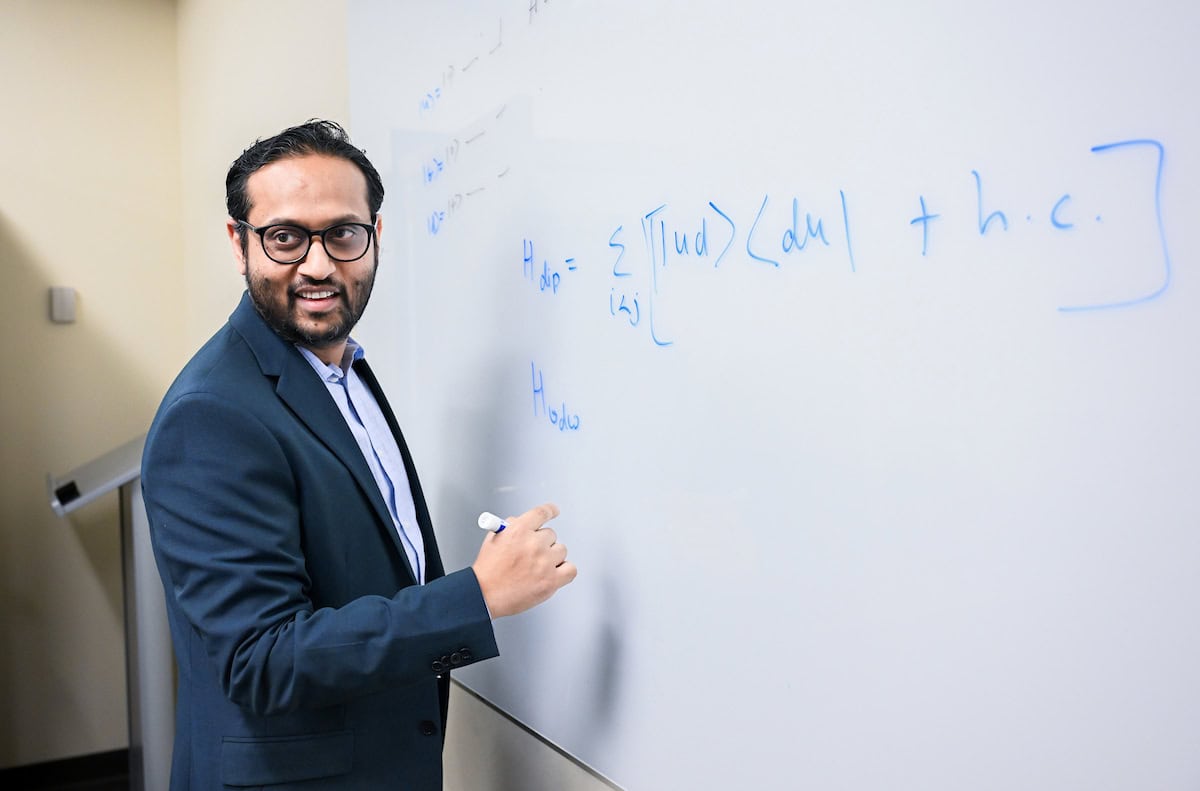
“Currently, our researchers are transmitting pairs of entangled photons across EPB’s fibre network and characterizing multipartite entangled states,” explains Mukherjee. “This work represents the next step toward realizing the potential of quantum networks for advanced communication, sensing and distributed quantum computing applications.”
Alongside his leadership role, Mukherjee remains an active researcher and oversees a group of research faculty, postdocs and graduate/undergraduate students who specialize in theoretical quantum physics, quantum algorithms and quantum machine-learning applications. Crucially, the team’s algorithms are designed to be hardware-agnostic, allowing them to run across diverse quantum computing architectures – from superconducting and neutral-atom systems to photonic platforms – regardless of the vendor.
By avoiding dependence on any one technology, the research is positioned to adapt versus a rapidly changing quantum landscape. “Whatever modality ultimately wins the race to deliver at-scale quantum computing,” Mukherjee says, “we’ll be ready to deploy our algorithms and unlock quantum advantage on those machines.”
The quantum connector
Alignment with industry is a defining theme at UTC Quantum Center, evidenced by a twin-track approach that aims to engage both technology developers and future end-users. On the one hand, Mukherjee and colleagues are initiating traditional academic-industry partnerships with hardware and software companies at all levels of the quantum supply chain; on the other, they are positioning UTC as a “quantum connector” to help businesses and public-sector organizations de-risk the early-stage adoption of quantum technologies and applications.
“Universities have an important role to play here,” says Mukherjee. As such, he sees UTC Quantum Center as an “honest broker”, providing specialist information in an unbiased manner to help engineering and management teams understand the commercial upsides of quantum technologies across sectors as diverse as finance, healthcare, telecoms and energy.
“We are working with the future adopters of quantum on their early-stage orientation and upskilling,” he explains. “Our professional development programmes – ‘Quantum 101’ if you like – will ensure Tennessee has a ‘quantum-ready’ workforce.”
Proof-of-concept R&D studies represent a natural progression of such partnerships, with UTC researchers addressing real-world problems that could potentially be better solved using quantum methods and applications. Joint projects with utilities like the Tennessee Valley Authority, for example, are developing quantum algorithms for power grid optimization and load management. Elsewhere, UTC Quantum Center recently published work on the gate-assignment problem (another quantum optimization challenge) with Lufthansa Industry Solutions (the research arm of Germany’s Lufthansa Airlines). A similar research collaboration is underway with the consultancy Deloitte.
Network effects
That engagement with industry is matched by UTC Quantum Center’s efforts to build bridges with other academic institutions. Over the past two years, Mukherjee and his team have put in place a network of collaborations with quantum researchers at top-tier universities, among them Harvard, Purdue, Texas A&M and the University of Tennessee at Knoxville in the US as well as the University of Hamburg in Germany.
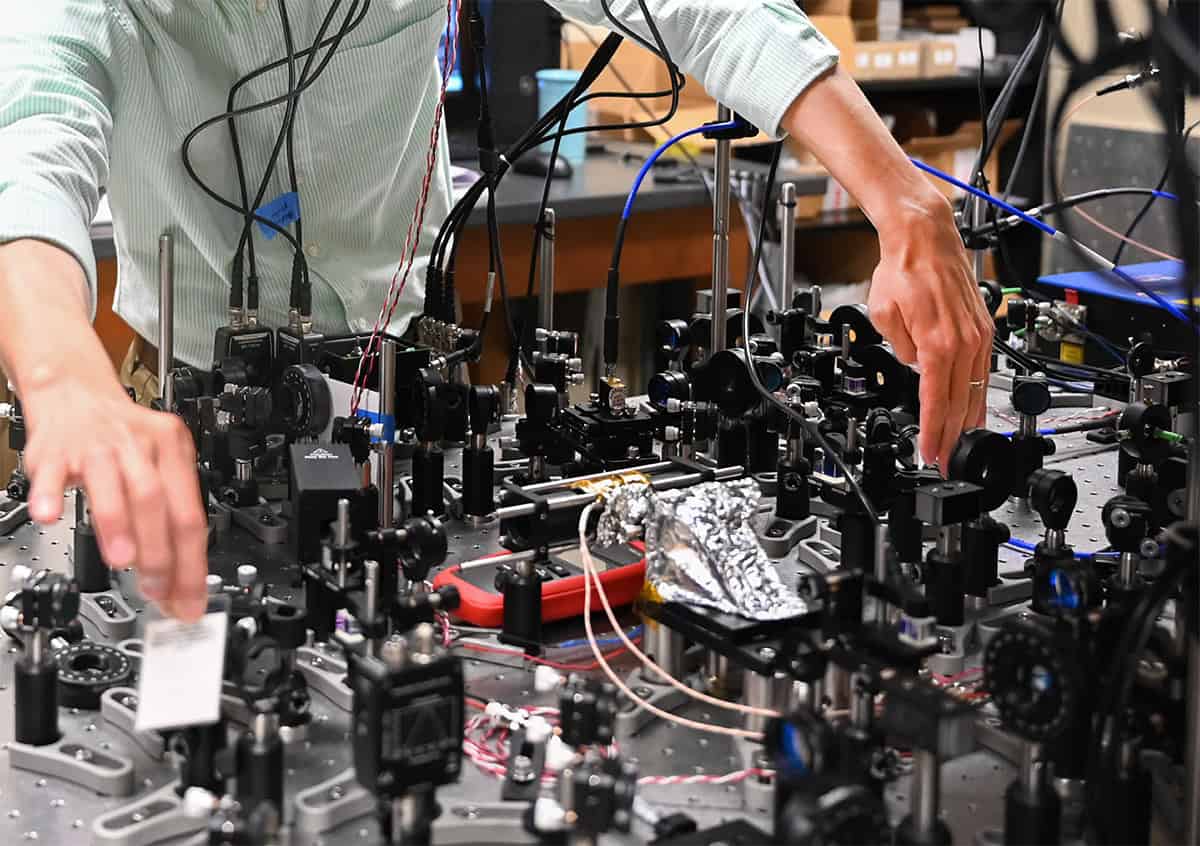
Meanwhile, a series of joint projects is underway with ORNL in areas like quantum networking, quantum information theory and quantum simulation. UTC Quantum Center will also shortly become an official partner of ORNL’s Quantum Science Center (one of five dedicated National Quantum Information Science Research Centers within the US Department of Energy National Laboratory system).
The recently announced UTC/ORNL Governor’s Chair in Quantum Information Science and Engineering reflects the momentum of these efforts. This senior faculty position will further strengthen ties between UTC and ORNL, with the eventual post-holder overseeing a joint team across both institutions to create new opportunities for collaborative research, student engagement and workforce development.
So what does success look like for UTC Quantum Center in 2030? “Ultimately,” concludes Sartipi, “success means that when people think about the future of quantum technologies in the US, they think of Chattanooga as the Quantum Capital of the South – a place where talent is cultivated, partnerships flourish and discoveries translate out of the laboratory into societal and economic impact.”
- UTC is currently inviting applications for PhD and postdoctoral research positions in quantum information science. Applications are also invited for the Governor’s Chair Professor in Quantum Information Science and Engineering, a joint appointment with ORNL.