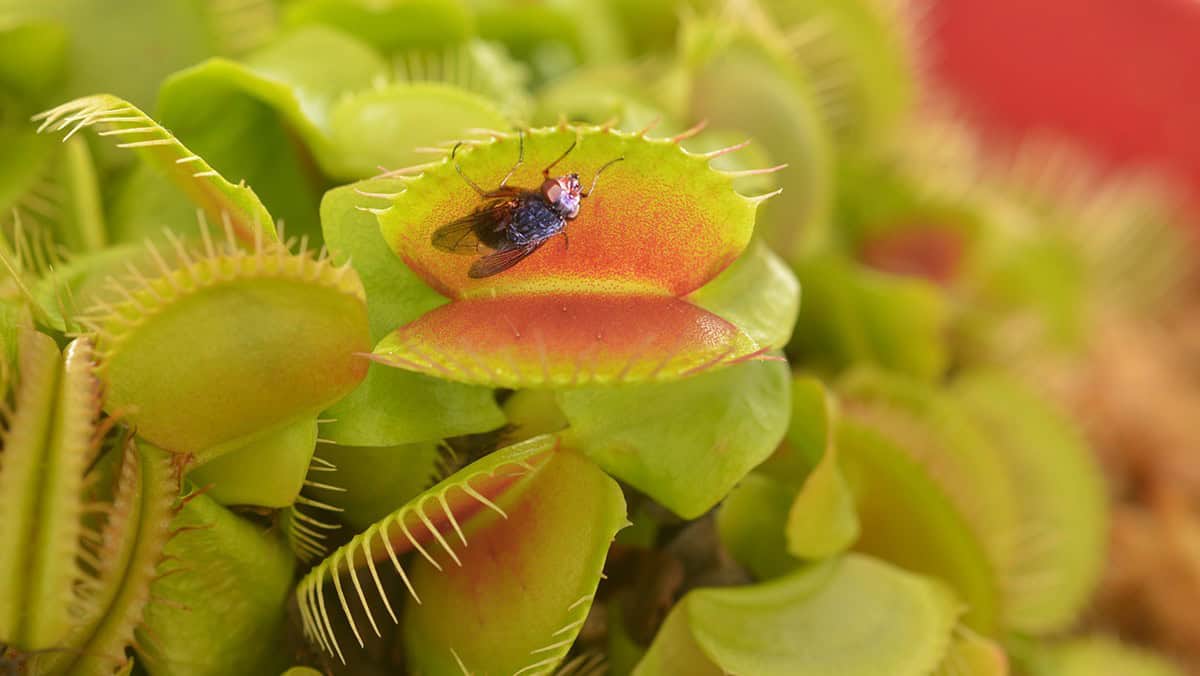
The trap lobes of the Venus flytrap – a carnivorous plant – snap shut by the rapid softening of their outer walls. This discovery by researchers in France is at odds with previous hypotheses that the mechanism involves water transport through the lobes.
The Venus flytrap is native to temperate and subtropical wetlands in the eastern US. These habitats are very poor in nutrients, so the plants capture insects and spiders to obtain nitrogen. “[Charles Darwin] was completely amazed by the motion, and he thought that if the plant was moving that fast it was because the plant had muscle,“ says biophysicist Yoël Forterre of Aix-Marseille University. “He thought, ‘OK, if the plant has muscle then it must also have nerves’.” Darwin asked his colleagues, who had recently discovered electrophysiological signals in animals like frogs, to measure the plants, and was proved partially correct: ionic signalling in plant cells was first detected in the Venus flytrap. Nonetheless, plants have no muscles or nerves.
In 2005, Forterre and colleagues in the UK and US discovered that the trap’s rapid closure is amplified by a “snap-buckling instability”. In the trap’s open state, the two lobes adopt buckled, convex shapes that resist closure. These store elastic energy until a potential barrier is overcome. They then release the energy, suddenly becoming concave and snapping the trap shut in around 0.2 s. The underlying driving force has remained mysterious, however, and the instability makes measurement difficult.
“Many biological and chemical tools are kind of invasive and trigger the plant,” explains Forterre; “It’s not easy to probe the state of the plant before, after and most importantly during the motion.”
Poroelastic limit
One hypothesis is that osmosis causes water to diffuse from one side of the lobe to the other, causing bending. This is the most common driver of motion in plants, but its speed limit can be calculated theoretically from the permeability and elasticity of the host material. To work out whether or not the intrinsic speed of the trap exceeded this “poroelastic limit”, the researchers had to remove the amplificatory effect of the snap-buckling instability.
They devised two ways to do this. First, they cut the trap in several places, allowing it to open and close without storing elastic energy. Second, they clamped traps open between two fixed walls, one equipped with a force sensor. In both cases, they found that the closure timescale – inferred in the case of the trap that did not actually close – was around 4 s. Though much longer than in a trap with a snap-buckling instability, this time would have required water to cross the lobes more than an order of magnitude faster than the porolastic limit. This suggested osmosis could not be responsible.
Another popular hypothesis, first advanced in 1981, is that enlargement and softening of the outer walls drives the lobes into the concave shape. The researchers triggered the trap and probed the pressure of the outer surface with a nano-indenter, confirming that it did indeed decrease. However, this did not affirmatively prove that the material had become more flexible, because an osmotic pressure drop would also cause softening.
Inspired by killer plants

Forterre and colleagues used dental impression paste to make moulds of the topography of the cell walls before and after the trap was triggered. “If a balloon becomes softer because you have decreased the pressure, that means it has deflated,” explains Forterre; “If you keep the pressure inside the balloon constant but make the material softer, it will inflate.” The researchers confirmed using microscopy that the cells bulged more after the trap was triggered, showing that the driving force was cell-wall softening, not water movement.
The research is described in Science.
Biologist Anja Geitmann of McGill University in Canada describes the new work as “paradigm changing”. “Usually we always talk about changes in turgor pressure that induce movement,” she says; “Here they show that it’s not a change in turgor pressure but a very rapid change in the mechanics of the primary cell wall. That’s completely new: I know of no other system where this happens on this kind of timescale, and they prove it in very smart and clever ways.”
Plant biologist Daniel Cosgrove of Pennsylvania State University in the US, whose group discovered the proteins that allow cell walls to expand and soften, agrees that the research proves conclusively that osmosis is not the cause of the trap’s closure. “What will complete the story is when there’s a paper out explaining the molecular mechanism of how that cell wall gets softened or loosened in a couple of seconds,” he says.