Kate Ravilious reviews The Breath of the Gods: the History and Future of the Wind by Simon Winchester
In recent years the news has been dominated by devastating hurricanes, cyclones, tornadoes, wildfires and floods, and data show that these hazardous events are increasing in frequency and strength. It is clear that our weather is becoming more extreme, with a warming world adding more energy to the atmosphere and increasing the power of these wind-fuelled events.
With this in mind, Simon Winchester’s opening question in The Breath of the Gods: the History and Future of the Wind might surprise readers: are Earth’s winds slowing down? There was, indeed, a decrease in wind speeds over land between the 1980s and 2010, which was ominously dubbed the Great Stilling. In fact, observations show a decrease in average wind speeds over land of between 5 and 15% over the last 50 years. So what is going on?
Winchester – a writer and journalist with a background in geology – starts his quest to discover more atop the windiest place in the world, the summit of Mount Washington. With delicious irony, he finds the anemometers are still and a very rare calm hangs in the air.
He goes on to build the case for exceptional weather becoming the norm. He covers recent examples of extreme wind events, such as the exceedingly hot and dry Santa Ana winds of January 2025, which fed the dramatic and devastating wildfires that ripped through suburbs of Los Angeles; the record-breaking storms that pounded Europe during 2024 and 2025; and the freak tornado in March 2023 that killed 17 people and razed the town of Rolling Fork, Mississippi, to the ground.
Ever-present element
This book isn’t simply a tour of wind-related disasters, however. Winchester takes us back through thousands of years of human history, to explore how wind influenced some of the earliest civilizations. The first recorded mention of the wind arose 5000 years ago and comes from the ancient kingdom of Sumer (now south-eastern Iraq). People there identified four different prevailing winds and attributed their characteristics to four different gods. This classification system persists to this day, with our familiar north, east, south and west winds originating from these mythological four Mesopotamian winds.
For much of history humans have made use of the wind: from propelling pioneering populations in tiny boats across the Pacific Ocean some 5000 years ago, to enabling human flight; from milling grain and pumping water with windmills, to using them to generate energy. But it is only in more recent times that we have started to map and understand the major winds on our planet and the role they play in making it habitable.
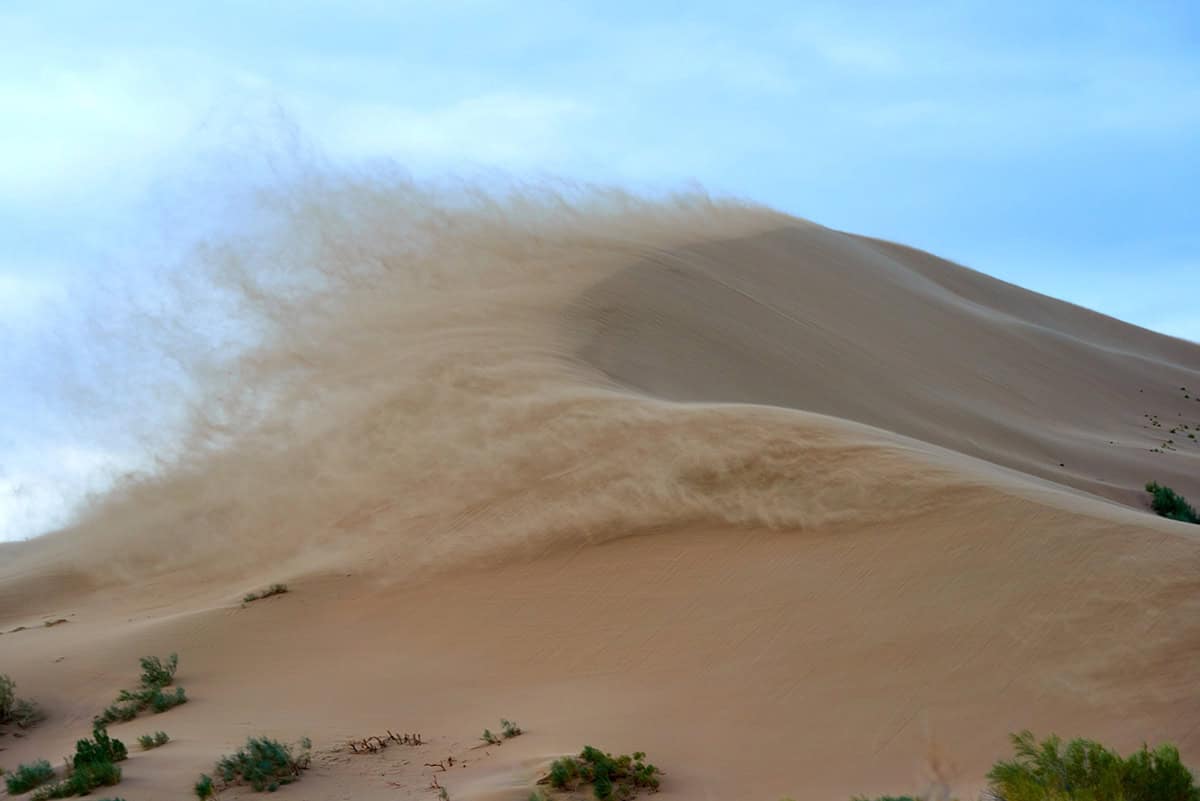
Winchester romps through the science. We learn how the wind has pummelled, shaped and moulded the Earth since time immemorial, and how the winds work in tandem with the oceans, constantly transporting energy from equator to poles and preventing the planet from overheating. He also introduces key characters along the way, such as Brigadier Ralph Bagnold, a British army engineer. Bagnold used wind tunnel experiments and his extensive desert experience to understand the physics of windblown grains and the circumstances that create everything from tiny ripples in sand, to mighty marching barchan dunes.
Not quite blown away
But it is when the wind works against us that its might is truly revealed, and Winchester devotes an entire chapter to inclement winds. He starts by transporting us into the wretched five years of the American Great Depression in the 1930s, when terrible dust storms tore the topsoil from the prairie states of Oklahoma, Texas, Kansas, Colorado and Nebraska, resulting in starvation and mass migration. We hear how the arrival of the settlers and farming technology triggered this tragedy, with steel-bladed ploughs ripping through the soil and tearing up the grasses that had previously glued the soil to the land.
However, this is a tale that ends well, with President Roosevelt taking sound advice and devising an audacious plan to fix it. As a result, some 220 million trees were planted in a series of windbreaks stretching from the Canadian border down to central Texas. These restored prosperous and stable farmland to the American Midwest, and survive to this day.
Writing a book about this invisible force of nature could be stuffy, but Winchester brings his trademark curiosity and storytelling to the fore. He whisks readers through history and around the world, inserting himself into the story and pulling out the human impacts that bring the topic alive.
But while it’s a thoroughly enjoyable read, The Breath of the Gods lacks a thread to hold the book together. And most frustratingly, it fails to really return to answer the opening question about what’s behind the slowing winds. I would have liked a bit more science – particularly in understanding the impact that climate change is having on the wind – but for those looking for an accessible read with lots of fascinating weather anecdotes to regale friends with, this book won’t disappoint.
- 2025 William Collins 416pp £25hb £11.99ebook