Rudolf Peierls, famous for co-writing the 1940 memorandum that outlined the technical requirements for an atomic bomb, describes in this classic 1991 Physics World article his understanding of the physical significance of quantum theory “at the level of logic of the working physicist”
In a stimulating article (“Against ‘measurement’” Physics World August 1990) the late John Bell professed dissatisfaction with the foundations of quantum mechanics as usually presented, particularly in connection with the so-called “collapse of the wavefunction” as a result of a measurement. He agreed that for all practical purposes the use of quantum mechanics by qualified practitioners leads to well defined answers which, where they can be checked, agree with experiment.
However, he regarded it as necessary to have a clearly formulated presentation of the physical significance of the theory without relying on ill-defined concepts. I agree with him that this is desirable, and, like him, I do not know of any textbook which explains these matters to my satisfaction. I agree in particular that the books he quoted do not give satisfactory answers (I assume that they are fairly quoted; I have not re-read them).
But I do not agree with John Bell that these problems are very difficult. I think it is easy to give an acceptable account, and in this article I shall try to do so. I shall not aim at a rigorous axiomatic, but only at the level of the logic of the working physicist.
The most fundamental statement of quantum mechanics is that the wavefunction, or more generally the density matrix, represents our knowledge of the system we are trying to describe
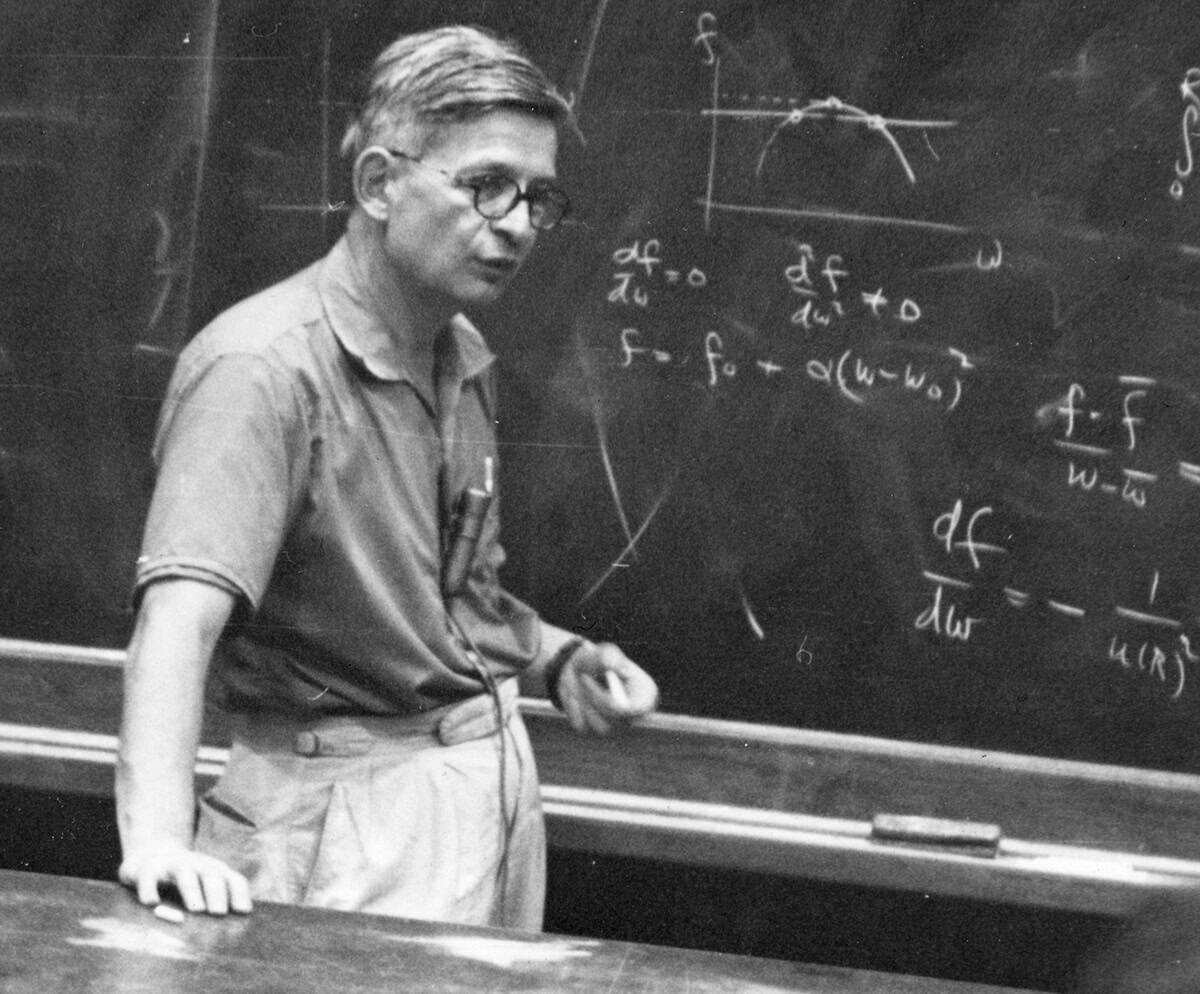
Rudolf Peierls
In my view the most fundamental statement of quantum mechanics is that the wavefunction, or more generally the density matrix, represents our knowledge of the system we are trying to describe. I shall return later to the question “whose knowledge?”. It is well known that we have to use a wavefunction if we have a “pure state” i.e. if our knowledge of the system is complete, in the sense that any further knowledge is barred by the uncertainty principle. Failing such complete knowledge we must use a density matrix, which therefore contains both quantum and classical ignorance. The wavefunction is a special case of a density matrix, and I shall here talk about “density matrix” when I mean “wavefunction or density matrix”.
More precisely, while the time variation of the density matrix is given by Schrödinger’s equation, the initial values represent knowledge usually obtained from observations. (There are not always measurements; for example, if an atom has been for a reasonable time in free space we know it must be in its ground state.)
In quantum mechanics we have to be specific about what we know, because our possible knowledge is confined by the uncertainty principle
Rudolf Peierls
Our knowledge is not fixed, but may increase or decrease. It increases if further observations are made; it decreases if the system is disturbed by external factors which we cannot control. There is nothing new in this. In classical physics our knowledge may increase and decrease in the same way. The only difference is that in quantum mechanics we have to be specific about what we know, because our possible knowledge is confined by the uncertainty principle. In classical physics there is no reason in principle why we cannot know everything about the system and we usually argue as if we did. But in a practical situation our knowledge may increase or decrease as indicated.
In quantum mechanics any increase in our knowledge is usually accompanied by a decrease in some other respect, because of the uncertainty principle. This applies particularly when we are concerned with a “pure state”. Then we can gain no new information (other than confirming what we know already) without losing some of the existing information.
Once this significance of the density matrix is understood, it is clear that upon a change in our knowledge the density matrix must change. This is not a physical process, and we certainly cannot expect it to follow from the Schrödinger equation. It is just the fact that our knowledge has changed, and thus must be represented by a new density matrix.
When I refer to “observation”, this term has its common-sense meaning. The observation usually (but not necessarily) involves an apparatus which interacts with the system in question, and which produces a signal (visible, audible, or other) which we can recognise, and which is correlated with the variables of the system. Bell quoted the view of Landau and Lifshitz (and therefore of Bohr) that the apparatus must necessarily obey classical physics. In my view this is not correct. It is of course true that our senses are macroscopic, and that the instruments we find convenient are also macroscopic and in practice classical. But this is a practical point, not one of principle. The sensitivity of the human eye is almost sufficient to detect a single photon. If some experimentalist has sufficient vision to see one photon, the observation of that photon might perfectly well serve as a measurement.
The apparatus usually consists of a chain of correlated events. I have elsewhere (Peierls 1979, 1985) discussed as an example the observation of a spin component of a spin-1/2 atom by a Stern–Gerlach magnet. The first step, the passage through the inhomogeneous magnetic field, sets up a correlation between the spin component and the position of the atom. It is not yet a measurement; we have not yet gathered any information. This requires determining the position of the particle, i.e. in which part of the split beam it travels. To find this out, we may use a counter, but again this conveys no information – and nothing collapses! – until we find out whether the counter has been activated. We can obviously pursue this chain: the counter will be part of an electrical circuit, the circuit will operate a digital recorder, we may read this recorder by means of the light it reflects into our eye, etc. Each step is correlated with the preceding ones and therefore with the spin component of the particle. Each step keeps both options open until we “see” the result, and then we revise our density matrix.
Because of the uncertainty principle we cannot acquire knowledge of, say, the z component of the spin without losing what information we had previously about, say, the x component. Is this happening in the first step, the passage through the magnet? At first sight this looks likely, because information about sx is contained in the phase relation between the components of the wavefunction belonging to sz = +1/2 and sx = –1/2. Since the beams corresponding to the two sz values are now split, they do not overlap and do not interfere, so their phase relationship is not observable. However, the information is not irretrievably lost. By arranging a further magnet we could recombine the two beams and observe their phase relation (thereby foregoing the possibility of observing sz). We do finally lose the “forbidden” information when we “see” the atom in one of the beams. We then have to replace our density matrix by one containing only the one sz value, so there is no interference.
As long as we do not “see” the atom in the beam, the reconstruction of the seemingly lost information is troublesome, but easy to visualise. At the next stage, i.e. after the counter, it becomes much more involved. Since the density matrix now contains the variables of the counter, interference requires not only that the two atomic beams be made to overlap, but in addition that there be an overlap between the density matrices for the activated and unactivated states of the counter. The observation of the phase relation therefore requires an operator capable of deactivating the counter coherently. This is possible in principle, but in practice prohibitively difficult. As we go further down the chain of connections involved in our “measurement”, this difficulty gets worse.
This is the origin of the belief that the apparatus makes the off-diagonal matrix elements of the density matrix disappear. In most cases that is true “for all practical purposes”, but not in principle. The off-diagonal matrix elements disappear only when we know the result of the measurement.
The “system” to which we apply our description can be as large as we like, including the whole world if we want. However, if we make the system too large, the amount of information we can obtain is relatively small, so that the density matrix is made up mostly of parts proportional to the unit matrix (which denotes complete ignorance) and it becomes hard to do any useful physics. In any case the “system” cannot include the mind of the observer and his knowledge, because present physics is not able to describe mind and knowledge (and it is not obvious that this is a proper subject for physics).
The objection is sometimes made: “How can one apply quantum mechanics to the early Universe, when there were no observers around?” The answer is that the observer does not have to be contemporaneous with the event. We can, from present evidence, draw conclusions about the early Universe, the classical example being the cosmic microwave background. In this sense we are observers. If there is a part of the Universe, or a period in its history, which is not capable of influencing present-day events directly or indirectly, then indeed there would be no sense in applying quantum mechanics to it.
That leaves the question: whose knowledge should be represented in the density matrix? In general there will be many who may have some information about the state of a physical system. Each of them has to use his or her density matrix. These may differ, as the nature and amount of knowledge may differ. People may have observed the system by different methods, with more or less accuracy; they may have seen part of the results of another physicist. However, there are limitations to the extent to which their knowledge may differ. This is imposed by the uncertainty principle. For example if one observer has knowledge of sz of our Stern–Gerlach atom, another may not know sx, since the measurement of sx would have destroyed the other person’s knowledge of sz, and vice versa. This limitation can be compactly and conveniently expressed by the condition that the density matrices used by the two observers must commute with each other.
I must confess that the scheme, with both hidden variables and probability rules, seems to me exceedingly ugly, but of course one cannot argue about this
Rudolf Peierls
John Bell referred to two alternative interpretations of quantum mechanics, that of de Broglie–Bohm (BB), and that of Ghiradi–Rimini–Weber (GRW). As far as I know the BB scheme reproduces all predictions of quantum mechanics. A decision can therefore be made only on aesthetic grounds. I must confess that the scheme, with both hidden variables and probability rules, seems to me exceedingly ugly, but of course one cannot argue about this. I have not studied the implications of the GRW scheme in detail, but I believe that there must be cases where it makes predictions differing from those of quantum mechanics, which would be observable in principle.
Further reading
J S Bell 1990 “Against ‘measurement’” Physics World August 33–40
R Peierls 1979 Surprises in Theoretical Physics Princeton section 1.6 (Some of the points made in this article will also be discussed in a forthcoming volume, More Surprises in Theoretical Physics, Princeton)
R Peierls 1985 “Observations in Quantum Mechanics and the ‘Collapse of the Wave Function’” in Symposium on the Foundations of Modern Physics World Scientific