Particles such as protons and neutrons are more accurately represented as “baryon junctions” than as simple collections of three quarks, say physicists. This finding, which is based on studies of heavy-ion collisions, is at odds with textbook descriptions, but it confirms a longstanding belief among many nuclear physicists that these descriptions are over-simplified.
Like charge and energy, baryon number is conserved in all experimentally observed reactions. This conservation law was first articulated in 1938, long before physicists developed the theory of quantum chromodynamics (QCD) to explain the behaviour of nuclei. It also predates the coinage of the term “quark” by Murray Gell-Mann in 1963.
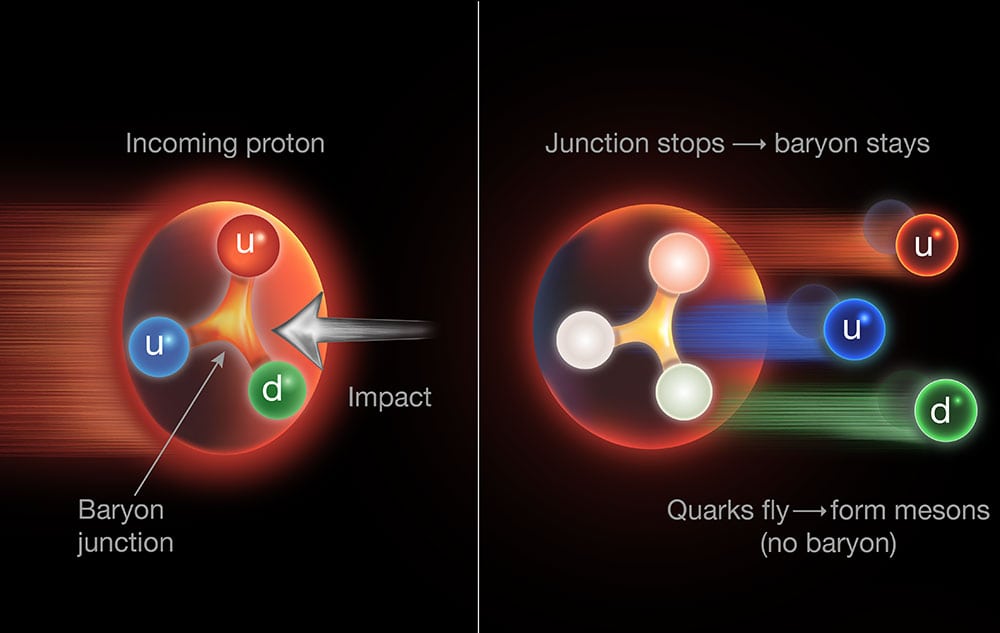
Initially, theorists working on QCD felt that the simplest way to incorporate baryon number conservation was to assign a baryon number of 1/3 to every quark and -1/3 to every antiquark. As bound states of three quarks, protons and other baryons therefore have a baryon number of +1, antibaryons are -1, and quark-antiquark pairs, or mesons, are 0. However, this association of the baryon number with the quark – known as the valence quark model – is not fundamental to QCD, and as early as the 1970s theorists were already considering alternatives. In 1996, for example, Dmitri Kharzeev of Stony Brook University in New York, US proposed a model in which the baryon number was assigned not to the quarks themselves but to the Y-shaped junction in the gluon field that mediates their interactions.
At high-energy accelerators such as the LHC, collisions are usually modelled in the high-energy “perturbative QCD” regime. Here, quarks can be treated as isolated particles, and the two models are effectively equivalent. Inside a proton or in a quark-gluon plasma, however, quarks are more deeply immersed in the gluon field. This makes perturbative calculations such as those used in the theory of quantum electrodynamics (QED) impossible. “You can’t do these Feynman-like calculations anymore,” explains Anselm Vossen, an experimental nuclear physicist at Duke University in North Carolina, US. “Every diagram you write out has the same importance.” Within this so-called “lattice QCD” regime, the two models’ predictions can differ.
Discrepancies between models
In the new work, the STAR collaboration – which studies particles produced in quark-gluon plasmas generated at Brookhaven National Laboratory’s Relativistic Heavy Ion Collider (RHIC) in New York, US – homed in on these differences. By comparing predictions from the baryon junction model with those from the valence quark model in various scenarios, and matching them against experimental results, they hoped to find evidence to support one model over another.
First, they studied head-on collisions of gold nuclei, plus near-misses that led to the exchange of a virtual photon and the break-up of one nucleus. They found that the proportion of particles scattered varied sharply with the energy of the incoming nuclei, but not as the valence quark model predicted.
“The net baryons scattered decreases as the beam energy increases – that is expected – because the higher the energy the more things will just move straight through without being scattered to a large angle,” explains Chun Yuen Tsang, a STAR project leader who is now at Argonne National Laboratory in Illinois. However, he adds that the rate of decline “is actually slower than the existing valence quark model would have you believe”. A baryon junction should scatter more easily than a valence quark, so the fact that a simulation designed using the latter model underpredicts scattering at high energies points towards the baryon junction model.
A charged result
The researchers also compared fragments produced in collisions with zirconium-96 and rubidium-96 nuclei. Since both particles contain the same number of nucleons, they have the same baryon number. However, the ruthenium-96 nucleus has 44 protons, whereas the zirconium-96 nucleus has only 40, giving them different electric charges.
In a nuclear collision, both charge and baryon number – while being conserved overall – are rearranged among the fragments. The charge is localized to the quarks, so, according to the valence quark model, charge and baryon number should move approximately the same amount. Because the colliding nuclear pairs in this experiment differed only in their charge, the outcomes of collisions could be predicted relatively well across a range of energies. However, these predictions were strongly violated, with baryon number moving much more easily than electric charge. “This is evidence for quarks not being the carriers of both baryon number and electric charge,” Tsang says.
The researchers now wish to study collisions from other experiments. They also hope that the Electron-Ion Collider currently planned to replace RHIC will provide a more precise baryon probe and yield a definitive answer.
CP violation in baryons is seen for the first time at CERN
Vossen, who was not involved in the research, says that in some sense, its conclusions are “not that surprising”. His own research has examined the so-called “proton spin crisis” precipitated by the discovery that the proton’s spin cannot be explained by the spin of its constituent quarks, while the proton’s mass is much greater than the sum of the quark masses. “It’s part of this general picture that shows that a proton is much more complex than three valence quarks,” he says. Nevertheless, he says the STAR findings are not trivial: “It’s still a very interesting result,” he concludes.
The work is published in Science.