A new microscopy technique that can probe short-wavelength spin waves has been developed by researchers in Europe. Dubbed magnon momentum microscopy, the technique uses X-rays to observe quantized spin waves (magnons) in magnetic materials. Unlike existing techniques, the new method can characterize nonlinear interactions involving short-wavelength magnons – interactions that could be used to create new “magnonic” technologies.
The research was done by a team including Steffen Wittrock, Bastian Pfau and Daniel Schick at Germany’s Helmholtz Center Berlin for Materials and Energy and the Max Born Institute for Nonlinear Optics and Short Pulse Spectroscopy. The team comprised researchers at those German institutes and at EPFL in Switzerland.
Every ferromagnetic material is full of tiny atomic magnets, all lined up and pointing in the same direction. Nudge one of them, and the disturbance travels through the material like a ripple across a pond, passing from one atomic magnet to the next. These disturbances are called spin waves, and are quantized in units called magnons. Magnons have both particle-like and wave-like properties and physicists believe that magnons could one day carry information inside computers more efficiently than electrical signals do today. Such technologies are dubbed magnonics.
Magnon behaviour is most interesting when the magnon wavelength is shorter than about 100 nm. At these wavelengths, magnon dynamics are dominated by short-range quantum exchange interactions, rather than the longer-range forces that govern magnons with longer wavelengths.
At high magnon intensities, magnons will collide, combine, and split into new magnons before heading off in completely different directions. These nonlinear interactions will be crucial for developing magnonic technologies, but existing tools have consistently fallen short at probing this regime. Previous techniques, for example, could only probe short-wavelength magnons from one direction at a time. What magnonics researchers needed was a way to probe all directions simultaneously with extremely high sensitivity.
Now, the German–Swiss team has created an instrument that does exactly that.
Mapping in momentum space
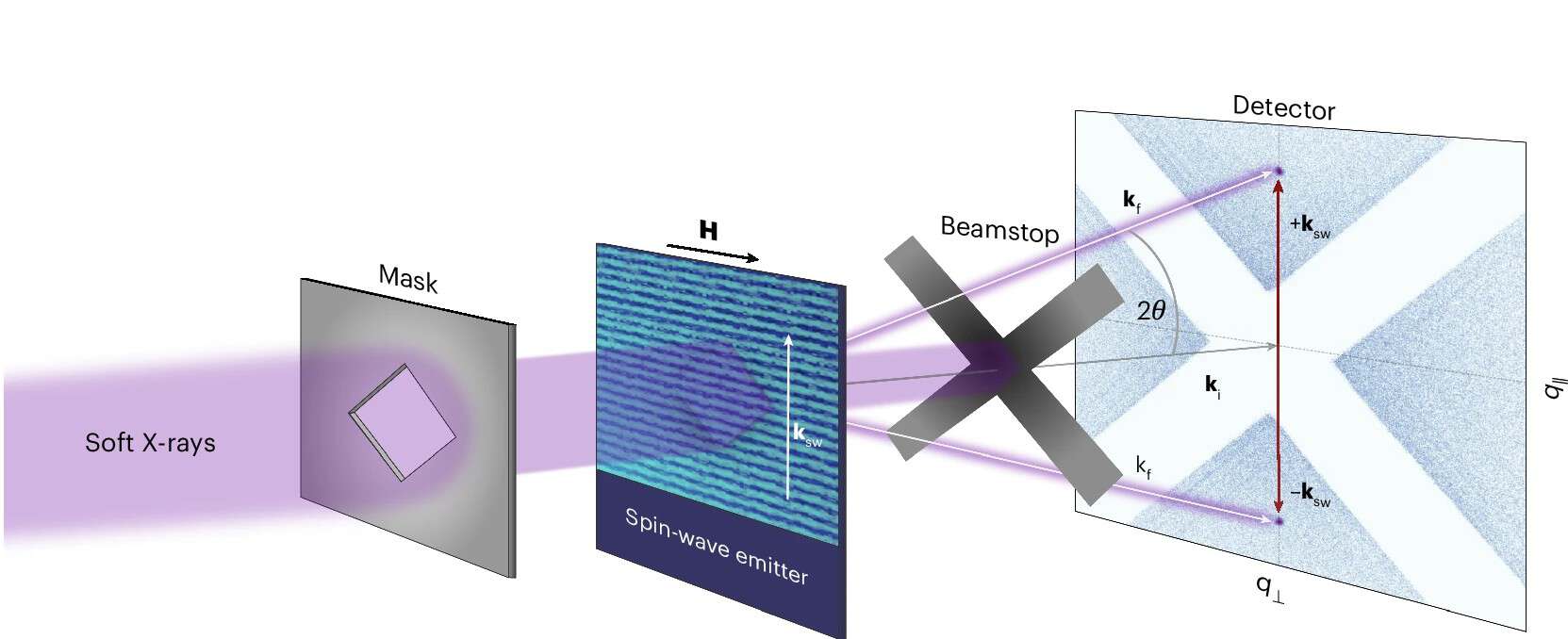
Their technique, called magnon momentum microscopy, uses soft X-rays as a probe. When a magnon travels through a magnetic material, it leaves a regular imprint on the material’s magnetization. Soft X-rays tuned at just the right wavelength scatter off this transient imprint.
The angle of scattering directly reveals the magnon’s direction and wavelength. A detector placed behind the sample records the full scattering pattern in one shot. The result is a map in momentum space. This is a single image in which every magnon direction and wavelength appears at once, rather than one at a time. The team acquires each full map in as little as 30 s. The technique can detect magnons driven by power levels more than a thousand times weaker than what previous X-ray methods required.
Watching waves multiply
The team demonstrated the technique using a sample of yttrium iron garnet (YIG), a standard material in magnon research. They directly observed a process called four-magnon scattering, in which two high-amplitude spin waves scatter off each other and populate new waves spreading out in every direction.
Inverse design configures magnon-based signal processor

On the detector, four-magnon scattering shows up as a bright elliptical ring. The ring covers all directions in 2D momentum space in a single snapshot. Its shape is a very good match for theoretical predictions of the spin-wave dispersion. Dispersion is a function that relates the propagation speed of a spin wave to the frequency of that wave. This agreement confirms both the physics and the precision of the new technique.
At higher driving powers, new waves appear at simple fractions of the driving frequency. These fractional harmonics go beyond standard theoretical descriptions. They point to a richness in nonlinear magnon behaviour that remains to be fully understood.
With its ability to capture the full directional landscape of spin waves in one measurement, and its sensitivity reaching down to the shortest wavelengths where exchange interactions dominate, magnon momentum microscopy opens a direct route into a regime of magnon physics that was previously out of reach. The research is described in Nature Physics.