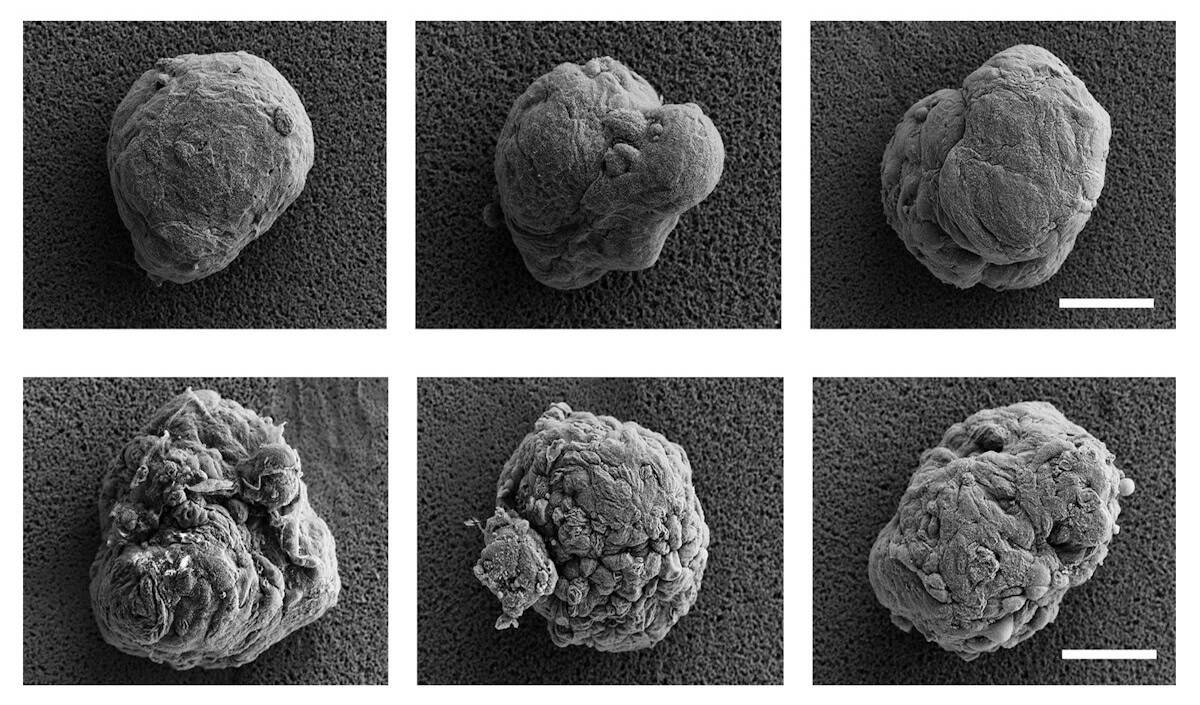
Islet transplantation, in which insulin-producing islet cells from a donor are implanted into a patient’s liver, is a promising therapy for type 1 diabetes. To prevent rejection of the donated cells, however, recipients need to continuously take immunosuppression drugs. Using a new type of cell encapsulation, researchers at The Pennsylvania State University demonstrated that diabetic mice could maintain normal blood glucose levels for 100 days, without requiring immunosuppressants. This represents a substantially longer time period than traditional cell therapies for diabetes.
The Penn State researchers developed their cell encapsulation process based on the molecular characteristics of the zona pellucida, a thin membrane that coats mammalian eggs. Once an egg is fertilized, biochemical reactions lead to hardening of the zona pellucida, which acts as a protective shield during embryo development. Here, biomimetic zona pellucida (BZP) encapsulation serves to hide the donor islets from the body’s immune system.
Pancreatic islets are clusters of five types of cells that work in tandem to regulate insulin and sugar levels in the body and prevent severe insulin deficiency. Islets harvested from healthy pancreases of deceased organ donors were first transplanted into Type 1 diabetes mellitus patients in 1974.
And in 2000, a landmark procedure increasing the mass of islets transferred and using steroid-free immunosuppression regimens was introduced by the University of Alberta in Edmonton, offering the hope of curing diabetes. But when implemented clinically, only 24% of recipients achieved insulin independence at 28 months with the Edmonton protocol.
Research on islet implantation continued unabated, particularly initiatives in islet encapsulation, using semi-permeable membranes to allow the entry of oxygen and nutrients and prevent the entrance of immune response cells. Most current work in this area uses large, 1.5 mm capsules. The Penn State team took an opposite tack: creating a thin 20-µm hydrogel capsule that spontaneously generates on the cell surface with 100% encapsulation efficiency.
Protection from immune attack
Principal investigator Yong Wang and colleagues spent eight years developing an ultrathin hydrogel layer that effectively lays against the curved edge of living cells or cell clusters without impacting their functionality. The islet encapsulation process takes place spontaneously in aqueous solutions under physiological conditions, without exposure to harsh physical, chemical or biological factors, ensuring that BZP development on the cell membrane does not cause any loss of cellular viability or function.

Writing in Nature Biomedical Engineering, the researchers explain that they emulated the biological processes that harden the zona pellucida on a fertilized egg (calcium ion-induced glycoprotein cleavage, assembly and crosslinking on the egg surface). In spite of its thinness, the BZP protects the cell as effectively as the much larger 1.5 mm diameter capsules.
The small capsule size significantly reduces the potential transplantation volume, improving an organ’s ability to receive and accommodate the large number of islets needed to be effective. When coating a 100-µm islet, for example, a 20-µm-thick BZP uses only 1/71 of the polymer volume of a 500-µm microcapsule. The researchers also suggest that the reduced polymer volume used for cell protection by the thin capsule may be a safety advantage of BZP compared to larger capsules.
In vivo assessment
The researchers first examined whether BZP could reduce the level of foreign body response to polystyrene microparticles injected into the peritoneal cavities of mice. Compared with uncoated microparticles, the BZP-coated particles induced a lower immune system response. They examined BZP synthesized using two types of alginate (involved in crosslinking reactions during BZP formation and hardening): chemically modified ultrapure alginate (BZP-U) and regular alginate (BZP-R). Tests in mice verified that BZP-U significantly mitigated the foreign body response compared with BZP-R encapsulation.
Immunocompetent diabetic mice treated with BZP-U-coated islets had their blood sugar restored to healthy levels within seven days. Additionally, the majority stayed diabetes free for over 100 days without continuously needing systemic immunosuppression. By comparison, mice treated with uncoated islets could not maintain healthy blood sugar levels for more than seven days.
In addition to effectively regulating blood glucose levels, one of the biggest advantages of the BZP approach is that it eliminates the need for long-term systemic immunosuppression. Lantidra, the only islet transplantation treatment for Type 1 diabetes cleared by the US Food and Drug Administration, requires continuous immunosuppressants to stop immune system attacks. Such long-term immunosuppressant use can lead to increased risk of infection and other serious health issues, including cancer.
Bioelectronic medicine aims to improve type-1 diabetes management

Wang and colleagues plan to further study the BZP approach to better understand the specific duration of resistance each islet transplant may offer, as well as its effect in large animals.
“Large animal studies will be necessary to fully demonstrate their potential in cell transplantation,” the researchers write. “When large animals are used, one needs to examine not only glucose levels but also other key biomarkers. Moreover, the long-term immune responses to BZP and BZP-encapsulated cells warrant further investigation to yield deeper insights into BZP optimization and improvement.”