Margaret Harris reviews Trinity: an Illustrated History of the World’s First Atomic Test by Emily Seyl and colleagues
One does not simply walk into the Trinity test site. Although the radioactivity from the world’s first atomic explosion has mostly dissipated over the past 81 years, the gates to this real-life Mordor are still guarded by military police, and the US Army continues to use it as a missile range.
Members of the public are allowed in just once a year, on the third Saturday in October, between 8 a.m. and 3.30 p.m. Apart from these tightly controlled “open house” events, the site where Manhattan Project participants gathered on 16 July 1945 to witness the dawn of the nuclear age is strictly off-limits.
For fans of atomic history who lack the time, money or inclination to visit this inhospitable corner of New Mexico during its annual open house, Trinity: an Illustrated History of the World’s First Atomic Test is the next best thing. In some respects, this coffee-table-sized book by Emily Seyl and her colleagues at the Los Alamos National Laboratory’s National Security Research Center (NSRC) may even be better.
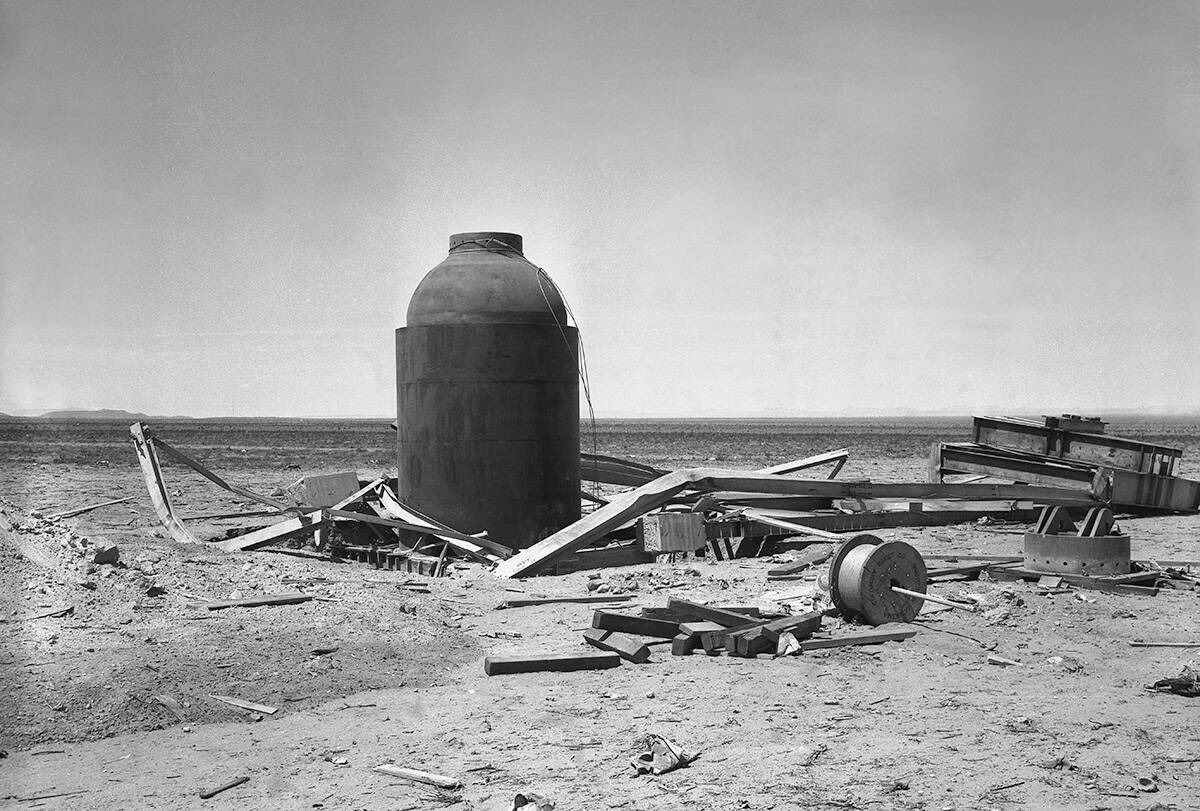
As the book makes clear, there is not much to see at Trinity nowadays. A few dilapidated buildings; a commemorative obelisk; a fragment of a half-million-pound steel tank – these are all that remain of the once-bustling site where the first atomic device, known as the Gadget, was assembled and tested.
Trinity’s great achievement is to turn back the clock and make both the site and the individuals who worked there come alive. Using more than 200 photos from the test’s official archive and other sources, Seyl and her colleagues have created an important public record of a period that is fast receding from living memory and a place that is still veiled in secrecy. The result is a book that is by turns illuminating, beautiful and disturbing.
A fresh look at familiar history
Let’s start with the illuminating part. As an undergraduate intern at Los Alamos, I read Richard Rhodes’ seminal book The Making of the Atomic Bomb. Since then, I’ve read (and occasionally reviewed for this magazine) numerous other works of atomic history, from Ray Monk’s 800-page biography of the Manhattan Project’s scientific leader, J Robert Oppenheimer, to Denise Kiernan’s The Girls of Atomic City and Kate Brown’s Plutopia, both of which focus on less well-known figures.
Even so, once I got past Trinity’s introduction – which takes just six pages to cover Lise Meitner and Otto Frisch’s 1938 realizations about nuclear fission; the start of the Second World War; Enrico Fermi’s demonstration of the first nuclear chain reaction; and the launch of the Manhattan Project to weaponize these discoveries and thereby secure an Allied victory – I was into material new to me.
That steel tank, for example. Its name is Jumbo, it cost $12m in 1940s money, and it was originally designed to withstand the conventional explosives that imploded the Gadget’s plutonium core. If the explosives worked, but the chain reaction didn’t (a definite possibility – hence the need to test the Gadget’s design before deploying it in a bomb), the idea was that Jumbo would prevent plutonium from spraying all over the site.
So far, so sensible. In early 1944, Manhattan Project engineers duly drew up specifications for a containment vessel. An Ohio-based manufacturer, Babcock & Wilcox, agreed to build it, though for security reasons no-one told them what this mysterious “accumulator” was for. The finished Jumbo was then transported, under wraps, to New Mexico by heavy-duty freight train, offloaded onto a specially built carriage and wheeled to a location 800 yards from the intended ground zero.
Which is where it stayed. By the time it arrived in spring 1945, scientists working at the Manhattan Project’s nerve centre in Los Alamos, nine hours’ drive north of Trinity, had grown confident enough in the Gadget that Jumbo was deemed surplus to requirements, more likely to confuse diagnostic tests than to provide any useful safety function.
The fact that technicians had spent days hauling Jumbo across the desert is an excellent example of how the Manhattan Project combined herculean effort and ingenious engineering with tremendous cost and institutionally stupid bureaucracy
The fact that their technician colleagues had spent days hauling it across the desert is thus an excellent example of how the Manhattan Project combined herculean effort and ingenious engineering with tremendous cost and institutionally stupid bureaucracy. Despite this, I do not recall reading about Jumbo before. It’s to Seyl’s credit that she and her NSRC managers granted this potentially embarrassing episode so many pages of gorgeous black-and-white photos.
Because make no mistake, Trinity is gorgeous. I love the New Mexico desert, but you don’t need to be a fan of this austere landscape to appreciate these photographs of the people who toiled there and the machines they built. Though Oppenheimer and other well-known physicists appear in several photos, much of the book focuses on the contributions of relative unknowns such as Jack Aeby, a technician in the Army’s Special Engineer Detachment.
This organization existed to divert soldiers with technical training away from battlefields and into atomic grunt work, and Aeby, an amateur photographer, asked his group leader (the physicist Emilio Segrè) if he could document the explosion with his personal camera. Due to technical problems with the official Kodak cameras, Aeby’s snapshot is now the only decent colour image we have of the Trinity test.
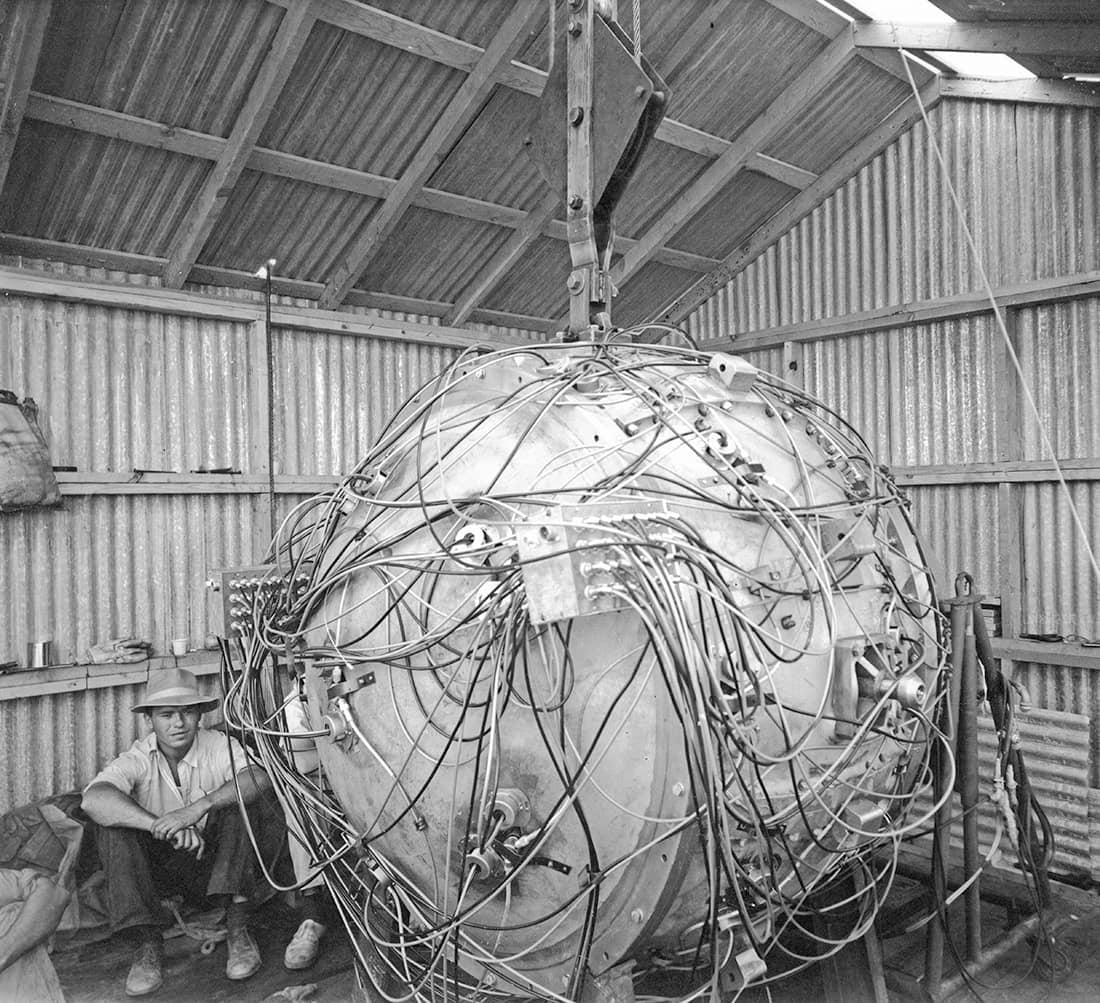
My favourite photo in the book is of a chemist called Donald Hornig. As the inventor of the X unit – a heavy-duty switch that triggered the Gadget’s detonators – Hornig had the unenviable job of arming this switch a few hours before the test, with a summer lightning storm flickering all around him. He thus became the last person to see the Gadget intact, and his expression as he slumps next to it is hard to read. Is he smiling? Proud? Or merely exhausted and wishing the photographer would leave him alone?
Robert Oppenheimer: how cinema has depicted this icon of the nuclear age

The final pages of Trinity depict events that followed the test, including the atomic bombings of Hiroshima and Nagasaki. Only five photos are known to exist of the immediate aftermath in Hiroshima, and the book reproduces three of them. Taken by Yoshito Matsushige, a staff photographer at the regional newspaper Chugoku Shimbun, they are far more disturbing for what they don’t show than for what they do. Although Matsushige later explained that he felt a professional duty to document the bombing, he found himself unable to press the shutter on most of what he witnessed. It was simply too horrible.
Beauty and horror make an unsettling combination. Despite Trinity’s quality, it is hard to see it appealing to a broad audience; in one of the book’s two forewords, Jim Eckles, who used to work in the missile range’s public affairs office, suggests it will “make a great memento for visitors to the site”. This unambitious statement is probably correct, but I hope that some physicists – weaponeers, disarmament campaigners and everyone in between – will also find space for it on their shelves. Our atomic age may yet end with a whimper, but it began with a bang, and it is worth remembering that bang in all its complicated majesty.
- 2026 University of Chicago Press $39.00/£32.00hb 344pp