At this week’s ASTRO 2026 meeting in Boston, MA, researchers shared the results of clinical trials addressing important and longstanding questions in cancer care. In a dedicated news briefing highlighting noteworthy research studies, two speakers presented new evidence that could help inform how we deliver care to patients with brain metastases.
Brain metastases – cancerous cells that spread to the brain from another site in the body – are typically removed surgically or treated with radiotherapy. For most types of cancer, the preferred approach is stereotactic radiosurgery (SRS), in which high-dose radiation is precisely directed to individual lesions while limiting dose to surrounding healthy brain tissue.
Randomized trials have shown that SRS results in superior cognitive preservation and quality-of-life compared with whole-brain radiotherapy (WBRT), where the entire brain is irradiated to ensure treatment of both visible tumours and microscopic disease. There’s an exception, however. Historically, for brain metastases arising from small cell lung cancer (SCLC), a rare, fast-growing cancer, WBRT remains the standard-of-care. Results of a new trial challenge this approach.
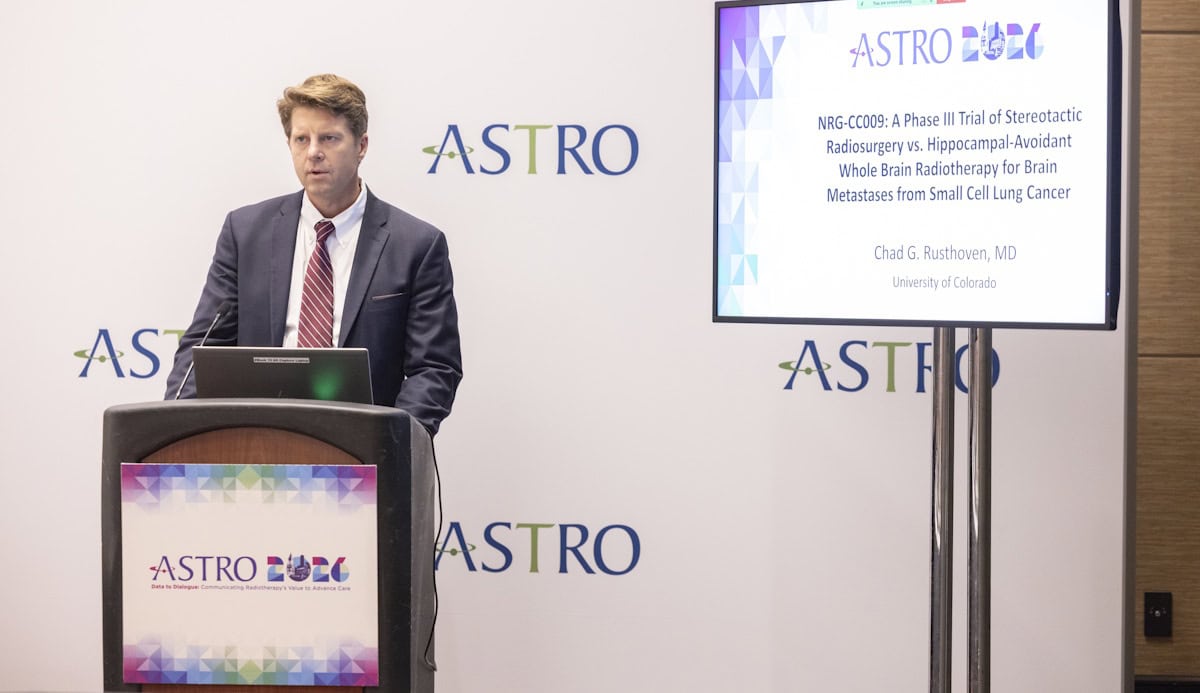
Chad Rusthoven from the University of Colorado Anschutz School of Medicine shared the findings of the first phase III randomized trial to compare SRS versus WBRT for brain metastases from SCLC. The trial found that after adjusting for patient and disease characteristics, SRS was associated with a 40% lower risk of death than WBRT.
Rusthoven noted that recent advances have improved outcomes for patients receiving WBRT. “This includes addition of memantine [a drug that helps protect cognitive function], as well as hippocampal avoidance techniques,” he explained. “As a result, HA-WBRT plus memantine is now the preferred whole-brain treatment strategy for cognitive preservation.”
As such, the NRG-CC009 trial – which included 151 patients in the US and Canada – randomly assigned participants to receive either focused SRS to visible metastases or HA-WBRT plus memantine. All subjects had a median of two SCLC metastases, although some had more than 20.
For the primary endpoint – the time before a patient experienced cognitive decline – the study found no significant difference between the two treatment groups. However, patients treated with SRS had a median overall survival of 17.4 months, compared with 8.6 months for those in the HA-WBRT group. Rates of serious treatment-related side effects or death from neurologic causes were similar for the two cohorts.
Although no differences in neurocognitive failure were observed, the superior overall survival with SRS addresses a fundamental historical objection to SRS alone for small cell lung cancer brain metastases. That is, the concern that omission of WBRT would lead to worse overall survival in this population. Overall these findings support SRS as a treatment option for patients with brain metastases from small cell lung cancer,” Rusthoven concluded.
The power of fractionation
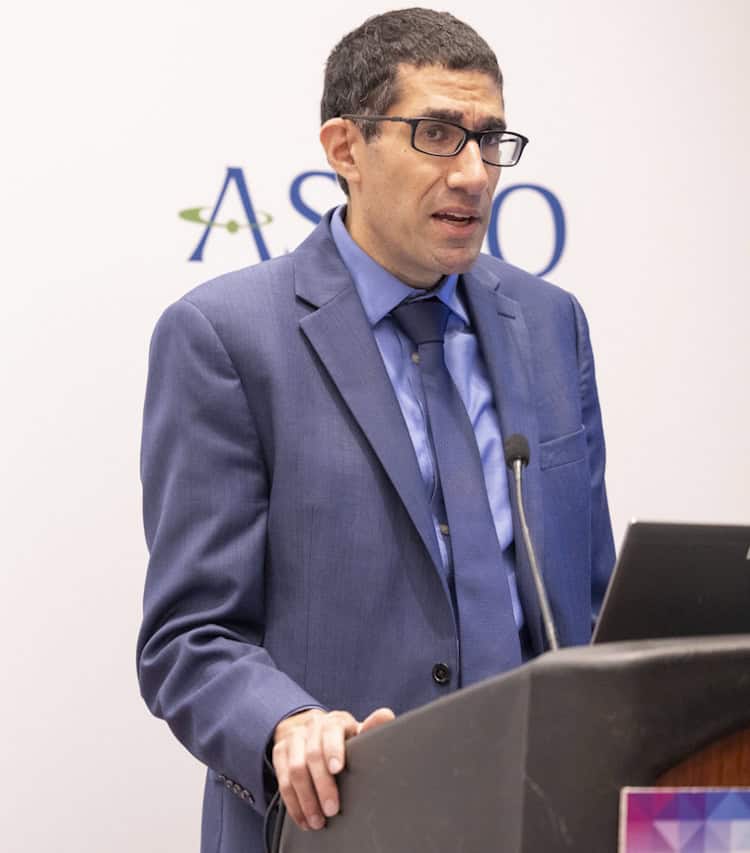
Speaking at the same briefing, Ayal Aizer from Mass General Brigham/Dana-Farber Cancer Institute explained how fractionated radiosurgery can reduce the risk of cancer recurrence after surgery for large brain metastases, without significantly increasing side effects. Fractionation – in which the radiation dose is divided into several treatments – gives healthy tissue time to recover between doses while still effectively treating the surgical cavity.
Large metastases, which can cause pressure on the brain leading to symptoms such as seizures, headaches or difficulties with speech or movement, can be removed via surgery. This is usually followed by radiotherapy to destroy any microscopic cancer cells left behind in the surgical cavity. Aizer explained that current guidelines recommend treating the cavity with SRS, following two pivotal trials demonstrating favourable outcomes for SRS compared with postoperative WBRT and observation.
For larger surgical cavities, however, the challenge, is how to deliver enough dose to eliminate any remaining cancer cells without exposing too much surrounding healthy brain to radiation. “In both of these trials where single-fraction SRS was utilized, the one-year surgical bed recurrence rates were high: 40% in one trial, 28% in the other,” he explained. “Meanwhile, alternative approaches such as fractionated SRS to the surgical bed had been emerging.”
Aizer described Alliance A071801, the first randomized phase III trial to directly compare single-fraction versus fractionated SRS for resected brain metastases. The multi-centre trial enrolled 242 patients with one to four brain metastases, one of which was larger than 2 cm and surgically removed. The metastases arose from different primary tumour types, the most common being lung cancer.
The team randomly assigned patients to receive either a single session of SRS, with dose based on target size, or fractionated SRS: 27 Gy in three fractions for smaller targets or 30 Gy in five fractions (9%) for larger ones.
One year after treatment, 87% of patients who received fractionated SRS were free from recurrence at the surgical site, compared with 81% of those who received single-session radiosurgery. Side effects such as radiation necrosis and cerebral oedema were low in both treatment groups, with no significant differences between the two.
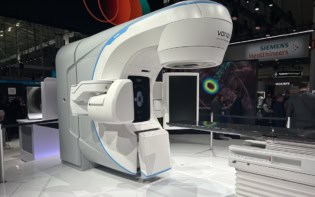
Siemens Healthineers unveils ultrafast Accela radiotherapy system

The overall survival was also improved after fractionated SRS, with patients surviving a median of 29 months, compared with 20 months for those treated in a single session. The researchers note that this survival difference was unexpected and it is not yet clear why this occurred.
“In conclusion, we can say that fractionated SRS improved surgical bed control compared with single-fraction SRS after resection of a brain metastasis,” said Aizer. “The improvement in surgical control was achieved without an apparent increase in toxicity. For patients undergoing resection of a larger brain metastasis, postoperative fractionated SRS should be considered the standard-of-care.”